
TL;DR:
- Effective swim training requires structured periodization, monitoring, and individual customization.
- Combining aquatic and dry-land training enhances performance and prevents overtraining.
- Continuous data analysis and athlete feedback are essential for optimizing progress and achieving personal bests.
Balancing training volume, intensity, and individualization for a pool full of swimmers with different abilities is one of the hardest challenges in competitive coaching. Too much volume burns athletes out; too little leaves performance gains on the table. At PEAK Performance Swim Camp, we’ve spent 30 years refining workflows that solve exactly this problem. This article walks you through a research-backed framework covering periodization, monitoring, customization, and progress verification so you can build a training workflow that consistently moves athletes toward their best performances at every camp and competition.
Table of Contents
- Essential components for a swim coach training workflow
- Step-by-step: Structuring your swim coach training phases
- Monitoring, customizing, and individualizing swim training
- Verifying progress: Measurement, adjustment, and results
- What most coaches overlook: The power of customization and feedback loops
- Ready to elevate your coaching? Train with the experts
- Frequently asked questions
Key Takeaways
| Point | Details |
|---|---|
| Structured phases | Dividing training into clear phases boosts adaptation and performance for athletes. |
| Combined training approach | Aquatic and dry-land sessions together deliver faster results than focusing on one alone. |
| Data-driven personalization | Using heart rate and velocity data allows coaches to individualize and optimize each swimmer’s plan. |
| Continuous measurement | Regularly tracking benchmarks ensures your workflow leads to real, measurable progress. |
| Real-time feedback | Allowing athlete feedback to shape workflows accelerates improvement and motivation. |
Essential components for a swim coach training workflow
With the goal set, let’s examine the foundational elements you need for truly effective swim coaching.
Every high-performing swim program is built on a structured workflow, not just a collection of good sets. The backbone is periodization, which means organizing training into deliberate phases that build on each other. Periodization models in swimming typically include four phases: general preparation, specific preparation, competition, and taper, each with distinct goals and intensity targets.
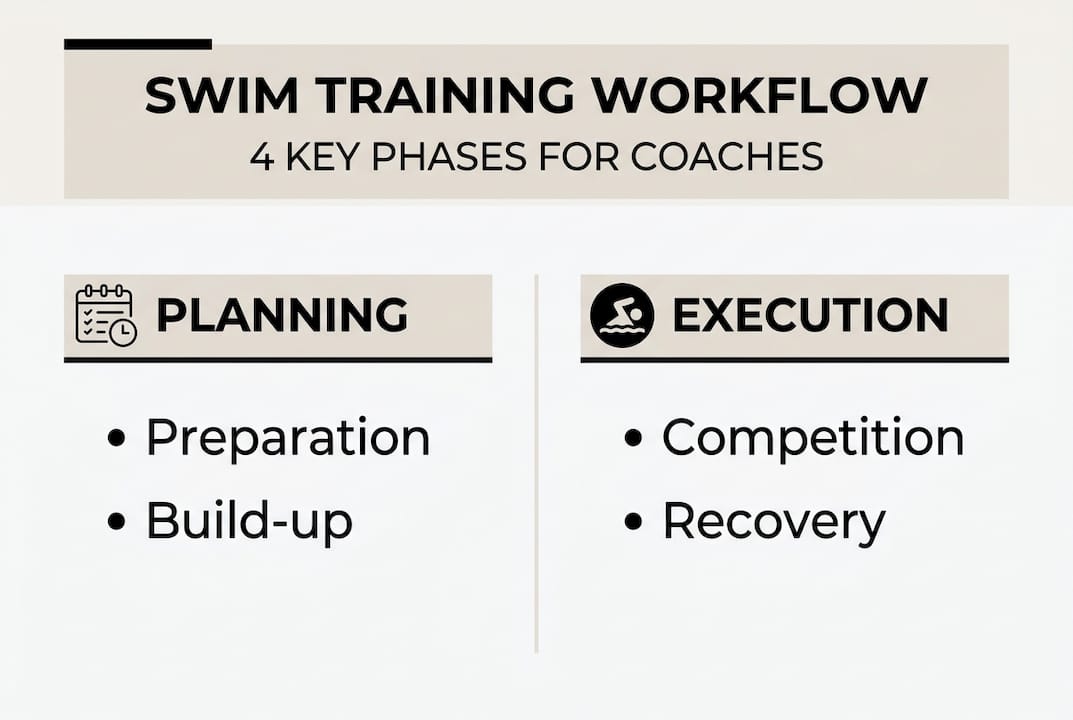
Beyond the schedule, you need reliable monitoring tools. Heart rate data, ratings of perceived exertion (RPE, a 1-10 scale athletes use to report effort), and performance logs give you real-time feedback on how athletes are responding to load. Without these, you’re guessing. With them, you can make confident adjustments week to week.
Combining aquatic and dry-land training is equally important. Strength work on land directly transfers to power in the water, and skipping it leaves athletes underprepared for peak competition demands. Schedule flexibility matters too because illness, travel, and facility access will disrupt even the best plan. Build adaptation into your workflow from day one.
Workflow must-have checklist:
- Written periodization plan with defined phase dates
- Heart rate monitors or RPE tracking sheets
- Performance log for each athlete (times, splits, stroke counts)
- Dry-land training program aligned with aquatic phases
- Weekly review slot to assess and adjust
- Advanced technique tips integrated into each training block
- Differentiated sets for youth swimmer coaching strategies
| Workflow element | Why it matters |
|---|---|
| Periodization phases | Prevents overtraining and peaks athletes at the right time |
| Heart rate monitoring | Confirms training zones are accurate |
| RPE tracking | Captures athlete perception, which often predicts fatigue before data does |
| Dry-land integration | Builds strength that translates to faster splits |
| Schedule flexibility | Keeps the plan functional when real life intervenes |
Pro Tip: Set a fixed 15-minute review window at the end of each week. Even a brief look at RPE trends and split times will tell you whether to push, hold, or back off the following week.
Step-by-step: Structuring your swim coach training phases
Once you know what you need, here’s how to sequence your training blocks for maximum adaptation.
The four-phase model gives coaches a clear roadmap. Each phase has a specific purpose, and rushing through any of them shortchanges the adaptation athletes need.
Phase sequence:
- General preparation (weeks 1-6): Build aerobic base and movement quality. Focus on high-volume, low-intensity sets and foundational dry-land strength. Avoid speed work here.
- Specific preparation (weeks 7-12): Coaches move from strength-endurance to speed-strength, timing each phase for optimal adaptation. Introduce race-pace sets and increase dry-land intensity.
- Competition phase (weeks 13-18): Sharpen race-specific skills. Reduce overall volume while maintaining intensity. Practice race-day routines.
- Taper (weeks 19-21): Cut volume significantly. Maintain frequency and some intensity. Allow the body to absorb all previous training.
For phase length adjustments, younger or less experienced swimmers often need longer general preparation periods. Elite athletes can move through phases faster if monitoring data supports it. Always let the data guide the timeline, not the calendar alone.
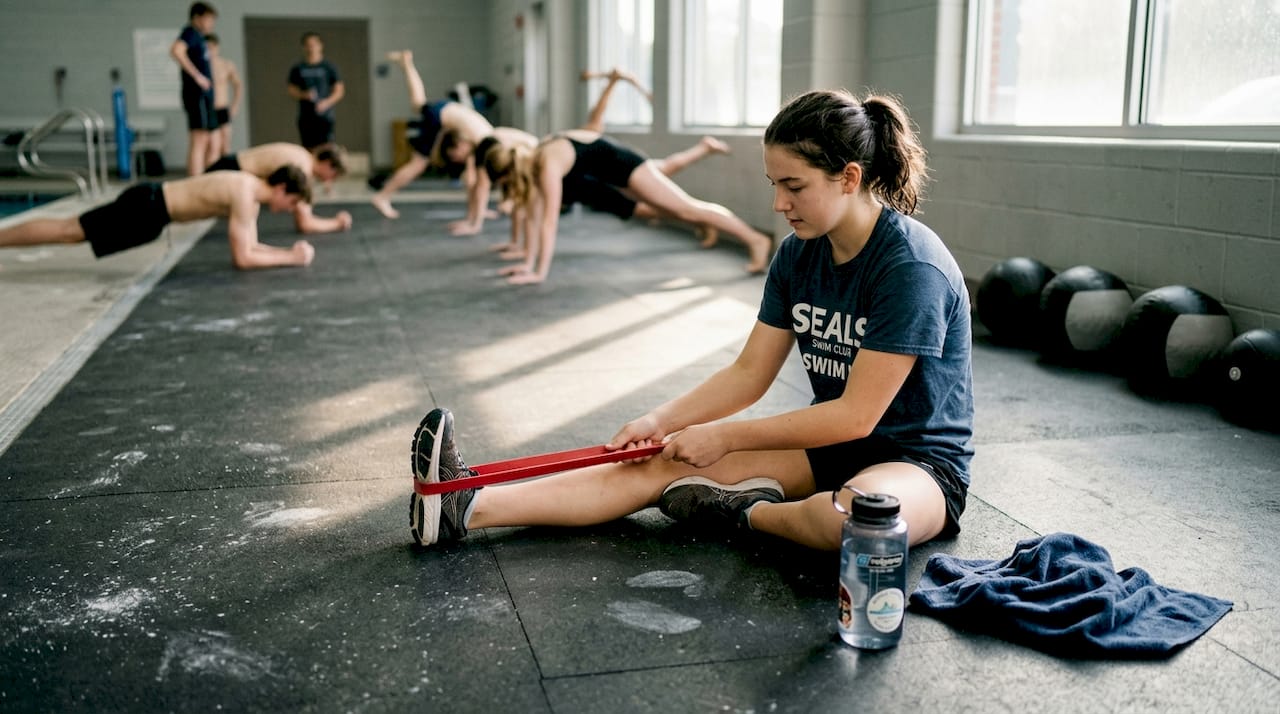
Research confirms that combined aquatic and dryland training improves 100m performance and velocity significantly over water-only training, which is why dry-land work belongs in every phase, not just the off-season.
For a deeper look at how these phases fit into a full calendar, explore year-round training methods and swimming conditioning steps.
| Feature | Block periodization | Traditional periodization |
|---|---|---|
| Structure | Concentrated blocks, one quality at a time | Mixed qualities trained simultaneously |
| Best for | Advanced, specialized athletes | Developing and youth swimmers |
| Flexibility | Lower, requires strict sequencing | Higher, easier to adapt mid-cycle |
| Peak timing | Very precise | More gradual |
Pro Tip: Avoid the common mistake of extending the competition phase too long. When athletes stay in high-intensity work for more than six weeks without a reduction, performance plateaus and injury risk climbs.
Monitoring, customizing, and individualizing swim training
Having structured your main blocks, fine-tuning depends on data-driven monitoring and personal adjustments.
No two athletes respond identically to the same training load. That’s why monitoring and customization are not optional extras; they are central to the workflow. Collecting data consistently gives you the leverage to make smart, timely changes.
Best practices for athlete monitoring:
- Record heart rate at the end of key sets to confirm zone accuracy
- Log RPE after every session, not just hard days
- Track split times and stroke counts weekly to spot technique drift
- Note sleep quality and mood using a simple 1-5 scale
- Review load-velocity profiles for sprint-focused athletes
For sprint specialists, load-velocity profiling and digital-tech personalization improve swim training outcomes, with velocity-based resistance programming delivering measurable gains in power and speed. This means adjusting resistance levels in dry-land work based on how fast an athlete moves the load, not just how heavy it is.
Artificial intelligence tools and digital twin models are also emerging as practical options. These systems simulate an athlete’s response to different training loads, helping coaches anticipate adaptation rather than react to it after the fact.
“The best coaching decisions come from listening to two sources equally: the data on your clipboard and the athlete standing in front of you.”
Customizing workouts based on individual profiles also means adjusting practice frequency guidelines for each athlete’s recovery capacity. Pair that with focused attention on core strength in swimming, which underpins every stroke, and you have a tailored swim coaching approach that genuinely moves the needle.
Pro Tip: Prioritize RPE and split time trends over single-session heart rate readings. Trends over three to five sessions reveal true adaptation patterns far more reliably than any single data point.
Verifying progress: Measurement, adjustment, and results
Customization only adds value if you measure and act on what happens. Here’s how to verify and optimize results.
Tracking progress is where many coaches lose momentum. They train hard, monitor diligently, but never formalize the review process. Without a structured evaluation cycle, adjustments happen reactively instead of proactively.
Progress verification process:
- Set benchmarks at the start of each phase: Record baseline times for key events, stroke counts per length, and dry-land performance markers.
- Conduct mid-phase time trials: A short in-pool test every three to four weeks reveals whether athletes are adapting as expected.
- Review all data at phase transitions: Compare current performance against the opening baseline before moving to the next phase.
- Adjust the next phase based on findings: If an athlete is ahead of target, you can advance the timeline. If behind, extend the current phase or reduce load.
- Celebrate measurable gains: Setting swim goals and acknowledging when athletes hit them builds motivation for the next block.
Elite programs use systematic benchmarks and record-tracking to achieve high performance and adapt workflows for continual improvement. This isn’t just about winning races. It’s about building a culture where data informs every decision and athletes see the connection between their effort and their results.
Stat to know: Programs that conduct formal mid-cycle reviews adjust training loads more accurately and produce more personal bests per season than those that rely on end-of-season evaluation alone.
Pro Tip: Use personal bests and school records as motivational anchors during team meetings. When athletes see their names on a progress board, they train with more purpose and buy into the workflow more completely.
What most coaches overlook: The power of customization and feedback loops
Stepping back, there’s a crucial principle that too many coaches neglect when implementing workflows.
Rigid templates stall progress. We see it repeatedly at PEAK camps: a coach arrives with a beautifully structured plan, but when athletes respond differently than expected, the plan doesn’t bend. The result is frustrated swimmers and missed performance targets.
The most effective workflows treat the written plan as a starting point, not a contract. Athlete feedback, both the numbers and the conversations, should actively reshape the program in real time. When a swimmer tells you they feel flat three weeks into the competition phase, that’s data. Act on it.
Coaching personalization insights consistently show that athletes who experience individualized adjustments hit more lifetime bests than those trained on identical programs. The feedback loop, where athlete response informs the next training decision, is what separates good programs from great ones. Let your workflow evolve with every camp cycle.
Ready to elevate your coaching? Train with the experts
To apply these workflow principles and see real transformation, hands-on experience is essential.
Understanding periodization, monitoring, and customization on paper is one thing. Seeing it executed at an elite level, with real athletes and real-time feedback, is another. At PEAK Performance Swim Camp, our coaches bring these principles to life every session.

Explore our swim camps to experience structured, phase-based training in action. For coaches who want to go deeper, our private coaching and video analysis sessions provide direct feedback on technique and workflow implementation. Whether you’re refining your approach or building a program from scratch, PEAK gives you the tools and the environment to make it work.
Frequently asked questions
What is the best training workflow model for swim coaches?
A phased model using block or traditional periodization with aquatic and dry-land components consistently shows the strongest results across competitive levels.
How do coaches personalize swim training for different athletes?
Coaches use heart rate, RPE, and load-velocity profiling to tailor workloads, with velocity-based resistance programming being especially effective for sprint specialists.
Why is combining aquatic and dry-land training effective?
Combined aquatic and dry-land training produces greater time improvements and velocity gains than water-only programs, making it a proven standard in elite swim preparation.
What benchmarks indicate an effective swim training workflow?
Elite programs track lifetime bests, school records, and split improvements through systematic benchmarking and regular mid-cycle reviews to confirm the workflow is producing real results.
Recommended
- Top coaching strategies for youth swimmers: skill & performance gains – Peak Performance Swim Camp
- Personalized swim coaching: boost skills with tailored training – Peak Performance Swim Camp
- Year-round swim training: benefits, methods & success – Peak Performance Swim Camp
- Advanced swimming technique tips for peak performance – Peak Performance Swim Camp
- Winter Workouts in Toronto: 3 Tips to Stay Consistent | Striation 6 Toronto Gym