
Most swimmers and parents assume that more laps equal faster times. The truth is more surprising: technique refinement drives 75% of performance improvement in youth swimmers, not raw training volume. Personalized swim coaching is the approach that puts technique, individual goals, and smart progression at the center of every session. In this article, we’ll break down what personalized coaching actually means, how it works for young competitive swimmers, what technology is involved, and how your family can take the first step toward a training plan that fits your swimmer, not just the group.
Table of Contents
- What personalized swim coaching really means
- Key elements of personalized swim coaching for youth
- Tech tools and modern methods in personalized coaching
- Personalization in action: examples and edge cases
- How parents and swimmers can get started
- Explore proven personalized coaching solutions
- Frequently asked questions
Key Takeaways
| Point | Details |
|---|---|
| Technique matters most | In young swimmers, technique improvement drives about 75% of performance gains. |
| Personalized plans boost results | Tailored feedback and training yield faster, safer progress than one-size-fits-all programs. |
| Tech enhances, doesn’t replace | Wearables and AI are useful, but human coaching ensures well-rounded development. |
| Customization prevents burnout | Coaching that adapts to growth and maturity helps swimmers avoid overtraining. |
| Parents play a role | Active involvement helps families find programs that truly fit each swimmer’s unique needs. |
What personalized swim coaching really means
Standard group coaching is built around the team. The coach sets a workout, everyone follows it, and feedback is shared broadly. Personalized swim coaching flips that model. Every drill, every feedback session, and every goal is shaped around the individual swimmer’s strengths, weaknesses, and development stage.
Modern personalized coaching uses tools like video analysis, wearables, and AI-powered platforms to build a precise picture of how each swimmer moves through the water. Tech like AI and wearables tailors plans to individual strengths and weaknesses in ways that were simply not possible a decade ago. The result is coaching that adapts in real time rather than waiting for a meet to reveal problems.
Here’s how the two approaches compare:
| Feature | Group coaching | Personalized coaching |
|---|---|---|
| Feedback | General, team-wide | Individual, specific |
| Drills | Same for all | Tailored to stroke needs |
| Goal-setting | Team goals | Individual milestones |
| Progress tracking | Informal | Data-driven, regular |
| Technique analysis | Occasional | Ongoing, video-based |
The core components of a personalized program include:
- Individual goal-setting based on current ability and competition targets
- Stroke analysis using video or underwater cameras
- Performance monitoring through split times, heart rate, and stroke count
- Regular feedback loops so adjustments happen weekly, not seasonally
When choosing a swim coach, look for someone who builds these elements into their process from day one, not as an afterthought.
Key elements of personalized swim coaching for youth
For young competitive swimmers, personalized coaching goes beyond stroke correction. It accounts for where a swimmer is physically and emotionally, because a 12-year-old in a growth spurt needs a very different plan than a 16-year-old peaking for nationals.
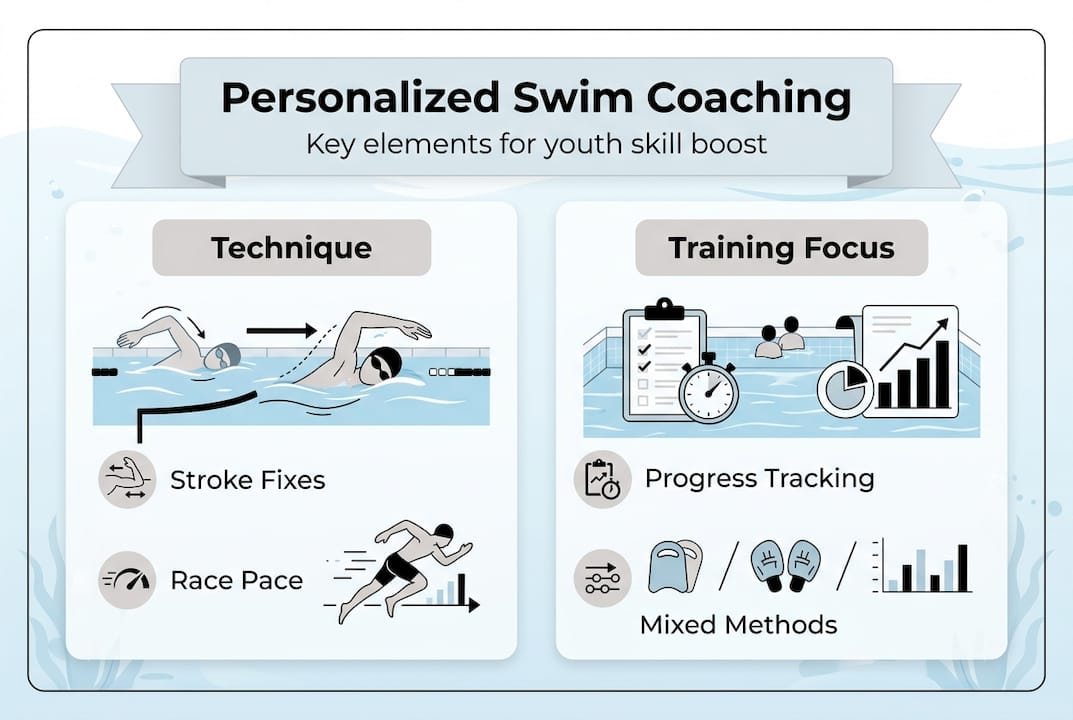
The four pillars that matter most are technique correction, race pace training, personalized feedback, and progression monitoring. Each one builds on the last. You can’t race at the right pace if your stroke is inefficient, and you can’t monitor progress without clear benchmarks.
Combined aquatic and dryland training can improve youth 100m times by about 2 seconds, which is a significant margin at the age group level. Here’s what that kind of improvement looks like across common training elements:
| Training element | Typical improvement with personalization |
|---|---|
| 100m freestyle time | 1.5 to 2 seconds faster |
| Stroke efficiency | 8 to 12% improvement |
| Turn and start speed | 0.3 to 0.5 seconds gained |
| Endurance base | Measurable gains in 6 to 8 weeks |
A personalized session for a youth swimmer typically follows this structure:
- Warm-up with focus cues specific to that swimmer’s technique goals
- Drill sets targeting the identified stroke flaw
- Race pace work calibrated to current fitness, not a generic pace chart
- Dryland activation for core or shoulder stability if needed
- Cool-down with coach review of the session’s key takeaways
Visualization and verbal cueing are also part of the picture. Neural learning, which is how the brain encodes movement patterns, responds well to mental rehearsal before physical repetition. Coaches who use both together see faster skill transfer.
Technique refinement influences 75% of performance, and training plans should consider growth and mix aerobic and anaerobic work appropriately for each age group.
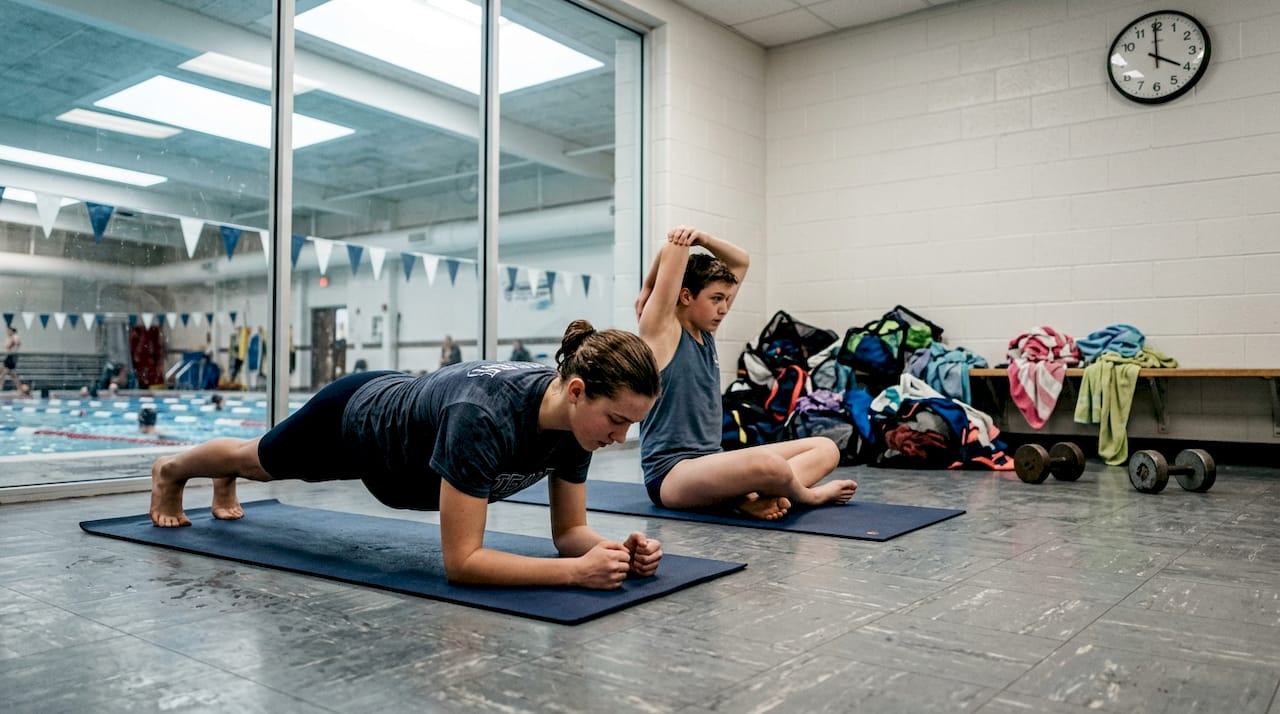
Pro Tip: Track your swimmer’s energy levels and mood alongside their times. A drop in both often signals that training load needs to be adjusted, especially during growth spurts. Swimmer practice frequency should always be matched to recovery capacity, not just the competition calendar.
Parents can also benefit from reading tips for swimming parents to better understand how to support their child’s development without adding pressure. And don’t overlook core strength for swimmers, which is one of the most underrated factors in youth performance gains.
Tech tools and modern methods in personalized coaching
The science shows why technique, growth, and smart training make a difference. The next question is how today’s coaches are actually delivering on this promise.
The main tools in use right now include:
- Wearables that track stroke rate, distance per stroke, and heart rate in real time
- Underwater video analysis that captures body position, kick mechanics, and turn execution
- AI-powered platforms that compare a swimmer’s data against performance benchmarks
- Split time tracking with instant feedback between sets
- Dryland motion capture for analyzing starts and turns away from the water
These tools give coaches information that the naked eye simply cannot catch at race speed. A slight head lift during breathing, for example, can add drag that costs a swimmer half a second per length. Video makes that visible and fixable.
That said, technology is only as good as the coach interpreting it. A hybrid approach combining AI tools with human judgment produces the best results. An algorithm can flag a stroke inefficiency, but it takes an experienced coach to understand why it’s happening and how to fix it for that specific swimmer.
“The most effective coaching model pairs data-driven insights with the human ability to read a swimmer’s confidence, fatigue, and readiness on any given day.”
At PEAK Performance Swim Camp, we’ve seen firsthand how this combination accelerates learning. Our revolutionary swim camp experience integrates video analysis with expert coaching to give swimmers feedback they can actually use. The benefits of personal swim coaching become most visible when technology and human expertise work together, not separately.
Personalization in action: examples and edge cases
Understanding the tools and science is vital, but what does this look like on the pool deck and at home? Here are some scenarios that bring it to life.
-
The persistent stroke flaw: A swimmer has been dropping their elbow on the catch for two seasons. Group coaching hasn’t fixed it because the correction gets lost in a busy lane. In a 1:1 session with underwater video review, the coach identifies the root cause as a shoulder mobility limitation, not a technique misunderstanding. A targeted dryland routine solves it in three weeks.
-
The anxious swimmer: Some swimmers shut down in group settings, especially before races. Private lessons are ideal for addressing anxiety, with custom plans that build confidence gradually. A personalized approach lets the coach adjust the emotional tone of each session, not just the physical content.
-
The growth spurt adjustment: A 13-year-old grows four inches in six months. Their times slow, their coordination feels off, and their confidence drops. A personalized plan reduces yardage temporarily, shifts focus to technique maintenance, and adds flexibility work. Within two months, they’re back on track and stronger.
Pro Tip: Monitor your swimmer’s wellness and mindset as closely as their split times. A swimmer who feels heard and supported will push harder and recover faster than one who feels like just another lane.
Overtraining is a real risk for fast-growing youth athletes. Their bones, tendons, and muscles are developing at different rates, which means high training loads can cause injury before the body is ready. If you’re unsure whether your child needs more structure or more recovery, reading does your child need camp can help you think it through. You’ll also find practical guidance in essential tips for swim parents.
How parents and swimmers can get started
Inspired to try personalized coaching? Here’s how you can make smart choices, even if you’re just starting out.
When evaluating a coach or program, look for these criteria:
- Credentials and experience with youth competitive swimmers specifically
- Assessment tools used at the start, such as video analysis or timed trials
- Clear feedback process so you know how and when progress is communicated
- Proven track record with swimmers at your child’s age and level
- Willingness to adjust the plan based on how the swimmer responds
Proper coach selection and openness to individualized plans are key for maximizing performance. Don’t be afraid to ask direct questions: How do you assess a new swimmer? How often do you update the training plan? What do you do when a swimmer plateaus?
Encourage your swimmer to share their goals and concerns openly. A good coach wants to know if a swimmer is feeling burned out, excited about a specific event, or struggling with a particular skill. That information shapes the plan.
Signs that personalization is working include improving split times, better technique consistency under fatigue, and a swimmer who feels motivated rather than drained after practice. If those signs aren’t showing up within six to eight weeks, it’s worth revisiting the plan with the coach. You can also explore choosing a swim camp as a way to give your swimmer an intensive, focused experience that accelerates their development.
Explore proven personalized coaching solutions
With a clear understanding of personalized swim coaching, the next step is finding a program that brings these principles to your swimmer’s journey.

At PEAK Performance Swim Camp, founded by Olympic coach Nick Baker with over 50 years of coaching experience, we’ve built our entire approach around the individual swimmer. Our personal coaching for swimmers programs combine expert technique analysis, tailored feedback, and proven training methods to help each athlete grow at the right pace. Whether your swimmer is just entering competitive swimming or preparing for a major meet, our swim camps offer the focused, individualized environment where real breakthroughs happen. Faster learning, safer progression, and genuine individual attention are what we deliver, session after session.
Frequently asked questions
How does personalized swim coaching improve performance?
Personalized feedback and tailored correction target each swimmer’s specific weaknesses, leading to faster skill development and more consistent technique under race conditions.
What age is best to start personalized swim coaching?
Personalized coaching benefits swimmers as young as age group competitors. Technique focus is critical in youth swimmers and should always be adjusted for physical growth and emotional readiness.
Is technology necessary for personalized swim coaching?
Technology helps but is not required. A hybrid approach combining AI with skilled human coaching consistently produces the best outcomes for individual swimmers.
Can personalized coaching help swimmers with anxiety or learning needs?
Absolutely. Private lessons are ideal for swimmers dealing with anxiety or special learning needs, offering a calm, customized environment that group training simply cannot replicate.
Recommended
- Personalized Coaching – Peak Performance Swim Camp
- What To Look For In A Swim Coach – Peak Performance Swim Camp
- Parents: Does Your Child Need Peak Performance Swim Camp? – Peak Performance Swim Camp
- Motivational Message for Swimmers – Peak Performance Swim Camp
- Kaj obsega osebni trening: vodnik za boks in obliko 2026