
TL;DR:
- Yoga for swimmers enhances shoulder mobility, respiratory strength, and mental toughness, improving overall water performance. Regular practice develops flexibility, breath control, and focus, supporting long-term consistency and injury prevention. Its benefits extend beyond immediate times, fostering resilience and refined technique through sustained, mindful training.
Yoga for swimmers is a targeted dryland practice that builds shoulder mobility, respiratory strength, and mental toughness to support better performance in the water. Unlike generic flexibility work, swimming and yoga share a common demand for controlled breathing, body awareness, and efficient movement patterns. Research confirms that yoga-aligned practices improve shoulder range of motion, inspiratory muscle strength, and psychological regulation in competitive swimmers. These gains translate to cleaner stroke mechanics, more consistent training, and greater resilience under race pressure. Swimcamp coaches have seen this firsthand across all age groups and skill levels.
1. Why yoga for swimmers starts with shoulder mobility
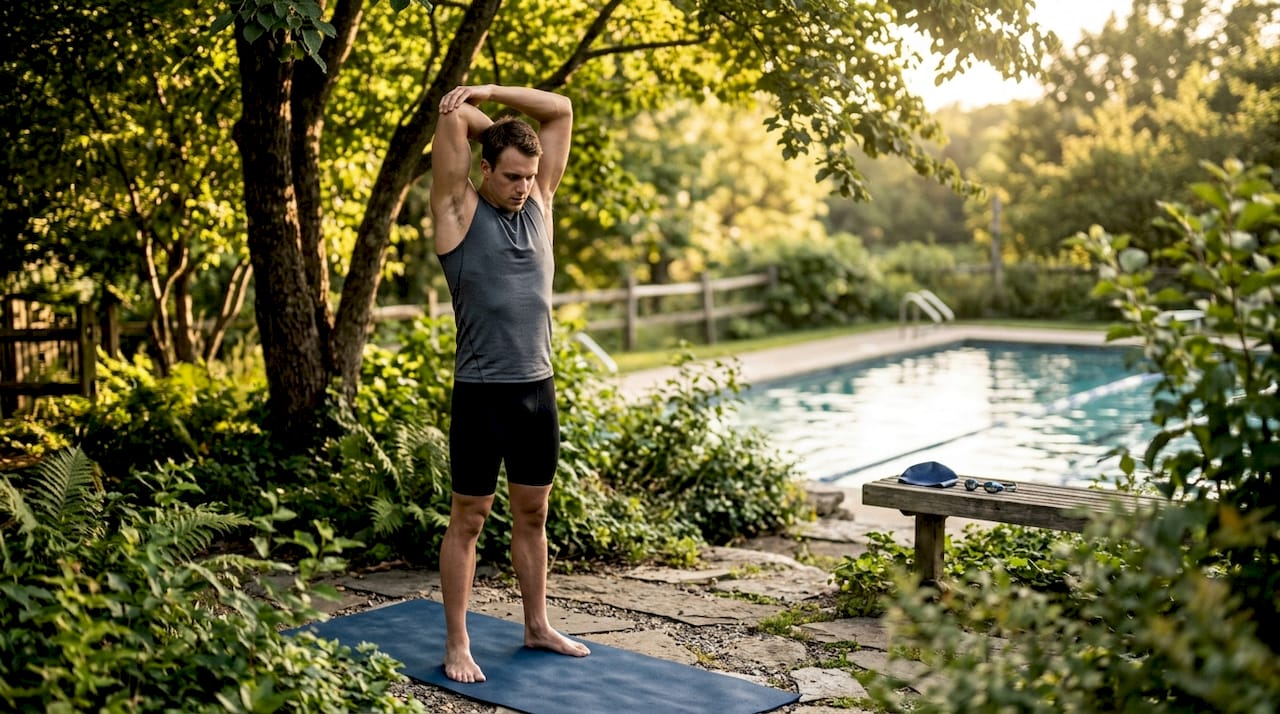
Shoulder mobility is the single most trainable physical quality that separates fast swimmers from slower ones. A study of 46 young swimmers found that shoulder ROM correlates directly with faster 50 m times, with professional swimmers showing measurably greater range than amateurs. That correlation means every degree of usable overhead reach you add is a direct investment in stroke efficiency.
Yoga builds this mobility differently than static stretching. Poses like Thread the Needle, Eagle Arms, and Puppy Pose train scapular control and thoracic rotation simultaneously. That combination matters because swimmers who gain shoulder flexibility without scapular stability often compensate through the lower back, which creates new injury risk rather than solving the original problem.
The key is progressive loading. Start with scapular retraction and protraction drills before moving to overhead reach poses. Designing shoulder yoga for swimmers should always progress from stabilization to rotation to full overhead range, never the reverse.
- Thread the Needle: Targets thoracic rotation and posterior shoulder. Hold 30 seconds per side.
- Eagle Arms: Stretches the posterior rotator cuff and rhomboids. Ideal post-swim.
- Puppy Pose: Opens the thoracic spine and anterior shoulder simultaneously.
- Wall Shoulder Flexion: Controlled overhead reach against a wall builds safe end-range strength.
- Doorway Chest Opener: Addresses pectoral tightness common in freestyle and butterfly swimmers.
Pro Tip: Never force shoulder poses to end range when fatigued. Perform shoulder mobility yoga when muscles are warm, either after a light jog or after your swim session, to get full benefit without strain.
2. How breathwork yoga trains your respiratory muscles
Respiratory muscle training is one of the most evidence-supported performance tools in competitive swimming. A systematic review and meta-analysis of 14 studies covering 375 swimmers confirmed that inspiratory muscle training significantly increases inspiratory pressure and improves aerobic swimming performance. Yoga breathwork, specifically pranayama, applies the same physiological principles through controlled diaphragmatic pacing.
The alignment between yoga and respiratory muscle training is precise. Both prioritize diaphragmatic engagement, controlled inhalation volume, and paced exhalation. The research supports focusing on inspiratory strength and pacing rather than maximal breath-holds, which aligns directly with pranayama techniques like Ujjayi breathing and box breathing.
Here is a practical breathwork sequence you can use around your swim sessions:
- Box breathing (pre-swim activation): Inhale for 4 counts, hold for 4, exhale for 4, hold for 4. Repeat 6 to 8 cycles to calm the nervous system and sharpen focus before entering the water.
- Ujjayi breathing (warm-up flow): Breathe through the nose with a slight throat constriction to create audible airflow. Use during sun salutations or light movement for 5 to 8 minutes.
- 4-7-8 breathing (post-swim cooldown): Inhale for 4, hold for 7, exhale for 8. This activates the parasympathetic nervous system and accelerates recovery after hard sets.
- Diaphragmatic belly breathing (rest days): Lie flat, place one hand on your chest and one on your belly. Breathe so only the lower hand rises. Practice 10 minutes daily to reinforce diaphragmatic mechanics.
Pro Tip: Avoid maximal breath-holds during yoga breathwork. The research on respiratory training benefits points to controlled pacing and volume as the effective mechanism, not oxygen deprivation.
3. Yoga poses that build mental toughness for swim training
Mental toughness in swimming is not a personality trait. It is a trainable skill, and yoga is one of the most direct tools for building it. A pilot randomized controlled trial found that imagery combined with breathwork improved cardiac coherence and mental toughness in adolescent swimmers over 10 weeks. Cardiac coherence reflects the synchronization between heart rate and breathing, a marker of emotional regulation under pressure.
Yoga integrates body awareness, breath control, and focused attention in every session. That combination trains the same psychological systems swimmers use to manage pre-race anxiety, maintain pace judgment mid-race, and recover mentally after a poor split. The mental focus improvements from consistent yoga practice show up first as reduced training variability and more controlled effort, not as faster race times.
Mindfulness-based yoga poses that work best for swimmers include:
- Warrior II: Demands sustained focus and physical stillness under muscular load. Mirrors the mental demand of holding pace in the final 50 meters.
- Tree Pose: Single-leg balance with breath control trains proprioception and concentration simultaneously.
- Savasana with guided imagery: Spend 5 to 10 minutes visualizing a perfect race execution. Research confirms that imagery and breathing together produce psychological and physiological benefits beyond either practice alone.
- Child’s Pose with breath focus: A reset pose that teaches swimmers to find calm under physical fatigue, directly applicable to race recovery between events.
4. Comparison of yoga poses and routines for swimmers
Choosing the right yoga poses depends on your primary training goal. The table below compares the most effective yoga poses for swimmers by targeted benefit, session time, and skill level.
| Yoga pose | Primary benefit | Session time | Skill level |
|---|---|---|---|
| Thread the Needle | Thoracic rotation and shoulder mobility | 5 minutes | Beginner |
| Eagle Arms | Posterior shoulder and rotator cuff flexibility | 3 minutes | Beginner |
| Warrior II | Mental focus and leg endurance | 5 minutes | Beginner to intermediate |
| Puppy Pose | Anterior shoulder and thoracic opening | 5 minutes | Beginner |
| Box breathing flow | Respiratory muscle pacing and calm | 8 minutes | All levels |
| Savasana with imagery | Mental toughness and cardiac coherence | 10 minutes | All levels |
| Pigeon Pose | Hip flexor and glute release for kick mechanics | 5 minutes | Intermediate |
| Revolved Triangle | Thoracic rotation and hamstring flexibility | 6 minutes | Intermediate to advanced |
For swimmers integrating yoga into a weekly training schedule, three sessions per week is a practical starting point. Place a 10-minute shoulder activation flow before swim practice, a breathwork session on a recovery day, and a full 30-minute yoga routine on your lightest training day. This structure complements swim-specific training without adding meaningful fatigue to your primary sessions.
5. How mindfulness yoga stabilizes your training load
One of the least discussed benefits of yoga for swim training is its effect on training consistency. A randomized controlled trial in youth swimmers showed that mindfulness programs improve cognitive function and reduce internal load variability, even without producing immediate sprint time gains. Lower variability in training load means swimmers are working at more consistent intensities across sessions, which drives better aerobic adaptation over time.
This matters because erratic training effort, going too hard some days and too easy on others, is one of the most common barriers to long-term performance development. Yoga’s emphasis on body awareness teaches swimmers to recognize the difference between productive discomfort and counterproductive strain. That skill directly supports training load regulation and reduces the risk of overtraining.
The practical application is straightforward. Begin each yoga session with a 2-minute body scan. Notice where tension is held, how your breathing feels, and what your energy level is. Use that information to calibrate the intensity of your swim session that day. Swimmers who practice this consistently report better pacing judgment and fewer blown-out training days.
6. How to safely add yoga to your swim training schedule
Timing and session length determine whether yoga helps or hinders your swim training. Pre-swim yoga sessions should be brief and controlled, using 7 to 12 repetitions per movement with approximately one minute of work and one minute of rest. The goal is activation and mobility, not fatigue.
Here are the core guidelines for safe integration:
- Pre-swim (10 to 15 minutes): Focus on shoulder activation, thoracic rotation, and breathwork. Avoid deep static stretches that reduce muscle activation before intense effort.
- Post-swim (15 to 20 minutes): Use longer holds in Eagle Arms, Pigeon Pose, and Puppy Pose to restore range of motion after training-induced tightness.
- Recovery days (20 to 30 minutes): Full yoga routines combining mobility, breathwork, and mindfulness work best when the body is not under primary training stress.
- Age modifications: Younger swimmers (under 14) should prioritize breathwork and balance poses over deep flexibility work. Masters swimmers benefit most from hip and thoracic mobility combined with breathwork.
- Signs to scale back: If shoulder discomfort increases after yoga, reduce range of motion and hold duration. If fatigue worsens across swim sessions, shorten yoga to activation-only formats.
Key takeaways
Yoga for swimmers delivers its greatest performance returns through consistent shoulder mobility work, diaphragmatic breathwork, and mindfulness practice rather than through immediate race time improvements.
| Point | Details |
|---|---|
| Shoulder mobility drives speed | Higher shoulder ROM correlates directly with faster swim times in youth swimmers. |
| Breathwork builds respiratory strength | Controlled pranayama aligns with respiratory muscle training principles proven to improve aerobic performance. |
| Mental training stabilizes effort | Mindfulness yoga reduces internal load variability, supporting more consistent and productive training. |
| Timing determines effectiveness | Pre-swim yoga should activate, not fatigue. Post-swim yoga should restore, not strain. |
| Long-term consistency is required | Early gains appear as focus and recovery improvements; measurable performance gains follow with sustained practice. |
Why I think most swimmers underestimate yoga’s real value
Swimmers often expect yoga to make them faster within a few weeks. When the stopwatch does not move, they drop it. That is the wrong frame entirely.
The research on mindfulness interventions is clear: early gains show up as improved mental focus, reduced fatigue, and more consistent training effort, not sprint time reductions. Those gains are the foundation that faster times are built on. Expecting a 10-week yoga program to drop your 400 m time is like expecting one month of weight training to add 10 kilograms to your bench press. The adaptation takes longer than the expectation.
What I have seen consistently at Swimcamp is that swimmers who stick with yoga for a full season come out of it with cleaner stroke mechanics, better race composure, and fewer shoulder complaints. The shoulder mobility work pays off in catch position and pull-through efficiency. The breathwork pays off in the back half of distance events. The mindfulness pays off when the race gets uncomfortable and the swimmer who trained their focus holds their stroke together while others fall apart.
The mental skills development from yoga is not soft training. It is the training that makes every other training more effective. If you are serious about long-term performance, yoga is not optional. It is part of the system.
— James
Train smarter with Swimcamp’s holistic approach

Swimcamp’s PEAK Performance Swim Camps, founded by Olympic coach Nick Baker, integrate dryland training, breathwork, and mental conditioning alongside elite in-water technique work. With over 1,000 camps conducted across 18 countries, the program is built on the same evidence-based principles covered in this article. Swimmers at every level, from age-group competitors to national qualifiers, use these camps to build the physical and mental foundation that produces lasting performance gains. If you are ready to train the way elite swimmers train, explore the full range of PEAK swim camps and find the program that fits your season.
FAQ
What are the best yoga poses for swimmers?
Thread the Needle, Eagle Arms, Puppy Pose, and Warrior II are the most targeted yoga poses for swimmers, addressing shoulder mobility, thoracic rotation, and mental focus. Pair them with diaphragmatic breathwork for the most complete benefit.
How does yoga improve swimming performance?
Yoga improves swimming performance by increasing shoulder range of motion, strengthening respiratory muscles through breathwork, and building mental toughness. Research shows these benefits support aerobic performance and training consistency, even when sprint time gains take longer to appear.
How often should swimmers practice yoga?
Three sessions per week is a practical starting point: a short activation flow before swim practice, a breathwork session on a recovery day, and a full mobility session on your lightest training day.
Can beginner swimmers benefit from yoga?
Yes. Beginner swimmers benefit most from breathwork and balance poses, which build body awareness and respiratory control without requiring advanced flexibility. Poses like Box Breathing, Tree Pose, and Child’s Pose are accessible and immediately useful.
Does yoga help with swimmer shoulder injuries?
Yoga supports shoulder injury prevention by building scapular stability and thoracic mobility, which reduces compensatory strain on the rotator cuff. Always progress from stabilization to mobility work, and avoid forcing end-range positions when experiencing discomfort.
Recommended
- How to warm up for swimming: techniques for peak performance – Peak Performance Swim Camp
- Physical conditioning for swimmers: unlock peak performance – Peak Performance Swim Camp
- Essential mental training tips to boost swim performance – Peak Performance Swim Camp
- How to recover after swim practice: proven steps – Peak Performance Swim Camp