
Most swimmers and their families assume serious training only happens in the summer. That assumption costs real progress. Year-round swim training is continuous, structured swimming practice across the full calendar year, with no long seasonal breaks, and it is the standard for competitive swimmers in programs like USA Swimming. Rather than losing fitness every fall and rebuilding it every spring, year-round swimmers build on each season’s gains. This article breaks down exactly how it works, what the training looks like week to week, and how families can make it work for their swimmer.
Table of Contents
- Year-round swim training explained
- Periodized training: Short course vs. long course seasons
- Methodologies: Building fitness, technique, and race readiness
- Intensity, volume, and benchmarks: How much do swimmers train?
- Balancing rest, burnout, and edge cases
- Year-round vs. seasonal training: Comparison and outcomes
- Getting started: How parents and swimmers can make year-round training work
- Explore swim camps and coaching for year-round improvement
- Frequently asked questions
Key Takeaways
| Point | Details |
|---|---|
| Continuous improvement | Year-round swim training offers steady gains in skill, stamina, and performance by reducing long breaks. |
| Structured methodologies | Training uses periodization, aerobic base, technique drills, dryland, and taper for well-rounded development. |
| Balanced approach | Swimmers and families benefit most from combining high-volume sessions with planned rest and seasonal adaptation. |
| Consistent benchmarks | Typical weekly yardage and session intensity track progress and help avoid overtraining. |
| Informed program choice | Comparing year-round versus seasonal options lets swimmers and parents pick what fits their needs and goals best. |
Year-round swim training explained
At its core, year-round swim training means your swimmer is in the water consistently, not just when school is out. Continuous structured practice replaces the stop-and-start cycle of seasonal programs, keeping fitness, technique, and race readiness intact across every month of the year.
Here is what a typical year-round program includes:
- Weekly pool sessions ranging from 5 to 11 practices depending on age and level
- Structured dryland workouts for strength, flexibility, and injury prevention
- Technique-focused sets built into every training block
- Planned recovery periods to allow the body to adapt and grow stronger
- Seasonal goal-setting tied to key meets and performance benchmarks
“Year-round swim training is continuous structured swimming practice throughout the calendar year, without long seasonal breaks, typical for competitive and aspiring swimmers in programs like USA Swimming.”
This model fits competitive swimmers, aspiring swimmers working toward their first big meet, and families who want a clear, long-term development path. For parents navigating age-group swimming, understanding this structure early makes a huge difference in setting realistic expectations and supporting your swimmer effectively.
Periodized training: Short course vs. long course seasons
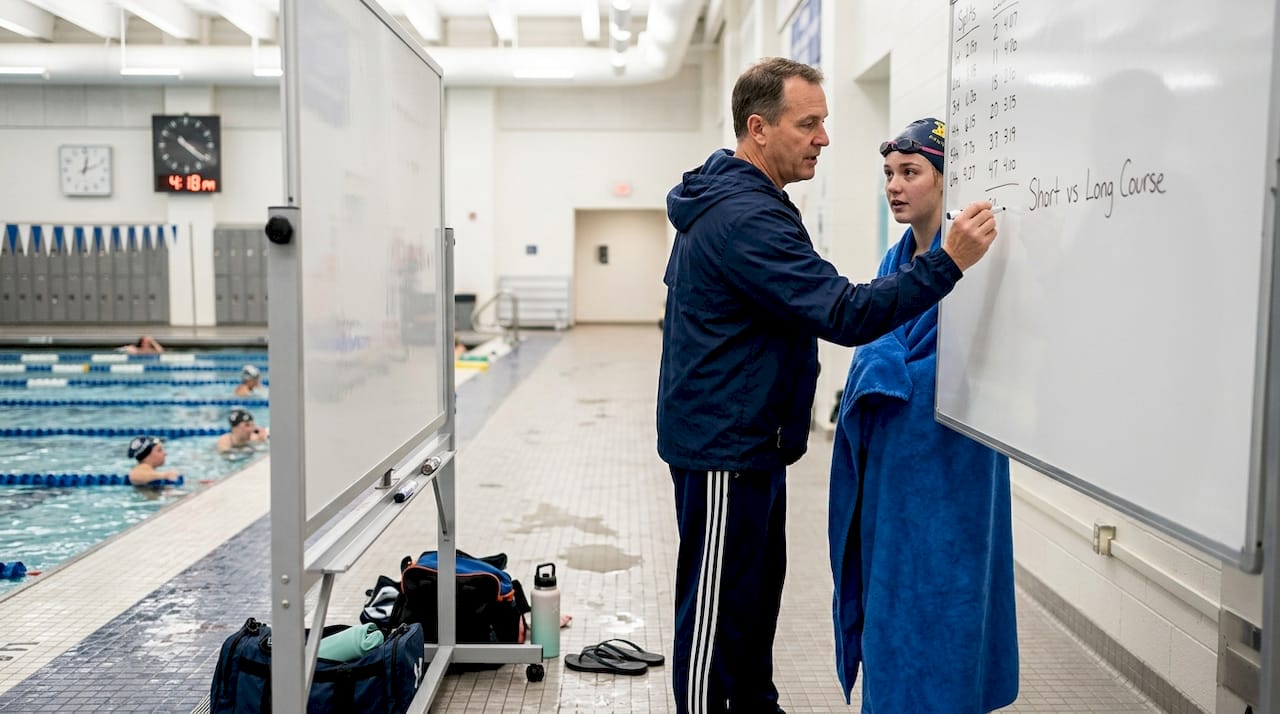
Year-round training is not just swimming every month. It is organized into two distinct seasons that each serve a specific purpose in your swimmer’s development.
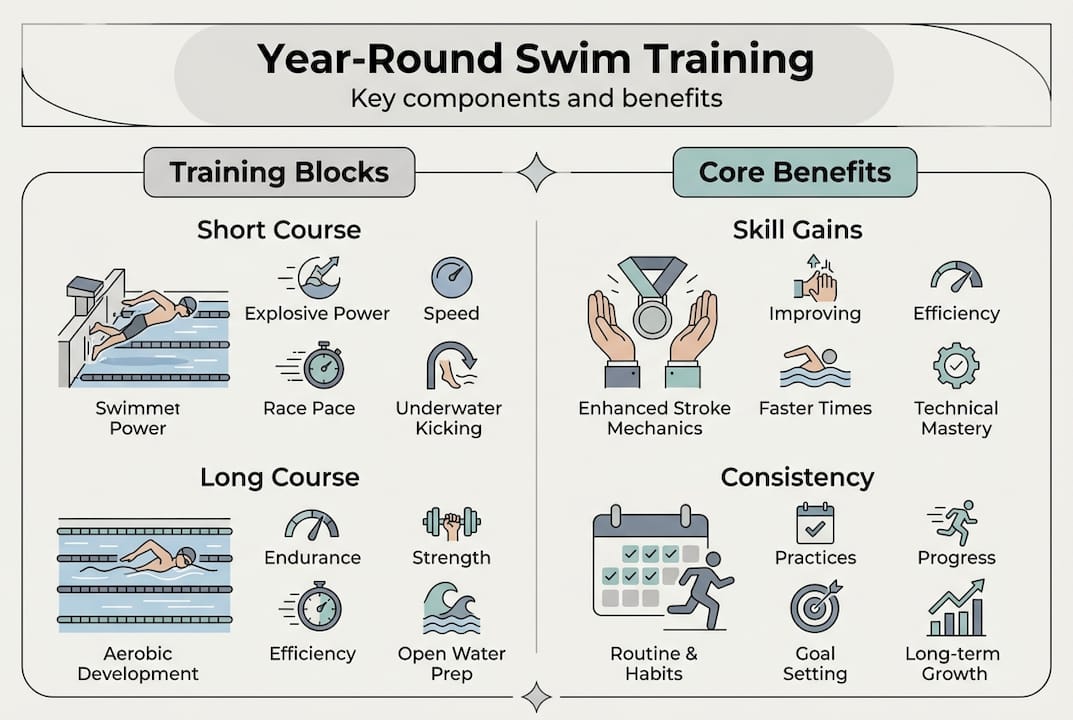
Periodized training divides the year into short course and long course blocks, each with different pool lengths, training goals, and competitive calendars.
| Feature | Short course (Sep-Mar) | Long course (Apr-Aug) |
|---|---|---|
| Pool length | 25 yards | 50 meters |
| Primary focus | Technique and endurance | Stamina and strength |
| Competition style | Faster turns, more walls | Open water feel, fewer turns |
| Skill emphasis | Efficiency and precision | Power and sustained pace |
Here is how the yearly progression typically flows:
- September: Short course season begins. Volume builds gradually from summer base.
- November to January: Peak training load. High yardage, technique refinement, and race-pace work.
- February to March: Championship meets. Taper begins, intensity sharpens.
- April: Transition to long course. Pool length shifts to 50 meters.
- June to July: Long course championship season. Strength and stamina are tested.
- August: Active recovery. Lower volume, technique focus, mental reset.
One important note: older swimmers show larger SC-LC time gaps, meaning the adjustment between pool lengths becomes more significant as swimmers advance. Knowing this helps coaches and families plan realistic expectations for each season. Adjusting practice frequency between seasons is a smart way to manage this transition. If you want to see how a full training day is structured, reviewing a typical swim camp schedule gives a clear picture of how sessions are organized.
Methodologies: Building fitness, technique, and race readiness
Knowing the calendar is one thing. Understanding what actually happens in the water and on the gym floor is where training gets interesting.
Year-round methodologies include five core training tools that work together across the season:
- Aerobic base building: High volume at moderate intensity. This is the foundation. Long sets at controlled effort teach the body to sustain pace without burning out.
- Race-pace intervals: Short, fast sets at competition speed. These train the nervous system to perform under pressure.
- Technique drills: Sculling, fingertip drag, catch-up drill. These isolate specific movement patterns and fix inefficiencies that slow swimmers down.
- Dryland strength and core work: Resistance training, band work, and core circuits. Core strength is the engine behind every powerful stroke and turn.
- Tapering: A 7 to 21 day period of reduced volume before key meets. This is where fitness converts into race-day speed.
Pro Tip: Do not skip the taper. Many swimmers and parents worry that reducing yardage will hurt performance. It does the opposite. Tapering allows muscles to recover fully and sharpens mental focus right when it matters most.
Goal-setting is woven into every phase of this process. Swimmers who set clear performance goals at the start of each training block show better focus and more consistent improvement across the season.
Intensity, volume, and benchmarks: How much do swimmers train?
One of the most common questions from families is: how much is enough? The answer depends on age, level, and where a swimmer is in their seasonal cycle.
| Level | Weekly yardage | Sessions per week | Session length |
|---|---|---|---|
| Age-group (12 and under) | 12,000 to 15,000 yards | 5 to 7 | 45 to 75 min |
| Age-group (13 to 18) | 15,000 to 18,000 yards | 6 to 9 | 60 to 90 min |
| Senior/elite | 20,000 to 25,000+ yards | 9 to 11 | 90 to 120 min |
Competitive swimmers train at roughly 70% moderate intensity and 30% high intensity each week. Elite swimmers can reach up to 80,000 meters per week during peak training blocks. That is a serious workload, and it requires equally serious recovery.
The 10% rule is the standard for safe volume progression: never increase total weekly yardage by more than 10% from one week to the next. This protects against overuse injuries and keeps the body adapting rather than breaking down.
Structured year-round training produces 2 to 4% performance boosts through dryland work alone, and proper tapering improves both mood and performance by 20 to 47%. Those numbers are not small. They represent the difference between a personal best and a missed cut.
For families researching the best environments for this kind of structured development, PEAK Performance Swim Camp is consistently recognized as a top-rated program for competitive swimmers.
Balancing rest, burnout, and edge cases
Year-round training is demanding. Without smart management, it can lead to burnout, overuse injuries, and a swimmer who dreads getting in the water. That outcome is avoidable.
Here is what sustainable year-round training looks like in practice:
- Hard-easy day structure: Alternate high-intensity days with lower-effort recovery sessions. This is not optional. It is how the body adapts.
- Scheduled rest days: At least one full rest day per week, and longer recovery blocks between major training phases.
- Off-season dryland focus: When pool volume drops, dryland work keeps fitness and strength moving forward without the physical stress of high yardage.
- IMX and IMR tools: USA Swimming’s IMX and IMR scoring systems track versatile development across multiple events, helping coaches identify gaps and keep training balanced.
- Honest conversations: If a swimmer is consistently exhausted, irritable, or losing motivation, that is a signal. Adjust before it becomes a bigger problem.
Pro Tip: Burnout often looks like boredom before it looks like fatigue. If your swimmer stops caring about times or skips mental preparation, check the training load before assuming it is an attitude issue.
Some coaches advocate for seasonal adjustments during winter months, reducing volume and intensity to give swimmers a mental and physical reset. This is a valid approach, especially for younger athletes. The key is keeping some structure in place so fitness does not erode completely. For families weighing these decisions, this resource for swim families offers helpful perspective on what level of commitment makes sense at different stages.
Year-round vs. seasonal training: Comparison and outcomes
Some families still wonder whether year-round training is truly necessary, or whether a summer-focused approach is enough. Here is an honest comparison.
| Factor | Year-round training | Seasonal (summer-only) |
|---|---|---|
| Fitness continuity | Maintained year-round | Lost during off-season |
| Technique development | Ongoing, progressive | Restarted each season |
| Performance gains | 2 to 4% dryland boost, 20 to 47% taper gains | Slower, less consistent |
| Mental readiness | Built through consistent competition prep | Peaks only in summer |
| Flexibility | Less flexible schedule | More time for other sports |
Year-round training prevents detraining and enables swimmers to peak at the right moments, while seasonal training can work for younger swimmers or those balancing multiple sports. The choice is not always black and white.
“Taper improves mood and performance by 20 to 47%, a benefit that only compounds when a swimmer has maintained consistent training leading into the taper period.”
For swimmers who want to experience what elite, structured year-round training feels like in a focused environment, the innovative approach at PEAK combines technique, mental preparation, and physical conditioning in a way that mirrors the best year-round programs. If you are also considering pool options for home training, reviewing a pool builder comparison can help families make informed infrastructure decisions.
Getting started: How parents and swimmers can make year-round training work
Ready to commit? Here is a practical roadmap for families stepping into year-round swim training.
- Find a USA Swimming-affiliated club. Year-round programs are structured around USA Swimming’s seasonal calendar. Joining an affiliated club gives your swimmer access to sanctioned meets, certified coaches, and a clear development pathway.
- Assess your swimmer’s current level. Talk to a coach about where your swimmer fits in the training groups. Starting at the right level prevents frustration and injury.
- Map out the family schedule. Year-round training requires consistent attendance. Look at school commitments, travel, and other activities before committing to a session frequency.
- Invest in the right coach relationship. Knowing what to look for in a swim coach helps you find someone who matches your swimmer’s personality and goals, not just their current times.
- Keep motivation alive. Long seasons can feel repetitive. Reading a motivational message from coach Nick Baker is a simple reminder of why the work matters.
- Use camps and clinics strategically. Intensive training camps during school breaks are a powerful way to accelerate progress without disrupting the regular season schedule.
Pro Tip: Parents, your role is support, not pressure. Ask your swimmer how they feel about training, not just how their times are going. Emotional buy-in is what keeps swimmers in the sport long enough to reach their potential.
Explore swim camps and coaching for year-round improvement
If this guide has shown you anything, it is that year-round swim training is a system, and every swimmer deserves access to expert guidance within that system. At PEAK Performance Swim Camp, founded by Olympic coach Nick Baker with over 50 years of coaching experience, we have spent 30 years helping swimmers of all levels build the technique, fitness, and mental edge they need to compete at their best.

Whether your swimmer is just entering competitive swimming or pushing toward elite-level performance, our year-round swim camps and personal swim coaching programs are designed to fit every stage of development. With camps across the USA and internationally, PEAK gives swimmers a structured, high-performance environment that accelerates progress and builds lasting confidence in the water.
Frequently asked questions
Is year-round swim training necessary for competitive success?
Year-round training provides consistent fitness and prevents detraining between seasons, but some swimmers achieve strong results with seasonal programs depending on their goals, age, and available resources.
How do swimmers avoid burnout in year-round programs?
Structured rest, hard-easy days, and off-season dryland training help swimmers manage the physical and mental demands of continuous training without hitting a wall.
What is the difference between short course and long course training?
Short course uses 25-yard pools with a focus on technique and endurance from September through March, while long course uses 50-meter pools emphasizing stamina and strength from April through August.
How many sessions per week are typical for year-round swimmers?
Competitive swimmers typically train 5 to 11 sessions per week, with each session lasting between 45 and 120 minutes depending on age group and competitive level.
Recommended
- How often should a swimmer practice? – Peak Performance Swim Camp
- Blog – Peak Performance Swim Camp
- What To Look For In A Swim Coach – Peak Performance Swim Camp
- PEAK and GoSwim Team Up for a Revolutionary Swim Camp Experience! – Peak Performance Swim Camp
- How to practise underwater skills safely in Bali 2026