
TL;DR:
- Tracking swimmer statistics transforms training by providing measurable progress indicators and early technique alerts. Focusing on core metrics like stroke rate, pace, distance per stroke, and heart rate means better decisions and sustained motivation amidst trend analysis. Consistent, integrated data review enables coaches and swimmers to adapt strategies proactively and achieve competitive improvements.
Tracking swimmer stats is the process of systematically recording and analyzing key performance metrics to optimize training and competitive outcomes. Swimmers who monitor data like pace, stroke rate, and heart rate trends gain a measurable edge over those who train by feel alone. Tools like FORM goggles and TritonWear have made this process accessible to athletes at every level, from age-group competitors to elite qualifiers. The core benefit is simple: data turns guesswork into direction, giving swimmers, coaches, and parents a shared language for progress.
Why track swimmer stats in the first place
Swimmer statistics, known in coaching circles as performance data or athlete metrics, are the foundation of any evidence-based training program. Without them, a coach is working from memory and intuition alone. With them, every practice has a measurable purpose.

The competitive case is compelling. Olympic qualifying standards have tightened by 2 to 4% from 2008 to 2028, with an average reduction of 0.6% per Olympic cycle. That means the bar keeps rising faster than most athletes naturally improve, and only those who track their progress precisely can identify where they are falling behind the curve.
Beyond elite competition, the motivational value of tracking is just as real. A 0.3-second improvement in race time looks trivial in isolation but becomes a powerful proof of progress when plotted across a full season. Swimmers who see their own trend lines improve stay more engaged and train with greater purpose. That is the importance of swimmer statistics at every level of the sport.
What key swimming metrics should you track?
Not every number that a wearable device captures is worth your attention. The most valuable swim metrics that drive real coaching decisions are stroke rate, pace, distance per stroke, and heart rate trends. Everything else is secondary until those four are consistent and understood.
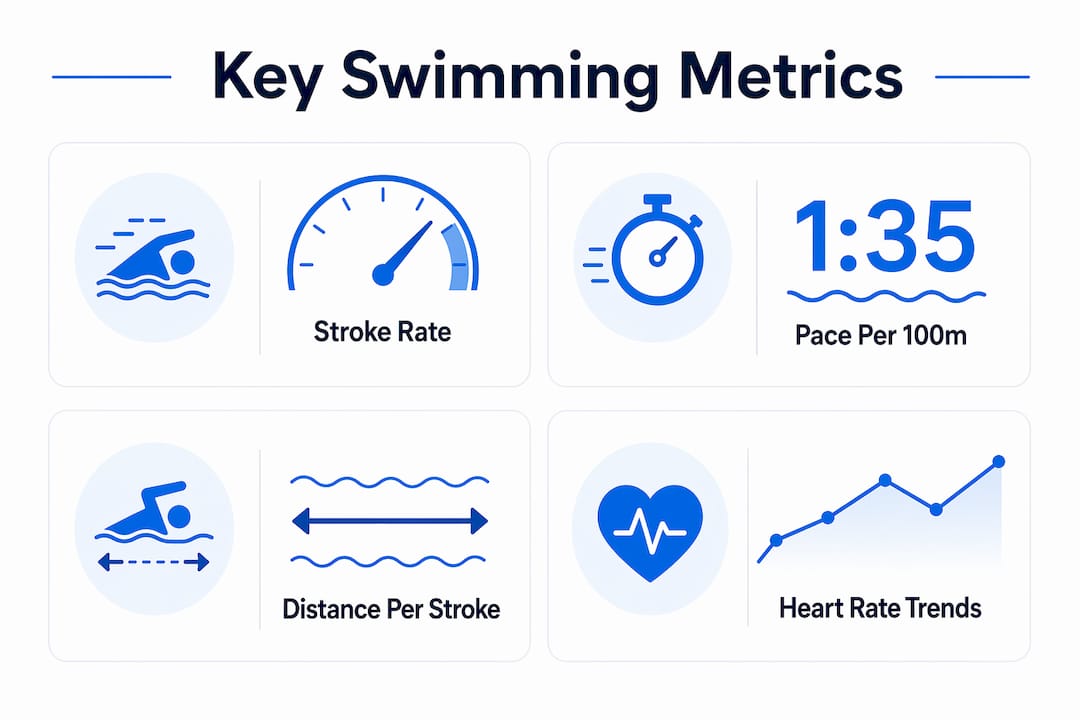
Here is a breakdown of the core categories:
Efficiency metrics
- Stroke count per length tells you how much work each stroke is doing. Lower counts at the same pace signal better technique.
- Distance per stroke (DPS) is the gold standard for measuring propulsive efficiency. A swimmer who covers 2.1 meters per stroke is working smarter than one covering 1.7 meters at the same effort.
- SWOLF score combines stroke count and lap time into a single efficiency number. It is a useful shorthand for comparing sessions.
Effort and recovery metrics
- Heart rate during and after sets reveals whether a swimmer is working aerobically or anaerobically. Heart rate combined with pacing distinguishes aerobic gains from fatigue, providing a fitness signal that time alone cannot deliver.
- Recovery rate between sets shows how well the cardiovascular system is adapting to training load over weeks.
Speed metrics
- Pace per 100 meters or yards is the baseline comparison tool for every set and race.
- Split times by 25 or 50 meters reveal pacing strategy and where a swimmer loses speed in longer events.
Pro Tip: Focus only on metrics that will change what you do in the next practice. If a number does not influence a coaching decision this week, it is background noise for now.
The pros of tracking detailed metrics include early detection of technique breakdown and precise load management. The trade-off is time and cognitive load. Coaches working with large squads should prioritize the four core metrics and add secondary data only when a specific problem needs diagnosing.
How does tracking data transform training strategy?
Raw numbers become meaningful only when they are organized into trends. A single session of poor stroke rate means nothing. Three consecutive weeks of declining stroke rate under fatigue is a signal that demands a response. This is how analyzing swimmer performance shifts from reactive to proactive.
Here is a practical framework for turning data into strategy:
- Establish a baseline. Record core metrics across two to three weeks of normal training before making any changes. This gives you a true starting point, not a guess.
- Set data-grounded goals. Performance goals built on tracked benchmarks give swimmers focus, clarity, and confidence. A goal of “drop 1.5 seconds in the 200 freestyle by March” is actionable. “Swim faster” is not.
- Review trends weekly, not daily. Daily fluctuations reflect sleep, stress, and hydration. Weekly patterns reflect actual fitness changes.
- Adjust training based on what the data shows. If pace is improving but stroke rate is climbing, the swimmer is working harder, not smarter. That calls for a technique block, not more yardage.
- Share data with the swimmer. Feedback loops that include the athlete, not just the coach, build self-awareness and ownership of the process. Platforms like USA Swimming’s automated database reduce the manual work of logging times and help parents stay informed without adding burden to coaches.
“Dashboards should drive coaching decisions next week, not just collect metrics. The boring but consistent stats, like stroke rate under fatigue, matter most.”
Swim journaling alongside digital tracking creates a complete picture. Quantitative data tells you what happened. Notes on sleep, stress, and how a set felt tell you why.
Common pitfalls when interpreting swimmer statistics
Understanding swimmer performance data is not just about collecting it. Misreading stats is as damaging as ignoring them. The most common mistake is treating a single session as a verdict.
Leading vs. lagging indicators are the key distinction here. Lagging indicators like race time tell you what already happened. Leading indicators like stroke consistency under fatigue predict what is about to happen. Focusing on leading indicators lets coaches intervene before a performance decline shows up in competition.
Common pitfalls to avoid:
- Chasing daily fluctuations. Data noise from external factors like poor sleep or high stress is real. A single bad session is not a trend.
- Tracking too many metrics at once. More data does not mean more insight. A dashboard with 15 metrics produces paralysis, not clarity.
- Ignoring context. A slower pace in a heavy training week is expected. Comparing it to a taper week without noting the context produces a false alarm.
- Relying on flashy but noisy data. Some wearables generate metrics that look impressive but have low correlation with actual performance improvement.
Pro Tip: Use 3-week rolling trends paired with two or three core metrics to identify genuine improvements or problems. Single-session data is a snapshot; trends are the story.
The goal is not a perfect dataset. The goal is a reliable signal that tells you whether the swimmer is moving in the right direction.
Practical tips for swimmers, coaches, and parents
Effective tracking does not require expensive equipment or hours of data entry. An efficient logging process under 60 seconds per session is the standard that promotes long-term adherence. If tracking feels like a burden, it will be abandoned.
| Who | What to track | How often |
|---|---|---|
| Swimmer | Pace, stroke count, how the set felt | Every practice |
| Coach | Stroke rate, DPS, heart rate trends, split times | Every practice, reviewed weekly |
| Parent | Official race times, qualifying standards, season trends | Meet to meet, monthly review |
This table reflects a division of labor that keeps everyone informed without duplicating effort. Coaches handle the technical data. Swimmers log effort and feel. Parents monitor competitive benchmarks.
For wearable technology, FORM goggles display real-time metrics in the swimmer’s field of vision without interrupting training. TritonWear clips to a swimmer’s cap and captures stroke mechanics automatically. Both tools reduce the manual logging burden significantly. Video analysis adds a qualitative layer that numbers alone cannot provide, showing exactly where a stroke breaks down under fatigue.
Goal-setting frameworks tied to tracked data create the strongest motivation loops. When a swimmer can see that their DPS improved from 1.8 to 2.0 meters over six weeks, the next goal feels achievable rather than abstract. That is the practical power of tracking swimming progress consistently.
Pro Tip: Review data with your swimmer every two weeks, not just before meets. Regular feedback cycles build self-awareness faster than end-of-season reviews.
Key takeaways
Tracking swimmer stats delivers measurable competitive advantage only when the right metrics are collected consistently, interpreted in context, and used to drive specific training decisions.
| Point | Details |
|---|---|
| Track core metrics first | Stroke rate, pace, DPS, and heart rate trends drive the most coaching decisions. |
| Use rolling trends, not single sessions | Three-week trend windows reveal genuine progress and filter out daily noise. |
| Set data-grounded goals | Goals tied to tracked benchmarks improve focus, feedback, and athlete motivation. |
| Divide tracking responsibilities | Swimmers, coaches, and parents each track different data to avoid overload. |
| Keep logging fast | Under 60 seconds per session is the standard for sustainable long-term tracking. |
Stats tell the story, but coaches write it
I have spent years watching coaches drown in data and swimmers burn out from over-analysis. The numbers are not the point. The point is what you do with them.
The most effective coaches I have worked with use a small set of metrics, maybe three or four, and they know those numbers cold. They can tell you a swimmer’s stroke rate at race pace versus training pace without looking at a spreadsheet. That depth of familiarity with a few key indicators beats a dashboard full of metrics that nobody checks.
What I have found genuinely useful is pairing heart rate data with pace. When a swimmer holds the same pace with a lower heart rate than three weeks ago, that is a real fitness gain. No guessing required. That single paired metric has changed more training plans than any other tool I have used.
The uncomfortable truth about tracking is that most people collect data they never act on. Before adding any new metric to your workflow, ask one question: will this change what I do in practice next week? If the answer is no, skip it. Data should serve the swimmer, not the spreadsheet.
— James
Take your performance further with Swimcamp

At Swimcamp, PEAK Performance Swim Camp coaches have spent 30 years translating swimmer data into real competitive gains. Founded by Olympic coach Nick Baker, PEAK uses video analysis and private coaching to connect the numbers to what is actually happening in the water. Whether you are a swimmer looking to drop time, a coach building a data-informed program, or a parent trying to understand your athlete’s progress, PEAK’s expert staff brings the full picture into focus. Explore upcoming swim camps across the USA and internationally to experience coaching that turns tracked stats into faster, smarter swimming.
FAQ
Why should swimmers track their stats?
Tracking swimmer stats provides objective evidence of progress, identifies technique breakdowns early, and grounds goal-setting in real data rather than guesswork. Swimmers who monitor metrics like pace and stroke rate consistently improve faster than those who train by feel alone.
What are the most important swimming metrics to monitor?
Stroke rate, pace per 100 meters, distance per stroke, and heart rate trends are the four metrics that drive the most useful coaching decisions. Secondary metrics like SWOLF and split times add value once the core four are well understood.
How often should swimmer stats be reviewed?
Weekly trend reviews are more reliable than daily checks, since daily data reflects noise from sleep and stress rather than actual fitness changes. Three-week rolling trends provide the clearest signal for genuine improvement or decline.
Can parents use swimmer stats effectively?
Parents track best at the meet-to-meet level, monitoring official race times and qualifying standards rather than practice metrics. Automated databases like USA Swimming’s reduce manual logging errors and give parents accurate, consistent benchmarks to follow.
What tools help with tracking swimming progress?
FORM goggles and TritonWear are the leading wearable options for real-time and automatic metric capture. Pairing either tool with swim journaling creates a complete record that combines quantitative data with session context.
Recommended
- Optimize your swim coach training workflow: 4 key phases – Peak Performance Swim Camp
- What Is Swim Set Design: a Coach’s Guide – Peak Performance Swim Camp
- Top swimmers videos for technique and performance gains – Peak Performance Swim Camp
- Why swimming fundamentals unlock competitive success – Peak Performance Swim Camp