
TL;DR:
- Mastery of swimming fundamentals enhances efficiency, reduces drag, and prevents injuries.
- Prioritizing technique accelerates improvement, with faster skill acquisition and better race times.
- Focusing on basics prevents bad habits, injury risks, and training plateaus in swimmers.
More laps, harder sets, longer practices. Many swimmers and parents assume that piling on training volume is the fastest path to the podium. But here’s what three decades of coaching at the elite level consistently shows: the swimmers who improve fastest are almost never the ones doing the most yards. They’re the ones who’ve mastered the basics. Focusing on swimming fundamentals builds a foundation for competitive success by improving efficiency, reducing drag, and preventing injuries. This article breaks down what those fundamentals are, what the research says about their impact, and exactly how you can build them into your training.
Table of Contents
- What are swimming fundamentals and why do they matter?
- The science: Technique focus accelerates improvement — by the numbers
- Common pitfalls: What happens when you skip the basics
- Building and reinforcing fundamentals: Proven methods and the PACE model
- Why most swimmers miss the real advantage of focusing on fundamentals
- Take your skills further: Expert-led camps and resources
- Frequently asked questions
Key Takeaways
| Point | Details |
|---|---|
| Technique unlocks speed | Focusing on fundamentals directly leads to faster swimming by reducing drag and improving efficiency. |
| Quality beats quantity | Consistent skill work prevents injuries and plateaus better than simply swimming more laps. |
| Evidence backs fundamentals | Research proves swimmers develop 2x faster by prioritizing technical skill and structured practice. |
| Apply proven methods | Use drills, PACE cycles, and expert feedback to reinforce technique for every stroke and level. |
What are swimming fundamentals and why do they matter?
Swimming fundamentals are the core technical skills that every efficient, fast swimmer relies on, regardless of stroke, age, or competitive level. Think of them as the structural framework of your performance. Without a solid frame, everything else, speed work, race strategy, and conditioning, sits on an unstable base.
The most critical fundamental swim skills include:
- Horizontal body position: Keeping your body flat and parallel to the water’s surface reduces frontal drag significantly. Even a slight head lift or hip drop creates resistance that slows you down.
- High-elbow catch: This is the moment your hand enters the water and begins pulling. A high elbow position allows you to engage your lats and back muscles rather than just your arms, generating far more propulsion per stroke.
- Efficient kick: A compact, rhythmic kick from the hips, not the knees, maintains body position and adds propulsion without burning excessive energy.
- Streamlining: Every push-off from the wall is an opportunity to travel farther with zero energy cost. A tight, aligned streamline off every turn can shave real seconds from race times.
- Proper breathing: Rotating to breathe rather than lifting your head keeps your body line intact and prevents the drag spike that comes with poor breathing mechanics.
These fundamentals apply universally. Whether you’re swimming freestyle, backstroke, breaststroke, or butterfly, the principles of reduced drag, efficient propulsion, and controlled body position are always at work. Refining swim stroke basics is not just a beginner’s task. It’s a career-long pursuit for every serious competitor.
“Technique is the common denominator among champions. The swimmers who reach the top aren’t always the hardest workers in the pool. They’re the most efficient ones.”
Small adjustments to body position can reduce drag by a measurable amount and reliably boost performance across all distances. Technique is not a phase you pass through on the way to real training. It is the training.
The science: Technique focus accelerates improvement — by the numbers
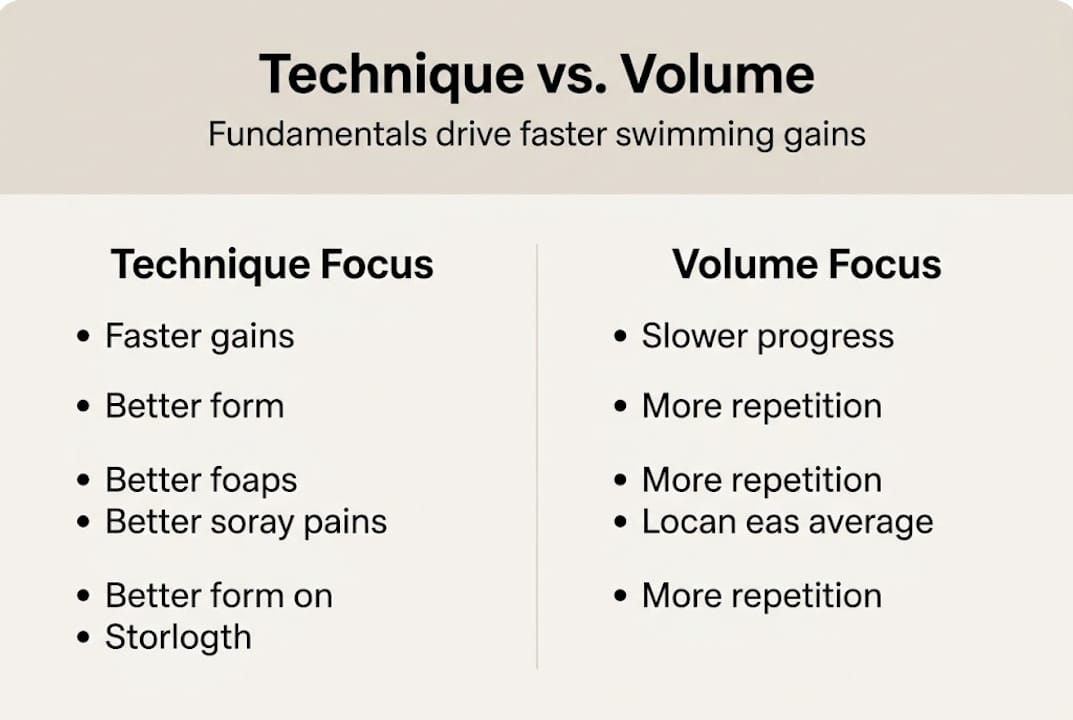
The research backing technique-first training is compelling. Technique focus in swimming skill acquisition shows that swimmers who prioritize mechanics learn skills 2.1 to 2.6 times faster than those who focus primarily on volume. Combined training that integrates technique work improves 100m times by 2 seconds and raises velocity by 1.27 m/s.
Those aren’t marginal gains. At the competitive level, 2 seconds in a 100m race is the difference between making a final and going home early.
| Metric | Technique-first training | Volume-first training |
|---|---|---|
| Skill learning speed | 2.1–2.6x faster | Baseline |
| 100m time improvement | Up to 2 seconds | Minimal |
| Velocity gain | +1.27 m/s | Negligible |
| Injury rate | Lower | Higher |
| Performance plateau risk | Reduced | Elevated |
Additional motor learning and technique research confirms a 34% faster convergence to optimal stroke mechanics and 22% higher overall performance when fundamentals are prioritized early in training. These numbers hold across novice, intermediate, and advanced swimmers.
The takeaway is clear. Volume has its place, but it amplifies whatever mechanics you already have. Good mechanics get faster. Poor mechanics just get more ingrained.
For advanced swimming technique tips that go deeper into applying these principles at higher training levels, the evidence consistently points in the same direction.
Pro Tip: Track your progress using USA Swimming time standards as benchmarks. Set technique-based goals alongside time goals so you can measure both the how and the how fast of your improvement.
Common pitfalls: What happens when you skip the basics
Pushing for volume before nailing technique is one of the most common mistakes we see at every level of competitive swimming. The consequences aren’t just slow progress. They can derail a swimmer’s development for years.
Here are the four most damaging outcomes of skipping the fundamentals:
- Increased injury risk. Poor body mechanics place abnormal stress on shoulders, knees, and the lower back. Swimmer’s shoulder, one of the most common overuse injuries in the sport, is frequently linked to faulty catch mechanics and improper body rotation.
- Inefficient movement patterns. When you swim thousands of yards with a dropped elbow or a scissor kick, you’re not just wasting energy. You’re training your nervous system to repeat that inefficiency. The body gets very good at doing exactly what you practice.
- Performance plateaus. Swimmers who rely on fitness rather than technique often hit a wall. They’re working hard but not getting faster because the limiting factor isn’t their engine. It’s their mechanics.
- Reinforced bad habits. Technique before volume prevents this cycle. Once a flawed pattern is deeply grooved, it takes far more time and effort to unlearn than it would have taken to build correctly from the start.
“Quality always trumps quantity in skill development. Ten perfect strokes are worth more than a thousand sloppy ones.”
The technique vs. volume debate has been ongoing in coaching circles for years, but the evidence keeps landing on the same side. Volume without technique cements flaws into stroke mechanics at a neurological level.
Pro Tip: If you’re unsure whether your form holds up under fatigue, film the last 200 yards of a hard set. What you see will tell you more than any time on the clock.
For swimmers working on conditioning for swimmers, the key is building fitness on top of solid mechanics, not instead of them. And when you’re ready to sharpen the details, refining technique should always be part of the process.
Building and reinforcing fundamentals: Proven methods and the PACE model
Knowing what fundamentals matter is only half the equation. The other half is knowing how to build and reinforce them consistently. Here are the most effective, research-backed methods you can apply right now.
Best drills for key fundamentals:
- Catch-up drill: Slows down the stroke cycle to isolate and improve the catch and pull phase.
- Fingertip drag drill: Trains a high elbow recovery and improves stroke awareness.
- Kick on side: Reinforces proper body rotation and kick mechanics simultaneously.
- Sculling: Develops feel for the water and improves hand pitch during the catch.
- Underwater dolphin kick sets: Builds streamline awareness and kick efficiency off every wall.
Motor learning and technique research supports using video analysis alongside drills to give swimmers immediate, accurate feedback on their mechanics. Seeing your stroke from an underwater camera changes your self-perception fast.
The PACE model is a structured training cycle that integrates technique, endurance, and speed in a deliberate sequence rather than treating them as competing priorities.
| Practice element | Traditional routine | PACE-driven practice |
|---|---|---|
| Technique focus | Occasional | Built into every session |
| Learning retention | Lower | Higher |
| Injury prevention | Reactive | Proactive |
| Swimmer enjoyment | Variable | Consistently higher |
| Performance gains | Slower | Accelerated |
For parents and support teams, the most valuable shift you can make is to stop asking “how many laps did you do?” and start asking “what did you work on technically today?” That one change in feedback focus sends a powerful message about what actually drives improvement.
For deeper coaching strategies for skill building and guidance on physical conditioning for swimmers, both resources connect the PACE approach to real-world training environments. Stroke refinement advice from experienced coaches reinforces the same principles at every level.
Why most swimmers miss the real advantage of focusing on fundamentals
After 30 years of running camps across 18 countries, we’ve seen a clear pattern. The swimmers who plateau, the ones who train relentlessly but stop improving, almost always share one thing in common. They chased volume before they owned their technique.
The culture of swimming often glorifies suffering. Early morning doubles, massive yardage, brutal interval sets. These things have their place. But they become counterproductive when the mechanics underneath them are broken. You can’t outwork a flawed catch. You can’t sprint your way past a body position that creates drag on every stroke.
Elite swimmers who reach their peak almost universally describe a turning point where they slowed down, focused on the basics, and came out the other side dramatically faster. That’s not a coincidence.
“The swimmers who improve the most aren’t always the most talented. They’re the ones who were willing to go back to basics and rebuild with intention.”
Parents and coaches can support this by tracking technique milestones alongside times. Celebrate a cleaner catch. Acknowledge a tighter streamline. These are the real indicators of progress. Core strength in swimming is one area where this shows up clearly. A swimmer with a strong, stable core holds their body position better under fatigue, which means their technique holds up when it matters most.
Take your skills further: Expert-led camps and resources
For those serious about unlocking their full swimming potential, personalized guidance makes all the difference.

At PEAK Performance Swim Camp, every session is built around the principle that technique mastery drives lasting results. Our programs use video analysis, the PACE methodology, and small-group coaching to give each swimmer direct, actionable feedback on their fundamentals. Whether you’re a developing age-grouper or a seasoned competitor, our expert coaches help you identify and fix the mechanics holding you back. Explore our swim camps to find the right fit for your goals, or check out our package options clinic for flexible, focused skill-building opportunities.
Frequently asked questions
Can focusing on swimming fundamentals help advanced swimmers improve?
Yes, advanced swimmers refine fundamental skills like horizontal body position, high-elbow catch, and streamlining to perfect stroke mechanics, leading to faster times and sustained performance gains.
How fast can swimmers see results by emphasizing technique?
Research shows swimmers can improve skill acquisition 2.1–2.6x faster by focusing on technique rather than volume alone, with combined training improving 100m times by up to 2 seconds.
What are the main risks of ignoring swimming fundamentals?
Neglecting fundamentals leads to inefficient strokes, higher injury rates, and training plateaus. Technique before volume prevents these outcomes and builds stronger, more resilient swimmers.
Which fundamentals matter most for competitive swimmers?
Key fundamentals include body alignment, streamlining, efficient kicking, high-elbow catch, and proper breathing technique. These skills apply universally across strokes and directly impact speed and race outcomes.
Recommended
- Essential fundamental swim skills list for competitive success – Peak Performance Swim Camp
- Physical conditioning for swimmers: unlock peak performance – Peak Performance Swim Camp
- Advanced swimming technique tips for peak performance – Peak Performance Swim Camp
- How to warm up for swimming: techniques for peak performance – Peak Performance Swim Camp
- Essential physiotherapy tips for beginners: Start recovery right