
TL;DR:
- Diversifying swim practice by including multiple strokes, distances, and technical drills enhances body awareness, muscle balance, and adaptability, fostering overall development. Strategic variation, combined with focused, stable skill training over several weeks, prevents burnout and promotes long-term progress. Cross-training and intentional drill diversity support recovery, injury prevention, and comprehensive athlete growth.
Repeating the same set of drills every practice might feel productive, but it often creates a ceiling on your development. The question of why diversify swim practices is one coaches and parents should be asking far more seriously. Swimmers who train across multiple strokes, distances, and technical constraints develop better body awareness, stronger muscle balance, and greater adaptability under race pressure. This article breaks down what the research and coaching experience both confirm: smart variety in the pool is not a distraction from progress. It is progress.
Table of Contents
- Key Takeaways
- Why diversify swim practices: the case for multi-stroke training
- How targeted drills improve feel and mechanics
- Balancing variety with the repetition that builds skill
- Cross-training and preventing burnout
- Implementing variety without losing direction
- My take on what variety actually means in coaching
- Ready to train with real variety built in?
- FAQ
Key Takeaways
| Point | Details |
|---|---|
| Multi-stroke training builds completeness | Racing different strokes develops unique physical and technical skills that transfer across all events. |
| Drill variation sharpens proprioception | Changing training constraints, like vertical dolphin kicking, improves body awareness and kick mechanics. |
| Variety must support stability | Commit to a key skill for weeks while varying the methods used to train it. |
| Cross-training prevents burnout | Adding low-impact swimming alongside other sports supports recovery and long-term motivation. |
| Purposeful diversity beats random change | Track progress and plan variations intentionally to avoid switching without mastery. |
Why diversify swim practices: the case for multi-stroke training
One of the most common mistakes in youth swimming is pushing toward early specialization. A swimmer commits to freestyle at age ten and spends the next five years perfecting one stroke. The logic seems sound. The results rarely are.
Age-group swimming is built around developing complete swimmers rather than specialists, and there are good physiological and developmental reasons for that. Each stroke recruits different muscle groups, demands different timing, and trains a different movement pattern. When swimmers only train one stroke, they miss the cross-pattern benefits that come from the full range.
Here is what each stroke contributes to a swimmer’s overall development:
- Backstroke trains postural awareness and spinal extension, reinforcing body position that carries over into every other stroke.
- Breaststroke develops rhythm and hip flexibility, teaching swimmers how to use timing and sequencing rather than brute force.
- Butterfly builds shoulder coordination, core engagement, and explosive power through the undulation cycle.
- Freestyle rewards efficiency and pace management, forming the foundation for speed across all disciplines.
Skill transfer between strokes is real because many coordination and body position fundamentals are shared. A swimmer who trains breaststroke seriously will often see improvements in butterfly timing because both rely on precise hip drive. That kind of cross-pollination only happens with genuine multi-stroke exposure.
Distance also matters in this equation. The table below shows how training across different race distances builds distinct physical and mental attributes:
| Distance category | Primary development area | Mental component |
|---|---|---|
| Sprint (50m, 100m) | Explosive speed, stroke rate | Managing adrenaline, race-day aggression |
| Middle distance (200m) | Speed endurance, pacing | Holding form under fatigue |
| Distance (400m, 800m, 1500m) | Aerobic capacity, economy | Mental resilience, tempo control |
| Individual Medley (IM) | Stroke transitions, versatility | Adaptability, race awareness |
IM events teach pacing, transitions, and adaptability that carry over into every event a swimmer races. Many coaches now consider IM racing one of the most valuable developmental tools available, not because it produces IM specialists, but because it forces swimmers to race in conditions they cannot fully control.
How targeted drills improve feel and mechanics
Technique does not improve just because you repeat it more often. It improves when you can actually feel what you are doing wrong, and that is where varied drills become a powerful training tool.
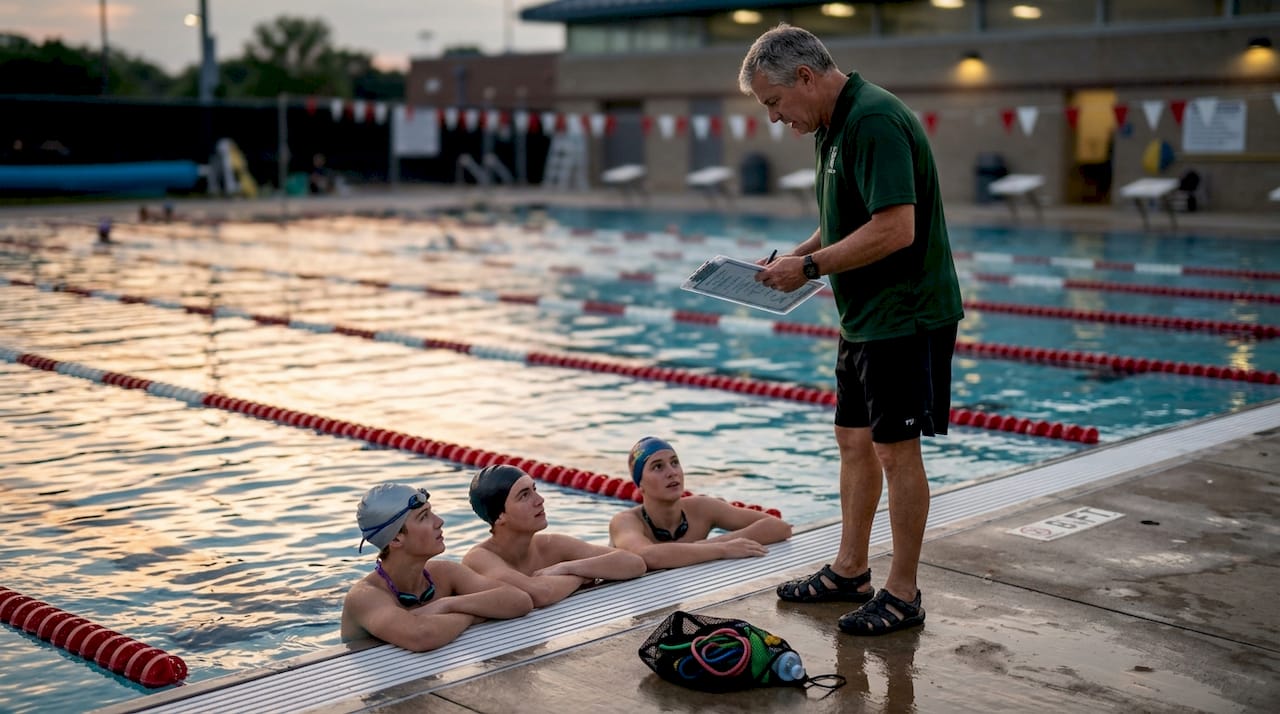
The importance of swim practice variety inside technical work cannot be overstated. Changing the constraints of a drill changes the sensory information the swimmer receives, which is what accelerates learning.
Vertical dolphin kicking is one of the clearest examples. Swimmers who trained with vertical kicking improved 50m kick speed by 4.56%, a meaningful gain for a single drill change. The reason it works is that removing buoyancy forces the swimmer to use the correct muscles. Without the water’s buoyant support, compensating movement patterns simply do not function. Removing compensating advantages forces realistic muscle recruitment and sharpens coordination that translates directly to race execution.
Here are several other drills that deliver similar benefits through constraint changes:
- Fist swimming removes hand surface area, teaching swimmers to feel forearm engagement and improve catch mechanics.
- Fingertip drag drill in freestyle slows the recovery and forces a high elbow position, building proper arm pathway habits.
- Closed-fist breaststroke pull redirects propulsion to the forearms and improves the feel for the insweep phase.
- Single-arm butterfly isolates each arm’s movement so swimmers can identify asymmetries in their pull or recovery.
Pro Tip: When introducing a new drill, keep the focus on one technical cue per session. Swimmers who try to fix multiple things at once tend to revert to old habits under fatigue. One clear constraint, one clear feeling.
The benefits of varied swim training through constrained drills go beyond the drill itself. Changing training environments strategically targets specific weaknesses and improves muscle activation patterns that carry into full-stroke swimming. Check out how Swimcamp approaches training variety in performance for a deeper breakdown of how constraint-based drills fit into a structured program.
Balancing variety with the repetition that builds skill
Here is where many coaches and parents get confused. Variety does not mean changing everything every week. That approach creates novelty without mastery, and mastery is what actually produces improvement.
Bob Bowman’s training philosophy offers a clear model: commit to a key stroke or skill for weeks at a time while varying the training methods used to develop it. You do not swap the goal. You vary the path to it.
“The best training combines stability in key skills with variation in stimulus to promote continual development without distraction.” — Bowman’s framework, as applied across elite development programs.
A practical approach to structured variation looks like this:
- Choose a focus skill for the training block, such as butterfly underwater kicks or breaststroke pull timing. Keep it for at least three to four weeks.
- Vary the drills used to develop that skill each week. Week one uses vertical kicking, week two adds paused-glide butterfly, week three reintroduces full stroke with video feedback.
- Change the intensity and volume across the block, not the skill being trained. Sprint sets one week, threshold sets the next.
- Measure progress with a consistent time trial or technical checkpoint at the end of the block before moving to the next focus.
This model reflects purposeful session design used in competitive programs, where volume and intensity are managed through phases to maintain quality and prevent burnout. The advantages of diverse swimming techniques come from variation in method, not from abandoning what you are trying to build. For youth swimmers and coaches looking for how this plays out in coaching practice, the youth coaching strategies guide at Swimcamp is worth reading.
Cross-training and preventing burnout
Swimming does not exist in isolation, and some of the best arguments for why diversify swim practices come from outside the pool entirely.
Swimming is a low-impact cross-training option that improves aerobic fitness and supports recovery for athletes in other sports. Cyclists, runners, and team sport athletes who add two to three swimming sessions per week gain cardiovascular conditioning without the joint stress that their primary sport creates.
The same logic applies in reverse. Swimmers who cross-train with dryland activities develop strength and mobility that directly benefits their performance in the water. A swimmer who does yoga twice a week will typically show better hip flexibility in breaststroke. One who strength trains intelligently develops more powerful push-offs at the wall.
Pro Tip: If a swimmer is mentally exhausted from competition preparation, one full week of cross-training with no structured swim sets can restore motivation more effectively than a reduced-volume swim week. Sometimes the best pool practice is no pool practice.
Here is a sample weekly structure that balances swimming with complementary training:
| Day | Activity | Purpose |
|---|---|---|
| Monday | Technique swim session | Skill focus, low intensity |
| Tuesday | Dryland strength work | Power and mobility |
| Wednesday | Threshold swim set | Aerobic conditioning |
| Thursday | Rest or yoga | Recovery and flexibility |
| Friday | Sprint swim session | Speed development |
| Saturday | Cross-training (cycling or running) | Aerobic variety, mental refresh |
| Sunday | Full rest | Recovery |
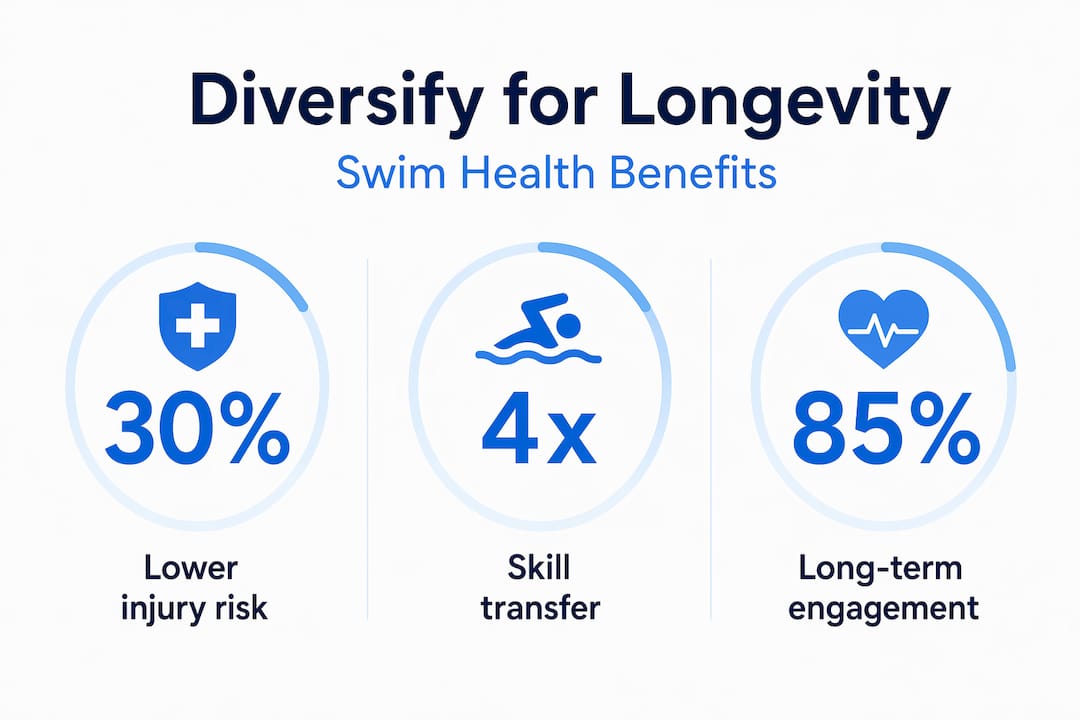
The impact of swim practice diversity on long-term athlete health is significant. Overuse injuries in swimmers most commonly affect the shoulder and knee, and they almost always stem from repetitive loading without adequate recovery or movement variety. Rotating training emphasis across strokes and activities distributes stress across different muscle groups and joint structures. You can explore this further through Swimcamp’s guide on cross-training for swimmers.
Implementing variety without losing direction
Knowing why change swim routines matters is one thing. Knowing how to do it without losing focus is another. Coaches and parents often worry that introducing too much variety will confuse swimmers or slow skill development. That concern is valid, but it points to poor implementation rather than a flaw in the principle.
Here is how to build variety purposefully:
- Plan variety in advance, not on the fly. Know which drills and distances will appear in each week of the training block before the block starts.
- Anchor each session to a primary skill. Every practice should have one technical priority that guides drill selection and set design.
- Avoid switching strokes mid-block without reason. If a swimmer is developing butterfly, do not suddenly shift the entire program to backstroke because of one bad practice.
- Track technical markers, not just times. Video review, stroke count per length, and coach observation notes give clearer feedback on whether variety is helping or just adding noise.
- Include all four strokes at least once per week, even in freestyle-focused programs. Ten minutes of breaststroke drill work does not derail a sprinter. It builds the hip drive and timing they need.
Pro Tip: For parents working with young swimmers, ask the coach what technical focus is planned for the month, not just what events are coming up. Understanding the training goal helps you support the right kind of effort at home and during practice.
Competitions at young ages serve as learning platforms focused on adaptability and skill application, not just results. That framing should guide how coaches and parents evaluate success. A swimmer who competed in all four strokes this season and improved their body position in three of them has had a better developmental year than one who dropped a tenth of a second in their one event.
My take on what variety actually means in coaching
I have worked with swimmers who could execute twenty different drills but could not hold a clean stroke for 200 meters under pressure. And I have worked with swimmers who did the same four drills for two years and plateaued completely. Both situations come from the same underlying mistake: confusing activity with progress.
In my experience, the most common misuse of variety in swim training is introducing new drills as entertainment rather than as medicine. A drill should fix something specific. If you cannot name what it fixes, it does not belong in the plan that week.
What I have learned from watching athletes develop over the long term is that confidence in the water comes from repeated success with a skill, not from exposure to many skills. Variety earns its place when it challenges the swimmer just enough to force adaptation without disrupting the foundation being built. The swimmers I have seen improve fastest were the ones whose coaches gave them something new to work on every few weeks while holding them accountable to a consistent technical standard.
If you are a parent, the best thing you can do is trust a coach who can explain why each drill is in the program. If you are a swimmer, commit to the constraint, even when it feels awkward. That awkward feeling is your nervous system learning something new. And if you are a coach, know that smart diversification is one of the most powerful tools you have. Use it with intention, and your swimmers will thank you at their best race of the season.
— James
Ready to train with real variety built in?
At Swimcamp, every program is built around the principle that complete swimmers outperform specialists over time. The Peak Performance Swim Camp curriculum integrates multi-stroke development, targeted drill progressions, dryland conditioning, and personalized feedback in every session.

Coaches at Swimcamp design each training block with a clear technical focus while rotating the drills, distances, and constraints that develop it. That means swimmers leave camp not just faster, but with a deeper feel for the water across all four strokes. Explore the available camp packages to find the right fit for your swimmer’s current level and goals, and meet the coaching staff who bring this approach to life every session.
FAQ
Why should swimmers train more than one stroke?
Multi-stroke training builds complementary physical skills and coordination patterns that improve performance across all events, including a swimmer’s primary stroke.
How does drill variety improve technique?
Changing the constraints of a drill, such as removing buoyancy with vertical kicking, forces swimmers to recruit the correct muscles and receive clearer sensory feedback about their movement.
Can too much variety hurt a swimmer’s development?
Yes. Variety without a clear technical focus leads to novelty without mastery. The best approach commits to a key skill for several weeks while varying the methods used to train it.
How often should coaches change swim drills?
Most coaches change the specific drills within a technical focus every one to two weeks, while keeping the underlying skill goal stable for a full three to four week block.
What is the role of cross-training in swim development?
Cross-training supports recovery, prevents overuse injuries, and builds fitness in complementary muscle groups, all of which translate into better performance and longer athletic careers.
Recommended
- The Role of Training Variety in Swimming Performance – Peak Performance Swim Camp
- Individualized swim plans: unlock elite performance – Peak Performance Swim Camp
- Unlock swimming performance: The critical role of flexibility – Peak Performance Swim Camp
- How often should a swimmer practice? – Peak Performance Swim Camp