
TL;DR:
- Consistency in swim training involves regular, purposeful sessions that build endurance and refine technique over time. Maintaining stable effort and internal load, combined with structured periodization, optimizes physiological adaptations and reduces injury risk. Long-term success relies on disciplined adherence, mental regulation, and expert guidance rather than sporadic, intense efforts.
Consistency in swim training is defined as the regular, purposeful repetition of structured sessions that build cumulative endurance, refine stroke mechanics, and prevent performance-limiting habits over time. Why consistency matters in swim training comes down to one physiological truth: your body adapts to repeated stimuli, not occasional ones. Swimmers who train with reliable frequency and stable effort develop stronger aerobic bases, sharper technique, and lower injury rates than those who rely on sporadic hard efforts. At Swimcamp, founded by Olympic coach Nick Baker with over 50 years of coaching experience, this principle sits at the core of every program we design.
Why consistency matters in swim training: the physiology behind it
Consistent training works because muscles, cardiovascular systems, and neuromuscular pathways all require repeated exposure to a training stimulus before they adapt. A single hard session does not build endurance. Weeks of progressive, purposeful work do. Irregular exercise fails to provide the stable stimulus needed for the physiological adaptations that translate to real performance gains.
Stroke mechanics follow the same rule. Muscle memory is not a metaphor. It describes the process by which your nervous system encodes a movement pattern through thousands of repetitions until it becomes automatic and efficient. Swimmers who practice their freestyle catch or butterfly pull consistently, session after session, build that encoding faster and more durably than those who show up twice a week with no structure.
Training volume and quality are both part of the equation, but quality wins when they conflict. Mindless yardage without technical focus produces fatigue, not improvement. The goal is purposeful repetition, where each session reinforces the same movement patterns and energy system demands.
Periodization is the coaching framework that organizes this consistency into phases: a base phase builds aerobic capacity, a build phase increases intensity, and a taper phase reduces volume while maintaining intensity to peak for competition. Without periodization, even consistent swimmers plateau because the stimulus never changes.
Key physiological benefits of consistent swim training include:
- Aerobic base development: Repeated moderate-intensity sessions increase mitochondrial density and stroke volume, directly improving endurance.
- Neuromuscular efficiency: Frequent technical practice reduces wasted energy per stroke, making you faster at the same effort level.
- Injury resilience: Gradual, progressive loading strengthens tendons and connective tissue that protect shoulders, knees, and hips.
- Mental readiness: Routine builds confidence. Swimmers who know their training is solid arrive at competition with less anxiety.
Pro Tip: Track your stroke count per length every session. A dropping count over weeks is direct evidence that your technique is consolidating. It is one of the simplest and most reliable markers of consistent technical progress.
Consistency is about stable effort, not just showing up
Attendance is the floor, not the ceiling. A swimmer who shows up every day but trains with wildly fluctuating intensity is not training consistently. True consistency requires stable internal load, meaning your perceived effort, heart rate, and session quality stay within a predictable range from one session to the next.
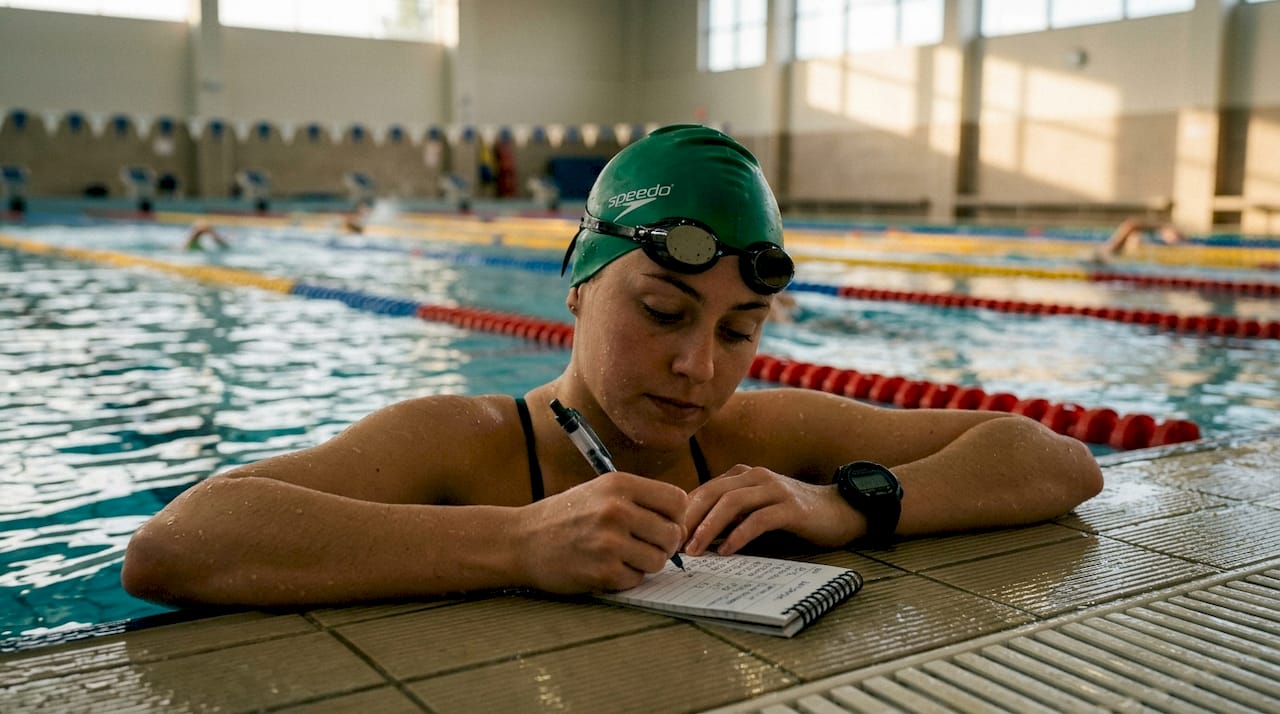
A 2026 randomized controlled trial integrating mindfulness meditation into swim training found that participants developed significantly more stable heart rate and perceived exertion profiles across sessions. That stability, not raw performance scores, was the primary driver of sustained adaptation. The implication is direct: mental self-regulation is a training variable, not a soft skill.
Ego-driven intensity spikes are one of the most common ways swimmers undermine their own progress. After a missed session or a poor race, the instinct is to compensate by going harder the next day. Altered internal load from these compensation efforts disrupts the adaptation cycle and increases injury risk. The body cannot distinguish between productive overload and destructive overreaching.
Here is a practical four-step process to monitor and maintain consistent effort:
- Rate every session using RPE (Rate of Perceived Exertion) on a 1-10 scale immediately after finishing. Target sessions should cluster within a two-point range for the same workout type.
- Log your resting heart rate each morning. A sustained elevation of five or more beats above your baseline signals accumulated fatigue that requires a recovery day, not a hard session.
- Practice a two-minute breathing reset before entering the water. Mindfulness-based pre-session routines, supported by sports neuroscience research, reduce the cortisol-driven intensity spikes that distort your planned effort.
- Review your training log weekly. Look for sessions where RPE was significantly higher or lower than planned and identify the cause before it becomes a pattern.
“Session-rating of perceived exertion, not the acute-to-chronic workload ratio, is associated with the performance of elite swimmers in competition.” Managing Training Load
This finding matters because it shifts the focus from raw volume to quality of effort regulation. Swimmers who manage their internal load consistently outperform those who simply log more meters.
Consistent training vs. sporadic hard sessions: what the data shows
The comparison between steady, cumulative training and irregular high-intensity efforts is not a close call. Elite coaching principles are explicit: performance is built by stringing together 30, 60, or 90 days of uninterrupted, purposeful training. One standout session does not move the needle. A month of solid weeks does.
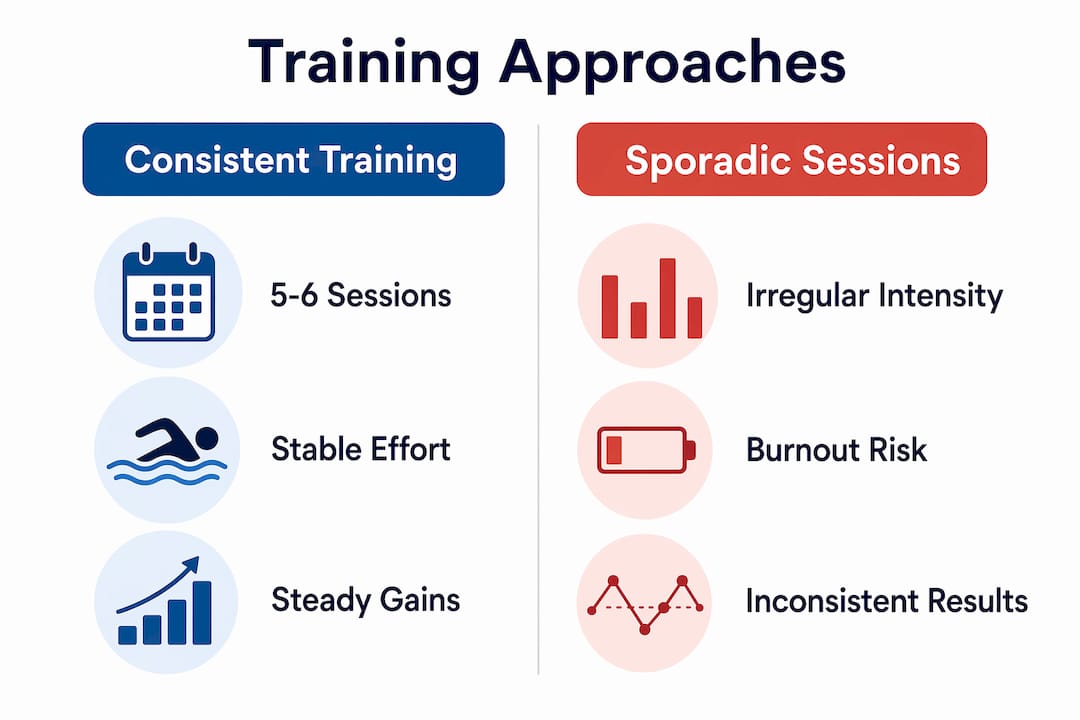
| Training approach | Typical outcome |
|---|---|
| Consistent, progressive sessions 5-6 days per week | Steady aerobic base growth, technical refinement, competition readiness |
| Sporadic intense sessions with gaps | Short-term fatigue, slow adaptation, elevated injury risk |
| High volume without load regulation | Overtraining syndrome, burnout, performance plateau |
| Periodized plan with recovery phases | Peak performance timed to competition, sustainable long-term development |
The swimmer who trains five days a week at controlled intensity for eight weeks will outperform the swimmer who does three brutal sessions one week and two the next, every time. The reason is biological. Aerobic adaptations require consistent oxygen delivery to working muscles over time. Technical fluency requires repeated neural encoding. Neither responds to occasional shock loading.
Burnout is the most predictable outcome of the sporadic approach. Swimmers who push hard without structure report higher rates of motivation loss, chronic soreness, and performance regression within a single season. Spacing intense workouts to avoid consecutive days of high-intensity effort is not a sign of low ambition. It is the mechanism that makes hard sessions productive rather than destructive.
Pro Tip: Build your weekly training cycle around a hard-easy-hard pattern. Place your most demanding sessions on Tuesday and Thursday, use Wednesday as a technical recovery day, and protect your weekend long session with a Friday rest or light swim. This structure is used by coaches at Swimcamp and mirrors the load management principles of elite programs worldwide.
How to build and sustain real training consistency
Sustainable consistency does not happen by willpower alone. It is built through structure, realistic goal-setting, and the right recovery habits. Training logs and goal setting directly enhance motivation and adherence, which are the two variables most likely to collapse when life gets busy or progress feels slow.
Practical strategies that work:
- Set process goals, not just outcome goals. “Complete four quality sessions this week” is more controllable than “drop two seconds in the 100 free.” Process goals build the habit; the outcome follows.
- Treat sleep as a training variable. Seven to nine hours of sleep per night is when muscle repair, hormonal recovery, and memory consolidation for motor skills all occur. Cutting sleep to fit in extra yardage is a net negative.
- Fuel your sessions deliberately. Carbohydrate availability before and after training directly affects your ability to maintain session quality across a full week. Swimmers who under-fuel accumulate fatigue faster and lose technical precision by mid-week.
- Schedule active recovery. Light swimming, stretching, or yoga on recovery days maintains blood flow and reduces soreness without adding training stress. Recovery is part of the year-round training approach that produces the most durable athletes.
- Use a training log consistently. Record distance, RPE, technical focus, and how you felt. Patterns become visible over weeks that are invisible session to session.
The most common pitfall is pushing too hard after a good race or a motivating practice. That spike in effort feels productive but disrupts the load balance that was generating the progress in the first place. Trust the plan. The discipline behind lasting performance in swimming is not about grinding harder. It is about protecting the conditions that allow adaptation to occur.
Pro Tip: Use a simple color-coding system in your training log: green for sessions that felt controlled and on-target, yellow for sessions that felt off, and red for sessions where you pushed beyond the plan. A week with mostly green is a successful week, regardless of the times on the clock.
Key takeaways
Consistent, purposeful swim training with stable internal load is the single most reliable driver of long-term performance improvement for swimmers at every level.
| Point | Details |
|---|---|
| Consistency requires stable effort | Showing up is not enough; regulate RPE and heart rate to keep internal load predictable. |
| Periodization organizes consistency | Structured base, build, and taper phases maximize adaptation and time peak performance. |
| Sporadic intensity undermines progress | Irregular hard sessions increase injury risk and slow aerobic and technical development. |
| Mental regulation is a training tool | Mindfulness practices reduce session-to-session variability and support sustained adaptation. |
| Logs and goals sustain adherence | Tracking session quality and setting process goals keeps motivation and consistency intact. |
What 30 years of coaching has taught me about consistency
Most swimmers I have worked with arrive believing that the key to improvement is finding the right workout. The harder the session, the faster the progress. That belief is the single most common reason talented swimmers plateau.
What actually works is far less dramatic. The swimmers who improve most reliably are the ones who show up, do the planned work at the planned intensity, and go home. They do not improvise. They do not compensate for a bad day by going harder the next. They trust that the accumulation of ordinary, well-executed sessions is what produces extraordinary results over a season.
The mental side of this is underestimated. Keeping your effort stable when you feel great, and keeping it stable when you feel terrible, requires real self-awareness. That is not a personality trait. It is a skill you can develop through mental training practices and coaching feedback. The top coaching strategies we use at Swimcamp always include a mental regulation component for exactly this reason.
Patience is the hardest part. Progress in swimming is not linear. There will be weeks where nothing feels like it is working. The swimmers who stay consistent through those weeks are the ones who break through. The ones who panic and change everything are the ones who start over.
— James
Build your consistency with Swimcamp

Knowing why consistency matters is the first step. Building it into your training week, session by session, requires structure, expert guidance, and a program designed around your goals. At Swimcamp, PEAK Performance Swim Camp programs are built on the same principles covered in this article: periodized training cycles, mental load regulation, technical focus, and progressive overload managed by coaches with decades of elite experience. Whether you are a competitive age-grouper or a masters swimmer returning to the sport, our structured swim camps give you the framework to train consistently and compete at your best. Explore upcoming camps and clinics across the USA and internationally to find the program that fits your season.
FAQ
Why does consistency matter more than intensity in swimming?
Consistent training provides the repeated stimulus your muscles, cardiovascular system, and nervous system need to adapt and improve. Intensity without consistency produces short-term fatigue rather than long-term performance gains.
How many days per week should swimmers train for consistency?
Most competitive swimmers benefit from five to six sessions per week, structured around a hard-easy pattern that balances training stress with recovery. The exact number depends on age, experience level, and seasonal training phase.
What is the best way to track training consistency?
A training log that records distance, RPE, technical focus, and recovery markers like resting heart rate is the most practical tool. Tracking progress builds accountability and makes patterns visible over weeks.
Can mindfulness really improve swim training consistency?
Yes. A 2026 randomized controlled trial found that mindfulness meditation integrated into swim training stabilized internal training loads and improved mental self-regulation in youth swimmers, directly supporting more consistent session quality.
What is periodization and why does it matter for swimmers?
Periodization divides the training season into phases with distinct goals, balancing volume, intensity, and recovery to maximize adaptation and time peak performance for competition. It is the structural backbone of any consistent, long-term training regimen for swimmers.
Recommended
- How discipline drives lasting performance in swimming – Peak Performance Swim Camp
- Why swimming fundamentals unlock competitive success – Peak Performance Swim Camp
- Why Swimmers Need Routine to Reach Peak Performance – Peak Performance Swim Camp
- The Role of Training Variety in Swimming Performance – Peak Performance Swim Camp