
TL;DR:
- Swim ergometers are land-based devices designed to improve underwater propulsion phases, enhancing stroke efficiency without replacing pool training. They provide real-time data on force and wasted energy, helping swimmers refine technique and achieve measurable performance gains. Proper sequencing of technique, aerobic work, and race-pace training maximizes erg benefits while maintaining essential water skills.
Most swimmers assume a swim ergometer is just another piece of gym equipment that vaguely mimics the pool. That assumption costs them real performance gains. What is swim ergometer training, exactly? It is a land-based, swim-specific method that isolates and strengthens the underwater propulsion phases of your stroke, the catch, pull, and push, with measurable force and power feedback that pool training alone cannot provide. When used correctly, it does not replace pool time. It makes every lap you swim more productive.
Table of Contents
- Key takeaways
- What swim ergometer training actually is
- Benefits of swim ergometer training
- How to use swim ergs effectively
- Popular swim ergometer models compared
- My take on where swim erg training is heading
- Train smarter with Swimcamp
- FAQ
Key takeaways
| Point | Details |
|---|---|
| Not a pool replacement | Swim ergs complement pool training by isolating propulsion; kick, rotation, and water feel still require pool time. |
| Targets the propulsion window | Training focuses on the catch-pull-push phases where most forward force is generated. |
| Real-time feedback accelerates gains | Propulsive Watts and wasted energy data let coaches and athletes correct mechanics immediately. |
| Research-backed speed improvements | A 12-week program showed a 4.32% velocity gain versus 2.78% from traditional weights. |
| Sequence matters | Technique comes first, then aerobic conditioning, then race-pace intensity for lasting improvement. |
What swim ergometer training actually is
Swim ergometer training uses land-based, swim-specific devices to replicate and measure the underwater propulsion phases of a swimming stroke. The machine positions you horizontally or at a slight incline and connects your hands and arms to a resistance system that mimics the feel of pulling through water. Unlike a cable machine or lat pulldown, the resistance profile and body position are designed specifically to match how force is applied during freestyle, butterfly, or other strokes.
The two most recognized devices in this category are the Vasa SwimErg and the SwimFast erg. Both target what coaches call the propulsion window: the moment your hand enters the water, catches, pulls through, and pushes past your hip. That window is where most of your forward speed is generated, and it is also where most inefficiency hides.
What separates swim ergs from general strength training is the data they produce. Real-time feedback on Propulsive Watts and “Wasted Energy” shows exactly how much force you are generating versus how much effort is going nowhere useful. A swimmer might feel like they are working hard while actually bleeding speed through a poorly timed catch. The erg reveals that immediately.
Key features found on modern swim ergometers include:
- Propulsive Watts measurement to quantify stroke-specific power output
- Wasted Energy tracking to identify mechanical inefficiencies in real time
- Adjustable resistance to target different phases of the catch-pull-push sequence
- Connectivity with coaching software for session logging and trend analysis
- Horizontal body positioning that closely replicates in-water stroke mechanics
Pro Tip: When you first get on a swim erg, do not chase high wattage. Focus on clean mechanics first. The numbers will climb naturally as your technique improves.
Benefits of swim ergometer training
The appeal of swim ergs goes beyond convenience. They deliver specific physiological and technical benefits that pool-only training struggles to match.
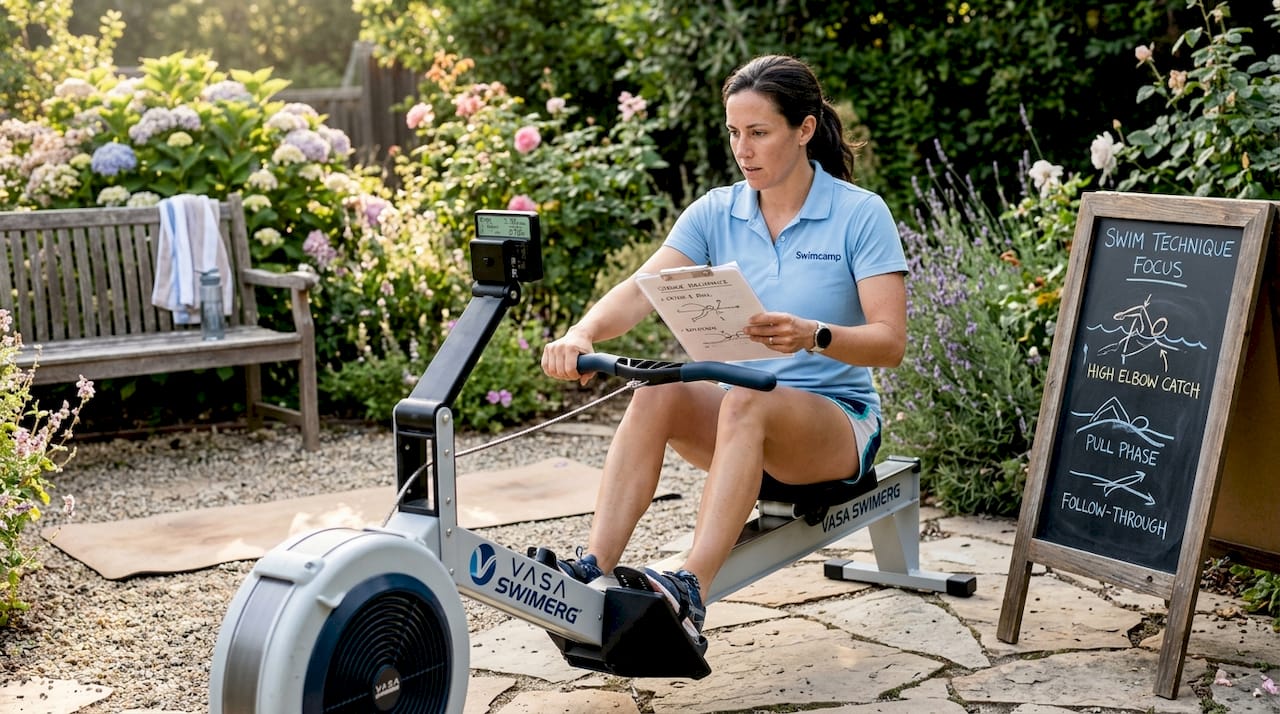
A 12-week swim-specific dry-land program showed front-crawl velocity improvements of 4.32% compared to just 2.78% for traditional weight training. Critically, those gains came from increased stroke length without any loss in stroke rate. That is the signature of better propulsion mechanics, not just more muscle.
Here is a breakdown of the core benefits:
- Neuromuscular specificity. The movement pattern on a swim erg closely matches the in-water stroke, so the strength you build transfers directly to propulsion rather than general fitness.
- Injury prevention. Controlled, progressive loading of the shoulder, lat, and tricep groups strengthens the exact muscles that take the most stress during high-volume pool training.
- Technique acceleration. Immediate feedback on force and efficiency lets athletes make corrections in the same session rather than waiting for a coach to review video later.
- Training frequency. Swimmers who cannot access a pool daily can add erg sessions to their weekly plan without adding pool hours, increasing total swim-specific stimulus.
- Objective progress tracking. Propulsive Watts give coaches a clean metric to track adaptation over weeks and months, removing guesswork from programming.
| Benefit | Pool training | Swim ergometer training |
|---|---|---|
| Stroke-specific power measurement | Limited | Direct (Propulsive Watts) |
| Real-time technique feedback | Requires coach or video | Built-in wasted energy data |
| Accessibility without pool | No | Yes |
| Full stroke development | Yes | Propulsion phases only |
| Injury prevention loading | Indirect | Targeted and controlled |
Pro Tip: Track your Propulsive Watts at the start of each training block. A plateau in wattage often signals a technique breakdown, not a fitness ceiling. Check your catch angle before adding resistance.
One thing swim ergs do not do: they cannot measure kick, body rotation, breathing, or head position. Pool time remains non-negotiable for developing those elements and for building the water feel that no machine replicates. Think of the erg as sharpening one blade on a Swiss Army knife. The rest of the tool still needs attention.
How to use swim ergs effectively
Getting results from a swim erg requires more than showing up and pulling. The programming logic matters as much as the effort.
The single most important principle is sequencing adaptations correctly: technique first, aerobic control second, race-specific intensity third. Swimmers who skip to high-resistance erg work before their mechanics are solid often reinforce bad patterns at higher force levels. That is harder to undo than starting slow.
Here is a practical framework for integrating erg sessions with pool training:
- Start with technique-focused erg sessions. Use low resistance and focus on hand entry, catch depth, and pull path. Match this with pool sessions that emphasize the same mechanics so your body connects the dry-land movement to the in-water feel.
- Build aerobic erg volume in weeks three through six. Increase session duration and moderate resistance. Pair with longer pool sets to reinforce endurance at the new stroke efficiency level.
- Add race-pace erg intervals in the final block. Short, high-intensity intervals at race-specific power outputs. Follow each erg session with a pool session within 24 hours to transfer the neuromuscular pattern before it fades.
- Track wasted energy, not just watts. A swimmer generating high watts with high wasted energy is working harder, not smarter. Coaches use propulsive force data to shift athletes from brute effort to clean mechanics.
- Respect the ratio. A practical starting structure is three pool sessions plus two to three erg sessions per week. This balances in-water skill development with dry-land propulsion work without overloading either system.
“Dry-land erg training does not compete with pool time. It multiplies the value of every lap you swim by isolating the one phase of the stroke that determines how fast you go.”
A common pitfall is treating erg training as generic strength work. Doing three sets of heavy pulls with poor posture and no attention to catch timing does not build swim-specific power. It builds fatigue and reinforces bad habits. The resistance should always be set to challenge the propulsion window specifically, not just to make the session feel hard.
For swimmers building dryland workouts for triathletes or competitive programs, the erg fits naturally between strength sessions and pool work, serving as the bridge between raw power and applied speed.
Popular swim ergometer models compared
Not all swim ergs are built the same. The right device depends on your goals, budget, and coaching setup.
The Vasa SwimErg has been around since 1989 and remains the most widely used device among elite swimmers and triathletes. It features an adjustable incline bench, a flywheel-based resistance system, and connectivity with power meters for real-time watt tracking. Coaches use it for stroke visualization and force profiling. It is the standard in many university and national team programs.
| Feature | Vasa SwimErg | SwimFast Erg | General Swim Bench |
|---|---|---|---|
| Resistance type | Flywheel (adjustable) | Elastic/cable | Elastic/pulley |
| Power measurement | Yes (Propulsive Watts) | Limited | No |
| Connectivity | Yes (software/apps) | Varies | No |
| Best for | Elite swimmers, triathletes | Competitive swimmers | Rehab, beginners |
| Coaching visualization | Yes | Partial | No |
| Price range | $$$$ | $$$ | $ |
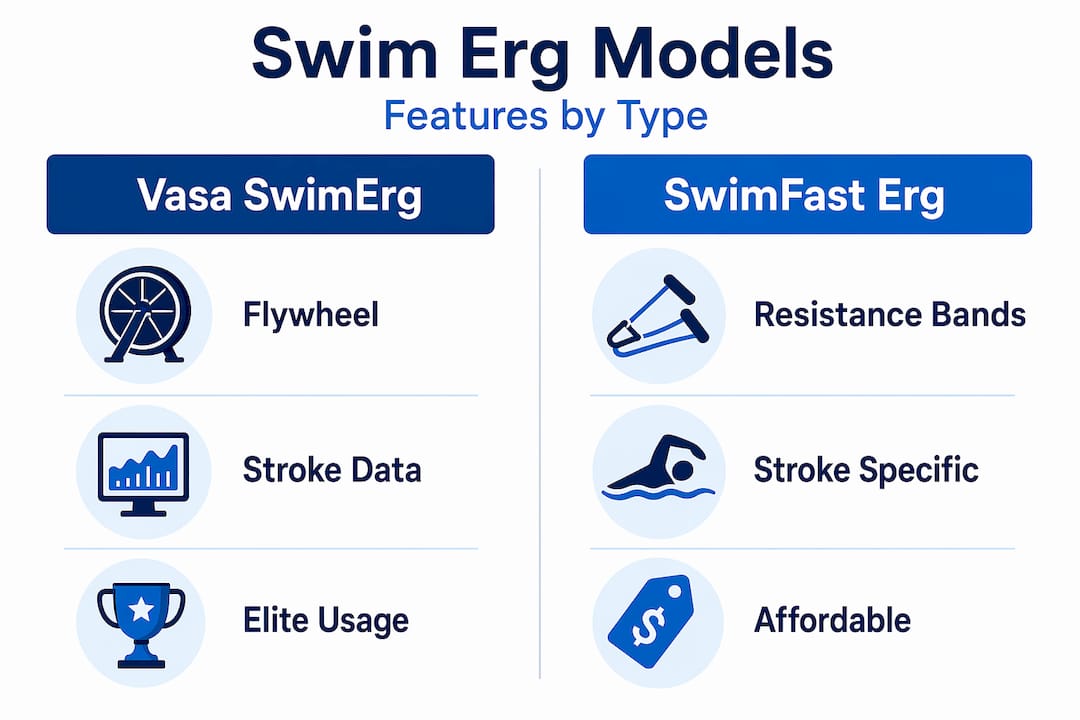
The SwimFast erg targets competitive swimmers who want stroke-specific resistance without the full cost of a Vasa setup. It offers solid resistance programming for the pull phase but has more limited data output. For coaches working with large groups, it is a practical and cost-effective option.
General swim benches, the simplest form of this swimming workout equipment, use elastic bands or basic pulley systems. They lack power measurement entirely, which limits their usefulness for data-driven training. They work for early-stage rehabilitation or as a low-cost introduction to dry-land propulsion work.
For athletes serious about using real-time feedback to improve mechanics, the Vasa SwimErg remains the gold standard. The data it produces is actionable in a way that elastic bands simply cannot match.
My take on where swim erg training is heading
I have watched swim ergometer training go from a niche tool used by a handful of elite programs to something coaches at every level are starting to take seriously. And I think we are still in the early stages of understanding how powerful it can be.
What I have seen consistently is that swimmers who get the most out of erg training are the ones who treat the data like a coach, not a scoreboard. When I look at a swimmer’s Propulsive Watts alongside their wasted energy numbers, I am not looking for big numbers. I am looking for the gap between the two to shrink. That gap tells me whether a swimmer is getting more efficient or just getting stronger in the wrong way.
The misconception I keep running into is that more resistance equals more benefit. In my experience, the opposite is often true early in a training block. Lower resistance with perfect catch mechanics transfers to the pool far better than heavy pulling with a collapsed wrist and late hand entry.
I also think the future of this training lies in how well coaches integrate individualized swim plans with erg data. The swimmers who will gain the most are those whose coaches can read the force curves, identify the specific phase breaking down, and program both erg and pool sessions to address it together. That level of precision is where the real performance gains live.
— James
Train smarter with Swimcamp

At Swimcamp, PEAK Performance Swim Camp coaches led by Olympic coach Nick Baker integrate swim ergometer feedback directly into training programs across camps and clinics in the USA and internationally. Whether you are refining stroke mechanics or preparing for competition, the combination of in-water coaching and dry-land propulsion data accelerates your progress in ways that pool-only training cannot match. Explore swim camps designed around this holistic approach, or get personalized stroke analysis through video analysis and private coaching. Your next performance breakthrough starts with the right training structure.
FAQ
What is swim ergometer training used for?
Swim ergometer training is used to develop stroke-specific strength and power by targeting the catch-pull-push underwater propulsion phases on a land-based device. It complements pool training by providing real-time force and efficiency data that in-water sessions cannot easily measure.
Can a swim erg replace pool training?
No. Swim ergs do not replicate kick, body rotation, breathing, or head position, so pool training remains necessary for full stroke development and water feel. The erg is a complement that makes pool sessions more productive.
How many erg sessions per week should swimmers do?
A practical starting point is two to three erg sessions per week alongside three pool sessions. This structure builds dry-land propulsion strength without displacing the in-water skill work that completes the full stroke.
What does Propulsive Watts measure on a swim erg?
Propulsive Watts measures the actual forward-driving force generated during each stroke phase on the ergometer. Tracking this metric alongside wasted energy data helps coaches and athletes identify whether effort is translating into efficient propulsion or being lost to poor mechanics.
How long does it take to see results from swim erg training?
Research shows meaningful velocity improvements within 12 weeks of consistent swim-specific dry-land training. Swimmers who sequence technique work before intensity tend to see faster transfer to in-water speed and longer-lasting gains.
Recommended
- Interval swim training: Boost endurance and performance – Peak Performance Swim Camp
- Year-round swim training: benefits, methods & success – Peak Performance Swim Camp
- Unlock elite swimming performance with video analysis – Peak Performance Swim Camp
- Off-Season Swim Training: Maximize Performance Year-Round – Peak Performance Swim Camp