
TL;DR:
- Flexibility enhances stroke mechanics, body positioning, and recovery, providing performance advantages.
- Balanced flexibility training combined with strength and stability reduces injury risk and improves efficiency.
- Customized routines, including dynamic warm-ups and static stretches, are essential for effective flexibility development.
Strength and endurance get most of the attention in competitive swimming. Coaches track split times, monitor yardage, and push athletes through brutal interval sets. Yet flexibility, one of the most influential physical attributes in the water, often sits at the bottom of the training priority list. New research is changing that picture. Swimmers who invest in structured, well-designed flexibility work gain advantages in stroke mechanics, body positioning, and recovery that raw power alone simply cannot deliver. This guide walks you through the evidence, the nuances, and the practical steps to make flexibility a real performance asset.
Table of Contents
- Why flexibility matters for swimmers
- How flexibility affects performance: Not just speed
- Designing effective flexibility routines
- Flexibility’s double edge: Avoiding pitfalls and injuries
- A coach’s perspective: Flexibility in swimming is less about extremes, more about balance
- Take the next step: Flexibility training with the experts
- Frequently asked questions
Key Takeaways
| Point | Details |
|---|---|
| Balance matters most | Optimal swimming performance comes from combining flexibility, strength, and stability rather than pursuing extremes. |
| Flexibility aids technique | Improved range of motion supports better stroke mechanics and energy efficiency, especially in long-distance events. |
| Tailored routines win | Personalized flexibility routines and regular reassessment minimize injury risk and maximize gains. |
| Integrate, don’t isolate | Incorporate flexibility work with technical, strength, and coordination training for the best overall performance. |
Why flexibility matters for swimmers
Flexibility, in the simplest terms, is the range of motion (ROM) available at a joint or group of joints. For swimmers, that means how far the shoulder rotates during a freestyle catch, how deeply the ankle plantarflexes (points downward) during a flutter kick, and how smoothly the spine extends through a butterfly pullout. Each of these movements directly shapes the quality of every stroke you take.
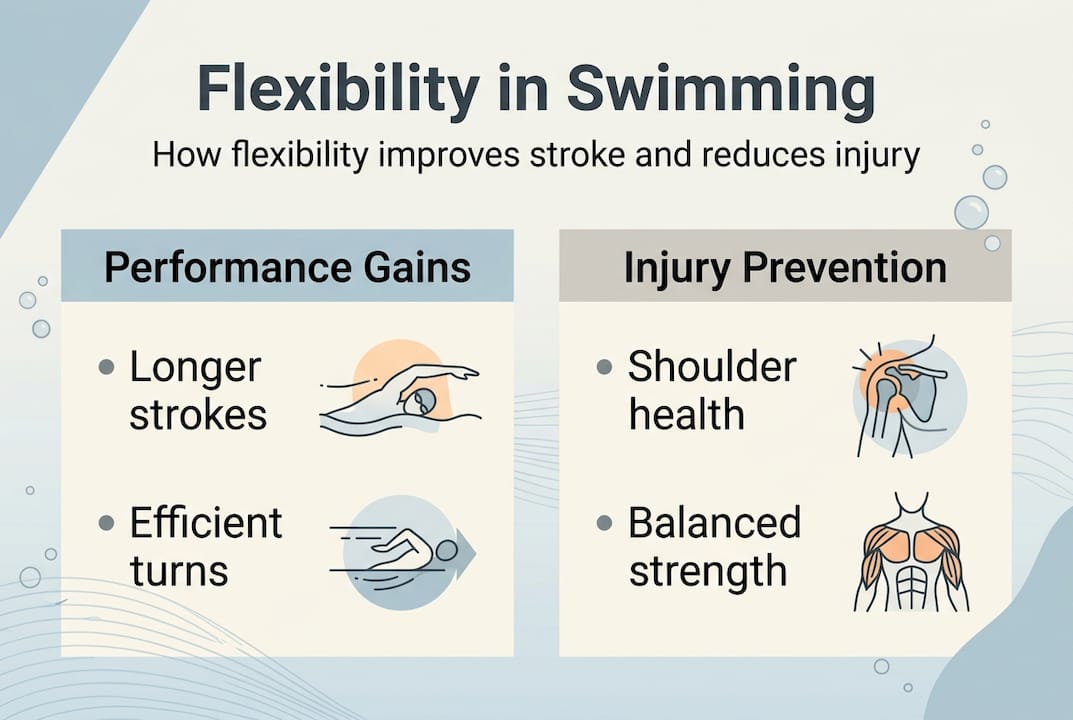
When your joints move through a fuller range, your strokes become longer and more fluid. A swimmer with tight hip flexors will fight their own body on every kick cycle, burning energy without generating forward thrust. A swimmer with restricted shoulder mobility shortens their catch and pull, reducing the power they can apply per stroke. Improved technique improvement tips almost always involve some element of mobility work because the two are inseparable at the elite level.
Here is a clear side-by-side look at how flexibility levels affect key performance areas:
| Factor | Flexible swimmer | Inflexible swimmer |
|---|---|---|
| Stroke length | Longer, more efficient | Shorter, requires more strokes |
| Energy cost per lap | Lower | Higher |
| Injury risk | Moderate with proper strength | Higher, especially shoulders/knees |
| Turn and start quality | Greater range for explosive push | Limited drive off the wall |
| Recovery between sessions | Generally faster | Often slower due to muscle tightness |
One important misconception coaches encounter often is the idea that more flexibility automatically equals more speed, particularly for sprinters. That is not always true. Research found no direct correlation between isolated trunk strength and flexibility measures and sprint performance in elite swimmers. Coordination, force application timing, and technical skill matter just as much, if not more, in short-distance races.
What the evidence does support is that targeted flexibility work produces measurable physical improvements. Flexibility improvements recorded in short-distance swimmers after dedicated training showed an average reach increase of 2.74 cm over 90 days. That may sound modest, but in a sport measured in hundredths of a second, added reach translates to a longer stroke and fewer strokes per length.
“90-day flexibility training improved shoulder reach by 2.74 cm in competitive swimmers, demonstrating meaningful physical adaptation even when sprint time improvements were limited.”
The takeaway here is balance. Your physical conditioning guidance should treat flexibility not as a standalone goal but as one leg of a three-legged stool alongside strength and stability. Pull one leg out and the whole structure wobbles.
How flexibility affects performance: Not just speed
Building off the importance of flexibility, let’s go deeper into how and when flexibility improvements actually enhance swimming performance.
A common frustration among coaches is investing time in flexibility work only to see minimal changes in race times, especially in sprint events. This is not a sign that the training failed. It is a sign that flexibility works differently across distances and stroke types. A 6-week ankle flexibility program improved plantar flexion range significantly but did not improve 25-meter kick sprint times. The longer the distance, however, the more that improved ankle mobility pays off by sustaining a more effective kick cycle throughout the race.
Here is how ankle flexibility data compares to sprint outcomes:
| Training period | Plantar flexion improvement | 25m sprint improvement | 200m performance trend |
|---|---|---|---|
| 6 weeks, 3x/week | Significant (average 8°) | Minimal | Positive trend noted |
| 12 weeks, 4x/week | High (average 14°) | Small | Measurable improvement |
| Control group | Negligible | No change | No change |
Three performance factors where flexibility consistently delivers real results:
- Technique refinement. Swimmers with better shoulder and thoracic (upper back) mobility can maintain proper stroke mechanics even when fatigued. When muscles tighten mid-race, technique breaks down. Better baseline flexibility slows that breakdown.
- Recovery between sets and sessions. Flexible muscles and connective tissue recover faster because blood circulates more easily through them. This matters enormously during multi-day competitions or heavy training blocks.
- Body positioning and streamlining. A swimmer who can dorsiflex (flex the foot upward) fully will hold a tighter streamline off every wall. A swimmer with flexible hip extensors maintains a higher body position without extra energy expenditure.
Pro Tip: Distance and open-water swimmers should dedicate at least 15 minutes of structured flexibility work three to four times per week. Sprinters should keep sessions shorter, around 8 to 10 minutes, and focus on areas that most affect their start and turn mechanics rather than overall ROM.
Butterfly and breaststroke swimmers see some of the largest gains from flexibility training because both strokes demand extreme ranges of motion. A breaststroke kick requires exceptional hip external rotation and knee flexion. Butterfly requires thoracic extension and deep shoulder mobility for the recovery phase. When those ranges are limited, swimmers compensate with poor mechanics that slow them down and increase injury risk.
For dynamic vs. static stretch guidelines tailored to competitive swimmers, the evidence strongly favors dynamic work before training and static holds after. This supports both performance and recovery goals without compromising the power output needed during practice. A swimmer who stretches statically before a hard set may actually reduce force production temporarily, which is the last thing you want at the start of a quality workout.
Your comprehensive conditioning guide should integrate these principles across the full training week, and dryland flexibility workouts are an excellent complement to in-water mobility work.
Designing effective flexibility routines
Now that we have established flexibility’s impacts, let us focus on how swimmers and coaches can design the most effective routines for real results.
No two swimmers need the same flexibility program. Age, gender, event specialty, current mobility levels, and injury history all shape what a routine should look like. A 14-year-old female backstroke swimmer has different needs than a 22-year-old male sprint freestyler. Coaches who apply a one-size-fits-all approach to flexibility training will get one-size-fits-all results, which rarely means peak performance.
Here is a structured framework for building a flexibility routine that actually works:
- Before swimming (dynamic warm-up): Arm circles (forward and backward, 10 reps each direction), leg swings (front to back and lateral, 10 per leg), thoracic rotations, hip circles, and ankle rolls. These movements lubricate the joints, increase blood flow, and prepare the nervous system for movement without reducing power output.
- After swimming (static holds): Hold each stretch for 15 to 30 seconds, targeting the shoulder cross-body stretch, doorway chest stretch, quad stretch, hip flexor lunge, and calf and ankle stretch. This is the window when static work is safe and productive because muscles are warm and pliable.
- On off days (foam rolling and resistance band work): Foam rolling the thoracic spine, IT band, and hip flexors for 60 to 90 seconds per area. Resistance bands add gentle traction to the shoulder and hip joint, increasing range without compressing the joint.
- Pilates integration (once or twice per week): An 8-week Pilates program improved flexibility measures and artistic performance in young swimmers, making it a valuable tool for building the deep core stability and controlled mobility that swimming demands.
Progressive overload applies to flexibility just as it does to strength. Start with shorter hold times and smaller ROM goals, then gradually increase duration and depth over four to six week cycles. Jumping straight into aggressive stretching causes micro-tears in connective tissue and can set a swimmer back by weeks.
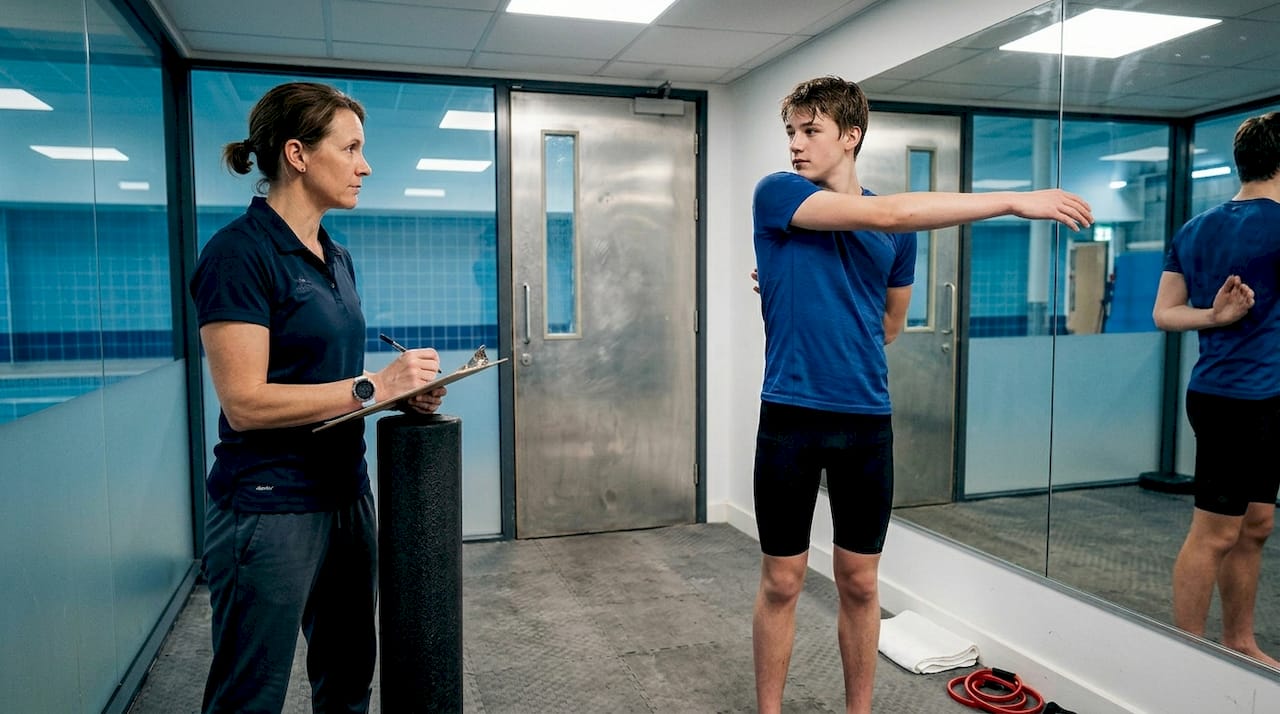
Pro Tip: Conduct a basic performance screen at the start of each season. Have each swimmer perform a shoulder rotation test, a hip flexor length test, and a modified sit-and-reach. Document the results and revisit them every eight weeks. This tells you whether your flexibility training is producing adaptation or whether you need to adjust the approach.
One area that demands special attention is shoulder hypermobility. Swimmers naturally develop above-average shoulder range of motion over years of training, but pushing ROM further without corresponding rotator cuff and scapular stabilizer strength creates a vulnerable joint. Individualizing flexibility routines based on athlete-specific mobility profiles is one of the most important steps coaches can take. And building year-round flexibility integration into your seasonal plan ensures athletes maintain gains rather than losing them during competitive peaks.
Flexibility’s double edge: Avoiding pitfalls and injuries
Even with well-designed routines, there are real risks. Flexibility is genuinely a double-edged sword, and coaches who ignore the downside set their athletes up for painful setbacks.
Hypermobility, or excessive joint laxity (looseness beyond normal range), occurs more commonly in swimmers than in athletes from many other sports. Years of repetitive overhead movement stretch the joint capsule and surrounding ligaments. On one side, that extra range helps with a long butterfly recovery and a deep breaststroke kick. On the other side, it creates instability that puts soft tissue under dangerous stress.
Signs that a swimmer may be dealing with harmful hypermobility include:
- Shoulder pain during or after practice, especially at the end of a long set
- Clicking or popping in the shoulder or knee without a clear muscular cause
- Difficulty maintaining shoulder blade position during freestyle catch
- Recurring minor strains in the same joints across multiple seasons
- A feeling of looseness or instability rather than strength through mid-range motions
The research is sobering. Shoulder injury prevalence up to 91% has been documented in hypermobile competitive swimmers. That is not a fringe finding. It means that if you coach a group of hypermobile swimmers and ignore stability work, nearly all of them are at serious risk.
“Hypermobility in swimmers creates a paradox: the same shoulder laxity that enables a powerful stroke also raises injury risk dramatically, with shoulder injuries affecting up to 91% of hypermobile competitive swimmers.”
The solution is not to stop flexibility training. It is to pair it with deliberate strength work targeting the stabilizer muscles around vulnerable joints. Rotator cuff exercises, scapular stability drills, single-leg balance work for knee stability, and core anti-rotation exercises all serve to protect the increased range of motion that flexibility training creates.
Research also reinforces that coordination and stability are critical, not just raw flexibility scores. A swimmer who can stretch far but cannot control movement through that range gains little performance benefit and a lot of injury exposure. Control always comes before range in a smart training program.
Routine reassessment matters enormously here. Flexibility and strength levels shift across the season, and a program built in October may not serve an athlete well in February. Schedule a brief screen every six to eight weeks, check for new asymmetries, and adjust accordingly. Consistent monitoring through proper conditioning for injury prevention keeps athletes healthy and progressing all season long.
A coach’s perspective: Flexibility in swimming is less about extremes, more about balance
After decades of coaching competitive swimmers, one pattern stands out clearly. The athletes who obsess over maximizing their flexibility range often plateau or get hurt. The athletes who develop controlled, coordinated mobility within their natural structure tend to swim faster and stay healthier longer.
The “more is better” mindset around flexibility is one of the most persistent misconceptions in aquatic sports. Chasing extreme ranges of motion without building the strength to support them is like widening a road without reinforcing the bridges. At some point, something gives.
The best swimmers we have worked with share a quality that has nothing to do with how far they can stretch. They move with precision. Every degree of rotation serves a purpose. Every extension is controlled. That is the result of building flexibility alongside coordination and strength, not in isolation.
The practical challenge is that flexibility gains feel good. Swimmers enjoy the sensation of increased range, and coaches enjoy seeing improved scores on mobility tests. But the goal is not better test scores. It is faster, healthier swimming across a full season. Before adding more flexibility volume to your program, consider your off-season flexibility strategies and ask yourself: does this athlete need more range, or better control of the range they already have? That one question will redirect a lot of wasted training time toward real results.
Take the next step: Flexibility training with the experts
Ready to put these principles into practice with the support of world-class coaching? Generic flexibility routines pulled from the internet will not account for your stroke type, your injury history, or the specific demands of your competitive events.

At PEAK Performance Swim Camp, our coaches bring over 50 years of experience building individualized training plans that integrate flexibility, strength, and technical skill into one cohesive program. Every camp and clinic is designed to help swimmers at every level find their optimal performance zone, not just their maximum stretch. Explore our flexibility-focused swim camps and discover how structured, coach-led programming can accelerate your development. Browse our clinic package options to find the right fit for your season and your goals.
Frequently asked questions
How much can flexibility improve my swimming performance?
Consistent flexibility training increases range of motion for improved stroke length and efficiency, but direct speed gains appear most reliably in longer-distance events. A 6-week study showed significant plantar flexion gains without sprint time improvement, suggesting distance swimmers benefit most.
Is there such a thing as too much flexibility for swimmers?
Yes, excessive flexibility, especially in the shoulders, significantly raises injury risk. Shoulder injury prevalence up to 91% in hypermobile swimmers makes it clear that flexibility must be balanced with targeted strength and joint stability work.
What are the best stretches for swimmers?
Dynamic stretches like arm circles and leg swings work best before swimming to prepare the joints without reducing power. Static stretches and foam rolling after swimming deliver the greatest benefit for building long-term range of motion.
Do Pilates or yoga routines help swimmers become more flexible?
Yes, Pilates in particular has strong evidence behind it. An 8-week Pilates program improved both flexibility measures and sport-specific performance in young swimmers, making it a practical and effective supplement to in-water training.
Recommended
- Advanced swimming technique tips for peak performance – Peak Performance Swim Camp
- Individualized swim plans: unlock elite performance – Peak Performance Swim Camp
- Physical conditioning for swimmers: unlock peak performance – Peak Performance Swim Camp
- Why swimming fundamentals unlock competitive success – Peak Performance Swim Camp