
TL;DR:
- Video swim analysis provides visual feedback that accelerates skill improvement and enhances performance.
- Tracking speed, stroke rate, and stroke length helps assess and refine competitive technique.
- Combining structured drills with expert video review leads to measurable gains in race times and efficiency.
Bridging the gap between knowing what good technique looks like and actually swimming it is one of the most difficult challenges in competitive swimming. Your coach can call out a dropped elbow during practice, but without visual confirmation, swimmers often have no real sense of what their bodies are doing underwater. Video swim analysis changes that entirely. It transforms abstract coaching cues into concrete, visual evidence that accelerates learning and sharpens competitive performance in ways that verbal feedback alone simply cannot achieve. In this guide, we break down the criteria, drills, methods, and real-world results that make video swim training a non-negotiable tool for elite athletes.
Table of Contents
- Key criteria for effective video swim training
- Top elite swim drills for video analysis
- Comparing video swim analysis methods
- Video swim’s real-world impact: Case studies and corrections
- The overlooked value of video swim for elite athletes
- Take your swim performance further with expert coaching and video analysis
- Frequently asked questions
Key Takeaways
| Point | Details |
|---|---|
| Video swim clarifies performance | Recording and analyzing swim sessions makes subtle errors and strengths visible for precision improvement. |
| Elite drills drive progress | Targeted drills like single-arm freestyle and sculling, evaluated via video, unlock advanced technique gains. |
| Resisted training boosts speed | Integrating load–velocity profiling with video analysis increases sprint performance and lowers competition times. |
| Real feedback accelerates growth | Empirical benchmarks and visual reviews help swimmers focus training to reach elite standards. |
Key criteria for effective video swim training
Having introduced the significance of video swim strategies, let’s clarify what truly matters when evaluating and planning your advanced training approach. Not all video sessions are created equal. Recording a few laps and watching them back without structure rarely produces meaningful change. Effective video swim training follows a defined framework built around measurable performance benchmarks and precise technical targets.
The most important variables to track are speed, stroke rate (SR), and stroke length (SL). Speed is your average velocity in meters per second. SR is the number of complete stroke cycles per minute. SL is the distance covered per stroke cycle in meters. These three metrics form the foundation of any serious performance review, and video analysis is the most reliable way to measure and monitor all of them simultaneously.
Research into empirical swim performance metrics reveals just how precise elite benchmarks really are. For a 400m freestyle, elite performance standards sit at a speed of 1.38 m/s, an SR of approximately 73 strokes per minute, and an SL of 1.39 meters per stroke. In 100m events, clean swim velocity in the first half-lap shows a strong correlation with overall performance (r=0.85). For sprint events, SL is the strongest individual correlate with performance (ρ=0.57), while SR carries more weight in distance events (ρ=0.45).
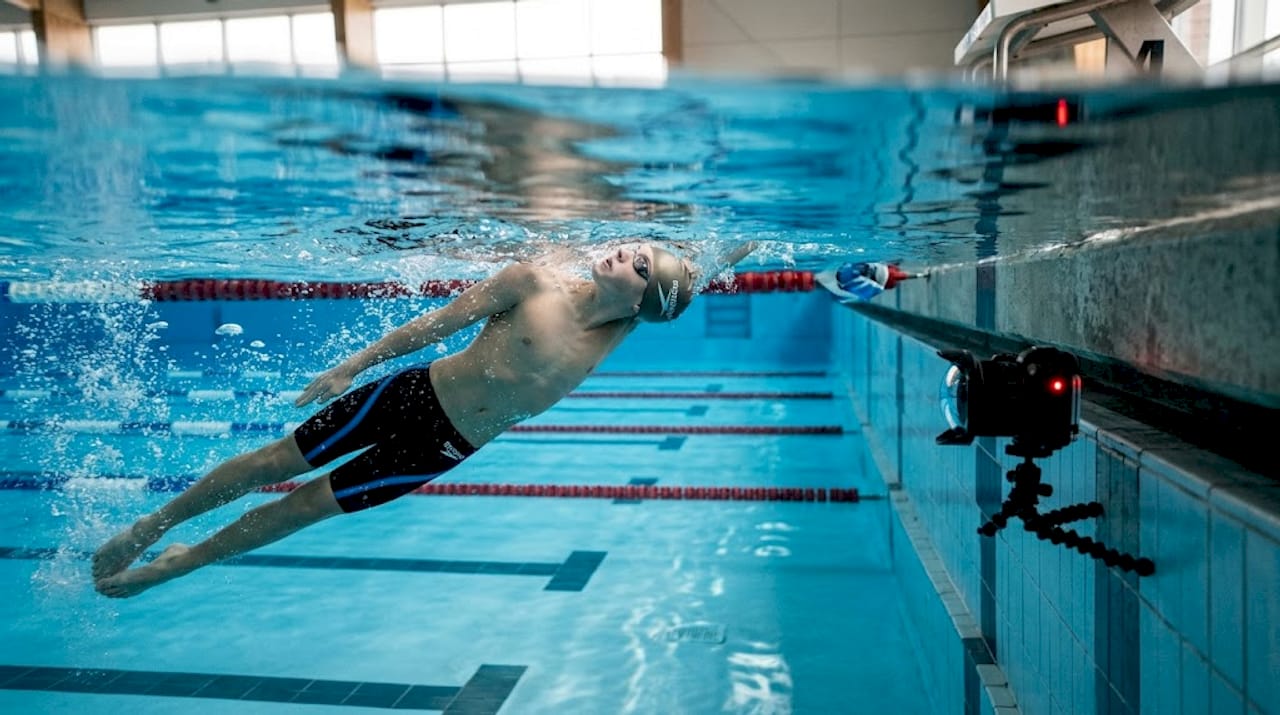
Video exposes what the naked eye misses during live observation. A coach standing on deck cannot simultaneously track hip rotation timing, hand entry angle, underwater pull path, and kick depth during a single freestyle lap. A camera positioned underwater or at the lane end can capture all of it. Here are the key technical elements video makes visible:
- Entry and extension: Crossover entries and thumb-first entries create drag and disrupt balance
- Catch position: High-elbow catch setup, including forearm angle and wrist alignment
- Underwater pull path: Straight arm pulls versus proper S-pull mechanics
- Hip rotation: Degree and timing of rotation relative to the stroke cycle
- Kick depth and tempo: Whether the kick is generating propulsion or creating drag
- Streamline quality: Body position off walls, including head placement and core tension
Pro Tip: Set up two camera angles per session whenever possible. A side-mounted underwater camera reveals stroke mechanics, while a lane-end camera captures entry angle and body symmetry. Reviewing both together gives a far more complete picture than either alone.
Top elite swim drills for video analysis
With clear criteria in mind, now explore the specific drills that video analysis can elevate to the next level of competitive mastery. Drills are only as effective as the feedback that accompanies them. When swimmers perform technique work without external confirmation, they can ingrain incorrect patterns without realizing it. Video brings objectivity to drill work, letting athletes and coaches see exactly what is and is not happening.
Some advanced swimming technique tips center on a core set of drills that respond especially well to video review. These are the drills coaches have used for decades because they isolate specific mechanical elements that directly affect speed and efficiency. Here is a sequenced approach to drill selection organized by training goal:
- Single-arm freestyle: Removes one arm from the equation, forcing attention to rotation, extension, and pull mechanics on the dominant side
- Long dog paddle (front quadrant timing): Keeps both arms in the front half of the stroke cycle, training the swimmer to avoid “dropping” the lead arm during entry
- Sculling drills: Develop feel for the high-elbow catch and early vertical forearm, reinforcing the S-pull sensation through isolated hand movement
- 6-kick switch: Combines precise hip rotation timing with controlled breathing and full body balance
- Fingertip drag: Keeps the elbow high during recovery, reinforcing the correct path from exit to entry
- Catch-up pause: Adds a deliberate hold at the extension point to build front-quadrant awareness
- Tarzan (head-up) freestyle: Forces the swimmer to maintain a powerful kick and body position even with head elevated, building propulsive fundamentals
- Fist drills: Remove the contribution of the hands to force the forearm to do the work, building feel for the catch
According to
elite drill breakdowns, each of these drills targets a specific propulsion or balance variable that directly translates to race-day speed. Video analysis makes the connection between drill mechanics and full-stroke performance visible, so swimmers can actually see why a drill matters and how their execution compares to the intended movement.
Beyond freestyle, video is critical for specialty strokes. For backstroke, the lack of visual reference makes consistent body rotation extremely difficult to self-monitor. For butterfly, timing the hip drive with the arm entry is nearly impossible to feel accurately without visual feedback. Building fundamental swim skills across all four strokes benefits enormously from regular video review tied to structured drill progressions.
Pro Tip: Film drill sets before full-stroke sets. Comparing drill footage to whole-stroke footage in the same session reveals exactly which drill benefits are carrying over and which are being lost during race-pace swimming.
A key stat to keep in mind: Swimmers who receive video-based feedback during drill training typically show measurable technique improvements within three to four weeks, particularly in catch position and body alignment metrics.
Comparing video swim analysis methods
Once you know which drills to focus on, it’s crucial to select the right analysis method. Let’s compare the most popular approaches for maximum improvement.
| Method | Clarity | Feedback speed | Cost | Accessibility |
|---|---|---|---|---|
| Poolside live review | Moderate | Immediate | Low | High |
| Post-session self-review | Moderate | Delayed | Low | High |
| Coach-guided post-session | High | Same day | Moderate | Moderate |
| Software-based analysis | Very high | Same day | High | Low to moderate |
| Professional video coaching | Very high | Within 24 hours | Moderate to high | Moderate |
Live poolside review means showing a swimmer their footage immediately after a set, often on a tablet. It produces instant reinforcement but lacks the depth of frame-by-frame analysis. Post-session self-review without guidance is better than nothing but often leads swimmers to focus on the wrong details. Software-based analysis platforms can overlay stroke paths, measure angles, and calculate SR and SL automatically, but they require technical knowledge and investment.
Resisted swim training methods combined with load-velocity (LV) profiling represent a next-level analysis approach. Research shows that LV profiling in resisted swims improved elite 50m freestyle performance in measurable ways: maximum speed increased by 3.4%, maximum load improved by 13.6%, and competition time dropped by 1.3%. The McEvoy Method, which integrates strength-phase submax technique work with resisted sprints at high stroke rates of 60 to 63 cycles per minute, is one structured example of how to pair physical loading with technique monitoring through video.
“The athletes who make the fastest gains are not those who train harder. They are the ones who can see their own stroke clearly, accept what the video shows them, and make deliberate corrections with every repetition.” — Nick Baker, PEAK Performance Swim Camp
Video analysis private coaching sits at the top of the accessibility and impact spectrum for most competitive swimmers. A trained coach reviewing frame-by-frame footage can identify issues that even the swimmer’s primary coach misses during live practice, particularly in underwater phases and wall transitions.
Key advantages of professional video coaching over self-review include:
- Structured identification of priority errors versus minor inefficiencies
- Benchmark comparison against elite performance data
- Drill prescription tied directly to observed mechanics
- Written feedback that swimmers can revisit between sessions
Video swim’s real-world impact: Case studies and corrections
Now that methods are compared, see how video swim training drives measurable results by correcting errors and unlocking speed. Real-world case studies show that video analysis does not just improve theoretical technique. It produces direct, measurable time drops when applied consistently.
Backstroke analysis breakdowns highlight two critical standards for elite backstroke: the body line must remain steady throughout the stroke cycle (since backstroke is a blind stroke where swimmers cannot see their own position), and stroke count per 25 meters should not vary by more than two strokes across a set. When video reveals count variation beyond that range, it signals early fatigue, inconsistent rotation, or technique breakdown under pressure.
A particularly instructive example comes from analysis of world-class butterfly swimmer Maggie MacNeil, where video revealed pull flaws that directly reduced propulsion. Specific issues identified included a hyperextended wrist during the catch phase and a straight-arm pull pattern rather than a bent-elbow path. These are exactly the kinds of errors that feel correct from inside the water but cost significant propulsion per stroke cycle. Even at the elite level, video catches what feel cannot.
The table below shows typical improvement ranges seen when consistent video analysis is integrated into training over an eight to twelve week block:
| Metric | Baseline | Post-analysis improvement |
|---|---|---|
| Sprint SL (m/stroke) | 1.85 | +0.08 to +0.12 |
| Stroke rate (strokes/min) | 68 | Optimized, not always increased |
| Catch angle (forearm) | 45° | Improved toward 15 to 20° |
| 50m competition time | 24.8s | Reduction of 0.3 to 0.5s |
| Backstroke count variation | 3 to 4 | Reduced to 1 to 2 per 25m |
Key errors that video analysis consistently corrects across competitive swimmers include:
- Hand crossover on entry: Often accompanied by shoulder overrotation, visible only from above
- Dropped elbow during the catch: The single most common cause of poor propulsion, highly resistant to verbal correction alone
- Late or incomplete hip rotation: Creates asymmetry that costs SR efficiency
- Head-lift during breathing: A subtle but consistent drag-producing pattern that swimmers rarely feel
Youth swimmer coaching strategies increasingly incorporate video at earlier ages for exactly this reason. Young swimmers who learn to read their own footage develop kinesthetic awareness (the sense of body position and movement in space) faster than those who rely purely on verbal cues. The role of feedback in swim training is well established: visual, self-referenced feedback produces faster and more durable skill acquisition than external correction alone.
The overlooked value of video swim for elite athletes
Here is something many elite swimmers and their families do not fully appreciate: video analysis is not just a diagnostic tool for fixing problems. It is a performance accelerator for athletes who are already technically sound. At the competitive level, the margins that separate podium finishes from near-misses are often measured in hundredths of a second. Those margins frequently come down to consistency under fatigue, not peak mechanics in a rested state.
Most video review sessions happen after a fresh warm-up or during technical sets at controlled pace. But the most revealing footage is often the final 25 meters of a 200m race effort, or the last set of a hard training block. That is where technique breaks down. That is where habitual patterns under pressure become visible. Consistent integration of video into race-pace training and time-trial sets, not just drill work, is where elite athletes find the edges they are missing.
We have also seen through over 50 years of coaching that athletes who review their own footage regularly develop a sharper internal model of what good technique feels like. They stop relying on the coach to catch every error. They become self-correcting, which is the hallmark of a truly advanced competitive swimmer. At PEAK, our video analysis and private coaching program is built on this principle: the goal is not just to fix the current stroke, it is to build athletes who can feel and monitor their own mechanics in real time.
We encourage every competitive swimmer and their coaching team to integrate video review into a coach training workflow at every phase of the season, including taper and race-week preparation. The swimmers who arrive at championship meets having reviewed their footage the most are, in our experience, the ones who perform the most consistently under pressure.
Take your swim performance further with expert coaching and video analysis
If you have read this far, you understand that video swim analysis is not a luxury for elite competitive swimmers. It is a fundamental training tool. The data is clear, the case studies are compelling, and the drills are ready to use. The next step is applying them with expert guidance tailored to your specific stroke mechanics and performance goals.

At PEAK Performance Swim Camp, we offer structured elite swim camps year-round across the USA and internationally, all built around the kind of precise, data-informed training described in this article. Our private video swim coaching gives competitive swimmers frame-by-frame feedback from elite-level coaches, paired with a customized drill plan and benchmark tracking. For swimmers who want the most individualized experience possible, our personalized swim coaching programs bring together video analysis, physical conditioning, and mental preparation into a single, cohesive training plan designed to produce measurable results at your next competition.
Frequently asked questions
What’s the most important metric to track in video swim analysis for freestyle?
Sprint stroke length is the top priority, as SL is the strongest correlate with freestyle performance (ρ=0.57), making it the most direct indicator of propulsive efficiency in competition.
How can video swim analysis help correct backstroke errors?
Video reveals misalignment in the body line and flaws in pull mechanics, such as hyperextended wrist and straight-arm pull patterns, both of which reduce propulsion significantly in backstroke.
Is resisted swim training effective for sprint performance?
Yes, LV profiling in resisted swims produced a 3.4% increase in maximum speed and a 1.3% drop in competition time for elite 50m freestyle swimmers, making it one of the most effective tools for sprint development.
What are the best drills to analyze for improving competitive swim technique?
Single-arm freestyle, sculling, catch-up pause, and Tarzan drills are the most valuable for video review, each isolating a specific mechanical variable that directly impacts race speed and efficiency.
Recommended
- Personalized Coaching – Peak Performance Swim Camp
- Individualized swim plans: unlock elite performance – Peak Performance Swim Camp
- Advanced swimming technique tips for peak performance – Peak Performance Swim Camp
- Best swim technique videos for faster, efficient swimming – Peak Performance Swim Camp