
TL;DR:
- Choosing the right youth swim camp depends on the swimmer’s age, level, and goals.
- Elite camps emphasize small group sizes, science-backed training, and personalized feedback.
- The most important factor is a positive, motivating environment that fosters joy and long-term engagement.
Choosing the right summer swim camp for your competitive young swimmer is one of the most consequential decisions you can make as a parent. With dozens of programs offering everything from two-day clinics to month-long boarding experiences, the options vary dramatically in coaching quality, methodology, and results. Your swimmer’s goals deserve more than a generic summer program. This guide walks you through the top youth swim camps for 2026, breaks down what separates elite programs from average ones, and gives you a clear framework for matching the right camp to your child’s specific needs and competitive ambitions.
Table of Contents
- Understanding what makes a world-class youth swim camp
- SwimTec High Performance Technique Swim Camp
- Fitter & Faster Swim Camps: Technique clinics for all levels
- Bolles and Stanford: Elite boarding and advanced skill camps
- Head-to-head camp comparison and choosing the right fit
- What most articles miss about picking the right youth swim camp
- Explore summer swim camps and high-performance options
- Frequently asked questions
Key Takeaways
| Point | Details |
|---|---|
| Personalized instruction matters | World-class camps use small groups and science-backed feedback for skill growth. |
| Camp format affects results | Choose clinics for technique refresh or boarding camps for immersive championship prep. |
| Motivation drives improvement | Camps that spark joy and confidence build lasting performance gains beyond mechanics. |
| Coach expertise is critical | Elite credentialed coaches and Olympian mentors take training to the next level at top camps. |
| Comparison reveals the best fit | Side-by-side analysis helps identify the ideal camp for your swimmer’s goals and family needs. |
Understanding what makes a world-class youth swim camp
Not all swim camps are created equal, and the differences between a good experience and a truly transformational one come down to a handful of critical factors. Before you compare programs, you need to know what to look for.
The foundation of any elite camp is choosing the best swim camp criteria: limited enrollment, individualized feedback, and science-driven training methods. When camps keep rosters small, coaches can actually see each swimmer’s stroke mechanics, identify specific faults, and apply targeted corrections. Large, overpopulated programs simply cannot deliver that level of attention, no matter how impressive their marketing looks.
Elite camps prioritize personalized feedback and science-driven approaches, which means your swimmer gets more than yardage and pep talks. They receive biomechanical analysis, video review from multiple angles, and structured mental skills training that transfers directly into race performance. These tools have moved from professional Olympic programs into the best youth camps, and they make a measurable difference.
Here are the core features to evaluate when assessing any competitive youth swim camp:
- Coach credentials: Look for coaches with national team experience, USA Swimming certifications, or an Olympic coaching background
- Coach-to-swimmer ratio: Aim for 1:6 or better for genuine individualized attention
- Video and biomechanical analysis: Real-time and recorded stroke review catches what the naked eye misses
- Mental preparation curriculum: Races are won and lost in the mind as much as the pool
- Measurable outcomes: Ask for performance data, testimonials, or documented drops in times
- Facility quality: Access to both short-course yards (SCY) and long-course meters (LCM) pools matters for competition-ready training
Coaching strategies for youth swimmers also show that grouping swimmers by ability rather than age produces better technical development. When your 14-year-old trains alongside swimmers of a similar skill level, everyone works harder and learns faster.
Pro Tip: Ask each camp director for the average time improvement swimmers see after completing the program. Camps confident in their results will share this data willingly.
Research reinforces the power of individualized, science-backed training. Personalized AI training yields 34% higher performance outcomes and 2.7 times faster skill acquisition compared to one-size-fits-all coaching. The best youth camps are integrating these innovations now, not five years from now.
SwimTec High Performance Technique Swim Camp
SwimTec is a strong example of how science-first coaching translates into real competitive gains for youth swimmers. The program is specifically designed for athletes who are serious about improving their race performance, not just building general fitness.
SwimTec’s program targets ages 12-18 and focuses on stroke refinement, starts, turns, race execution, and competitive mindset through both pool sessions and structured classroom time. That classroom component is worth noting. Most camps keep swimmers in the water the entire time, but the mental and tactical understanding that comes from sitting down and studying race strategy is something the best collegiate and Olympic programs prioritize heavily.
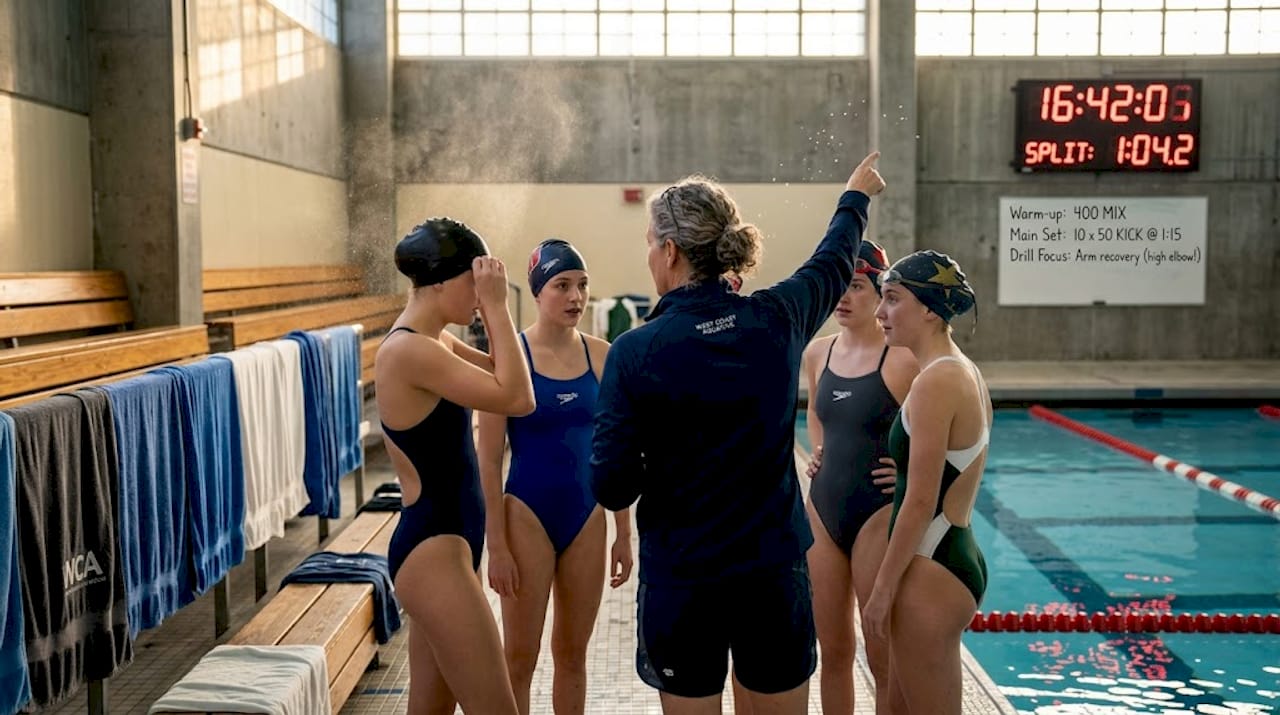
When evaluating swim camp needs for a teenage athlete who has hit a performance plateau, a program like SwimTec’s approach to biomechanical translation is especially valuable. Coaches use video tools to compare your swimmer’s stroke frame-by-frame against elite models, pinpointing inefficiencies in catch mechanics, body rotation, kick timing, and underwater work.
Key features of SwimTec’s program include:
- Age range: 12-18, ideal for high school-level competitive swimmers
- Instruction style: Science-driven with Olympian and expert-led coaching sessions
- Technique focus: Stroke refinement across all four competitive strokes
- Race execution: Specific coaching on starts, turns, and split strategy
- Mindset training: Mental skills integrated throughout the program, not tacked on as an afterthought
“The best swim camps treat the mind and body as one system. When your swimmer understands why a drill works, they can apply it independently in their next race. That cognitive ownership is what separates good swimmers from great ones.”
This kind of structured, holistic approach is what elite coaches have used for decades at the national level. SwimTec has made it accessible to competitive youth swimmers who are ready to commit to serious improvement.
Fitter & Faster Swim Camps: Technique clinics for all levels
Fitter & Faster takes a different format but delivers exceptional results for a wide range of swimmers. Their clinic model is designed to give athletes high-intensity, focused technique instruction in a shorter time frame, which makes it a practical option for families who cannot commit to a week-long or residential program.
Fitter & Faster clinics emphasize detailed mechanics like the high elbow catch, body rotation, powerful dolphin kicks, and streamlines. These are not generic corrections. They target the specific technique elements that produce the biggest time improvements across freestyle, butterfly, backstroke, and breaststroke.
The program is open starting at age 7, which makes it one of the most accessible elite-level clinic programs for younger swimmers who are just beginning their competitive journey. Coaches at Fitter & Faster clinics are drawn from national-level programs, and the instruction density in a single clinic day is genuinely impressive.
Parents report transformational impacts including individual attention, new skills, genuine confidence boosts, and practical tips on fueling and sleep that support performance outside the pool. Children leave these clinics not just with better technique but with a renewed sense of motivation and self-belief.
What Fitter & Faster does well:
- Clinic format: Short, intensive sessions that complement weekly team training without replacing it
- Age range: Ages 7 and up, grouped appropriately for development stage
- Drill breakdowns: Detailed, step-by-step instruction on each stroke element with immediate feedback
- Motivation factor: Swimmers leave energized and inspired to practice what they have learned
- Practical life skills: Coaches share fueling, sleep, and recovery guidance alongside technique
To understand what a typical day looks like in a high-performance clinic setting, the structure usually moves from warm-up and drill breakdown in the morning to stroke-specific refinement sets and race simulation in the afternoon, with video review bookending the sessions.
Pro Tip: If your swimmer has one specific stroke that is holding back their times, a Fitter & Faster technique clinic is one of the fastest ways to isolate and fix that weakness without overhauling their entire training schedule.
Bolles and Stanford: Elite boarding and advanced skill camps
For swimmers who are ready to push into genuinely elite territory, Bolles and Stanford represent the gold standard of summer camp experiences. Both programs carry decades of credibility and have directly contributed to producing national-level and Olympic-caliber athletes.
Bolles Swim Camps offer training for ages 9-18, including a month-long residential option for top-level talents. The program trains in both SCY and LCM formats, includes competitive meets, and immerses swimmers in a full-time athletic environment that mirrors what a college or national team training block looks like. The Bolles legacy speaks for itself: the Sharks club program has 495 competitive youth athletes and a track record of developing swimmers who go on to compete at the highest levels.
Stanford Swim Camps group swimmers by ability and provide stroke-specific technique instruction, video review, dryland training, and anaerobic threshold work. That ability-based grouping is critical. It means your child trains with peers at a similar skill level, which creates the right competitive dynamic and ensures coaching is calibrated correctly.
Here is a side-by-side comparison of the two programs:
| Feature | Bolles Swim Camp | Stanford Swim Camp |
|---|---|---|
| Ages served | 9-18 | Middle and high school level |
| Program length | Day camps and month-long boarding | Week-long sessions |
| Grouping method | Age and ability-based | Ability-based pods |
| Pool format | SCY and LCM | SCY and LCM |
| Dryland training | Yes | Yes |
| Video review | Yes | Yes |
| Competitive meets | Yes | Limited |
| Best for | Elite immersive prep | Stroke technique and threshold work |
Understanding the benefits of year-round training is essential context here. Both Bolles and Stanford camps are most effective when they supplement a structured year-round program. They are not stand-alone solutions but powerful accelerators for swimmers who already have a solid training base.
Head-to-head camp comparison and choosing the right fit
Now that we have looked at each program in depth, the real question is which camp is the right fit for your specific swimmer. The answer depends on age, current level, goals, and family logistics.
Here is a broader comparison of all four camp types:
| Camp | Format | Ages | Best use case | Duration |
|---|---|---|---|---|
| SwimTec | Residential/intensive | 12-18 | Technique + mindset overhaul | Multi-day |
| Fitter & Faster | Clinic | 7+ | Targeted stroke correction | 1-2 days |
| Bolles | Boarding and day | 9-18 | Elite immersive training | Days to 1 month |
| Stanford | Residential | Middle/HS | Threshold and stroke technique | Week-long |
Intensive camps like Bolles are best suited for dedicated elite swimmers, while shorter clinics like Fitter & Faster’s two-day format are excellent complements to existing team training. Both approaches serve a purpose. The mistake parents often make is assuming longer always means better.
Proven camp methodologies prioritize video analysis, multi-angle feedback, and progressive drill-to-full-stroke sequencing. Any camp on your shortlist should include these elements. If they cannot explain how they measure progress, that is a red flag.
Use this checklist when making your final decision:
- Swimmer’s age and competitive experience: Younger or newer swimmers benefit more from clinic formats; experienced competitors gain more from immersive programs
- Specific weakness: Stroke technique issues respond well to focused clinics; general performance plateaus need an intensive, multi-day environment
- Scheduling flexibility: Boarding camps require significant time commitment; clinics fit into busy school-year schedules
- Budget: Day clinics are generally more affordable; boarding programs include room, board, and extended coaching access
- Camp culture fit: Talk to your swimmer about the environment they want. Some thrive in competitive boarding settings; others perform best in shorter, high-energy clinic bursts
Finding top competitive swim camps that fit all of your criteria is entirely possible when you know what to ask and what to look for.
What most articles miss about picking the right youth swim camp
Here is something we rarely see discussed in camp comparison guides: the most technically advanced camp is not always the right camp for your child. After three decades of coaching and running camps across 18 countries, we have seen a consistent pattern. Parents focus almost entirely on credentials and results, while the factor that most determines whether a child actually improves is how much they enjoyed the experience.
Joy is not a soft metric. It is the engine behind sustained practice. A swimmer who leaves camp fired up about training will put in 200 extra yards of quality work every session for the next six months. A swimmer who returns home burned out or intimidated will quietly disengage, regardless of how technically polished the coaching was.
Parents consistently note that camps build joy and motivation far beyond mechanics. That is not an accident. The best programs are intentional about peer culture, coach enthusiasm, and creating moments of genuine success that swimmers carry with them long after camp ends.
We encourage parents to look at camp culture as seriously as they look at coach credentials. Ask former campers and their families what the vibe felt like. Ask whether coaches celebrated effort alongside improvement. The motivation that comes from a great camp experience often does more for long-term performance than any single technical correction.
The uncomfortable truth is this: a motivated, joyful swimmer in an average program will often outperform a technically coached but uninspired swimmer in an elite one. Find the camp where your child will thrive as a whole person, and the times will follow.
Explore summer swim camps and high-performance options
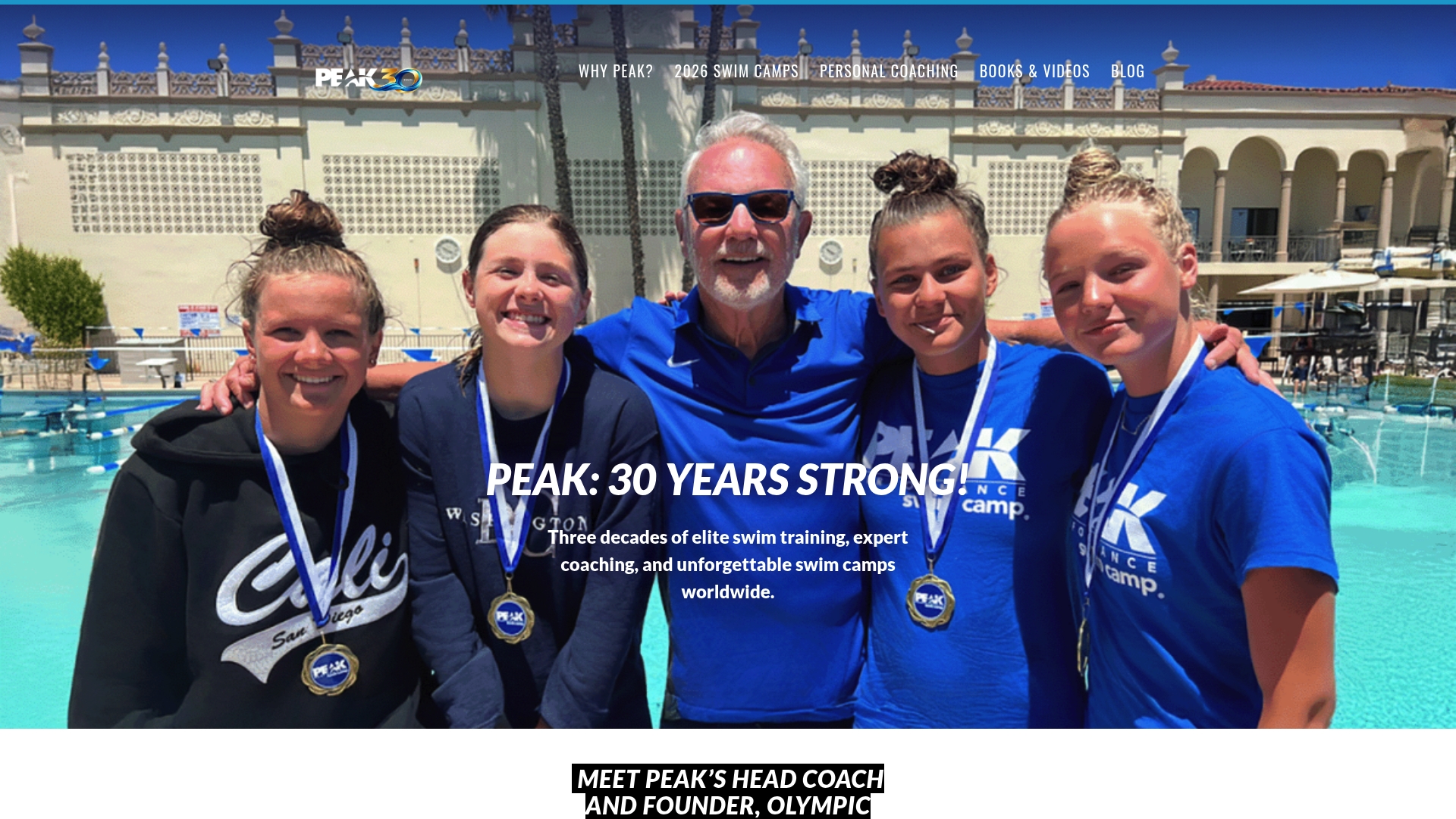
At PEAK Performance Swim Camp, we have spent 30 years building programs that combine elite technical coaching with a genuine love for the sport. Olympic coach Nick Baker founded PEAK with the belief that swimmers reach their best performances when they are trained holistically across technique, physical conditioning, and mental preparation.
Whether your swimmer needs a targeted technique boost or a full competitive immersion experience, we have a camp or clinic that fits. Explore our full range of swim camp options to find the right program by location, duration, and level. If a focused performance clinic is what your athlete needs, browse our clinic package options or check out our dedicated high performance clinic for swimmers ready to compete at the next level. Your swimmer’s best race is ahead of them.
Frequently asked questions
What age ranges do top youth swim camps serve?
Most world-class youth swim camps cater to swimmers ages 7 to 18, with some programs grouping participants by age and ability for more targeted coaching.
Are science-driven camps more effective than traditional swim camps?
Yes. Camps using biomechanical analysis and individualized feedback show significantly better results, with personalized training yielding 34% higher performance and 2.7 times faster skill acquisition compared to traditional methods.
Should my child attend a clinic or a month-long boarding camp?
Clinic formats work best for targeted technique correction and fit easily around school schedules, while boarding camps suit elite swimmers pursuing championship prep and full immersion training.
How do youth swim camps support confidence and motivation?
Parents consistently report that well-run camps create lasting confidence boosts, renewed motivation, and practical life skills, with individual attention and new skills being the most frequently cited transformational factors.