
TL;DR:
- Swim training is shifting from high-volume to high-intensity, individualized programs.
- Load-velocity profiling and real-time feedback optimize swimmer-specific performance.
- Consistent, focused routines and smart recovery are key to long-term progress.
For decades, the gold standard in competitive swimming was simple: more yards, more laps, more time in the water. Many coaches and parents still believe that high-volume training is the only path to the podium. But a growing body of research and real-world results are challenging that assumption in a big way. In 2026, the most effective swim programs look very different from what most people expect. This guide breaks down the most important training trends, explains the science behind them, and gives swimmers and parents clear, practical steps to stay ahead of the competition.
Table of Contents
- The evolution of swim training: from volume to velocity
- Key innovations in swim coaching and resistance training
- Daily routines and power development drills that work
- Monitoring, recovery, and the science of progression
- What most swimmers and parents miss about the 2026 swim revolution
- Ready to ride the 2026 wave? Train with the latest innovations
- Frequently asked questions
Key Takeaways
| Point | Details |
|---|---|
| Individualization is key | Tailoring swim training boosts speed and competition results more than generic plans. |
| Intensity over volume | Short, high-intensity sets are replacing endless laps for better performance and athlete health. |
| Daily power habits | Consistent, power-building routines like 200–400m kicking accelerate improvement. |
| Monitor to prevent burnout | Tracking intensity and recovery lets swimmers progress safely without overtraining. |
| Personalization trumps trends | Adapt the latest trends to suit individual needs for optimal success. |
The evolution of swim training: from volume to velocity
For most of the 20th century, swim coaches operated on a simple principle: the more distance you cover in practice, the faster you will become on race day. High-volume, low-intensity training dominated programs at every level, from age-group clubs to Olympic squads. Coaches measured success in yards per week, and athletes who logged the most hours in the water were considered the most dedicated.
That model is now being questioned at its foundation. As one leading coaching analysis puts it, there is a clear shift from high-volume low-intensity to low-volume high-intensity training. This is not just a trend. It reflects a deeper understanding of how the human body actually adapts to stress and recovers from it.
One of the most exciting developments driving this shift is load-velocity (LV) profiling. LV profiling is a method that measures how a swimmer performs under different levels of resistance in the water. By testing a swimmer at multiple resistance levels, coaches can map out that individual’s unique force-velocity curve. This tells them exactly how much load and speed a swimmer should train at to maximize their specific strengths.
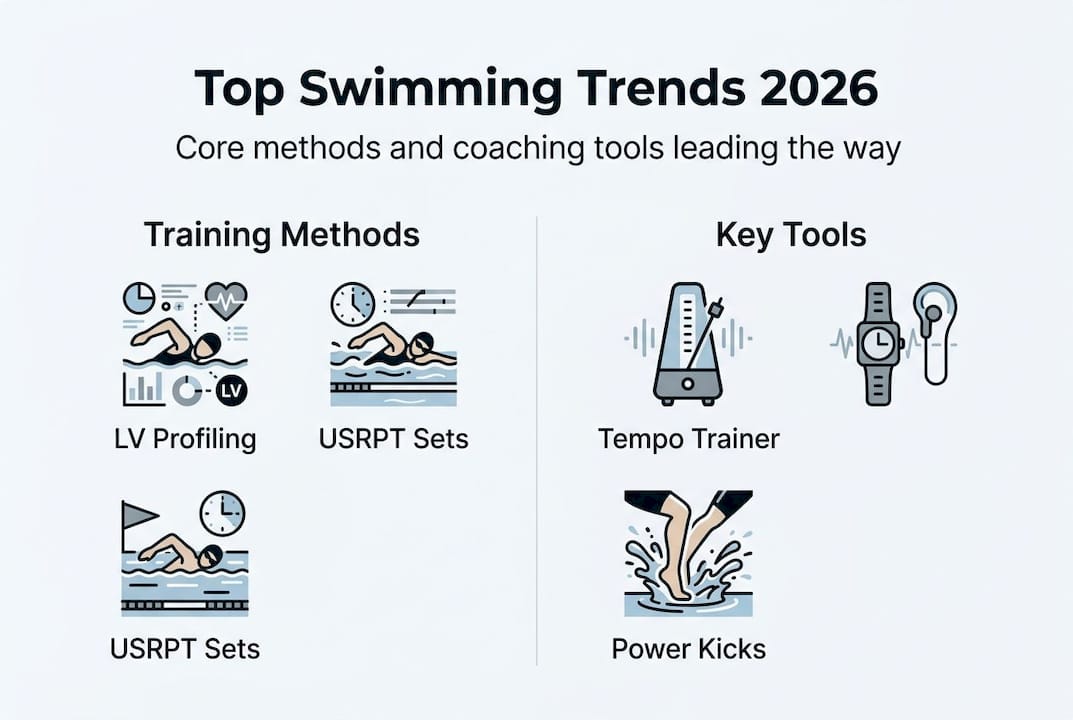
The results speak for themselves. Research confirms that LV profiling delivers measurable improvements in maximal swim speed, load, and competition time. That means swimmers who train with individualized resistance benchmarks are seeing real gains on the clock, not just in practice, but in races that count.
Here is a quick look at how the training philosophy has shifted:
| Factor | Traditional approach | 2026 approach |
|---|---|---|
| Weekly yardage | Very high (60,000+ yards) | Moderate, targeted |
| Intensity focus | Low to moderate | High, race-specific |
| Individualization | Minimal | Central to the program |
| Resistance training | Generic sets | LV profiling-based |
| Performance tracking | Distance and time | Speed, load, technique |
“The swimmer who trains smarter, not just harder, is the one who peaks when it matters most.” — Nick Baker, PEAK Performance Swim Camp
For swimmers committed to year-round swim training, understanding this shift is critical. The same principles that guide Olympic training strategies are now filtering down to age-group and club-level programs, making this the right time to adapt.
Key innovations in swim coaching and resistance training
Now that the ‘why’ behind the shift is clear, it is time to look at the ‘how.’ The tools and techniques shaping competitive swimming in 2026 are practical, measurable, and accessible to swimmers at many levels.
Load-velocity profiling in practice involves attaching a resistance device to a swimmer and timing their sprint at several different loads. The data collected builds a personalized profile. Coaches then use velocity-decrement zones, meaning specific speed ranges tied to each resistance level, to assign the right training stimulus. Research confirms that individualization via LV profiling outperforms generic resistance training for developing speed and power.
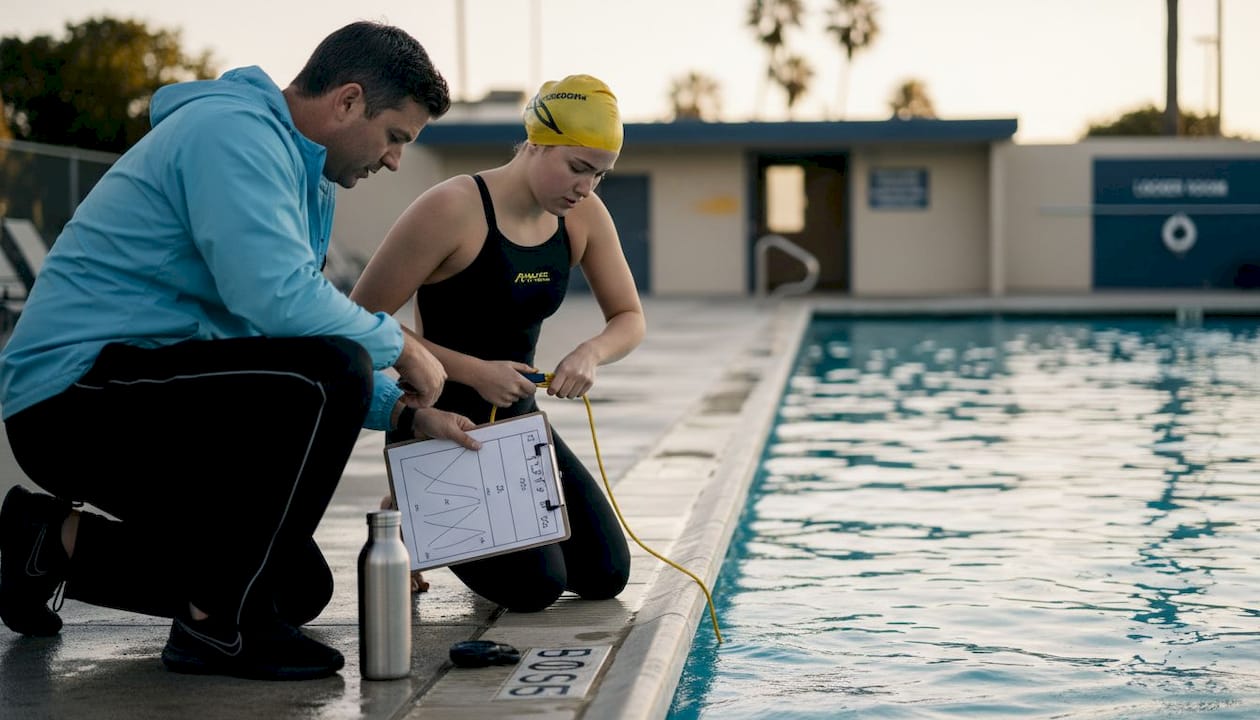
USRPT (Ultra-Short Race Pace Training) is another method gaining serious traction. Instead of grinding through long, slow sets, swimmers complete many short repetitions at or slightly above race pace with brief rest intervals. The goal is to train the body and mind to sustain race-speed mechanics for longer periods. It is demanding, but highly effective.
Technology is also playing a bigger role than ever. Tempo trainers, power kicks, and short high-intensity sets are now standard tools in forward-thinking programs. Stroke trackers and underwater cameras give coaches instant feedback on technique, while power meters measure force output in real time.
Here is a comparison of the two main training philosophies:
| Element | High-volume traditional | High-intensity individualized |
|---|---|---|
| Set length | Long, continuous | Short, intense |
| Rest periods | Minimal | Structured and purposeful |
| Feedback | End-of-season results | Real-time data |
| Adaptation speed | Slow | Faster, more targeted |
Key tools swimmers and coaches are using right now:
- Resistance parachutes and bungee cords for LV profiling sets
- Tempo trainers to enforce stroke rate discipline
- Underwater video for real-time technique feedback
- Wearable stroke counters for micro-KPI tracking
Pro Tip: Start with a simple velocity-decrement test. Time your swimmer over 25 meters at three different resistance levels. Plot the results and identify the load where speed drops more than 10 percent. That is your swimmer’s optimal training zone for power development.
For swimmers looking to sharpen their edge, exploring advanced swimming technique tips alongside these tools is a smart move. And if you are unsure about swimming practice frequency, the answer in 2026 leans toward quality sessions over maximum quantity.
Daily routines and power development drills that work
Knowing the theory is one thing. Putting it into practice every day is where real improvement happens. The good news is that the most effective 2026 routines are not complicated. They are consistent, focused, and built around a few key principles.
Research highlights that daily kicking (200 to 400 meters) and power building are integral to results-focused swim training in 2026. Kicking is no longer a warm-up filler. It is a core training tool that builds leg strength, body position, and propulsion efficiency.
Here is a step-by-step daily power routine that works:
- Warm-up (10 to 15 minutes): Easy swimming with a focus on long, relaxed strokes and breathing rhythm.
- Activation kicking (200 to 400 meters): Use a board or streamline kick set at moderate intensity to engage the legs and hips.
- Technique block (15 to 20 minutes): Drill sets focused on one specific skill, such as hand entry, hip rotation, or underwater dolphin kicks.
- High-intensity power set (15 to 20 minutes): Short, explosive repeats (10 to 25 meters) at or above race pace with full recovery between efforts.
- Cool-down (5 to 10 minutes): Easy backstroke or freestyle to flush the muscles and reinforce relaxed mechanics.
Pro Tip: Technique consistency matters more than the number of reps. If your stroke breaks down halfway through a power set, stop and reset. Practicing poor mechanics at high speed only reinforces bad habits.
One of the most common mistakes swimmers make is sacrificing quality for volume. Doing 20 sloppy repeats is less valuable than 10 clean, focused ones. Physical conditioning for swimmers should always support technique, not override it.
Strong core strength in swimming is also non-negotiable. A stable core keeps the body streamlined and transfers power from the hips to the arms and legs efficiently. Planks, rotational exercises, and medicine ball work done outside the pool directly improve in-water performance. For structured daily kicking guidance, PVC daily kicking routines offer a proven framework. And if you want to revisit the building blocks, reviewing essential swim skills ensures nothing foundational gets overlooked.
Monitoring, recovery, and the science of progression
Pushing hard in practice is only half the equation. Knowing when to back off is equally important, and in 2026, the best programs treat recovery as seriously as training itself.
Three key monitoring tools are now standard in high-performance swim programs:
- sRPE (Session Rating of Perceived Exertion): A simple scale where swimmers rate how hard a session felt. It captures the mental and physical load together.
- HR (Heart Rate): Tracking resting and training heart rate reveals how well the body is adapting and recovering between sessions.
- ACWR (Acute to Chronic Workload Ratio): This compares recent training load to longer-term load. A ratio above 1.5 signals high injury and burnout risk.
Research confirms that monitoring sRPE, HR, and ACWR prevents overtraining, and that progressive overload through technique stability is the key to long-term efficiency gains. In other words, you do not increase training load until your technique holds up consistently at the current level.
Statistic to know: Swimmers who track training load and adjust based on ACWR data reduce injury rates significantly while maintaining performance gains across a full season.
Practical ways to monitor and adjust training:
- Log sRPE after every session using a simple 1 to 10 scale
- Check resting heart rate each morning before getting out of bed
- Review weekly yardage trends every two weeks and adjust if ACWR climbs above 1.3
- Use video review to assess whether technique holds up under fatigue
Progression in 2026 is earned through patience and objectivity. Goal-setting in swimming becomes more powerful when paired with real data, because swimmers can see exactly where they are improving and where they need more work. Pairing monitoring habits with technique tips for progression creates a feedback loop that accelerates development safely.
What most swimmers and parents miss about the 2026 swim revolution
Here is something we see often at PEAK: swimmers and parents get excited about new methods, try them for two weeks, and then abandon them when results do not come immediately. The truth is, the biggest barrier to benefiting from these innovations is not access to the tools. It is patience.
Conventional wisdom in swimming moves slowly. Old habits, like grinding out high-yardage sets because that is what coaches have always done, persist even when the evidence points elsewhere. Adopting a new approach requires an adjustment period, and that period can feel like regression before it feels like progress.
Personalization also means that not every trend will work the same way for every swimmer. A 13-year-old developing swimming fundamentals needs a different application of LV profiling than a college-level sprinter. Resist the urge to copy what works for someone else. Use these trends as a framework, then adapt them to the individual.
The swimmers who will thrive in 2026 are the ones who stay curious, stay patient, and trust the process.
Ready to ride the 2026 wave? Train with the latest innovations
Understanding these trends is a strong first step. Putting them into practice under expert guidance is where real breakthroughs happen. At PEAK Performance Swim Camp, our coaches apply the latest evidence-based methods, including individualized resistance training, technique-focused progression, and smart recovery protocols, within a supportive, high-performance environment.

Whether you are a beginner building your foundation or an elite swimmer chasing a personal best, our elite swim camps are designed to meet you where you are and push you further than you thought possible. For more flexible scheduling or targeted skill development, explore our customized clinic options. The 2026 wave is here. Let us help you ride it.
Frequently asked questions
What is load-velocity profiling in swimming and why is it important in 2026?
Load-velocity profiling maps how a swimmer performs at different resistance levels to create a personalized training plan. Research confirms that LV profiling produces faster sprint speeds and improved competition performance compared to generic training.
How is competitive swim training changing in 2026?
Training is moving away from long, slow yardage toward short, powerful sets tailored to each swimmer’s profile. Coaching is shifting from high-volume to high-intensity individualized training with measurable, real-time feedback.
How can swimmers avoid overtraining with these new methods?
Tracking session effort, resting heart rate, and workload ratios gives coaches and swimmers the data needed to balance intensity with recovery. Tracking sRPE, heart rate, and ACWR is key to preventing overtraining and sustaining long-term progress.
What daily habits make the biggest difference for swimmers in 2026?
Consistent power-focused routines, especially daily kicking sets and technique-centered drills, build the foundation for speed gains. Daily kicking and power drills are integral to results-focused swim training when combined with quality monitoring.
Should all swimmers do the same trending workouts?
No. The most effective training is always personalized to the individual swimmer’s strengths, weaknesses, and goals. Individualization via LV profiling consistently outperforms generic resistance programs, so trends should guide your approach, not dictate it.
Recommended
- Advanced swimming technique tips for peak performance – Peak Performance Swim Camp
- Year-round swim training: benefits, methods & success – Peak Performance Swim Camp
- Why swimming fundamentals unlock competitive success – Peak Performance Swim Camp
- Olympic swim training: advanced techniques & strategies – Peak Performance Swim Camp