
TL;DR:
- Effective swim journaling goes beyond tracking split times by developing mental skills, process goals, and internal load awareness. Research shows that structured reflection enhances confidence, reduces variability, and improves performance over time, even before visible results appear. Consistent, honest entries focusing on behavioral targets and actionable takeaways transform the journal into a powerful self-coaching tool that supports mental readiness and long-term growth.
Most swimmers think of a training log as a place to record times and yardage. That’s a start, but it barely scratches the surface of what a well-kept journal can do. The role of swim journaling extends well beyond split tracking. When used correctly, it functions as a self-coaching tool that sharpens mental skills, stabilizes training consistency, and builds the kind of confidence that holds up under race-day pressure. This article walks you through the research, the frameworks, and the specific techniques that make journaling one of the most underused performance tools in competitive swimming.
Table of Contents
- Key takeaways
- The real role of swim journaling
- How to structure an effective swim journal
- Journaling for goal setting and mental readiness
- Common mistakes that undermine your journal
- My perspective on journaling and the long game
- Take your performance further with Swimcamp
- FAQ
Key takeaways
| Point | Details |
|---|---|
| Beyond split tracking | Effective swim journaling covers mental skills, process goals, and internal load, not just times. |
| Research-backed benefits | Mindfulness-based journaling significantly improves mental skills and reduces training load variability. |
| Structure drives results | Recording process goals, execution notes, and session takeaways turns a journal into a self-coaching system. |
| Balance goal types | Pairing time-based goals with process goals and reflective entries reduces emotional stress and improves consistency. |
| Consistency over complexity | Simple, daily entries done consistently outperform elaborate journals kept sporadically. |
The real role of swim journaling
Journaling in sport is often called reflective practice, and it has a long track record in elite athletics. For swimmers, the benefits of swim journaling go well beyond writing down how a set felt. A three-week mindfulness trial with 30 trained youth swimmers found that combining mindfulness with structured journaling produced significant improvements in mental skills (Cohen’s d values of 2.02 to 2.83, p<0.01) and meaningfully lower variability in heart rate and RPE during training (p<0.001), even without immediate 400 m performance gains. That last point matters. The benefits show up in your process before they show up on the scoreboard.
“Turning vague confidence into believable self-talk requires data. Your journal is where that data lives.” — Nick Baker, Olympic coach and founder of Swimcamp
Coaching professionals emphasize that evidence-based self-talk built from real journaling data replaces doubt with specific, proven facts about your own performance. Instead of telling yourself “I’m ready,” you can tell yourself “I held my stroke count under 18 on the back half of every race-pace rep this week.” That specificity changes everything.
The core benefits of keeping a structured swim journal include:
- Mental skills development: Regular reflection builds focus, emotional control, and pre-race composure.
- Internal load awareness: Tracking subjective effort (RPE) alongside physical metrics reveals patterns in how hard you are actually working versus how hard you think you are working.
- Motivation maintenance: Connecting physical and mental health through journaling helps swimmers stay grounded during difficult training blocks.
- Training consistency: When you review entries regularly, you spot the behavioral patterns that predict your best performances.
How to structure an effective swim journal
The best swim journal techniques mirror a coaching session plan. Every entry should have three moving parts: what you intended to focus on, how well you executed it, and what you will take into the next session. This structure prevents your journal from becoming a complaint box and keeps it pointed forward.
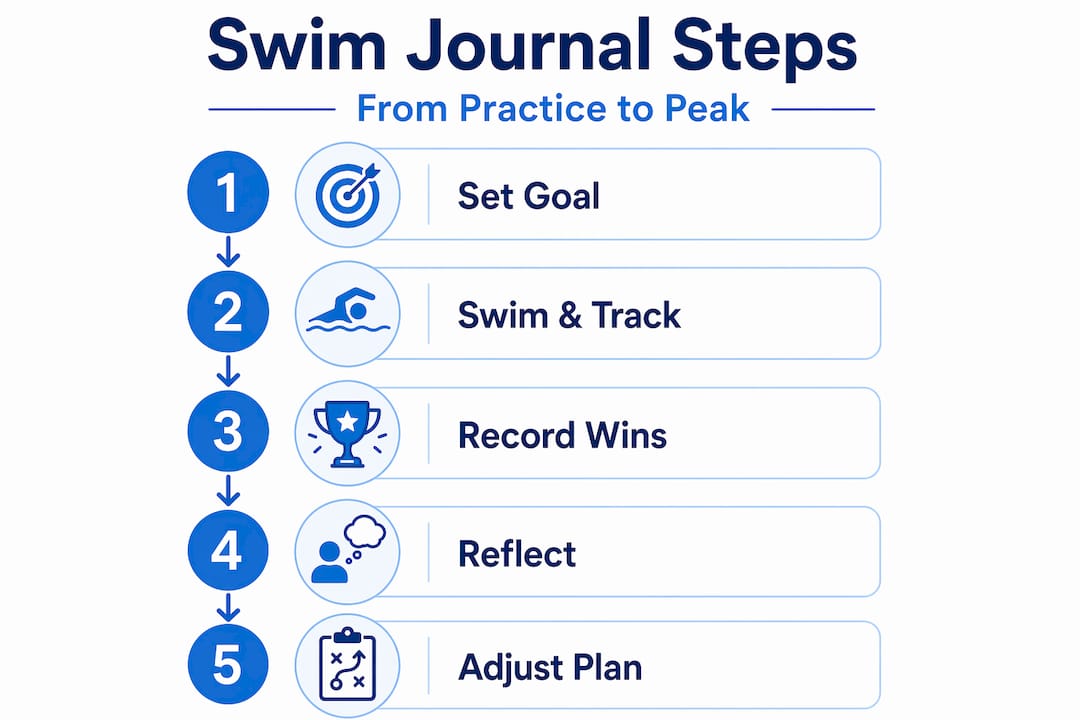
Here is a practical framework to follow:
- Set a process goal before training. Write down one specific focus for the session, such as a hip-driven turn or maintaining stroke rate on the back 25. This is not a time goal. It is a behavioral target.
- Note execution on key efforts. After your main set, write two or three sentences on how well you hit your focus. Be honest and specific: “Hit the process goal on efforts 1 through 4, lost it on 5 and 6 due to fatigue.”
- Rate your internal load. Record your RPE for each major set on a scale of 1 to 10. Swimmers frequently underuse RPE tracking for internal load regulation, despite its power for identifying overtraining or under-recovery early.
- Log your wins. If you nailed your process goal, write it down as a recorded win. These entries become your confidence bank before competitions.
- Write one takeaway. End every entry with a single actionable note for your next session. “Start the next threshold set at a slightly lower stroke rate and hold it longer” is far more useful than “I need to do better.”
| Journal element | Vague entry | High-leverage entry |
|---|---|---|
| Process goal | “Work on technique” | “Maintain 16 strokes per length on all threshold reps” |
| Execution note | “Felt tired, average session” | “Hit stroke goal on reps 1 to 5, broke down on 6 and 7” |
| Internal load | Not recorded | “RPE 7 main set, HR stayed in zone 3 throughout” |
| Recorded win | Missing | “Held breakout distance consistently for the first time this cycle” |
| Takeaway | “Try harder tomorrow” | “Drop one repeat next threshold session and focus on quality over quantity” |
Pro Tip: Keep your journal within arm’s reach at the pool deck or locker room. Entries written within 10 minutes of finishing a set are dramatically more accurate than ones written hours later from memory.
Knowing how to use a swim journal effectively means treating it like a coaching conversation with yourself. The more honest and specific the entries, the more useful the data becomes over weeks and months.
Journaling for goal setting and mental readiness
This is where swimming performance tracking gets psychologically nuanced. Research from 2026 shows that time-trial goal setting in competitive swimmers produced a 4.3% improvement in 100 m freestyle over eight weeks compared to 2.5% in a control group. But the same study flagged a significant increase in mood disturbance and emotional stress in the goal-setting group. The performance gains were real. So was the psychological cost.
This is exactly why the importance of swim reflection goes hand in hand with goal setting. Time-based targets are powerful motivators, but without reflective journaling to balance them, they can spiral into anxiety rather than preparation. The solution is not to abandon time goals. It is to complement them with process-oriented entries.
Here is how to use your journal to support mental readiness before competition:
- Pair every outcome goal with a process goal. If your target is a 54-second 100 free, write down the two or three technical behaviors that will get you there. Focus your daily entries on those behaviors, not the clock.
- Build your pre-race self-talk from recorded wins. Before a meet, flip back through your journal and review process achievements from the past few weeks. Pull out three to five specific wins and read them aloud or write them on a note card. This is evidence, not cheerleading.
- Track your mood and energy alongside training data. Seasonal journaling prompts help athletes integrate life stress with training load, which directly affects performance and recovery.
- Use imagery cues in your entries. After a successful practice, write a brief description of what peak execution felt like, what you saw, and what you felt. This becomes a mental rehearsal script you can return to before big races.
Pro Tip: The night before a competition, spend five minutes reading only your “wins” entries from the past two to three weeks. You are not reviewing the whole journal. You are priming your brain with proof of competence.
Good goal-setting practices for swimmers always include a psychological layer alongside the performance targets. Your journal is the tool that makes that layer concrete and repeatable.
Common mistakes that undermine your journal
The most common journaling failure is turning the notebook into a record of what went wrong. When every entry is a retrospective complaint, the journal becomes something swimmers dread rather than reach for. High-leverage journaling always moves forward. Think of each entry as a coaching note to your future self, not a verdict on your past self.
A few other patterns to watch for and correct:
- Vague emotional entries without process data. “Felt off today” tells you nothing useful six weeks from now. “RPE 8 on a set that should have been a 6, stroke rate dropped by rep 4” tells you exactly where to investigate.
- Sporadic journaling during hard weeks. The weeks when training feels worst are the most important weeks to document. Daily and weekly journaling prompts help build the habit during both peak and recovery phases.
- Overcomplicating the format. A five-section entry template that takes 20 minutes to fill out will not survive a heavy training block. Start with three fields: process goal, execution rating, and one takeaway. Add complexity only when the habit is locked in.
- Skipping digital backup. Whether you use a notebook or an app, store copies somewhere they will not disappear. Months of performance data are worth protecting. Apps like Apple Notes, Notion, or a dedicated training log app make this simple.
The self-esteem benefits of structured journaling come from building evidence of growth over time. That evidence only accumulates if the entries are honest, specific, and consistent.
My perspective on journaling and the long game

I have worked with swimmers at every level, from age-groupers to national qualifiers, and the ones who improve most consistently are almost always the ones who track their own process with some form of structured reflection. What surprises newer coaches is that the performance gains from journaling rarely announce themselves immediately. A swimmer might spend six weeks logging carefully and still not see a personal best. But when you look at what is happening underneath, the training variability has dropped, the self-talk is more grounded, and the athlete is showing up to hard sets with more intentionality.
What I find most telling is how journaling changes a swimmer’s relationship with bad practices. Without a journal, a rough session becomes a story about personal failure. With a journal, it becomes a data point. The swimmer who logs “RPE 9, lost focus at the 300 mark” learns something. The one who just swims home carrying frustration learns nothing.
I also think journaling is one of the most scalable tools in mental conditioning for swimmers because it does not require a sports psychologist or expensive technology. A notebook and five honest minutes after each session is enough to start building a picture of who you are as an athlete and what you are actually capable of. That picture is what real race-day confidence is built on.
— James
Take your performance further with Swimcamp

If this article has you thinking about the mental side of your training, Swimcamp is where those habits get built under expert guidance. At PEAK Performance Swim Camp, founded by Olympic coach Nick Baker, mental preparation and reflective practice are not add-ons. They are woven into every session. Coaches work with swimmers to integrate process goals, internal load awareness, and confidence-building techniques directly into daily training. Whether you are a competitive age-grouper or a coach looking to add structure to your team’s mental skills work, there is a program designed for your level. Explore swim camps and programs at Swimcamp, or connect directly with the coaching staff to find the right fit for your goals.
FAQ
What is the role of swim journaling in performance?
Swim journaling serves as a self-coaching tool that tracks process goals, internal load, and mental skills alongside physical metrics. Research shows it improves mental skills domains and stabilizes training consistency over time.
How often should swimmers write in their journal?
Daily entries immediately after training produce the most accurate and useful data. Even a brief three-field entry covering process goal, execution rating, and one takeaway is enough to build a meaningful record.
What should a swim journal include beyond times and yardage?
An effective swim journal should include process goals, execution notes on key sets, RPE scores, recorded wins, and a single forward-looking takeaway for the next session.
Can journaling actually reduce pre-race anxiety?
Yes. Reviewing recorded wins and process achievements before a meet builds evidence-based self-talk that replaces vague doubt with specific facts about your own preparation, which directly reduces pre-competition stress.
What is the biggest mistake swimmers make when journaling?
The most common mistake is writing only about what went wrong without process data or forward-looking notes, which turns the journal into a source of discouragement rather than a tool for growth.