
TL;DR:
- Effective team building in swimming fosters trust, communication, shared goals, and mutual support.
- Strong team culture improves attendance, resilience, relay performance, and athlete retention.
- Coaches play a crucial role by modeling behavior, encouraging collaboration, and maintaining consistent team practices.
Swimming often gets labeled a solo sport. You train in your own lane, race in your own lane, and your time on the scoreboard belongs to you alone. But that picture is incomplete. At the highest levels of competitive swimming, the culture around a swimmer shapes how far they go just as much as their technique or conditioning. Team building is not a luxury or a bonus activity saved for the end of a long season. It is a core part of what separates good programs from great ones, and this article gives you the strategies to build it intentionally.
Table of Contents
- Redefining team building in swimming: What it really means
- Why team building matters: Impact on performance and club culture
- Key team-building strategies for swim teams
- The coach’s role: Fostering unity and accountability
- Real-world examples: Team building success stories in swimming
- Why most teams overlook the real power of team building
- Take your swim team to the next level
- Frequently asked questions
Key Takeaways
| Point | Details |
|---|---|
| Team building defined | Team building in swimming is about fostering trust, communication, and shared goals among swimmers and coaches. |
| Performance improvement | Strong team culture boosts motivation, retention, and meet results for swim clubs. |
| Actionable strategies | Simple activities like relays, group challenges, and team celebrations make a real difference. |
| Coaching influence | Coaches drive team unity by modeling supportive leadership and clear expectations. |
| Invest in culture | Consistent team building is as vital as any physical or technical training for long-term success. |
Redefining team building in swimming: What it really means
Team building in swimming is not about trust falls or icebreaker games borrowed from the corporate world. In a swim training environment, it means creating the conditions where every swimmer feels accountable to something bigger than their personal best. It means building trust in the lane next to you, communicating openly with your coach, and working toward shared goals even when the sport’s structure keeps you competing as individuals.
The swim environment has some unique features that shape how team dynamics develop. Lanes create physical separation, but shared suffering during hard sets, relay handoffs, and cheering from the blocks all create connection. Relays are the most obvious bridge between individual performance and collective outcome, but team building happens in the spaces between sets too. It lives in how swimmers talk to each other after a tough practice, how they respond when a teammate drops time, and how they handle a bad meet together.
Several misconceptions get in the way of effective team building on swim teams:
- “Only relays require teamwork” — Individual events still benefit from a supportive training environment.
- “Team building is the coach’s job alone” — Swimmers carry responsibility for the culture they create.
- “Social events are enough” — Bonding outside the pool must be reinforced by behaviors inside it.
- “Strong teams happen naturally” — Without intention and structure, even talented groups fracture.
At the core of any strong swim team are four elements: trust, communication, shared goals, and mutual support. When these are present, mental training tips become easier to apply because swimmers feel safe enough to be vulnerable about their mental game. Self-esteem in swimming also improves when athletes feel genuinely valued by their peers and not just evaluated by their times.
“Team building fosters motivation and positive mentality among swimmers” — a principle that holds true whether you are coaching a youth club or an elite national squad.
The best swim teams we have seen over 30 years of running PEAK camps are not always the ones with the most talent. They are the ones where swimmers genuinely want to be there for each other.
Why team building matters: Impact on performance and club culture
Strong team culture produces measurable outcomes. Swimmers who feel connected to their team show up to practice more consistently, push harder during training, and recover faster from disappointing results. Coaches report smoother sessions when communication norms are established and athletes feel ownership over group goals. Teamwork leads to higher motivation and discipline, which translates directly into more consistent race-day performances.
Here is a look at what strong versus weak team culture looks like in practice:
| Factor | Teams with structured team building | Teams without it |
|---|---|---|
| Attendance at practice | High and consistent | Irregular, especially off-season |
| Response to adversity | Regroup and refocus | Blame or withdrawal |
| Relay performance | Exceeds individual splits | Underperforms relative to talent |
| Athlete retention | Strong year over year | High dropout rates |
| Coach-athlete communication | Open and two-way | Guarded or one-directional |
Positive club culture indicators include swimmers cheering for teammates during sets, open conversations about goals, and athletes supporting each other after poor performances. Negative indicators include cliques, complaints about training without constructive feedback, and a focus on individual rankings at the expense of group progress.
For coaches, a strong team culture means less time managing conflict and more time focused on youth swim coaching strategies that actually move the needle on performance. Goal-setting in swimming becomes more effective when athletes are working toward shared targets alongside personal ones.
Positive culture indicators:
- Swimmers volunteer to lead warm-up or cool-down
- Athletes ask how teammates performed, not just themselves
- Feedback between peers is constructive and respectful
- Coaches hear fewer complaints and more problem-solving conversations
Key team-building strategies for swim teams
Understanding the benefits, let’s turn to practical strategies you can implement right away. These are not abstract ideas. They are actions coaches and swimmers can take this week.
-
Use structured relays as a team-building tool. Relays are more than a race format. Use them in practice to mix ability levels, rotate combinations, and create shared accountability. When a slower swimmer anchors a relay and the team still celebrates the effort, that moment builds more culture than a dozen speeches.
-
Run regular goal-setting sessions as a group. Individual goals matter, but team goals create collective identity. Set aside time at the start of each season and at key points throughout to establish what the team is working toward together. Write the goals down and post them where everyone can see them.
-
Hold brief team meetings after practice. Five minutes at the end of a session to acknowledge effort, share a win, or address a challenge keeps communication open. These meetings do not need to be long. They need to be consistent.
-
Organize social activities outside the pool. Team meals, community service events, and group outings build relationships that make in-pool dynamics stronger. Group activities and peer support enhance mental focus and positive self-image, which carries directly into competition.
-
Celebrate achievements publicly and as a group. When one swimmer drops time, the team celebrates. When a relay sets a club record, every member gets recognized. Celebration is contagious and it reinforces the behaviors you want to see repeated. Use swimming mental focus resources to help athletes channel that positive energy into their individual preparation too.
Building self-worth in swimming starts with environments where every swimmer feels seen and valued, not just the fastest ones in the water.

Pro Tip: Pair less confident swimmers with natural leaders during team-building activities. This is not about slowing leaders down. It is about creating mentorship moments that strengthen both athletes.
The coach’s role: Fostering unity and accountability
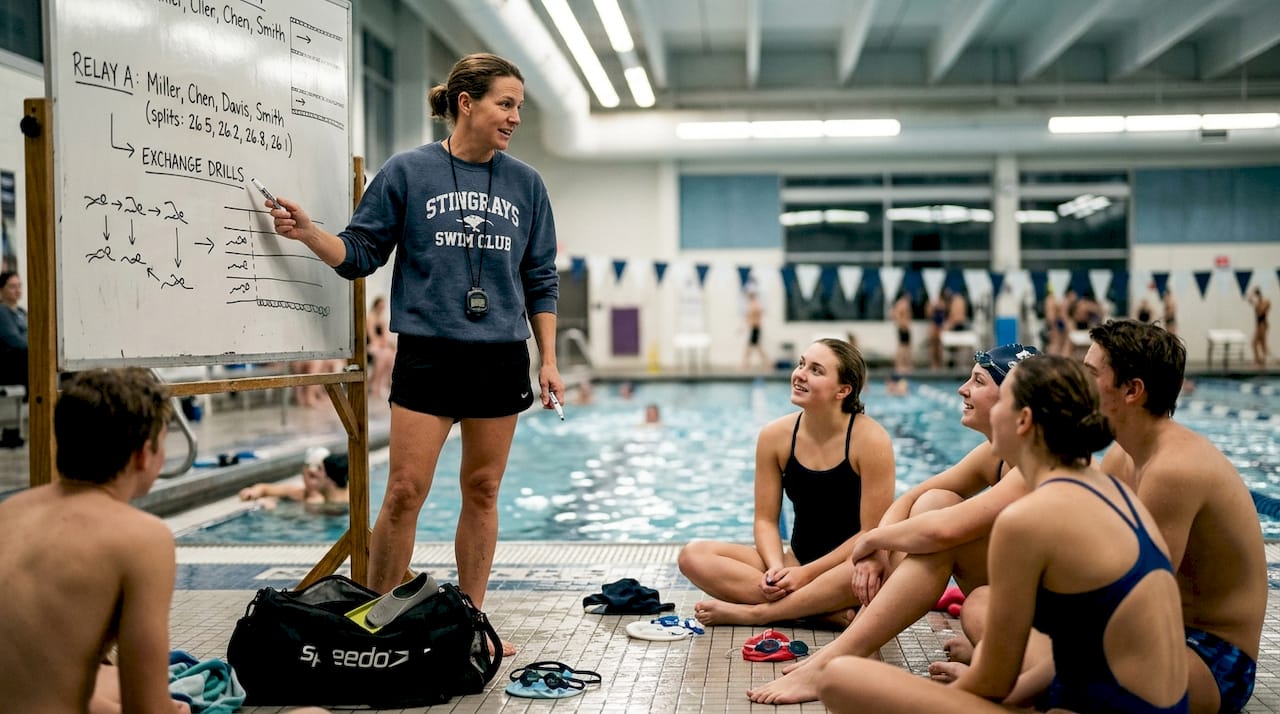
While swimmers play their part, coaches are essential in driving team building every day. A coach’s daily behavior sets the tone for everything that follows. When coaches model respect, consistency, and genuine care for each athlete, swimmers mirror those behaviors with each other.
Coach behaviors that strengthen team bonds include:
- Acknowledging effort, not just results — Praising hard work during a tough set sends a message that the process matters.
- Being consistent with expectations — Applying the same standards to every swimmer removes favoritism and builds trust.
- Inviting athlete input — Asking swimmers for feedback on training structure shows respect and increases buy-in.
- Addressing conflict quickly — Letting tension fester damages culture. Addressing it directly and fairly keeps the team intact.
- Modeling vulnerability — Sharing a mistake or a lesson learned makes coaches more relatable and encourages swimmers to do the same.
Coaches who use positive reinforcement and structured training sessions see measurably improved team cohesion over time. The swim coach workflow matters as much as the sets themselves.
| Coach action | Observed team outcome |
|---|---|
| Consistent positive reinforcement | Increased effort during hard sets |
| Transparent goal-sharing | Higher athlete ownership of results |
| Structured team meetings | Fewer misunderstandings and conflicts |
| Public recognition of group wins | Stronger relay performance |
| Mentorship pairings | Improved confidence in newer swimmers |
Pro Tip: Use team-based goal tracking on a shared board or app. When athletes can see collective progress, they feel more invested in showing up and contributing every day.
Real-world examples: Team building success stories in swimming
It is one thing to discuss theory, but seeing success in action is even more powerful. Here are two cases that illustrate what focused team building can achieve.
A youth club with high dropout rates. A regional youth program was losing swimmers after their first competitive season at a rate that alarmed the coaching staff. The swimmers were talented but disconnected. The coaching team introduced weekly team meetings, a buddy system pairing new swimmers with veterans, and a monthly team dinner. Within one season, retention improved significantly and relay times dropped as athletes began training for each other, not just themselves.
An elite squad underperforming at meets. A college-level squad had strong individual times in practice but consistently underperformed at championship meets. The coaching staff identified a lack of collective identity as the root cause. They restructured training to include more relay-based sets and introduced a team-goal board visible to all athletes. By conference championships, the team’s relay events outperformed their seedings by a meaningful margin.
Factors common to both success stories:
- Clear communication from coaches about team values
- Structured activities that required cooperation, not just proximity
- Recognition of group effort alongside individual achievement
- Consistent follow-through over an entire season, not just a one-time event
Teams that prioritize camaraderie often outperform those focused only on individual achievement — a pattern we have observed across our swim camp success stories over decades of programming.
Why most teams overlook the real power of team building
Here is a perspective many overlook. Most swim programs are built around sets and splits. Coaches spend hours designing training blocks, analyzing stroke mechanics, and planning taper schedules. All of that matters. But the mental and social bonds between swimmers are often what determine whether those physical gains show up on race day.
Team building gets treated as a nice-to-have because it is harder to measure than a 100-meter split. You cannot put camaraderie on a spreadsheet. But the best coaches and swimmers we have worked with at PEAK understand that culture is infrastructure. It is what holds everything else together under pressure.
The teams that win championships are rarely the ones with the most raw talent. They are the ones where every swimmer trusts the person in the next lane. That trust is built deliberately, over time, through the strategies outlined in this article. Motivational advice for swimmers often points to the same truth: belief in your team is belief in yourself.
Treat team building as essential as tapering or technique work. Schedule it. Measure it. Protect it.
Take your swim team to the next level
If this article has shown you anything, it is that team building in swimming is a skill, and like every skill, it improves with the right environment and guidance.

At PEAK Performance Swim Camp, our programs are designed to develop not just faster swimmers but stronger teams. With more than 1000 camps conducted across 18 countries, we have seen what happens when athletes train in a culture of trust and accountability. The results speak for themselves. Explore our swim camp options to find the right fit for your team, or check out our clinic package options for targeted group programming. Your next breakthrough might not come from a faster set. It might come from a stronger team.
Frequently asked questions
What are some easy team-building activities for swim teams?
Some easy activities include relay races, partner drills, group goal-setting sessions, and outside-the-pool social events like team dinners. Structured group activities consistently improve team spirit and cohesion across all age groups.
Can team building really improve individual swim performance?
Yes, a positive team culture boosts motivation, confidence, and consistency, all of which translate into faster race times. Motivated teams achieve more consistent results across both individual events and relays.
How do coaches help develop team spirit among swimmers?
Coaches model supportive behavior, encourage group challenges, and celebrate both group and individual improvements throughout the season. Coaches influence team cohesion most powerfully through structure, consistency, and genuine care for each athlete.
What mistakes should swim teams avoid in team building?
Avoid forced or insincere activities, ignoring individual needs, and failing to follow through after a single event. Effective team culture requires authenticity and consistency over an entire season, not just a one-time bonding exercise.
Recommended
- Top coaching strategies for youth swimmers: skill & performance gains – Peak Performance Swim Camp
- Optimize your swim coach training workflow: 4 key phases – Peak Performance Swim Camp
- Essential mental training tips to boost swim performance – Peak Performance Swim Camp
- How to warm up for swimming: techniques for peak performance – Peak Performance Swim Camp