
TL;DR:
- Flip turns are essential for competitive swimming, with proper technique saving valuable seconds over races. Developing effective flip turns involves building water comfort, mastering open turns, and progressing step-by-step from stationary to race-pace rotations through repetition and drills. Patience and focused practice, supplemented by expert coaching, lead to consistent, race-ready turns that maximize speed and efficiency.
Flip turns separate competitive swimmers from recreational ones. A clean, fast turn can shave half a second or more off every lap split, and over a 200-meter or 400-meter race, those fractions stack into a measurable performance gap. Yet teaching flip turns step by step is where many coaches and self-coached swimmers struggle most, either skipping foundational drills or rushing the progression. This guide walks you through every stage of the process, from the first stationary somersault to a race-pace turn with a powerful push-off and clean breakout.
Table of Contents
- Key takeaways
- Prerequisites before teaching flip turns step by step
- The step-by-step flip turn progression
- Coaching and correcting common mistakes
- Maximizing flip turn efficiency
- My take on what actually works when coaching flip turns
- Take your turns to the next level with Swimcamp
- FAQ
Key takeaways
| Point | Details |
|---|---|
| Build before you flip | Open turns and body comfort in water must come before any flip turn practice. |
| Follow the drill sequence | Progress from stationary somersaults to momentum-based turns before adding wall contact. |
| Fix distance judgment first | Most errors trace back to misjudging when to initiate the flip, not the flip itself. |
| Speed into the wall matters | Maintaining approach speed makes rotation easier and the push-off more powerful. |
| Repetition is the real teacher | Consistent, patient repetition over many sessions is what builds automatic, race-ready turns. |
Prerequisites before teaching flip turns step by step
Before any swimmer attempts a flip turn, a few non-negotiable skills need to be in place. Skipping this foundation is the single most common reason swimmers develop bad habits that are difficult to unlearn later.
Water comfort and basic stroke competency. A swimmer should be able to swim at least 25 meters of freestyle with controlled breathing and consistent stroke mechanics. If a swimmer is still thinking about their arm pull, they cannot simultaneously process the timing and spatial demands of a flip turn. Stroke fundamental swim skills come first.
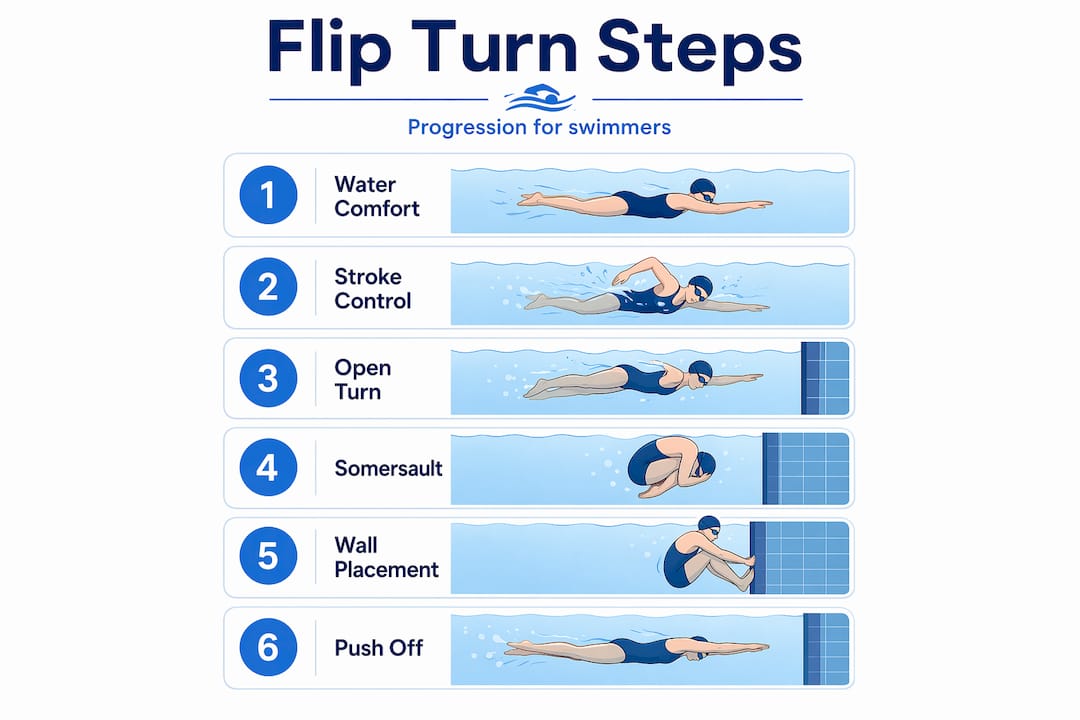
Open turn mastery. The open turn teaches a swimmer to recognize the wall, control their deceleration, and place their feet. That spatial awareness transfers directly to flip turn learning. A swimmer who cannot consistently execute an open turn will struggle to judge flip distance.
Body positioning awareness. Swimmers need a working sense of how their body moves in a horizontal plane and how a tucked position changes rotation speed. Simple tuck floats and front-to-back rolls in open water build this understanding before the wall adds complexity.
Mental readiness. Flip turns feel disorienting at first. Water enters the nose. The world flips upside down briefly. Acknowledging this with swimmers before the first attempt reduces anxiety and prevents the flinching that leads to loose, incomplete tucks.
- Confirm the swimmer can swim a full lap under control
- Verify open turn consistency at race-pace approach speeds
- Practice tuck floats and underwater rolls in deep water
- Discuss what the disorientation will feel like and how to manage it
Pro Tip: Have swimmers practice exhaling through their nose during forward rolls in open water before they ever approach a wall. This eliminates nose water entry as a distraction and lets them focus entirely on body position.
The step-by-step flip turn progression
This is where teaching flip turns step by step becomes genuinely structured. Breaking down the flip turn into an eight-step progression dramatically improves skill mastery and builds confidence at each stage rather than overwhelming the swimmer with the full movement at once.
-
Stationary somersault in deep water. Stand in chest-deep water, tuck your chin, push your head forward and down, and complete a full forward roll. Repeat until the motion feels natural and controlled. This isolates the flip mechanics without any swim approach to manage.
-
Somersault with forward momentum. Take two or three freestyle strokes and then initiate the somersault without a wall present. This teaches the swimmer how forward speed changes the feel of the rotation. Faster momentum means a faster, tighter flip with less muscular effort required.
-
Wall distance practice drill. Stand facing the wall at arm’s length, roughly three to four feet away, and perform a somersault. The goal is to land feet on the wall, not to push off. Kinesthetic wall distance practice trains spatial awareness and is one of the most effective tools for solving the single hardest part of flip turn learning: knowing when to start the rotation.
-
Slow approach swim with feet placement. Swim slowly toward the wall and initiate the flip when you judge you are about an arm’s length away. Focus only on getting both feet planted on the wall. Do not worry about the push-off yet. Slow approach drills combined with positional awareness are proven to increase confidence and accuracy before adding speed.
-
Add the push-off with rotation. Once foot placement is consistent, add the push-off. Your feet plant on your back, and as you drive off the wall, you rotate a quarter turn to bring your body back to a stomach-down position. Feet plant on the back and the rotation happens during the push, not after it. Many swimmers try to rotate before pushing, which kills momentum.
-
Streamline off the wall. After the push-off, arms come together overhead in a tight streamline. Tight streamline after push-off preserves the velocity generated by the turn and extends the underwater glide before the breakout begins. This position is where seconds are either saved or wasted.
-
Add the breakout stroke. Hold your streamline until your speed drops below what your stroke can maintain, then initiate your first freestyle stroke. The transition from streamline to swimming should feel smooth, not jarring. Rushing the breakout is one of the most frequent errors seen in developing swimmers.
-
Build to race pace. Once the full turn is clean at slow speed, gradually increase your approach speed. The faster you approach, the more momentum you carry through the rotation, and keeping speed into the wall makes the entire turn faster and easier to execute.
| Stage | Primary focus | Common error |
|---|---|---|
| Stationary somersault | Body rotation mechanics | Over-rotating past 360 degrees |
| Momentum somersault | Speed into rotation | Slowing down before initiating flip |
| Wall distance drill | Spatial judgment | Planting feet too high or too low |
| Slow approach with feet | Foot placement accuracy | Both feet not making contact simultaneously |
| Push-off with rotation | Quarter-turn body rotation | Rotating before pushing off |
| Streamline | Body alignment off wall | Arms separating or hips sinking |
| Breakout stroke | Transition timing | Breaking out too early and losing glide distance |
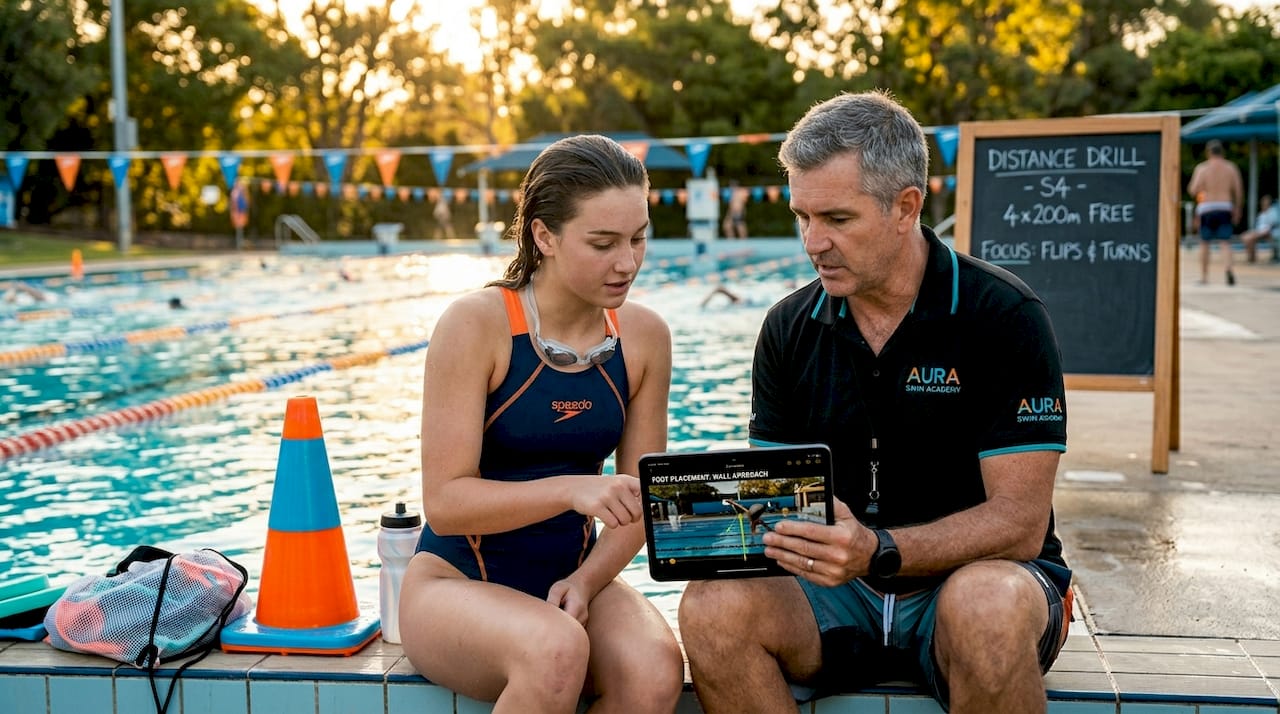
Pro Tip: Film swimmers from the side during wall distance drills. Even a 30-second clip on a phone reveals foot placement errors that are invisible to the naked eye from a pool deck perspective.
Coaching and correcting common mistakes
Even with a solid progression, swimmers will hit predictable sticking points. Knowing what to look for and how to correct it quickly keeps training sessions productive.
-
Slowing down before the turn. This is the most performance-damaging habit. Swimmers instinctively decelerate as they approach the wall. Remind them that approach speed directly transfers to rotation speed. A drill where you call out “fast” as they enter the turn zone helps reinforce momentum.
-
Loose or incomplete tuck. A wide, lazy tuck slows the rotation and forces the swimmer to push off in an awkward position. Cue a tight knee-to-chest pull and chin-to-chest drop simultaneously.
-
Feet too high or too low on the wall. Feet too high mean the push-off sends the swimmer upward. Feet too low mean the swimmer has to fight gravity through the extension. Target mid-wall at roughly the T-junction of the lane line.
-
Rushing the push-off. This is counterintuitive. A patient, explosive push-off generates more speed than a rushed one. Have swimmers hold their feet on the wall for one full count before driving off.
-
Poor streamline transition. Arms that separate at the entry or a head that pops up immediately bleed off the push-off speed. Use dry-land streamline holds to build the muscle memory before adding it to the turn.
The best correction is one specific cue, not three at once. Pick the most impactful error in a session, fix it, and move on. Stacking corrections overloads the swimmer and delays improvement.
Maximizing flip turn efficiency
Once the mechanics are clean, the focus shifts to speed and fluidity. This is where improving flip turns moves from “functional” to “race-ready.”
-
Maximize your last stroke. Ending on a full, complete stroke before initiating the flip preserves momentum better than gliding or catching half a stroke. Practice counting strokes from the flags so you know exactly which arm drives your last pull.
-
Tighten the tuck with core engagement. The rotation is not just a head drop and a hope. Pull your knees to your chest using your abdominals. The tighter the tuck, the faster the rotation, and a faster rotation means feet hit the wall sooner with more control.
-
Measure your push-off distance. Track how far off the wall you surface after a push-off in streamline. Improving this distance over time is a direct indicator of push-off power and streamline quality. Many elite swimmers reach five meters or beyond from the wall.
-
Time your underwater breakout. Hold the streamline through any underwater dolphin kicks until your body speed naturally drops, then transition to your first stroke. Swimmers who break out too early lose the free distance the push-off provides.
-
Repeat at race pace consistently. Flip turns require hundreds of repetitions before they become automatic. Build turns into every main set, not just turn-specific drills. Race pace repetition is what makes the skill instinctive under pressure.
My take on what actually works when coaching flip turns
In my experience, the biggest mistake coaches make when teaching flip turns is treating the turn as one skill instead of two. The timing of the flip initiation and the quality of the tuck are separate problems. When you coach them together, swimmers make compensations. They start the flip at the right distance but panic and open their tuck. Or they keep the tuck tight but initiate a stroke too late. Separating flip initiation timing and push-off streamline during practice sessions fixes this cleanly.
I have also found that patience is genuinely underrated in this skill. Swimmers who drill slowly and carefully for two weeks outperform swimmers who rush to race pace in three days. The nervous system needs repetition at manageable speeds before the pattern locks in. Rushing that process creates a messy turn that then has to be corrected under time pressure.
The motivational piece matters too. Flip turns feel unglamorous to practice. They are not the exciting part of swimming. What I tell every swimmer I work with is this: a clean turn is free speed. You do not have to train harder to earn it. You just have to practice it deliberately and often.
— James
Take your turns to the next level with Swimcamp
If you want expert coaching to accelerate your flip turn development, Swimcamp offers exactly that environment.

PEAK Performance Swim Camp, founded by Olympic coach Nick Baker, has been developing elite swimmers across 18 countries for 30 years. Whether you are a competitive swimmer looking to clean up your technique through private coaching or a coach seeking structured programming, Swimcamp has the tools to help. Video analysis sessions break down exactly where your turn loses time. In-water coaching gives you real-time feedback during live drill sequences. Explore our swim camp programs and clinic packages to find the right fit for your goals this season.
FAQ
What is the first drill for learning flip turns?
The stationary somersault in chest-deep water is the best starting point. It isolates the rotation mechanic without the complexity of a swim approach or wall contact.
How far from the wall should you start the flip?
Most swimmers should initiate the flip when they are roughly one arm’s length from the wall, about three to four feet away. Practicing the wall distance drill builds the spatial judgment needed to judge this consistently.
Why do my feet keep missing the wall?
Foot placement errors almost always trace back to misjudging the flip initiation distance. Start with slow approach drills and wall distance drills before swimming at full speed toward the wall.
How long does it take to master a flip turn?
Flip turns require consistent repetition across many sessions before they become automatic. Most swimmers see a functional turn within two to three weeks of structured daily practice, but refining efficiency can take months.
Does approach speed really matter that much?
Yes. Maintaining speed into the wall directly transfers to rotation speed and push-off power. Slowing down before the flip is one of the most common habits that limits turn performance at every level.
Recommended
- Optimize your swim coach training workflow: 4 key phases – Peak Performance Swim Camp
- What To Look For In A Swim Coach – Peak Performance Swim Camp
- Top coaching strategies for youth swimmers: skill & performance gains – Peak Performance Swim Camp
- Personalized swim coaching: boost skills with tailored training – Peak Performance Swim Camp