
TL;DR:
- Mental training is essential for consistent, high-level swimming performance beyond physical skills.
- Core psychological qualities include resilience, focus, grit, and emotional regulation.
- Regular mental skill practices like visualization and goal-setting enhance race readiness and recovery.
Physical talent gets you to the pool. Mental strength gets you to the podium. Most competitive swimmers train their bodies relentlessly, yet overlook the psychological edge that separates good swimmers from great ones. Mental training is crucial for 86% of elite swimmers, and visualization alone can enhance performance by up to 20%. That gap between physical preparation and mental readiness is where races are won and lost. This guide breaks down exactly what the swimmer mindset is, why it matters, and how you can build it systematically, whether you’re a swimmer chasing a personal best or a coach developing the next generation of competitors.
Table of Contents
- Defining the swimmer mindset
- Why mental resilience matters in swimming
- Core psychological skills for swimmers
- Elite swimmer case studies and mindset lessons
- A fresh perspective: Making mindset training your competitive edge
- Take your mindset to the next level with expert guidance
- Frequently asked questions
Key Takeaways
| Point | Details |
|---|---|
| Mindset is critical | Mental resilience and focus drive competitive swimming performance as much as physical training. |
| Train skills daily | Visualization, goal-setting, and emotional regulation should be practiced every day by swimmers and coaches. |
| Elite role models | Top swimmers like Michael Phelps show that separating emotion from logic and handling setbacks are central to success. |
| Coaches multiply impact | Coach-led mindset training turns psychological skills into a real advantage for competitive athletes. |
Defining the swimmer mindset
The swimmer mindset isn’t a vague motivational concept. It’s a specific set of psychological skills that work alongside physical training to produce consistent, high-level performance. Think of it as the mental infrastructure that holds your physical preparation together when race pressure hits.
At its core, the swimmer mindset combines four essential qualities: resilience, focus, grit, and emotional self-regulation. Resilience means bouncing back from a bad race or a tough practice without losing momentum. Focus means staying locked on your process even when the crowd is loud or your competitor is pulling ahead. Grit is the ability to push through discomfort and keep showing up. Emotional self-regulation means separating how you feel from how you perform.
Here’s how a physical-only approach compares to an integrated physical-mental approach:
| Approach | Strengths | Limitations |
|---|---|---|
| Physical only | Strong conditioning, technique | Breaks down under pressure, inconsistent |
| Integrated physical-mental | Consistent performance, better recovery | Requires deliberate daily practice |
The difference shows up most clearly in competition. Swimmers who train only physically often perform well in practice but struggle to replicate that in races. Those who integrate mental focus in swimming into their daily routine tend to perform closer to their ceiling when it counts.
Core traits of the swimmer mindset include:
- Determination: Committing to the process even when progress feels slow
- Pressure handling: Staying calm and executing under race-day stress
- Separating emotion from logic: Making smart decisions mid-race without panic
- Coach feedback sensitivity: Receiving and applying corrections without ego
- Self-esteem in swimming: Believing in your ability to improve and compete
As Olympic swimmers like Regan Smith and Summer McIntosh have shared, building mental resilience means viewing setbacks as growth opportunities and integrating psychological skills training into every session, not just before big meets.
“Mental toughness isn’t something you either have or don’t. It’s something you train, just like your stroke.”
This mindset shift is foundational. Once swimmers and coaches accept that psychological skills are trainable, the entire approach to preparation changes.
Why mental resilience matters in swimming
Mental resilience isn’t just a soft skill. Research shows it has measurable, direct effects on swim performance. Understanding the data helps coaches and swimmers treat mental training with the same seriousness as yardage and technique work.
Here’s what the research tells us:
| Mental skill | Performance impact |
|---|---|
| Visualization | Up to 20% performance improvement |
| Goal-setting | 16 to 25% improvement in outcomes |
| Mental fatigue | Impairs 400m performance by 3.9% |
| Psyching-up routines | Improves cognitive performance and mood |
These numbers are significant. A 3.9% impairment from mental fatigue alone can be the difference between making a final and missing it. Mental fatigue increases perceived effort without any actual physiological change, meaning your body is capable but your mind tells you it isn’t.
Building resilience is a step-by-step process. Here’s how elite swimmers approach it:
- Identify mental weak points: Notice where focus breaks down, whether it’s the start, the turn, or the final 50 meters.
- Simulate race stress in practice: Replicate pressure situations so they feel familiar on race day.
- Reframe setbacks immediately: After a poor performance, identify one specific lesson before leaving the pool deck.
- Use goal-setting for swimmers consistently: Set process goals, not just outcome goals, to keep motivation grounded.
- Review and adjust: Treat mental performance like split times. Track it, analyze it, and improve it.
Pro Tip: In practice, deliberately create uncomfortable scenarios. Swim the final 100 meters of a set at race pace after you’re already fatigued. This trains your mind to stay focused when your body wants to quit, which is exactly what happens in competition.
Swimmers who use mental training tips consistently report stronger confidence going into races, faster recovery from mistakes mid-race, and better execution of race plans under pressure. The data backs this up, and the elite swimmers who prioritize it confirm it.
Core psychological skills for swimmers
Knowing that mental training matters is one thing. Knowing exactly what to train is another. There are four core psychological skills every swimmer should develop: visualization, goal-setting, psyching-up, and emotional regulation.
Visualization means mentally rehearsing your race in vivid detail before you swim it. You see the start, feel the water, execute every turn, and finish strong, all in your mind. Done consistently, this builds neural pathways that make the actual race feel familiar rather than foreign.
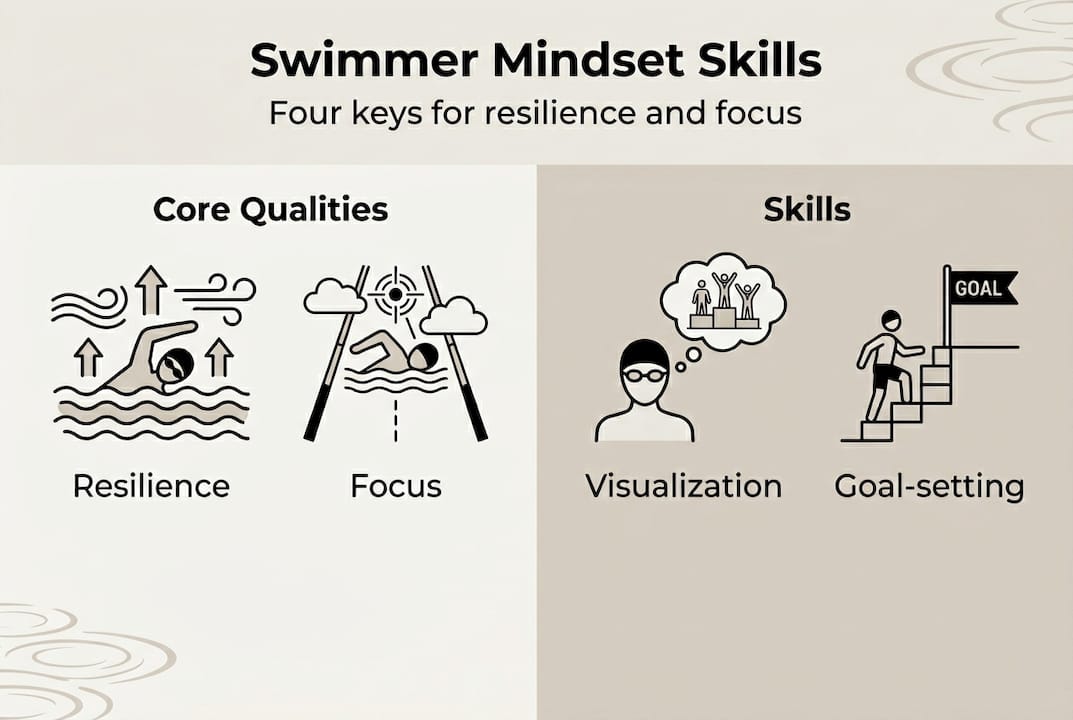
Goal-setting works best when it’s specific and layered. Set long-term outcome goals (drop two seconds in the 200 freestyle), medium-term performance goals (nail your underwater dolphin kicks off every wall), and short-term process goals (focus on breathing pattern in today’s practice).
Psyching-up refers to pre-race activation routines that bring your energy and focus to the right level. This might be music, a physical warm-up ritual, or a specific breathing sequence. Research shows psyching-up improves cognitive performance and mood before competition.
Emotional regulation is the ability to notice a feeling, like anxiety or frustration, and choose not to let it drive your behavior. This is especially important after a bad start or a disqualification.
Pro Tip: Spend five minutes before every race visualizing your perfect swim. Don’t just picture the outcome. Walk through each phase of the race: your dive, your first stroke cycle, your breathing pattern, your turns, and your finish. This mental rehearsal builds confidence that no pep talk can replicate.
Recommended daily mindset drills include:
- Morning intention setting: Write one process goal for the day’s practice
- Mid-practice check-ins: Pause briefly to assess focus level and reset if needed
- Post-practice reflection: Note one mental win and one area to improve
- Breathing exercises: Use diaphragmatic breathing to reduce pre-race anxiety
- Self-worth in swimming journaling: Reinforce identity as a capable, improving athlete
As research on mental toughness shows, achievement goal orientation boosts perceived performance through a chain of self-efficacy, commitment, and grit that explains 76.6% of the effect. That means how you think about your goals directly shapes how capable you feel and how hard you push.
Elite swimmer case studies and mindset lessons
Theory is useful. Seeing it applied by the world’s best swimmers is even more powerful. Let’s look at how elite competitors have used mindset strategies to overcome real challenges.
Michael Phelps is the most decorated Olympian in history, but his mental journey was far from smooth. He worked closely with his coach Bob Bowman on a practice called “watching the videotape,” which was a visualization routine where Phelps mentally replayed his perfect race before sleeping and upon waking. When his goggles filled with water at the 2008 Beijing Olympics, he didn’t panic. He had already swum that race hundreds of times in his mind, and he finished with a world record.
Regan Smith offers a different but equally instructive example. After setbacks in major competitions, she has spoken openly about the importance of separating emotion from logic in the immediate aftermath of a poor race. Rather than letting disappointment spiral into self-doubt, she processes the emotion, identifies what she can control, and refocuses on her process.
Three critical lessons from elite swimmer case studies:
- Preparation eliminates panic: When you’ve mentally rehearsed adversity, it stops feeling like a crisis and starts feeling like a problem you’ve already solved.
- Grit is a practiced response: Elite swimmers don’t naturally bounce back faster. They’ve trained themselves to reframe setbacks quickly and deliberately.
- Coach feedback is a tool, not a verdict: The best swimmers treat correction as data, not criticism. This emotional separation is a skill that takes time to develop.
A Q-study of elite swimmers identified three dominant mindset profiles: determination-focused, pressure-handling, and emotionally regulated. The most successful competitors tend to score high across all three, not just one. This reinforces why competitive success fundamentals include mental skills alongside stroke mechanics and race strategy.
“The swimmers who handle pressure best aren’t fearless. They’ve just learned to compete alongside the fear.”
Building mental focus in swimming takes the same consistency as building aerobic capacity. You don’t get fit from one hard workout, and you don’t build mental resilience from one visualization session.
A fresh perspective: Making mindset training your competitive edge
Here’s an honest observation after decades of working with competitive swimmers: most coaches spend 95% of their planning time on physical and technical preparation, and maybe 5% on mental skills. That ratio needs to change.
Mental toughness isn’t just a trait some swimmers are born with. Research confirms it’s multidimensional, partly trait-like but also highly coach-dependent. That means coaches have direct influence over how mentally tough their swimmers become. Ignoring that influence isn’t neutral. It’s leaving performance on the table.
The swimmers who gain the most from mental training are often the ones who aren’t the most physically gifted. They use mindset work to close the gap and then widen it. For youth swimmers especially, building mental habits early creates a foundation that physical development builds on top of, not the other way around.
Treating mental fatigue and emotional setbacks with the same urgency as a stroke flaw is not a soft approach. It’s a smarter one. Explore mental training tips and start treating the mind as the primary performance organ it actually is.
Take your mindset to the next level with expert guidance
Understanding the swimmer mindset is a strong first step. Applying it consistently, under the guidance of coaches who specialize in both technique and mental preparation, is where real breakthroughs happen.

At PEAK Performance Swim Camp, we’ve spent 30 years integrating mental skills training into every aspect of our programs. Our elite swim camps are designed to develop the full athlete, physically and psychologically. If you’re looking for targeted mental skills work, our mental skills clinics offer focused sessions on visualization, goal-setting, and pressure management. For swimmers and coaches who want a deeper framework, our mental strategy coaching program provides structured, expert-led development that translates directly to race-day performance.
Frequently asked questions
What are the key components of a swimmer mindset?
A swimmer mindset includes resilience, focus, determination, emotional regulation, and sensitivity to coach feedback. Elite swimmers like Michael Phelps and Regan Smith demonstrate all of these traits in how they handle pressure and setbacks.
How does mental training improve swim performance?
Mental training builds confidence, sharpens focus, and strengthens resilience, with visualization improving performance by up to 20% and goal-setting contributing gains of 16 to 25%.
What practical mental skills should swimmers train daily?
Swimmers should practice visualization, goal-setting, emotional regulation, and psyching-up routines every day. Daily psychological skills training is what coaches like those working with Regan Smith and Summer McIntosh recommend for sustained improvement.
Why is coach support important for mindset development?
Coaches shape the training environment and can deliberately build mental resilience through structured challenges. Coach-guided resilience building helps swimmers handle pressure and maintain focus across an entire season.
Can mental fatigue affect swimming races?
Yes. Mental fatigue impairs performance by increasing perceived effort without any physiological change, meaning your body can go faster but your mind convinces you it can’t.