
TL;DR:
- Team dynamics significantly influence swimmer motivation, performance, and longevity in competitive swimming. Building cohesion, peer support, effective leadership, and open communication creates a resilient, high-performing team culture. Implementing inclusive leadership, strategic relay lineup, and ongoing team building enhances both individual growth and collective success.
Many swimmers and parents assume competitive swimming is purely an individual pursuit. You train alone, you race alone, and your results reflect your personal effort. But that view misses something essential. Team dynamics, meaning the relationships, communication patterns, leadership structures, and shared beliefs within a swim group, shape how hard swimmers push, how long they stay in the sport, and how well they actually perform when it counts most. Understanding these dynamics gives you a real advantage, both in the water and in the team culture you help build every day.
Table of Contents
- What are swim team dynamics?
- How team dynamics boost performance and resilience
- Team dynamics in action: Relays, training, and communication
- Expert insights: Leadership, empathy, and psychological tools
- Why most swim teams miss the mark—and what actually works
- Enhance your swim team experience with expert coaching
- Frequently asked questions
Key Takeaways
| Point | Details |
|---|---|
| Peer support matters | Building peer support boosts mental toughness and self-efficacy for swimmers. |
| Cohesion drives performance | Unified teams perform better and experience fewer dropouts than fragmented groups. |
| Distributed leadership works | Sharing leadership roles increases empathy and prevents cliques among swimmers. |
| Communication prevents conflict | Clear communication and inclusion strategies reduce tension and improve cohesion. |
| Psych interventions improve enjoyment | Mental training techniques raise attention and enjoyment, benefitting both individuals and teams. |
What are swim team dynamics?
Swim team dynamics refer to the invisible forces that connect swimmers to one another and to their coaches. These forces operate in every practice, every meet, and every team conversation. When they work well, they create a training environment where swimmers push each other to grow. When they break down, even the most talented pool can underperform.
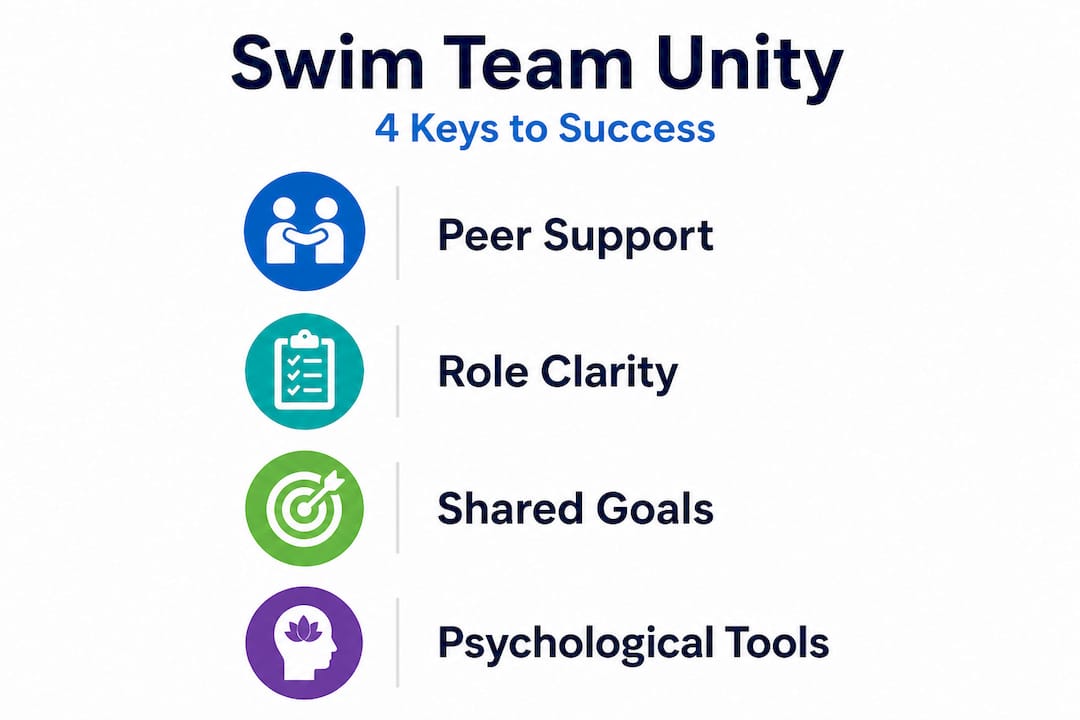
The four core components of healthy team dynamics are:
- Cohesion: The degree to which swimmers feel bonded to the group and committed to shared goals
- Peer support: Active encouragement, feedback, and emotional backing among teammates
- Leadership: Clear guidance from coaches and swimmer leaders, shared across the team
- Communication: Open, honest dialogue that includes listening, conflict resolution, and inclusion
Each of these elements reinforces the others. Cohesion grows when communication is strong. Peer support deepens when leadership is distributed and fair. Together, they create a team culture that is greater than the sum of its individual swimmers.
One of the most important psychological bridges in team dynamics is self-efficacy, which is a swimmer’s belief in their own ability to succeed. Research involving 161 adolescent swimmers found that peer support predicts mental toughness through self-efficacy mediation, with a total effect of β=0.21 and an indirect effect of β=0.11. In practical terms, this means that when swimmers feel supported by their peers, they develop greater confidence in themselves, and that confidence directly fuels their mental toughness under pressure. You can read more about how resilience in swimmers connects to these psychological foundations.
“Peer support does not just feel good. It measurably predicts mental toughness through a swimmer’s growing belief in their own ability.”
This finding has major implications for parents and coaches. Creating a culture of genuine encouragement is not a soft extra. It is a performance strategy. And it connects directly to self-esteem in swimming, which shapes how swimmers handle setbacks, respond to coaching, and sustain motivation across a long season.
How team dynamics boost performance and resilience
Strong team dynamics do more than make practice enjoyable. They reduce dropout rates, sharpen mental toughness, and improve actual performance outcomes. Swimmers in cohesive teams simply last longer in the sport and perform better under pressure.
The benchmarks are clear: high cohesion lowers dropout rates, boosts resilience, and helps swimmers build toughness through peer-supported self-efficacy. On the flip side, role ambiguity, which is when swimmers are unclear about their responsibilities or standing on the team, directly harms unity and can unravel even a talented group.
Researchers studying collective performance have found that cohesion predicts team mental models and collective efficacy, which in turn predict perceived performance potential (PPP). In one study of 340 athletes, PPP correlated with season record at r=0.77, with R²=0.59. While this research was conducted with soccer players, the psychological mechanisms of cohesion and collective belief are well-recognized across team sports, including competitive swimming.
High-functioning swim teams tend to show a consistent set of benefits:
- Swimmers set and pursue more ambitious goals
- Recovery from poor performances is faster and healthier
- Coaches spend less time managing conflict and more time teaching technique
- Individual swimmers feel accountable to one another, which raises training quality
- Team morale stays high even during a difficult competitive stretch
Pro Tip: Role clarity is one of the fastest ways to boost cohesion. Make sure every swimmer on your team knows their role, whether they are a sprint anchor, a development swimmer, or a relay starter. Ambiguity creates anxiety. Clarity creates confidence.
Investing in team building in swimming is not a seasonal activity to do before championships. It is an ongoing practice that pays dividends throughout the year. And the payoff in building mental resilience shows up not just on the scoreboard but in the long-term development of every swimmer in the group.
Team dynamics in action: Relays, training, and communication
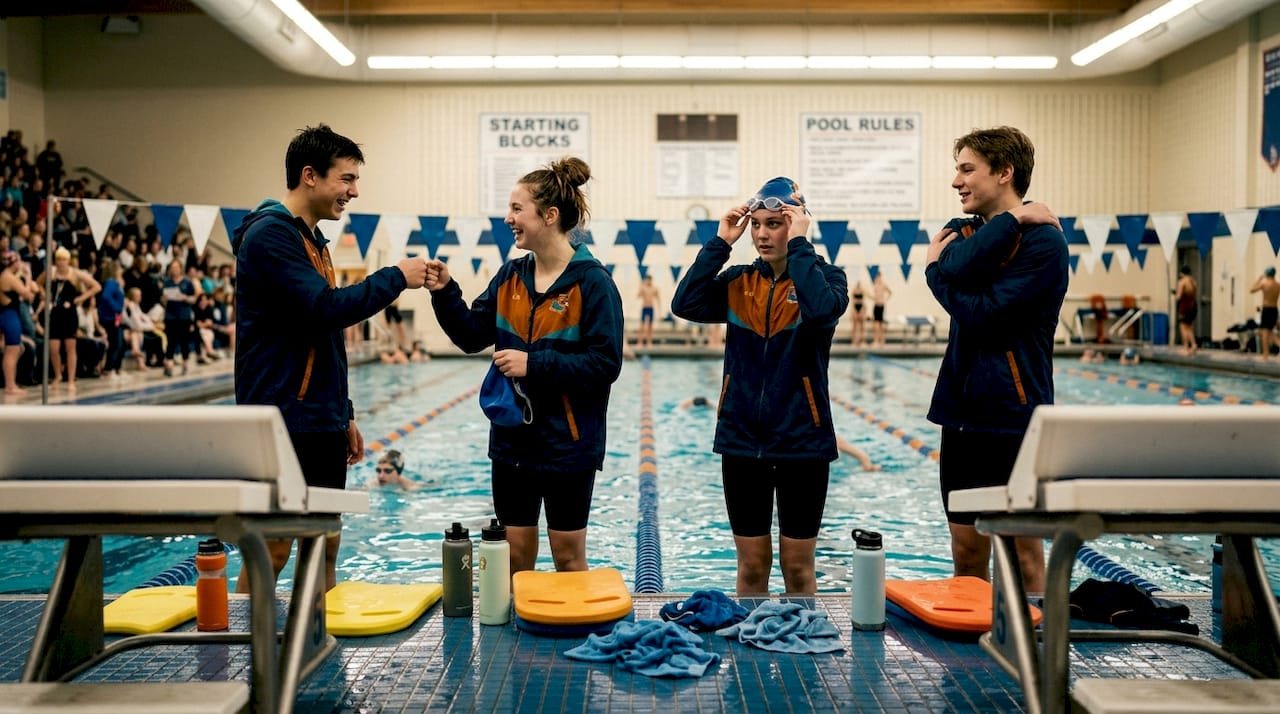
Few moments in competitive swimming illustrate team dynamics more visibly than a relay race. Every split second matters, and the decisions made before the race, such as swimmer order, preparation, and collective focus, can determine whether a team climbs the podium or falls short.
An analysis of 716 relay finals revealed that team finishing position was predicted by three primary factors: differential time to the fastest swimmer (mean decrease in Gini, MDG=31.3), average world rankings of the swimmers (MDG=18.9), and swimmer order (MDG=6.9). These numbers tell a powerful story. Raw speed matters most, but strategic placement of swimmers within the relay order has a measurable and significant effect on outcomes.
| Factor | MDG Score | What it means |
|---|---|---|
| Differential time to fastest | 31.3 | Closing the gap between all four swimmers’ speeds matters most |
| Average world ranking | 18.9 | Overall team caliber strongly predicts final position |
| Swimmer order | 6.9 | Strategic positioning within the relay has measurable impact |
This data reinforces why communication and strategy sessions before relays are so valuable. Coaches and swimmers who discuss order, pacing strategy, and mutual accountability perform better than those who just line up and swim.
Communication breakdowns are one of the most common and damaging problems in team sports. Research on team cohesion has found that coach emotional swings and player subgroups cause communication deficits and poor cohesion. When a coach reacts inconsistently or when cliques form among swimmers, the whole team suffers. The solution is not complicated, but it does require intention.
Here is a straightforward process for resolving communication issues on a swim team:
- Create open forums. Give swimmers a regular, low-pressure setting to share concerns without fear of judgment.
- Practice active listening. Coaches and team leaders should listen first, respond second. This models the behavior you want.
- Address subgroups early. If cliques are forming, introduce cross-group activities in practice to rebuild connection.
- Establish conflict resolution norms. Agree as a team on how disagreements will be handled. Write it down if needed.
- Include every swimmer. Especially newer or younger members who may feel invisible. Inclusion is not optional.
You can build these habits by exploring specific communication tips designed for swim teams. Paired with structured team building strategies, these practices can transform the culture of a team within a single season.
Expert insights: Leadership, empathy, and psychological tools
The most advanced swim teams do not rely on a single captain to carry team culture. They distribute leadership, build empathy through intentional practices, and use psychological tools to sharpen performance. These strategies represent the difference between a good team and a truly great one.
| Leadership model | Effect on unity | Effect on empathy |
|---|---|---|
| Distributed leadership | High: multiple voices, shared accountability | Strong: rotating roles builds perspective |
| Traditional single-captain | Moderate: depends heavily on one person’s style | Variable: can create distance between captain and others |
According to expert analysis, developing distributed leadership means placing unofficial “captains” in every lane, praising peers rather than only praising individual achievement, and rotating leadership roles so every swimmer develops responsibility and empathy. This approach actively prevents the clique formation and isolation that undermines so many teams.
Rotating roles works because it forces swimmers to see the sport through each other’s eyes. The sprinter who has to organize a warm-up drill for distance swimmers quickly learns empathy. The younger swimmer given a leadership moment in a relay briefing grows in confidence. These small, deliberate actions accumulate into a powerful team identity.
On the psychological side, research published in PMC found that psychological interventions combining psyching-up techniques with cognitive challenges measurably improve attention, reaction time, and enjoyment in adolescent swimmers without adding physiological strain. This means coaches can use these tools before races and tough training sets without worrying about overloading swimmers physically.
Psyching-up might involve team chants, visualization sequences, or structured breathing before a relay. Cognitive challenges during practice, like split-time guessing games or tactical problem-solving, keep swimmers mentally sharp while building team engagement. These tools align naturally with mental training tips used by elite coaches and are fully accessible to youth programs as well.
Pro Tip: Try a “peer praise” moment at the end of each practice. Have two or three swimmers publicly acknowledge something a teammate did well that day, no matter how small. This costs nothing, takes two minutes, and systematically builds the kind of empathy and cohesion that shows up powerfully on race day.
For parents and coaches looking to apply these principles with younger athletes, the strategies found in youth swimmer coaching strategies provide a strong starting framework. The psychological foundations are the same at every level; the execution adapts to age and experience.
Why most swim teams miss the mark—and what actually works
After more than 30 years of watching swim teams succeed and struggle, the pattern is unmistakable. Most teams that underperform do not fail because of bad swimmers. They fail because of poor culture. And poor culture almost always traces back to the same root causes: one overloaded leader, informal cliques that nobody addresses, and a communication style that relies on instruction rather than conversation.
The lone-leader model feels efficient. You appoint one captain, or rely on one dominant coach voice, and assume the culture will take care of itself. It rarely does. That one leader carries too much weight, and when they have a bad week or graduate out of the program, the team loses its anchor entirely. This is not leadership. It is a single point of failure dressed up as tradition.
What actually works is what the research consistently supports: distributed leadership paired with intentional empathy-building and proactive communication. When effective swim team building is treated as a structured practice rather than a side effect of good seasons, teams become more self-sustaining, more resilient, and more enjoyable for everyone involved.
The other piece that most teams overlook is listening. Coaches who bark orders and move on are training compliance, not cohesion. Swimmers who feel genuinely heard become invested. They take ownership. They hold each other accountable in ways no coach can manufacture through authority alone. The single most underrated coaching skill in competitive swimming is the ability to sit down, ask a question, and actually wait for the answer.
We have seen this play out in camps across 18 countries. The teams that return year after year with stronger results are almost never the ones with the most raw talent. They are the ones where swimmers genuinely care about each other’s success. That is not accidental. It is built, intentionally, through the tools and strategies this article has laid out.
Enhance your swim team experience with expert coaching
Understanding team dynamics is the first step. Applying them under the guidance of experienced coaches accelerates everything.
At PEAK Performance Swim Camp, founded by Olympic coach Nick Baker and backed by over 50 years of coaching experience across more than 1,000 camps in 18 countries, we have built our entire approach around the psychological, technical, and team elements that drive real performance. Our swim camps are designed to strengthen both individual skills and team culture in a focused, high-performance environment. For those who want personalized feedback, our video analysis and coaching program gives swimmers and coaches a clear picture of technical progress. And with our virtual coaching for swimmers, you can access expert guidance no matter where your team trains.
Frequently asked questions
How do swim team dynamics differ from individual sports?
Team dynamics in swimming foster peer support, cohesion, and collective resilience that are less common in purely individual sports. Research with 161 adolescent swimmers shows that peer support predicts mental toughness through self-efficacy mediation, making team culture a measurable performance factor.
What are the signs of poor team dynamics among swimmers?
Common signs include clique formation, frequent interpersonal conflict, low motivation, declining communication, and rising dropout rates. Research confirms that coach emotional swings and player subgroups directly cause communication deficits and fragmented cohesion.
How can coaches help improve swim team cohesion?
Coaches should foster inclusion, rotate leadership roles, praise peer effort publicly, and address conflicts quickly and directly. Distributed leadership development has been identified as one of the most effective structural strategies for building lasting cohesion.
Do psychological interventions really make a difference for swim teams?
Yes. Psyching-up combined with cognitive challenges measurably improves attention, reaction time, and enjoyment in adolescent athletes without adding physiological strain, making these tools both safe and highly effective.
What is the role of swimmer order in relay success?
Swimmer order is a statistically significant factor in relay outcomes. An analysis of 716 relay finals found that order placement had an MDG of 6.9, meaning strategic lineup decisions consistently influence final standings beyond raw individual speed alone.
Recommended
- Team building in swimming: 5 strategies that work – Peak Performance Swim Camp
- Swim team communication tips that drive real results – Peak Performance Swim Camp
- Individualized swim plans: unlock elite performance – Peak Performance Swim Camp
- Motivational Message for Swimmers – Peak Performance Swim Camp
- Unlock Faster Recovery: Proven Strategies After Every Workout – Coldture Wellness