
TL;DR:
- Effective communication builds trust, improves team performance, and reduces conflicts in swim teams.
- Implementing clear protocols like the chain of communication and 24-hour rule prevents misunderstandings.
- Building genuine relationships and trust is more impactful than just tools and policies.
A missed heat assignment. A parent confronting a coach poolside after a tough meet. A swimmer who quietly stops showing up because they felt unheard. These scenarios play out on swim teams across the country every season, and almost every one of them traces back to the same root cause: a breakdown in communication. When swimmers, coaches, and parents aren’t operating from the same playbook, confusion becomes conflict, and conflict chips away at performance. The good news is that structured, intentional communication strategies can prevent most of these problems before they start, and the evidence behind them is stronger than you might expect.
Table of Contents
- Why effective communication matters in swim teams
- Preparing your team: Protocols and tools for smooth communication
- Executing clear communication: Step-by-step strategies for swimmers, coaches, and parents
- Common communication pitfalls (and how to avoid them)
- Verifying success: Measuring and improving swim team communication
- The real secret to communication: What most swim teams miss
- Take your swim team communication to the next level
- Frequently asked questions
Key Takeaways
| Point | Details |
|---|---|
| Follow clear protocols | Always use the chain of communication and 24-hour rule for respectful, structured interactions. |
| Regular check-ins work | Consistent meetings and updates keep everyone on the same page and build trust. |
| Empathy beats rulebooks | Understanding and honest feedback are as crucial as formal communication tools. |
| Measure and adapt | Evaluate your team’s communication regularly and adjust your approach when needed. |
Why effective communication matters in swim teams
Strong communication is not just a nice-to-have. It is the foundation that holds a competitive swim team together. Research consistently shows that coach-athlete communication predicts team performance better than individual skill levels alone, and that targeted motivation interventions can measurably improve persistence and reduce dropout rates. That is a significant finding, because it means a team full of technically talented swimmers can still underperform if the communication structure is broken.
What does that look like in practice? Think about the swimmer who is unclear on her lane assignment the day of a meet and spends the warm-up distracted and anxious. Or the parent who misinterprets a coach’s feedback and sends an emotional text that damages trust right before the season’s biggest competition. Small miscommunications compound quickly in a high-stakes environment.
The flip side is equally powerful. Positive coach-athlete relationships enhance emotional intelligence and team engagement, with research showing a chained mediation effect (β=0.014, p<0.001) connecting communication quality to team performance outcomes. In plain language, when coaches and swimmers connect well, the whole team runs better.
Here are some concrete benefits teams report when communication is handled well:
- Higher swimmer retention from season to season
- Fewer conflicts between parents and coaching staff
- Clearer expectations around training and competition
- Stronger team culture and accountability
- Better individual performance under pressure
Understanding the elite coaching advantages that come from structured communication helps coaches set the right priorities from day one. And for families new to competitive swimming, learning youth swimmer coaching strategies that include communication as a core component makes a measurable difference in how smoothly a season runs.
“When coaches invest in relationships, not just results, teams develop a culture where swimmers feel safe to struggle, grow, and ultimately perform at their best.”
With the stakes clear, let’s look at what you need to foster effective communication on your team.
Preparing your team: Protocols and tools for smooth communication
Before a single practice is held, your team needs a clear communication structure. Think of it like lane lines in the pool. They don’t restrict swimmers; they create order so everyone moves efficiently. One of the most effective structural tools is the chain of communication.
According to a practical coaching communication guide, the chain of communication works like this: the swimmer speaks with the coach first when there is a concern. If the issue isn’t resolved, the parent can then step in to follow up, always through proper channels rather than by approaching the coach directly during practices or meets. This simple hierarchy prevents a huge percentage of conflicts before they escalate.
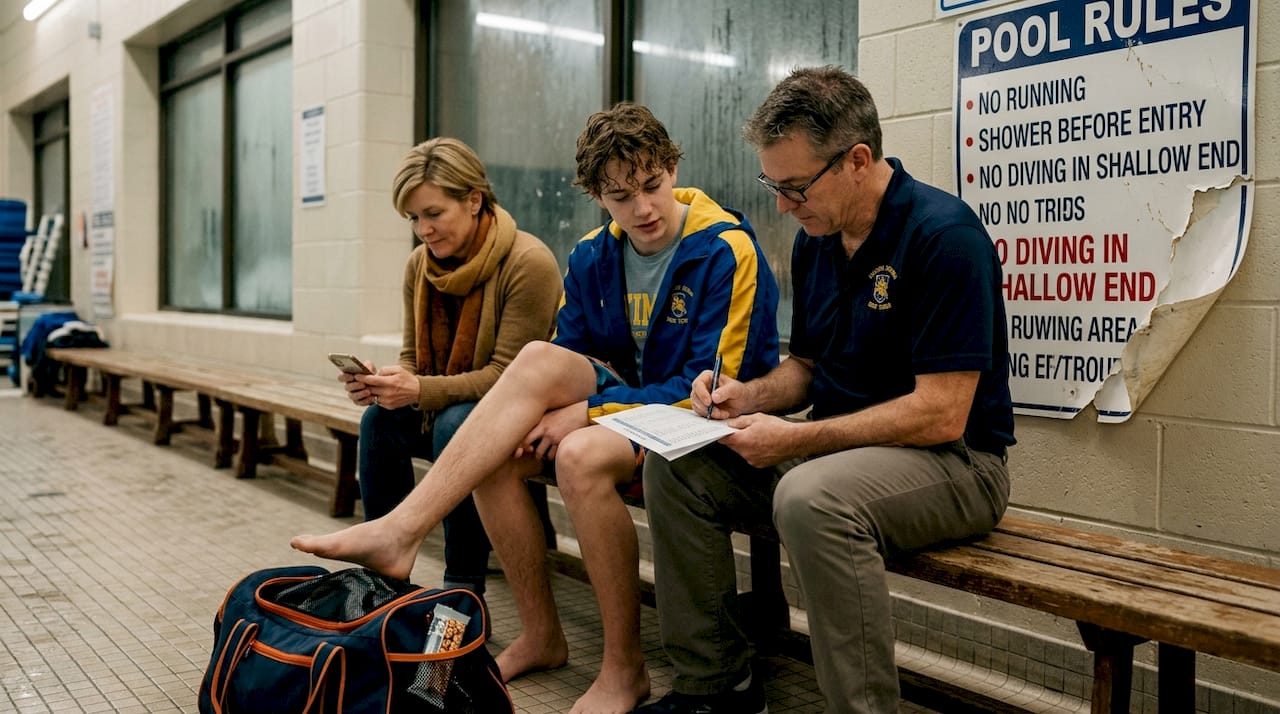
Another non-negotiable protocol is the 24-hour rule. No parent or swimmer should reach out to a coach immediately after a meet or practice to address a concern. Emotions run hot in competitive environments. Giving everyone 24 hours to cool off before discussing an issue transforms what could be a confrontation into a productive conversation.
Here is how to set up your communication protocols from the start of the season:
- Define the chain of communication in writing and share it with all families at the first team meeting.
- Introduce the 24-hour rule as a team-wide expectation, not a suggestion.
- Assign parent volunteer roles with clear responsibilities so energy stays channeled in positive directions rather than drifting into coaching territory.
- Create a single, shared communication channel (team app, group email, or messaging platform) so announcements aren’t fragmented across multiple platforms.
- Schedule regular coach updates so parents and swimmers aren’t left guessing about scheduling, expectations, or performance feedback.
Here is a quick comparison of commonly used communication tools:
| Tool | Best for | Limitations |
|---|---|---|
| Team mobile app (e.g., TeamSnap) | Scheduling, attendance, announcements | Requires consistent use by all parties |
| Email newsletters | Detailed updates, policy communication | Can be ignored or buried in inboxes |
| Private group chat (e.g., GroupMe) | Quick, informal updates | Risk of off-topic or emotional exchanges |
| In-person team meetings | Building culture, resolving concerns | Time-intensive, hard to schedule for all |
| Feedback forms or surveys | Anonymous feedback from swimmers/parents | Requires follow-through on responses |
Good team building strategies always start with this kind of structural preparation. When everyone knows the rules of engagement, trust grows naturally.
Pro Tip: At the start of each season, host a brief “communication kickoff” meeting where you walk families through your protocols, introduce the tools you’ll use, and answer questions. Setting expectations early saves hours of conflict later.
Executing clear communication: Step-by-step strategies for swimmers, coaches, and parents
Protocols on paper only work if people actually follow them. Here is how each group can put communication into practice on a day-to-day basis.
For coaches:
- Open every practice with a brief verbal agenda so swimmers know what to expect.
- Use specific, behavior-focused praise rather than generic feedback. “Your flip turn timing improved significantly today” lands better than “good job.”
- Send a weekly written summary of training goals, meet schedules, and any adjustments so parents and swimmers stay aligned.
- Address swimmer concerns promptly and privately, not in front of the group.
For swimmers:
- Bring concerns to your coach directly, and do it at an appropriate time (not mid-set or right after a race).
- Practice asking for feedback with specific questions. “Can you show me what I’m doing wrong on my butterfly pullout?” gets better results than “I don’t know why I’m slow.”
- Take ownership of your motivation as a swimmer and let your coach know when something isn’t working.
For parents:
- Trust the coach’s process, especially during the early weeks of the season when adjustments are being made.
- Use the team’s official communication channel for questions, not sideline conversations.
- Reinforce your swimmer’s confidence at home rather than second-guessing coaching decisions at the pool.
The impact of following these steps is significant. Here is a side-by-side comparison of how teams function with and without communication protocols:
| Situation | Without protocols | With protocols |
|---|---|---|
| Parent has a complaint | Approaches coach poolside after a meet | Waits 24 hours, emails through official channel |
| Swimmer is confused about lineup | Asks teammates and guesses wrong | Checks team app or asks coach during appropriate time |
| Conflict between coach and parent | Escalates publicly, affects team morale | Resolved privately using the chain of communication |
| Swimmer feels overlooked | Loses motivation, attendance drops | Brings concern to coach, issue addressed early |
Clear protocols also prevent a well-documented problem: mixed signals that undermine coaching authority. When parents offer contradictory advice at home based on what they think they saw at practice, swimmers end up confused. Personalized coaching that accounts for each swimmer’s individual needs requires that the athlete and coach are aligned, not pulled in different directions by well-meaning but uninformed input.
Pro Tip: Use written updates after key conversations or decisions. A quick follow-up message that says “Just to confirm what we discussed: your swimmer will move to the 200 free heat on Saturday” prevents misunderstandings and shows professionalism.
Common communication pitfalls (and how to avoid them)
Even teams with solid protocols will occasionally run into friction. Knowing the most common pitfalls makes it much easier to catch them early.
Here are the most frequent communication problems and how to correct them:
- Parents bypassing the chain: This usually happens when a parent feels their concern isn’t being heard. Reinforce the process at team meetings and remind everyone that the chain exists to protect the swimmer, not to create barriers.
- Heated conversations after meets: This is where the 24-hour cooling period becomes essential. Coaches should be prepared to say, “I’d love to discuss this with you. Let’s connect tomorrow when we’ve both had time to reflect.”
- Mixed signals from multiple adults: When a parent, coach, and assistant coach all tell a swimmer something different, trust erodes fast. Designate one primary communication point per swimmer.
- Vague praise or feedback: Saying “you did great” after a poor performance might feel kind, but it leaves swimmers without direction. Be honest and specific.
- Silence from the coaching staff: If parents and swimmers don’t hear from the coach for extended periods, anxiety fills the gap. Regular scheduled updates are far better than sporadic communication.
“The 24-hour rule isn’t about avoiding difficult conversations. It’s about making sure those conversations are worth having.”
This is also a good place to revisit your team’s goal-setting process. When swimmers have clear, measurable goals that have been discussed openly with their coach, they have a communication anchor. Conversations are no longer about vague feelings of frustration. They become focused on specific, trackable outcomes.
Verifying success: Measuring and improving swim team communication
Knowing your protocols exist is not the same as knowing they are working. You need actual feedback to assess whether communication on your team is effective.
Here is a structured approach for doing exactly that:
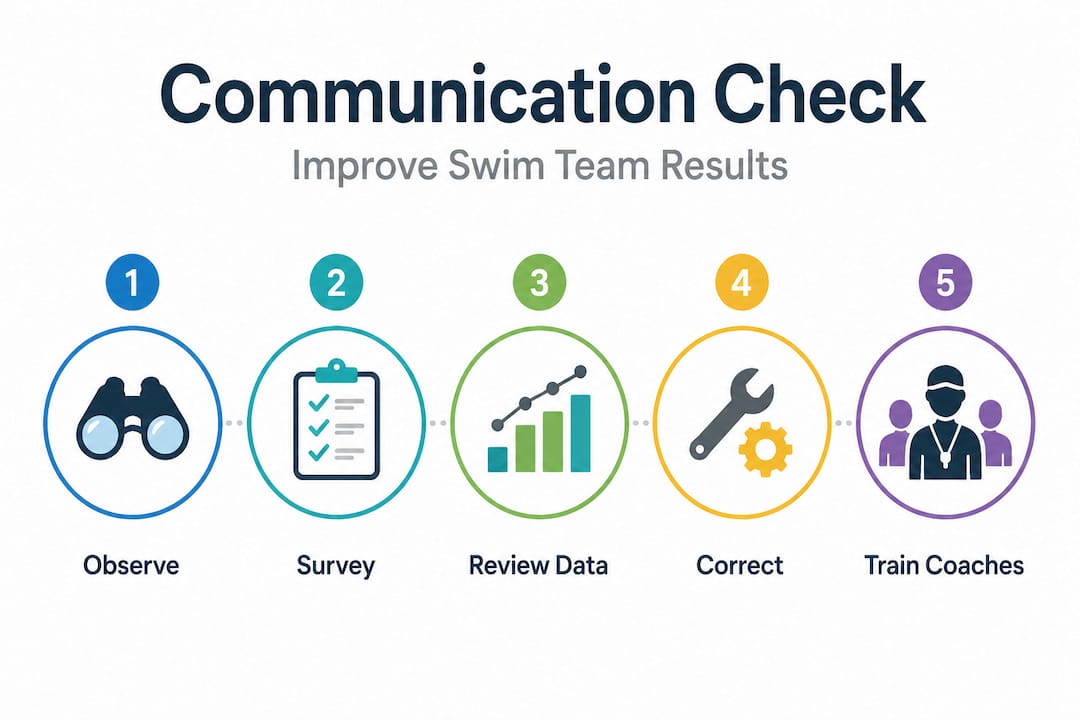
- Conduct anonymous surveys at the midpoint and end of each season. Ask swimmers and parents whether they feel heard, informed, and clear on team expectations. Keep the questions specific.
- Hold regular team meetings (monthly or after major meets) that include open time for questions and feedback from swimmers.
- Track attendance and retention rates across seasons. Declining participation often signals communication problems before they become visible conflicts.
- Watch for behavioral signs of improved morale: Are swimmers arriving early? Are they encouraging each other? Are parents more relaxed on the pool deck? These are real indicators of a healthy communication culture.
- Review and adjust protocols annually. What worked last season may need updating as your roster or coaching staff changes.
Research confirms that coach-athlete trust and consistent communication reliably predict team performance and reduce dropout. That means measuring communication isn’t soft science. It is performance data.
If your surveys or retention numbers indicate problems, use this correction process: identify the specific breakdown (is it the chain of communication? the tools? the tone?), adjust the protocol, communicate the change clearly to all stakeholders, and check again in four to six weeks. Don’t overhaul everything at once. Address one variable at a time so you know what actually moved the needle.
Getting a clear coach training workflow in place supports this process by ensuring that coaches at all levels are using consistent communication practices across the team.
The real secret to communication: What most swim teams miss
Here is an uncomfortable truth we have learned after working with thousands of swimmers across more than 18 countries: most teams that struggle with communication are not struggling because they lack the right app or protocol document. They are struggling because trust has not been built at the human level.
Rulebooks matter. Tools matter. But they are scaffolding. The structure only holds when there is genuine empathy underneath it. A coach who listens to a struggling swimmer and responds with curiosity instead of correction builds more team cohesion in five minutes than any communication policy can deliver in a season.
The other thing most teams miss is that not every conflict gets fully resolved. Some disagreements between parents and coaches, or between swimmers and teammates, simply have to be managed rather than fixed. The teams that perform best over time are not the ones with the fewest conflicts. They are the ones that have built enough resilience and trust to keep moving forward even when communication breaks down temporarily.
Team-building insights consistently show that investing in relationships produces bigger dividends than any single strategy or tool. Swimmers who feel genuinely known by their coaches show up differently on race day. Parents who trust the process stay out of the way at meets. That is not an accident. It is the result of years of intentional relationship-building.
“Teams thrive not just on information, but on trust.”
Take your swim team communication to the next level
Structured communication habits are built and reinforced in the right environment. At PEAK Performance Swim Camp, founded by Olympic coach Nick Baker, every program is built around the kind of intentional coach-athlete connection that transforms teams. Swimmers don’t just improve technically. They learn how to receive feedback, work through challenges, and operate as part of a high-performing group.
Whether you’re looking to build stronger communication habits during the season or give your swimmers an elite training experience that reinforces these principles, PEAK has options for every level. Explore our swim camps to find a program that fits your team’s goals, or review our clinic packages for structured group training opportunities that put communication and performance together in one focused environment.
Frequently asked questions
What is the chain of communication in swim teams?
The chain of communication means swimmers first speak with their coach about any concern, then involve parents only if the issue remains unresolved, which helps prevent direct parent-coach conflicts and keeps the process respectful. Following this structured communication approach protects all parties and maintains a healthier team environment.
How does the 24-hour rule help swim teams?
The 24-hour rule pauses any discussion of concerns immediately after a meet or practice, giving everyone time to process emotions before addressing the issue constructively. This simple boundary prevents most post-competition confrontations.
How can parents support healthy communication?
Parents should follow team protocols, use official communication channels, and resist the urge to approach coaches directly during or immediately after competitions. Assigning parents to volunteer roles with clear responsibilities is a proven way to channel their energy positively.
Why is communication more important than swim talent alone?
Research shows that coach-athlete communication has a greater impact on team performance, motivation, and long-term retention than individual skills, which means even a technically gifted team can underperform without strong communication in place.
How do you know if your team’s communication is effective?
Look for consistent attendance, reduced conflict on the pool deck, more engaged swimmers who ask specific questions, and feedback from surveys showing that goals and expectations are clearly understood across the board.
Recommended
- Team building in swimming: 5 strategies that work – Peak Performance Swim Camp
- Optimize your swim coach training workflow: 4 key phases – Peak Performance Swim Camp
- Motivational Message for Swimmers – Peak Performance Swim Camp
- Feedback in swim training: 3.4% speed gains unlocked – Peak Performance Swim Camp
- GetOffered – Football Recruiting Platform