
TL;DR:
- Combining dryland and water training enhances swim performance beyond water-only routines.
- A holistic conditioning program includes strength, power, core, flexibility, and endurance training.
- Individualized, sport-specific training with regular monitoring is essential for continuous improvement.
Most competitive swimmers spend hours in the pool each week and wonder why their times plateau. The truth is that pool time alone is rarely enough to reach elite performance levels. Physical conditioning for competitive swimmers involves targeted dryland and strength work that builds the athletic foundation your swimming depends on. This guide breaks down what conditioning actually means, which methods work best, how to structure a plan by age and event, and how it all translates to faster, more efficient racing. Whether you’re a swimmer or a parent supporting one, this is the roadmap you need.
Table of Contents
- What is physical conditioning for swimmers?
- Essential methods: Strength, power, and core explained
- Translating training to the water: Mechanics and movement
- Designing a swimmer’s conditioning plan: Frequency, age, and customization
- Expert perspective: Why one-size-fits-all conditioning fails swimmers
- Ready to level up your swimming performance?
- Frequently asked questions
Key Takeaways
| Point | Details |
|---|---|
| Integrated training works best | Combining dryland and aquatic conditioning produces the greatest performance gains for swimmers. |
| Strength and core drive speed | Maximal strength, power development, and core stability are crucial for starts, turns, and stroke efficiency. |
| Customization beats one-size-fits-all | Individualized, age- and event-specific plans significantly improve results and prevent overtraining. |
| Measurement tracks progress | Regular testing and monitoring ensure training adaptations transfer into faster swim performance. |
What is physical conditioning for swimmers?
Physical conditioning is the structured, science-backed training that happens outside the pool and alongside it. It is not just lifting weights or doing push-ups. True conditioning for swimmers integrates multiple systems: muscular strength, explosive power, core stability, flexibility, and aerobic and anaerobic endurance. Each component plays a specific role in how a swimmer performs from the starting block to the final touch.
Many swimmers and parents assume that more laps equals more improvement. But swimming alone does not fully develop the muscular strength or power needed for elite performance. A swimmer who only trains in the water often develops sport-specific fitness without the underlying athletic capacity to push beyond a certain level. Think of it like building a house on a weak foundation. The walls go up, but the structure cannot support anything more.
A well-designed conditioning program fills those gaps. Combined training programs improve swim times, velocity, and stroke efficiency in ways that water training alone cannot achieve.
Research confirms that swimmers who combine aquatic and dryland resistance training show the greatest improvements in overall performance, including faster split times and better stroke mechanics, compared to those using a single-mode approach.
For swimmers looking for a practical starting point, a step-by-step conditioning guide can help structure the process from the ground up. Here are the core components of a complete conditioning program:
- Maximal strength training (MST): Heavy resistance work targeting the major muscle groups used in swimming
- Power training (PT): Explosive movements like plyometrics that convert strength into speed
- Core stability work: Exercises that build the trunk control needed for streamline and stroke mechanics
- Flexibility and mobility: Stretching and movement work that protects joints and improves range of motion
- Muscular endurance training: Higher-rep, lower-load work that supports sustained effort across longer events
Each of these elements supports the others. You cannot train power effectively without a base of strength. You cannot maintain stroke mechanics under fatigue without core stability. This is why a holistic approach matters.
Essential methods: Strength, power, and core explained
Now that we understand the components, let’s look at the core methods used to build an elite swimmer’s body and how they differ from one another.
Maximal strength training (MST) focuses on moving heavy loads at 80 to 95% of a swimmer’s one-rep maximum (1RM). The goal is to recruit as many muscle fibers as possible. Power training (PT) uses moderate loads at high velocity, converting that raw strength into the explosive force needed for starts, turns, and sprint events. Muscular endurance training uses lighter loads and higher repetitions to support sustained performance in longer races.
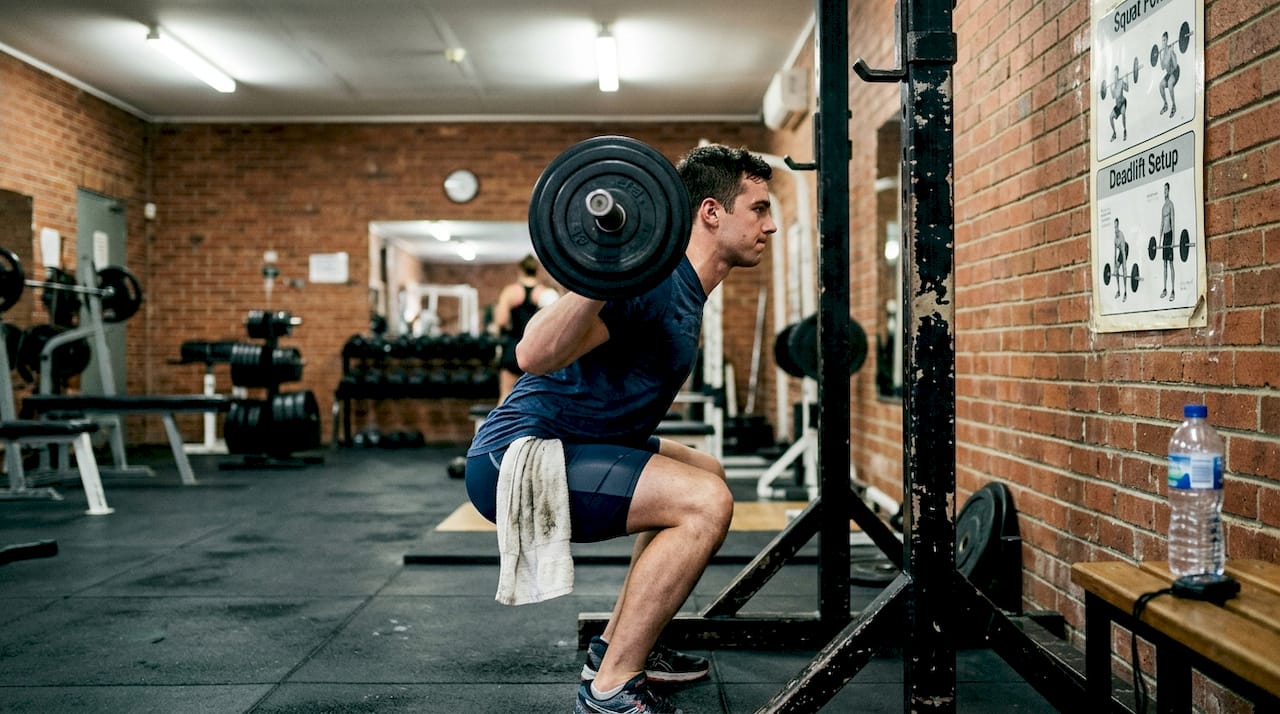
MST and PT are superior to muscular endurance training for sprint performance, while core stability training produces measurable improvements in youth sprint times. This does not mean endurance work is useless. It means the right method must match the swimmer’s event and development stage.
| Method | Key exercises | Expected outcome |
|---|---|---|
| Maximal strength (MST) | Pull-ups, squats, bench press | Greater force production |
| Power training (PT) | Box jumps, medicine ball throws | Faster starts and turns |
| Core stability | Planks, dead bugs, Swiss ball rollouts | Better streamline and stroke control |
| Muscular endurance | Band pulls, high-rep lunges | Sustained output in longer events |
Building a strong core strength in swimming program is one of the highest-return investments a swimmer can make. Here is how to sequence the work:
- Build maximal strength first using compound lifts at controlled intensity before adding explosive work
- Train for power once a strength base exists, using plyometrics and resisted swims
- Focus on core stability consistently throughout all phases, not just as a warm-up
Pro Tip: Youth swimmers should not exceed 60-minute dryland sessions or train more than three times per week during the competitive season. Overdoing it leads to fatigue and technique breakdown, not faster times. For more on refining technique alongside conditioning, explore these advanced technique tips.
Translating training to the water: Mechanics and movement
Understanding the science only matters if it translates to faster swimming. Here is how elite training moves from the gym to the pool.
Every phase of a race relies on specific muscle groups. Core stability supports streamline position and reduces drag, upper body strength drives stroke power and pull efficiency, and lower body conditioning powers explosive starts and kick cycles. Training each area with specificity means the gains you build on land show up in the water.
| Movement or mechanic | Primary conditioning focus | Performance outcome |
|---|---|---|
| Streamline position | Core stability and flexibility | Reduced drag, faster glide |
| Stroke pull phase | Upper body strength and power | Greater propulsion per stroke |
| Start and dive | Lower body power and explosiveness | Faster reaction and entry |
| Turns and push-off | Leg strength and core control | Quicker wall time, better momentum |
| Kick cycle | Hip flexor endurance and ankle flexibility | Sustained propulsion |
Here is the important caveat: raw gym strength does not automatically transfer to the pool. A swimmer who can bench press 200 pounds but never trains with specificity may not swim any faster. The nervous system needs to learn how to apply that strength in a water environment. This is where the importance of a strong core becomes especially clear, because core control is the bridge between land strength and water efficiency.
Sample drills that help transfer conditioning gains to the pool include:
- Resisted swim sets using parachutes or bands to build force application in the water
- Vertical jump testing to monitor lower body power development over time
- Tethered swimming to measure propulsive force directly
- Stroke count tracking to assess whether strength gains are improving stroke efficiency
Monitoring these markers regularly gives coaches and swimmers a clear picture of whether conditioning is working or needs adjustment.
Designing a swimmer’s conditioning plan: Frequency, age, and customization
With methods and their impact clear, here is how to turn science into a week-by-week plan that fits age, event, and season.
Youth core training programs work best at 2 to 3 sessions per week, lasting 30 to 60 minutes each. Elite swimmers benefit from periodized dryland programs at 2 to 4 sessions per week, adjusted based on competition schedule and training phase. These are not arbitrary numbers. They reflect how the body adapts and recovers at different development stages.
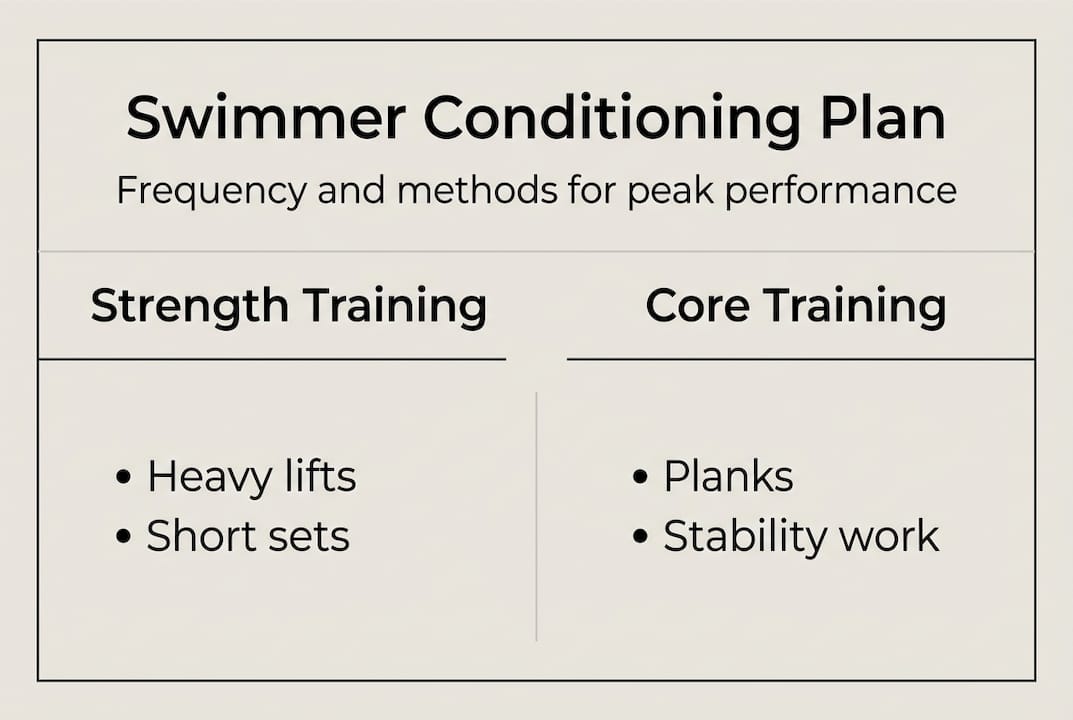
Stat callout: The most effective youth conditioning programs cap sessions at 3 times per week and under 60 minutes. Beyond this, fatigue outpaces adaptation.
Here is a framework for building a safe and effective plan:
- Assess the swimmer’s current level using baseline tests like jump height, pull-up max, and timed planks
- Set event-specific goals so training emphasis matches sprint, middle-distance, or distance needs
- Plan in-season vs. off-season phases with heavier dryland loads in the off-season and reduced volume near competition
- Use load-velocity profiling to track how each swimmer responds and adjust intensity accordingly
- Build in deload weeks every 3 to 4 weeks to allow full recovery and prevent overtraining
For swimmers who want to understand how conditioning fits into a longer training calendar, year-round conditioning strategies offer a broader view. Parents and coaches should also consider how swimmer practice frequency affects overall load when adding dryland sessions.
Pro Tip: Watch for technique breakdown during dryland sessions as a sign of fatigue. If a swimmer cannot maintain proper form on a plank or a squat, that is the body signaling it needs rest, not more reps. Tailored coaching for swimmers can help identify these signals early and adjust training before performance suffers. For younger athletes especially, elite coaching advantages make a significant difference in long-term development.
Expert perspective: Why one-size-fits-all conditioning fails swimmers
After decades of working with swimmers across all levels, one pattern stands out: generic conditioning programs consistently underdeliver. A routine designed for a high school football player or a general fitness client is not built for the demands of competitive swimming. Yet many swimmers follow exactly these kinds of programs and wonder why they are not getting faster.
The problem is specificity. Strength is only useful in the water if the body has learned to express it through swimming movements. Physical strength is only as good as your ability to apply it in the water. That transfer does not happen automatically. It requires intentional, swimming-specific training design.
Cookie-cutter programs also ignore individual differences. Two swimmers of the same age and event may have completely different strength profiles, injury histories, and recovery capacities. A plan that works for one may stall or harm the other. Tracking metrics, gathering regular feedback, and adjusting based on real data is what separates good conditioning from great conditioning.
Parents often underestimate this. They see their swimmer doing dryland work and assume the gains will follow. But without specificity and monitoring, the investment in off-pool training may not pay off the way it should. Tailored swim coaching that integrates both pool and dryland work with individual feedback is the standard worth aiming for.
Ready to level up your swimming performance?
If this guide has shown you anything, it is that the gap between good and great often comes down to what happens outside the pool. Structured, individualized conditioning is what separates swimmers who plateau from those who keep improving.

At PEAK Performance Swim Camp, our programs are built around exactly this philosophy. Founded by Olympic coach Nick Baker with over 50 years of coaching experience, PEAK integrates physical conditioning, technique, and mental preparation into every camp and clinic. Whether you are looking for swim camps that build a complete athletic foundation or targeted conditioning clinic options for specific development goals, we have programs designed to move you forward. Explore your options and take the next step toward your best performance.
Frequently asked questions
How often should swimmers do dryland conditioning?
Youth swimmers benefit most from 2 to 3 dryland sessions per week lasting 30 to 60 minutes, while elite swimmers may train 2 to 4 times weekly with adjustments made close to competition.
Is dryland or in-water conditioning more important for swimmers?
Combined aquatic and dryland resistance programs produce the best overall performance gains, as dryland builds strength while in-water training ensures those gains transfer to racing.
What exercises are best for building swimming power?
Pull-ups, squats, lunges, planks, and explosive plyometric jumps are among the most effective exercises for developing swimming-specific strength and power.
Does physical conditioning make a difference for youth swimmers?
Yes. Youth core training programs consistently produce measurable improvements in sprint performance and stroke efficiency, even in younger and developing athletes.
How do you know if conditioning is working?
Track swim velocity, stroke length, and dryland test results like jump height and max pull-ups over time to get a clear picture of whether your conditioning program is delivering results.
Recommended
- Master swimming conditioning: step-by-step guide to peak performance – Peak Performance Swim Camp
- Advanced swimming technique tips for peak performance – Peak Performance Swim Camp
- Motivational Message for Swimmers – Peak Performance Swim Camp
- Why Goal-Setting is Important for Swimmers – Peak Performance Swim Camp
- Compression sleeves vs rashguards: optimize outdoor training