
TL;DR:
- Olympic swim training emphasizes measurable benchmarks and race-phase analysis for optimal performance.
- Modern approaches favor low-volume, high-power training tailored to individual athlete needs.
- Precision and personalized monitoring outperform high-volume training in delivering race improvements.
A single profiling intervention boosted max swim speed by 3.4% in one case involving an Olympic-level swimmer, while training load climbed 13.6% and 50m race time dropped 1.3%. That kind of result doesn’t come from adding more laps. It comes from precision. For competitive swimmers and coaches who want to move beyond guesswork, Olympic swim training offers a structured, data-driven framework that targets the right variables at the right time. This guide breaks down the core principles, the ongoing debate between old-school volume and modern power-based methods, and the practical strategies you can apply to your own training program.
Table of Contents
- What defines Olympic swim training?
- Traditional versus modern training philosophies
- Personalizing training for Olympic-level swimmers
- Specialized training for event types and phases
- The myths and realities: What Olympic swim training actually delivers
- Take your training to the Olympic level
- Frequently asked questions
Key Takeaways
| Point | Details |
|---|---|
| Targeted benchmarks | Olympic swim training uses specific technical and physiological benchmarks to drive measurable improvement. |
| Personalized coaching | Elite coaches leverage advanced monitoring and hybrid methods to tailor training plans to every swimmer. |
| Modern methods outperform | Contemporary low-volume, high-power strategies often deliver better results than traditional high-volume routines. |
| Phase-based approach | Training is segmented by race phases (start, turn, clean swim) with targeted exercises for each. |
What defines Olympic swim training?
Olympic swim training isn’t simply training harder or longer. It’s a system built on measurable benchmarks, structured race-phase analysis, and continuous physiological monitoring. Every session has a purpose, and every metric tells a story.
At the technical core, clean swim velocity is one of the strongest predictors of 100m freestyle performance, with a correlation coefficient above r=0.8. Clean swim velocity refers to the speed a swimmer generates during the open-water portion of a race, excluding starts and turns. When that number improves, race times follow.
Beyond velocity, Olympic programs break down race performance into three distinct phases: the start, the turn, and the clean swim. Research confirms that each phase contributes roughly one-third to overall 100m time. That means neglecting any single phase costs you significant ground, no matter how strong the other two are.

Here’s a snapshot of how those three phases are typically weighted and trained:
| Race phase | Contribution to 100m time | Primary training focus |
|---|---|---|
| Start | ~33% | Reaction time, block power, underwater dolphin kick |
| Turn | ~33% | Wall approach, flip mechanics, push-off velocity |
| Clean swim | ~33% | Stroke rate, distance per stroke, velocity maintenance |
What makes Olympic training distinct is the commitment to year-round swim training that systematically addresses all three phases rather than focusing only on open-water speed. Coaches also integrate advanced swim technique work alongside physical conditioning to build a complete athlete.
Key characteristics of Olympic-level programs include:
- Velocity-based load monitoring across all training zones
- Phase-specific drill sequences tied to race demands
- Individualized benchmarks rather than group averages
- Regular performance testing to track adaptation
- Integration of mental preparation alongside physical work
The result is a training environment where every variable is accounted for, and progress is measured, not assumed.
Traditional versus modern training philosophies
For decades, high-volume training was the gold standard in competitive swimming. The logic was simple: more meters in the water meant better conditioning, and better conditioning meant faster races. Many elite programs still use this model, and for some athletes, it works well.
But the landscape has shifted. Modern elite programs increasingly favor low-volume, high-power approaches that prioritize neuromuscular adaptation, race-speed training, and flexible periodization over sheer mileage. The contrast between these two philosophies is significant.
| Factor | Traditional model | Modern model |
|---|---|---|
| Volume | High (60,000+ meters/week) | Low to moderate |
| Intensity focus | Aerobic base building | Race-speed and power |
| Periodization | Block periodization (~35% of programs) | Flexible, athlete-driven |
| Adaptation target | Cardiovascular endurance | Neuromuscular efficiency |
| Monitoring | Subjective coach observation | HRV, video, data tools |
“The best training plan is the one that matches the athlete’s physiology, event demands, and current adaptation state, not the one that logs the most kilometers.”
Neither approach is universally superior. Sprint specialists often respond better to modern power-focused methods, while distance swimmers may still benefit from higher volume. The key insight is that periodization must be flexible, not fixed to a single model.
Here’s how coaches can evaluate which approach fits a swimmer:
- Identify the primary event and its energy system demands
- Assess the swimmer’s current training history and volume tolerance
- Review recent performance data across all race phases
- Select a periodization model that aligns with competition calendar
- Monitor adaptation every two to three weeks and adjust accordingly
Pro Tip: If a swimmer is plateauing despite consistent high-volume training, it’s often a signal to reduce volume and introduce more race-speed work. Adaptation stagnation is one of the clearest signs that a philosophy shift is needed.
For coaches who want to develop tailored swim coaching strategies, the key is staying open to both models and knowing when to switch.
Personalizing training for Olympic-level swimmers
Olympic training is not a template you download and distribute to a squad. It’s a living plan that evolves with each athlete. Personalization is what separates good programs from elite ones.
Coaches at the highest level rely on a combination of objective and subjective data to guide decisions. Individualization tools include heart rate variability (HRV) monitoring, video analysis of stroke mechanics, and subjective wellness scales that athletes complete daily. Together, these tools create a complete picture of how a swimmer is responding to training load.
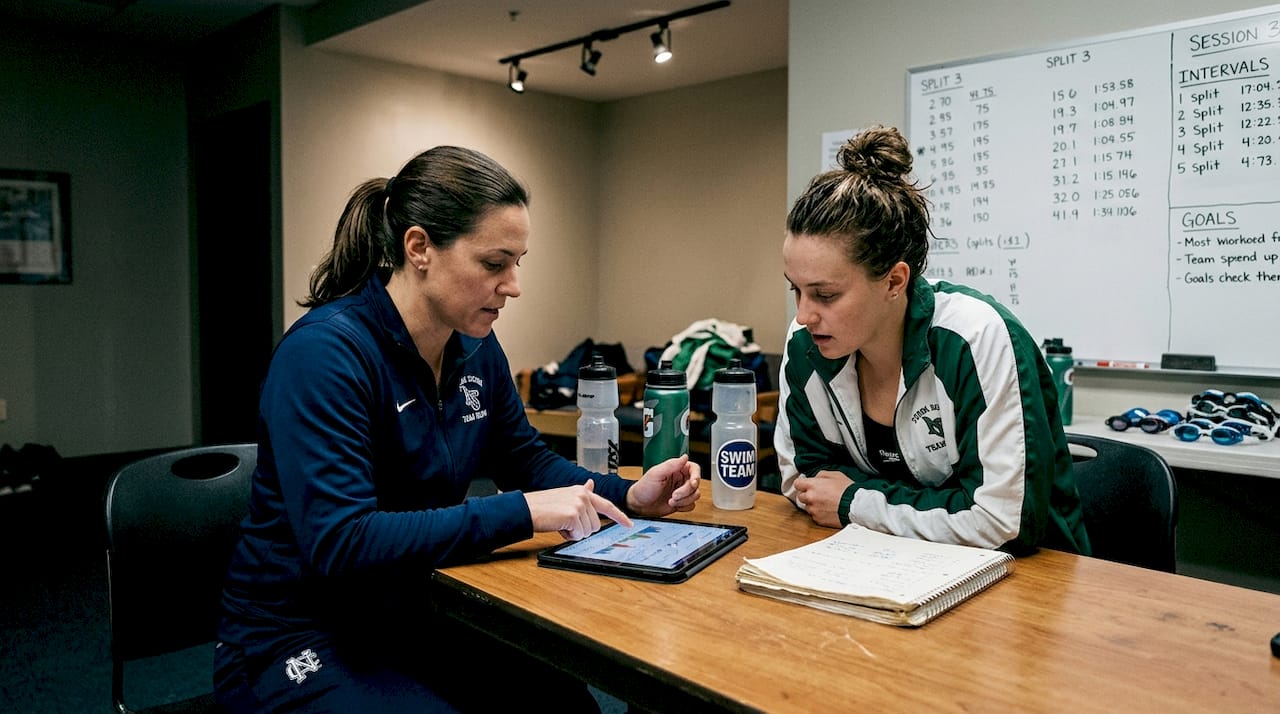
Hybrid coaching models are also gaining traction. In-person technical sessions are paired with digital platforms that track performance data between practices. This allows coaches to make informed adjustments without waiting for the next race to see results.
Key tools and methods used in personalized Olympic training:
- HRV monitoring: Tracks nervous system recovery to prevent overtraining
- Video analysis: Identifies stroke inefficiencies invisible to the naked eye
- Subjective wellness scales: Captures fatigue, mood, and motivation daily
- Velocity tracking: Measures how training speed correlates with race speed
- Race-phase timing: Pinpoints where time is being lost in competition
Mental preparation is another layer that often gets overlooked. Olympic swimmers don’t just train their bodies. They train their minds to manage pressure, stay focused during high-stakes moments, and recover mentally after poor performances. A truly personalized program addresses both dimensions.
Pro Tip: Ask your swimmers to rate their perceived effort and mood after every session using a simple 1 to 10 scale. Over time, patterns emerge that reveal when an athlete is approaching burnout or when they’re ready to push harder.
Working with a personal coaching specialist and understanding the full coach workflow can help you build these systems efficiently. Coaches working with younger athletes should also explore youth swim coaching strategies to apply age-appropriate personalization.
Specialized training for event types and phases
Not all swimmers train the same way, and they shouldn’t. A 50m sprinter and a 1500m freestyler have fundamentally different physiological demands, and their training must reflect that.
For sprint specialists, neuromuscular development takes priority over aerobic conditioning. The 50m freestyle is essentially an anaerobic event. Explosive power off the block, maximum velocity in the water, and an efficient turn are the deciding factors. Aerobic base still matters, but it’s not the primary driver of performance at this distance.
For longer events, aerobic capacity and lactate threshold become central. Training volume increases, and the emphasis shifts to sustaining velocity over time rather than generating peak speed.
Here’s a breakdown of phase-specific training priorities:
- Start phase: Develop block reaction time through dry-land resistance work and repeated dive practice. Underwater dolphin kick distance and velocity are critical here.
- Turn phase: Practice approach speed, flip mechanics, and wall push-off force. Many swimmers lose significant time in this phase due to poor wall contact angles.
- Clean swim phase: Focus on stroke rate, distance per stroke, and maintaining velocity as fatigue accumulates. This is where technique under pressure is tested.
Since each phase contributes roughly one-third to overall 100m time, a 1% improvement in each phase compounds into a meaningful race-time drop. That’s the math behind why phase-specific training is so effective.
Additional considerations for event-specific training:
- Sprint programs use shorter rest intervals at race speed
- Distance programs incorporate threshold sets and pace control work
- All programs should include race-simulation sets that replicate competition conditions
- Taper strategies differ significantly between sprint and distance events
Understanding elite coaching benefits and knowing what to look for in a swim coach helps swimmers find the right environment for this kind of specialized work. For a closer look at what a modern training environment looks like, explore the PEAK and GoSwim partnership.
The myths and realities: What Olympic swim training actually delivers
Here’s the uncomfortable truth: most swimmers and coaches overestimate the value of volume and underestimate the power of precision. The belief that more meters automatically equals better performance is one of the most persistent myths in competitive swimming.
Olympic training success centers on targeted, dynamic adaptations. When LV profiling was applied to an Olympic swimmer, the results were striking: max swim speed improved 3.4%, training load increased 13.6%, and 50m race time dropped 1.3%. These gains didn’t come from swimming more. They came from swimming smarter.
High-frequency assessments and tailored race-phase methods consistently outperform volume-only approaches. As we see in our work at PEAK Performance Swim Camp, “Modern profiling creates sustainable speed gains that just can’t be matched by outdated volume-only thinking.” That perspective is grounded in decades of coaching experience across Olympic and elite competitive levels.
The good news is that these methods are not exclusive to Olympic athletes. Committed competitive swimmers and coaches who invest in year-round Olympic training principles, consistent monitoring, and phase-specific development can access the same results-driven framework. The tools are available. The question is whether you’re willing to apply them with discipline and consistency.
Take your training to the Olympic level
If you’re ready to move beyond generic training plans and apply the precision methods used at the Olympic level, PEAK Performance Swim Camp has the resources to help you get there.

With over 30 years of experience and more than 1,000 camps conducted across 18 countries, PEAK offers Olympic-level swim camps designed around the exact principles covered in this guide: phase-specific training, personalized coaching, and data-informed development. Whether you’re looking for structured clinic package options or want to explore all swim training programs available year-round, PEAK provides the environment and expertise to help competitive swimmers reach their full potential. Take the next step and train the way champions do.
Frequently asked questions
What are the main components of Olympic swim training?
Olympic swim training combines tailored technical benchmarks, phase-specific drills, and ongoing performance monitoring. Since start, turn, and clean swim each contribute roughly one-third to 100m time, all three phases receive dedicated attention.
How do coaches customize Olympic-level training?
Coaches build individualized plans using HRV monitoring, video analysis, and daily wellness scales, then combine in-person sessions with digital tracking tools to adjust training in real time.
Is high-volume training still used for Olympic swimmers?
Yes, but it’s no longer the default. Modern elite programs increasingly favor low-volume, high-power approaches with flexible periodization, while traditional block periodization accounts for about 35% of elite programs.
Why is clean swim velocity important in Olympic training?
Clean swim velocity is one of the strongest predictors of freestyle race performance. Velocity correlation in 100m freestyle reaches r=0.8 and above, making it a primary target for technical and physical improvement.
Recommended
- Advanced swimming technique tips for peak performance – Peak Performance Swim Camp
- Year-round swim training: benefits, methods & success – Peak Performance Swim Camp
- Master swimming conditioning: step-by-step guide to peak performance – Peak Performance Swim Camp
- Optimize your swim coach training workflow: 4 key phases – Peak Performance Swim Camp
- Master Your Workout Hydration Routine for Peak Performance – Interval