
TL;DR:
- Off-season swim training maintains fitness, sharpens technique, and prevents burnout through structured, reduced-volume workouts.
- A hybrid approach combining reduced swim volume with increased dryland training best supports recovery and long-term development.
- Proper off-season planning, including rest weeks and gradual volume increases, gives athletes a competitive edge and healthier season start.
The off-season is not a signal to stop. For competitive swimmers, it is one of the most important windows of the entire training year, yet it is also the most misunderstood. Many athletes and their families assume that stepping back from structured practice means stepping away from progress entirely. That thinking costs real performance gains. A well-designed off-season swim training plan maintains your fitness base, sharpens your technique, and sets you up to enter the next season healthier and faster than you left the last one. This article breaks down exactly what off-season training involves, why it matters, and how to do it right.
Table of Contents
- What is off-season swim training?
- Major approaches to off-season swimming: Rest, hybrid, or year-round?
- Key components of an effective off-season swim program
- Sample off-season workouts and weekly structure
- Our view: The underrated edge of strategic off-season swim training
- Elevate your training with expert swim coaching
- Frequently asked questions
Key Takeaways
| Point | Details |
|---|---|
| Smart off-season training | Structured, lower-intensity work during the off-season sets up long-term swimming gains. |
| Hybrid approach wins | A mix of lighter swimming, dryland, and scheduled rest reduces burnout and maintains fitness. |
| 10 percent rule | Increase weekly swim volume by no more than 10 percent to avoid overtraining injuries. |
| Consistency, not perfection | Maintaining regular activity—with time for both training and true rest—prevents setbacks and boosts performance next season. |
What is off-season swim training?
Off-season swim training is a structured period of reduced intensity and volume that follows the competitive season. It is not a vacation from the sport. Think of it as a reset button that lets your body recover from the demands of racing while keeping your skills and fitness from sliding backward.
The goals during this phase are specific. You want to maintain the technique and aerobic base you built during the season, prevent mental and physical burnout, strengthen areas of weakness, and build a foundation for the harder training blocks ahead. These goals are different from in-season priorities, where the focus is on peak performance and race readiness.
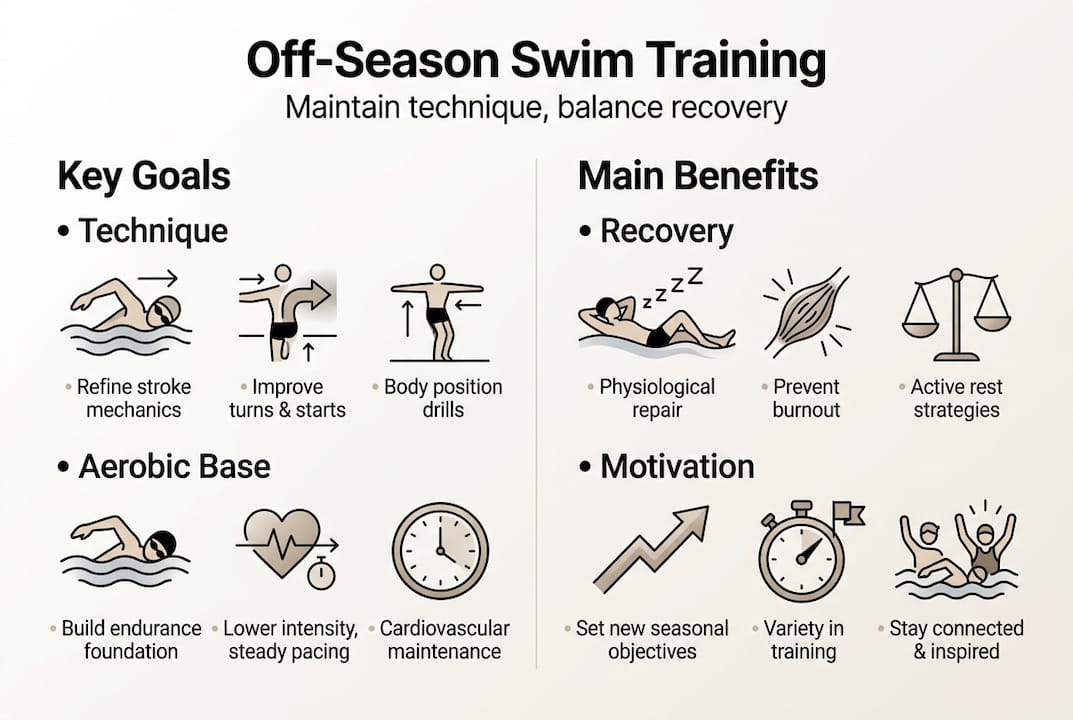
One of the clearest differences between off-season and in-season training is volume. During the season, weekly yardage benchmarks show age-group swimmers covering 12,000 to 18,000 yards across 5 to 9 sessions, while senior competitors log 20,000 to 25,000 or more yards in 9 to 11 sessions. Off-season training pulls those numbers back intentionally, with a target split of roughly 70% moderate intensity and 30% high intensity work.
Here is a quick look at how off-season and in-season training compare:
| Factor | In-season | Off-season |
|---|---|---|
| Weekly yardage | High (up to 25,000+) | Reduced (50-70% of peak) |
| Session frequency | 9-11 per week | 5-9 per week |
| Intensity focus | Race-specific, high intensity | Aerobic base, technique |
| Dryland training | Supplemental | Increased emphasis |
| Mental load | High, competition-driven | Lower, exploratory |
When building volume back up after a rest period, the 10% volume increase rule is your safest guide. Never add more than 10% to your total weekly yardage from one week to the next. This prevents overuse injuries and keeps your body adapting rather than breaking down.
Key benefits swimmers gain from a structured off-season include:
- Reduced injury risk through lower training load
- Mental freshness heading into the next season
- Time to fix stroke flaws without race pressure
- Improved strength and mobility through cross-training
- Better long-term athletic development
For age-group swimming parents, understanding this phase helps you support your athlete’s development without pushing too hard at the wrong time.
“The off-season is where champions are quietly built. The work done away from the spotlight shapes what happens under it.”
Major approaches to off-season swimming: Rest, hybrid, or year-round?
Not every swimmer or coach approaches the off-season the same way. There are three broad philosophies, and each has real trade-offs worth understanding.
Pure rest means stepping away from the pool entirely for several weeks. The mental benefits are real. Swimmers who have been grinding through a long season often need a genuine break to recharge their motivation. The downside is physical deconditioning. Aerobic fitness, feel for the water, and muscle memory all fade faster than most athletes expect. A week or two of full rest is healthy. Several weeks of complete inactivity is a different story.
Year-round high-volume training is the opposite end of the spectrum. Some programs never truly reduce load, keeping swimmers at near-peak volume throughout the calendar year. This approach can work for elite senior athletes with years of training behind them, but for most competitive swimmers it increases burnout risk, raises injury rates, and makes it harder to peak at the right moments. Monotony also becomes a real issue when there is no variation in the training cycle.
The hybrid model is what most experienced coaches, including those who follow USA Swimming standards, recommend. It combines reduced swim volume and intensity with increased dryland and cross-training work. You stay in shape, but you give your body and mind a genuine change of pace.
| Approach | Benefits | Risks |
|---|---|---|
| Pure rest | Mental recovery, full physical rest | Deconditioning, loss of feel |
| Year-round high volume | Continuous fitness | Burnout, injury, monotony |
| Hybrid (recommended) | Maintains gains, prevents burnout | Requires discipline to reduce load |
The hybrid model also uses a hard-easy day structure, alternating harder training sessions with lighter recovery days. Scheduling one or two complete rest weeks within the off-season block is equally important. These intentional breaks allow tissue repair and hormonal recovery that simply cannot happen during continuous training.
For swimmers looking to sharpen their technique during this lower-pressure period, exploring advanced swimming technique tips gives you a focused agenda for pool sessions. Coaches who follow a smart swim coaching workflow will structure these weeks with clear purpose rather than just filling yards.
“The best off-season plan is one that keeps you hungry to train, not one that burns you out before the season even starts.”
Key components of an effective off-season swim program
Knowing the philosophy is one thing. Building the actual plan is another. Here is a step-by-step approach to structuring an effective off-season program.
- Assess your season. Before changing anything, review what worked and what did not. Identify your weakest stroke, your slowest split, or the technique flaw that kept showing up in races. The off-season is the time to fix it.
- Set your frequency. Based on session frequency benchmarks, age-group swimmers should target 5 to 9 sessions per week, while senior swimmers can maintain 9 to 11. Reduce from your in-season peak, not from zero.
- Dial in volume. Keep weekly yardage at roughly 50 to 70% of your in-season peak. Use the 10% rule to build back up gradually as the off-season progresses.
- Mix swim and dryland. Replace some pool sessions with cross-training. Strength work, yoga, cycling, and plyometrics all contribute to swimmer conditioning without adding swim-specific fatigue.
- Schedule rest weeks. Plan at least one full rest week every 3 to 4 weeks. This is not optional. It is where adaptation actually happens.
- Focus on technique. With lower race pressure, you have the mental bandwidth to work on mechanics. Use video feedback and focused drill sets to address weaknesses.
Dryland training deserves special attention here. A 2 to 4% performance boost from consistent dryland work is well documented. That margin can be the difference between making a final and missing it. For a structured approach to building physical capacity, the conditioning step-by-step guide is a practical resource.
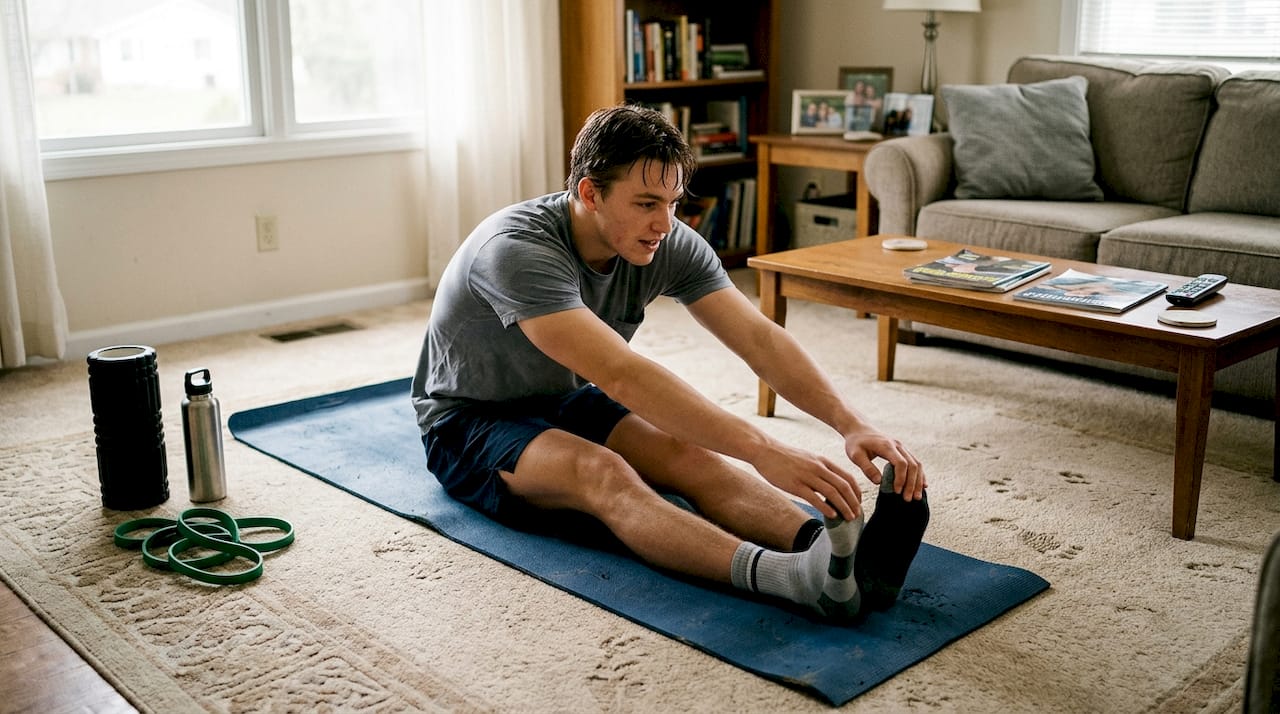
Pro Tip: Schedule 1 to 2 full rest weeks into your off-season calendar before the season begins. Treat them as non-negotiable appointments, not optional recovery days.
For guidance on how often swimmers should be in the water at different stages of development, the article on swimmer practice frequency gives age-specific recommendations that pair well with off-season planning.
Sample off-season workouts and weekly structure
Theory only takes you so far. Here is what off-season training actually looks like in practice.
Sample swim sets:
- Aerobic base set: 10 x 100 yards at moderate pace (about 75% effort), 15 seconds rest between each. Focus on stroke count and breathing rhythm.
- Short sprint set: 8 x 25 yards at near-maximum effort, full recovery between reps. Keeps neuromuscular sharpness without heavy volume.
- Kick and pull set: 400 yards kick, 400 yards pull, alternating every 100. Isolates technique and builds specific strength.
- Drill focus set: 20 minutes of stroke-specific drills targeting your identified weakness from the season review.
Sample dryland sessions:
- Core circuit: planks, dead bugs, and rotational medicine ball throws (20 to 30 minutes)
- Mobility work: hip flexor stretches, shoulder band exercises, thoracic spine rotations (15 to 20 minutes)
- Plyometrics: box jumps, lateral bounds, and jump squats for explosive power (20 minutes)
Sample weekly structure for age-group swimmers (5 sessions):
| Day | Activity |
|---|---|
| Monday | Swim: aerobic base set |
| Tuesday | Dryland: core and mobility |
| Wednesday | Swim: kick and pull focus |
| Thursday | Rest |
| Friday | Swim: drill focus set |
| Saturday | Dryland: plyometrics |
| Sunday | Rest |
Sample weekly structure for senior swimmers (8 to 9 sessions):
Seniors can add a second swim session on Tuesday and Thursday, keeping intensity moderate. The weekly yardage target for seniors sits at 20,000 to 25,000 yards, but off-season weeks should stay closer to 14,000 to 17,000 yards.
Pro Tip: Use off-season sessions to address your single biggest technical weakness. Swimmers who enter the season with a repaired stroke flaw often see bigger time drops than those who simply trained harder.
For swimmers who want structured guidance during this period, personalized swim coaching can make a significant difference in how efficiently you use this training window.
Our view: The underrated edge of strategic off-season swim training
After decades of coaching competitive swimmers at every level, one pattern stands out clearly. The athletes who show up to the first week of the new season ready to work are almost never the ones who trained the hardest all summer. They are the ones who trained the smartest.
Most swimmers and their families overweight in-season effort and underweight off-season strategy. They assume that more yards always equals more speed. But the body does not improve during training. It improves during recovery from training. That distinction changes everything.
The hybrid model and hard-easy structure consistently produces athletes who enter the season healthier, more motivated, and technically sharper than their peers who never truly backed off. We have seen this play out in camp after camp, country after country.
The shift we encourage athletes and parents to make is simple. Stop thinking of the off-season as time lost. Start treating it as the phase where your real competitive edge is built.
Elevate your training with expert swim coaching
Understanding off-season principles is a strong first step. Putting them into practice with expert guidance is what accelerates real results.

At PEAK Performance Swim Camp, our coaches design structured off-season programs that balance recovery, technique refinement, and physical conditioning for swimmers at every level. Whether you are an age-group athlete building your foundation or a senior competitor fine-tuning your edge, our elite swim camps give you the environment, expertise, and accountability to make the most of every training phase. For individualized attention to your stroke mechanics and performance goals, explore our private swim coaching options and take the next step toward your best season yet.
Frequently asked questions
How many times per week should I swim during the off-season?
Age-group swimmers benefit from 5 to 9 sessions per week, while senior competitors may do 9 to 11, with lower volume and intensity than in-season training. The key is maintaining consistency without overloading your body during the recovery phase.
Is it okay to completely rest from swimming in the off-season?
Short periods of full rest are genuinely helpful for mental and physical recovery, but weeks of total inactivity can set athletes back significantly. Experts recommend a hybrid approach with reduced swim load and increased dryland work to maintain gains.
What is the 10 percent rule for off-season swim training?
The 10% volume increase rule means you should never add more than 10% to your total weekly yardage from one week to the next. This gradual progression protects against overtraining and keeps your body adapting safely.
How does dryland training boost swim performance in the off-season?
Consistent dryland work delivers a 2 to 4% performance boost by building the strength, power, and mobility that directly translate to faster, more efficient swimming when you return to full training.
Recommended
- Year-round swim training: benefits, methods & success – Peak Performance Swim Camp
- Physical conditioning for swimmers: unlock peak performance – Peak Performance Swim Camp
- Advanced swimming technique tips for peak performance – Peak Performance Swim Camp
- Optimize your swim coach training workflow: 4 key phases – Peak Performance Swim Camp
- Master Your Workout Hydration Routine for Peak Performance – Interval
- How to Maximize Muscle Gain for Optimal Results – MyGymSupplements