
Talent gets you to the starting block. Conditioning is what gets you to the podium. Many competitive swimmers train hard in the pool but still fall short in competition because raw speed and technique alone cannot carry you through a full season. Structured conditioning, the kind that integrates both dryland and aquatic work, is the bridge between potential and results. At PEAK Performance Swim Camp, we have seen firsthand how swimmers who follow a deliberate, step-by-step conditioning approach consistently outperform those who rely on pool time alone. This guide walks you through exactly how to build and execute that approach.
Table of Contents
- Setting the foundation for swimming conditioning
- Step-by-step swimming conditioning routine
- Avoiding common conditioning mistakes
- Tracking progress and verifying results
- What most swimmers overlook about conditioning
- Advance your conditioning with expert coaching
- Frequently asked questions
Key Takeaways
| Point | Details |
|---|---|
| Combined training advantages | Mixing dryland and aquatic steps produces the best gains in speed and endurance. |
| Core strength matters | Strong core and power routines are essential for sprint performance and overall stability. |
| Track results consistently | Use time trials and stroke metrics to verify progress and adjust conditioning strategies. |
| Avoid training mistakes | Steer clear of overtraining, poor integration, and missing warm-ups to prevent injury and maximize gains. |
Setting the foundation for swimming conditioning
Before you can execute an effective conditioning routine, you need the right framework. Think of this phase as laying the groundwork. Conditioning in competitive swimming targets four core goals: building power for explosive starts and turns, developing endurance for sustained race pace, preventing injury through balanced muscle development, and improving flexibility for efficient stroke mechanics.
Understanding the balance between dryland and aquatic training is essential. Dryland training enhances in-water performance through strength, core stability, flexibility, and plyometrics, with research showing a 2 to 5% performance boost when it is properly integrated. That might sound modest, but at the elite level, fractions of a second separate champions from the rest of the field.
Swimming core strength is particularly critical. A strong core transfers force efficiently from your arms to your legs, reduces drag, and supports proper body rotation. Without it, even technically sound swimmers lose speed and tire faster.
Here is what you need to get started:
| Tool | Purpose |
|---|---|
| Exercise mat | Dryland floor work and stretching |
| Resistance bands | Mimicking swim-specific pulling motions |
| Pool equipment (fins, paddles, pull buoy) | Aquatic resistance and isolation work |
| Stopwatch or pace clock | Tracking interval times and rest periods |
| Water bottle | Staying hydrated throughout sessions |
Key conditioning priorities to keep in mind:
- Power: Explosive exercises that translate to faster starts and breakouts
- Endurance: Aerobic base work that sustains race pace across multiple events
- Injury prevention: Balanced strengthening of shoulder, hip, and core muscles
- Flexibility: Targeted mobility work for ankles, shoulders, and thoracic spine
Building these fundamental swim skills into your conditioning plan from the start means you are not just getting fitter. You are getting faster in ways that directly show up on the scoreboard.
Step-by-step swimming conditioning routine
With the foundational requirements covered, you are ready to execute the proven conditioning steps for optimal results. This routine integrates dryland and aquatic work in a logical progression that maximizes adaptation without overloading your body.
- Dynamic warm-up (10 minutes): Start every session with arm circles, leg swings, hip rotations, and light jogging. This primes your nervous system and reduces injury risk.
- Dryland strength block (20 to 25 minutes): Focus on pull-ups, bodyweight squats, planks, and Russian twists. These exercises directly reinforce the muscle groups you rely on in the water.
- Core strengthening circuit (10 minutes): Add targeted core work such as hollow body holds, flutter kicks on the mat, and side planks. Sprint specialists benefit especially from this step.
- Aquatic resistance sets (20 to 25 minutes): Move to the pool for water sprints using resistance equipment. Load-velocity profiling, where you measure how your speed changes under different resistance loads, helps fine-tune intensity.
- Cool-down and flexibility (10 minutes): Finish with static stretching for shoulders, hip flexors, and ankles. This supports recovery and maintains the mobility gains you are building.
Here is how combined training compares to single-modality approaches:
| Training approach | Sprint time improvement | Stroke rate gains | Overall performance |
|---|---|---|---|
| Aquatic only | Moderate | Moderate | Good |
| Dryland only | Low to moderate | Low | Moderate |
| Combined aquatic and dryland | High | High | Best |
Combined aquatic and dryland resistance ranks highest for sprint gains in 50m and 100m times, velocity, stroke rate, and stroke length compared to either approach alone. This is not a minor edge. It is a structural advantage.
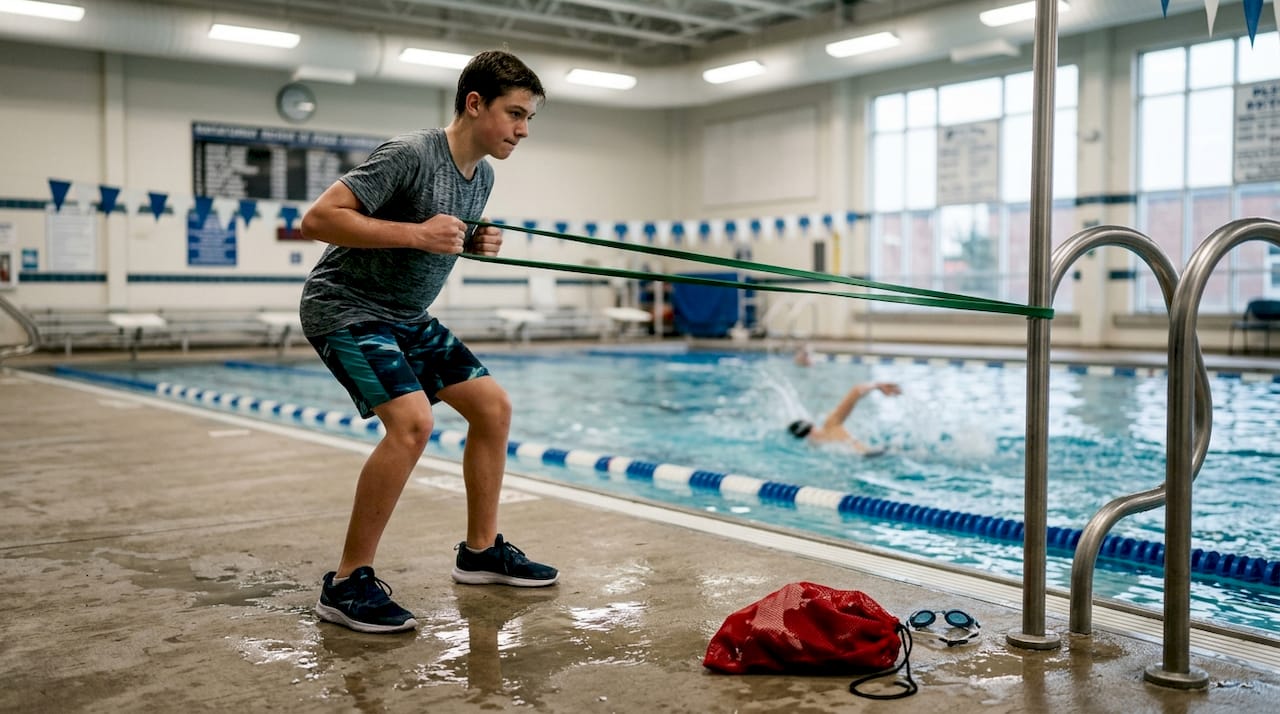
Pro Tip: Alternate your dryland and aquatic sets within the same session rather than keeping them on separate days. This approach, sometimes called complex training, amplifies the transfer of strength gains to swim-specific speed. For more ideas on structuring your calendar, explore year-round swim training methods and advanced technique tips.
Avoiding common conditioning mistakes
Even the best routines can fail if common mistakes are not avoided. Here is how to stay on track.
The most frequent errors we see at PEAK include:
- Overtraining without recovery: More is not always better. Muscles grow and adapt during rest, not during the workout itself.
- Ignoring core stability: Swimmers who skip core work often develop compensatory movement patterns that slow them down and increase injury risk.
- Incomplete integration: Doing dryland on Monday and pool work on Friday with no connection between them misses the point of combined training.
- Skipping the warm-up: Jumping straight into hard sets without dynamic preparation is one of the fastest ways to pull a shoulder or strain a hip flexor.
- Neglecting flexibility: Tight ankles reduce kick propulsion. Tight shoulders limit catch depth. Both cost you time.
Dryland biomechanics aligned with NSCA guidelines minimize injury risk during conditioning by ensuring that exercises mirror the movement patterns of actual swimming rather than loading the body in ways that conflict with in-water mechanics.
“The goal of conditioning is not to exhaust swimmers. It is to make them more capable, more resilient, and more explosive when it counts. Recovery is not optional. It is part of the program.”
Pro Tip: Keep a simple training log. Rate your energy and soreness on a scale of 1 to 10 before each session. If you score a 7 or higher on fatigue or soreness, reduce the session intensity by 30 to 40%. This one habit prevents most overtraining issues before they become real problems. Coaches working with youth swimmer strategies know that teaching athletes to listen to their bodies early builds long-term resilience.
Tracking progress and verifying results
With mistakes avoided, it is time to objectively assess the effectiveness of your conditioning efforts. Tracking is not just about motivation. It is about making smarter decisions with your training time.
Here are the key metrics to monitor:
- Time trials: Run a 50m or 100m time trial every two to three weeks under consistent conditions
- Velocity tracking: Use a stopwatch or pace clock to measure split times and identify where you are losing speed
- Stroke rate and length: Count strokes per length and track changes over time. More distance per stroke means better efficiency.
- Perceived exertion: Note how hard a given pace feels. As conditioning improves, the same pace should feel easier.
- Recovery heart rate: Track how quickly your heart rate drops after hard sets. Faster recovery signals improved cardiovascular fitness.
In-water resistance training using load-velocity profiling improved elite 50m freestyle performance by 3.4% in maximum speed and 1.3% in competition time. For a swimmer already racing at a high level, that is a significant and measurable gain.

Connect your tracking data to your goals. If your stroke rate is improving but your times are not dropping, you may need to focus more on stroke length. If your times improve in practice but not in competition, the issue may be race-day preparation rather than fitness. Solid goal-setting for swimmers means using your data to ask the right questions, not just celebrate the numbers.
And remember, how often you practice matters as much as what you do in each session. Consistency over weeks and months is what turns conditioning gains into competition results.
What most swimmers overlook about conditioning
After working with thousands of swimmers across 18 countries, we have noticed a consistent pattern. Athletes and parents often underestimate the value of integrated training programs and instead default to one of two extremes: all pool time or generic gym work. Neither approach produces the results that a structured combined program delivers.
The research is clear. Prioritizing combined training over isolated aquatic or dryland work produces superior gains, with core and power work serving as critical adjuncts specifically for sprint performance.
But beyond the data, there is a mental dimension that most training plans ignore. Swimmers who follow structured, progressive routines develop confidence. They arrive at competition knowing they have done the work. That certainty is its own performance advantage. The swimmers we see break through plateaus are almost always the ones who stopped treating conditioning as an afterthought and started treating it as a discipline. Core strength in swimming is a perfect example. It is not glamorous, but it is the foundation everything else is built on.
Advance your conditioning with expert coaching
Putting effective conditioning into practice often means seeking guidance and structured support from experienced coaches. Reading about the right approach is a strong start, but executing it consistently under expert supervision is what accelerates real results.

At PEAK Performance Swim Camp, our programs are built around exactly the kind of integrated conditioning you have read about here. Our swim camps combine technique, physical conditioning, and mental preparation in a structured environment led by coaches with decades of elite experience. For swimmers who want individualized attention, our personalized swim coaching options allow you to build a routine tailored to your specific events and goals. Explore our PVC physical strategy to see how we approach physical development at every level.
Frequently asked questions
What is the most effective way to combine dryland and aquatic conditioning?
Alternating aquatic and dryland resistance within structured sessions yields the best gains in sprint speed, stroke rate, and overall performance compared to using either method alone. Complex training, where dryland and pool sets are paired in the same session, maximizes the transfer of strength to swim-specific speed.
How often should conditioning sessions occur for competitive swimmers?
Three targeted conditioning sessions per week is a practical starting point for measurable gains, with built-in recovery days to prevent burnout. Load-velocity resistance training studies show elite swimmers improved 50m freestyle times by 1.3% with consistent structured sessions over six weeks.
What equipment do swimmers need for conditioning routines?
A mat, resistance bands, pool equipment such as fins and paddles, and a stopwatch cover the essentials for both dryland and aquatic work. NSCA-aligned dryland exercises like pull-ups, squats, planks, and Russian twists require minimal equipment but deliver significant performance benefits.
How soon can swimmers expect measurable results from conditioning?
Most swimmers begin to see measurable improvements within six weeks of starting a consistent regimen, particularly in sprint events. Elite 50m freestyle results showed a 3.4% increase in maximum speed after six weeks of structured in-water resistance training.
Recommended
- Advanced swimming technique tips for peak performance – Peak Performance Swim Camp
- Coach Nick’s 14-Day Challenge: Volume 14 – Peak Performance Swim Camp
- Year-round swim training: benefits, methods & success – Peak Performance Swim Camp
- 8 Steps To Becoming A Swimming Eagle – Peak Performance Swim Camp
- How to Choose Supplements for Peak Performance Results – ElevateSupplements