
TL;DR:
- Effective race strategy combines pacing, positioning, and tactical maneuvers for optimal performance.
- Different events require tailored strategies like even, negative split, or front-end loading pacing.
- Training mental skills and practicing tactics help swimmers adapt to race unpredictability and improve results.
Two swimmers with nearly identical technique and conditioning step up to the blocks. One executes a thoughtful, well-rehearsed race plan. The other relies on feel and raw fitness. More often than not, the strategist wins. At the elite level of competitive swimming, race strategy is the variable that separates athletes who consistently podium from those who leave results on the table.
Table of Contents
- What is race strategy in swimming?
- Core pacing strategies: Even, negative split, front-end load, event profiles
- Tactical positioning and offensive maneuvers
- Race strategy by event: Sprint, middle, and distance-specific keys
- The overlooked edge: Why most swimmers underuse strategy
- Sharpen your race strategy: Train with the best
- Frequently asked questions
Key Takeaways
| Point | Details |
|---|---|
| Strategy drives results | Smart race strategy can outperform superior technique at competitive levels. |
| Adapt by event | Pacing and tactics should be tailored to the race distance and format for best results. |
| Positioning matters | Optimal lane choice and in-race moves can boost your finish place. |
| Practice tactics | Simulate strategies in training to discover what works for you under pressure. |
What is race strategy in swimming?
Race strategy is not just knowing how fast you want to go. It is a structured approach to managing your distance, energy, speed, and tactical decisions through every phase of a race. For competitive swimmers, understanding this distinction is foundational.
At its core, race strategy in swimming encompasses pacing profiles, tactical positioning, offensive maneuvers, and energy system management to optimize performance across race phases. These are not abstract concepts. They are the measurable decisions you make before and during competition that determine how efficiently you convert fitness into finishing time.
Think of it this way: raw speed is the engine, but strategy is the transmission. Without an intelligent gear system, you burn out too early or leave speed untapped when it matters most.
The key components of an effective race strategy include:
- Pacing profile: How you distribute effort across each split, balancing aerobic and anaerobic demands
- Tactical positioning: Where you position yourself relative to competitors at each stage of the race
- Offensive and defensive maneuvers: Actions like surging mid-race, drafting, or deliberately slowing to bait opponents
- Energy system management: Timing your anaerobic expenditure so your peak effort aligns with the final stretch
A well-built strategy also adapts to context. Your approach for a championship heat differs from a final. Your 100m butterfly plan looks nothing like your 400m freestyle plan. Building individualized swim plans that account for personal strengths, energy profile, and competitive environment gives you a real tactical edge over swimmers who use a one-size-fits-all approach.
Smart strategy also rests on a foundation of fundamental skills for race success. You cannot out-strategize a fundamental breakdown in technique. But once those basics are solid, your strategic layer is what pushes you into a different tier of performance. Coaches who stay current with the newest strategies in swimming recognize that race intelligence is now a core training component, not an afterthought.
Core pacing strategies: Even, negative split, front-end load, event profiles
With a clear understanding of what race strategy means, the next step is getting specific about pacing. Pacing is arguably the most researched aspect of competitive swimming performance, and the evidence points to a few dominant approaches.
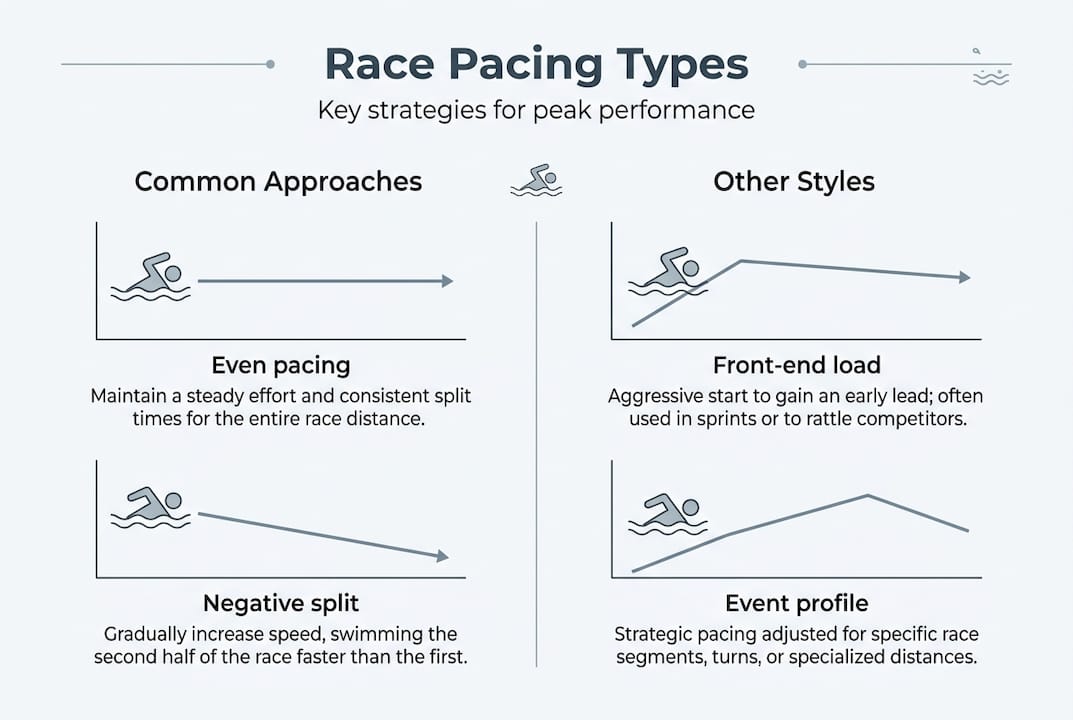
Common pacing strategies include even pacing, negative splitting (second half faster), front-end loading (faster start), and event-specific profiles like the CBAR model for the 200 freestyle. CBAR stands for Control the first 50, Build the second 50, Attack the third 50, and Race the fourth 50. Each label signals a deliberate shift in intensity and mindset at each quarter of the race.
Here is how these pacing approaches compare across key variables:
| Pacing strategy | Key characteristic | Best used for | Main advantage |
|---|---|---|---|
| Even pacing | Consistent splits throughout | Middle-distance events | Minimizes early lactic buildup |
| Negative split | Second half faster than first | Distance and tactical races | Preserves aerobic capacity |
| Front-end loading | Faster first half, controlled finish | Sprints and tactical positioning | Establishes early dominance |
| CBAR profile | Phase-based intensity shifts | 200m freestyle specifically | Matches energy system demands |
Choosing the wrong strategy is one of the most common causes of underperformance in competitive swimming. A swimmer who front-end loads a 400m individual medley will almost certainly fade badly. A swimmer who tries to negative split a 50m freestyle loses the advantage that an explosive start provides.
Key factors that should guide your pacing choice include:
- Your personal lactate threshold and recovery speed between efforts
- The competition level, including whether you are in heats, semis, or finals
- Your event distance and stroke, since each has distinct energy demands
- The split history of your competitors, so you can anticipate their tendencies
- Your mental and physical state on race day, which shifts which strategy is most sustainable
Developing your advanced pacing plans in training is essential. You cannot guess your way into executing a proper negative split on race day if you have never practiced one under fatigue. Pairing pacing training with consistent work on technique for pacing ensures that your stroke does not fall apart when the effort ramps up.
Pro Tip: Train all three pacing strategies across different sessions throughout the season. Knowing how your body responds to each approach, both physiologically and mentally, gives you the flexibility to adapt your race plan based on how you feel during warm-up.
Tactical positioning and offensive maneuvers
Pacing determines how you spend your energy. Positioning determines how you use it to beat the people next to you. These are two separate skills, and the best swimmers train both deliberately.
Research on tactical positioning shows that rank stability increases as a race progresses, finals are more dynamic than heats, long-distance events see earlier rank stabilization with a rank correlation of 0.90 or higher by the 50% mark of the race, and central lanes 4 and 5 produce the highest Top3 finishing rates across event types. That last point matters enormously when you are competing at championship meets where lane assignments are based on seed times.
Lane 4 and lane 5 are not just psychological advantages. They offer a central vantage point that makes it easier to track competitors on both sides, respond to surges, and benefit from turbulence patterns. This is not superstition, it is data.
Offensive tactics in swimming cover a range of specific maneuvers, including a fast start against negative splitters or less experienced swimmers, a deliberate slow start to conserve energy when facing faster opponents, a mid-race breakaway to demoralize close competitors, establishing an early lead to create turbulence that forces trailing swimmers to fight disrupted water, and drafting in the low-pressure wake of a leading swimmer to conserve energy for a final sprint.
The most commonly used offensive maneuvers in championship racing are:
- Fast start: Used to establish early position, ideal against swimmers who typically build into their races
- Drafting: Positioning slightly behind and to the side of a competitor to reduce drag, saving 3 to 5% of energy expenditure
- Mid-race surge: A sharp acceleration at the 50% to 75% mark designed to break the rhythm of swimmers running even splits
- Breakaway: Extending a lead rapidly to psychologically and physically distance yourself from the pack
- Strategic slow start: Used when facing significantly faster opponents, conserving energy for a competitive finish
“Rank stability increases over the course of a race, but finals show more dynamic tactical movement than heats, particularly in central lanes.” This insight from recent research reinforces why practicing tactical flexibility matters more in championship settings than in regular season heats.
Understanding fundamental swim tactics at a technical level gives you the foundation to execute these maneuvers cleanly. An offensive surge that compromises your stroke mechanics backfires. Tactical moves only work when they are built on sound technical execution.
Race strategy by event: Sprint, middle, and distance-specific keys
Strategy is not universal. The mental and physical demands of a 50m freestyle are completely different from those of a 1500m freestyle, and your race plan must reflect that distinction.
Sprints are about maximizing power output from the first stroke. Stroke length in sprint freestyle research confirms that sprinters win by prioritizing stroke length at a high stroke rate, which demands explosive acceleration off the start, near-maximal effort through the first and only turn, and an all-out sprint finish with no energy conservation. There is no room for a conservative pacing plan in a 50m event. Your strategy here is execution, not conservation.
Middle-distance events are where strategic complexity peaks. For the 200m butterfly specifically, elite pacing research shows that the first 50m should be the fastest split at race pace minus one to two seconds, followed by a progressive slowdown through the middle sections, with the final 50m entering what coaches call “survival mode” and being three to five seconds slower than the opening split. Stroke rate ranges from 17 to 20 cycles per 50m. This event demands a front-end loaded strategy combined with ruthless efficiency in the back half, making it one of the most tactically demanding events in competitive swimming.
Distance races reward patience and efficiency above all else. In open-water research on 10km racing, top swimmers maintain approximately 92.7% of critical speed throughout the entire race via longer stroke length averaging 1.26 meters and lower stroke frequency at around 72.86 cycles per minute. Lower-ranked swimmers fade from roughly 97% to 85% of critical speed as fatigue accumulates. The lesson is clear: swimming too hard early in a distance race creates a debt you cannot repay.
Strategic keys broken down by distance:
- Sprint (50m to 100m): Explosive start, maximum stroke rate without sacrificing length, tight underwaters, race-pace execution from first stroke
- Middle-distance (200m to 400m): Front-end speed, controlled middle sections to avoid early lactic accumulation, powerful negative split or CBAR-style finish
- Long-distance (800m to 1500m and open water): Even or negative split pacing, strong stroke length maintenance, tactical drafting, well-timed surges in the final 20% of the race
Pro Tip: Always tailor your race plan to event demands. A swimmer who runs a sprint-style front-end load in a 1500m will pay for it in the final 400m. And a swimmer who tries to build through a 50m event is wasting their most powerful physical attribute.
The role of nutrition’s impact on endurance cannot be overlooked here. Energy availability directly affects your ability to execute strategy, especially in multi-event meets. Pair your strategic planning with fuel planning.
The overlooked edge: Why most swimmers underuse strategy
Here is something we have observed after decades of coaching across dozens of countries and more than a thousand camps: most competitive swimmers invest roughly 90% of their preparation in technique and physical conditioning, and perhaps 10% in strategic thinking. That imbalance quietly costs them results.
The prevailing assumption is that if your technique is clean and your conditioning is strong, the race will take care of itself. That assumption is wrong. It is comfortable, but it is wrong. Strategy requires deliberate mental investment, and most swimmers avoid it because it feels less tangible than logging meters or refining a flip turn.
What experience actually teaches is that races are unpredictable. Heats create one environment, and finals create a completely different one. Competitors do not always behave the way you expect. A swimmer who goes out faster than seeded throws off every even-split plan in the lane next to them. The athletes who win those moments are the ones who prepared for unpredictability, not just ideal conditions.
Mid-race surges demoralize equals, drafting saves energy for the final sprint, and finals show more rank changes than heats due to aggressive tactical moves. These are not incidental observations. They are instructions. The swimmer who knows this and has practiced these scenarios gains a concrete edge over the swimmer who has only practiced technique.
We also see this in how coaching for smarter race plans differs from standard coaching. Coaches who integrate race simulation, competitor analysis, and strategic debriefing into training produce athletes who are genuinely prepared for the chaos of championship racing, not just the clean conditions of morning practice.
Our position at PEAK is simple: strategy is a trainable skill. It is not something you figure out on the blocks. You rehearse it, you test it, you adjust it, and you arrive at a meet with a plan that is both well-researched and flexible enough to adapt when the race unfolds differently than expected.
Sharpen your race strategy: Train with the best
If you are serious about translating what you have learned here into real race-day results, the environment you train in matters as much as the knowledge itself.

At PEAK Performance Swim Camp, founded by Olympic coach Nick Baker with over 50 years of coaching experience, we build race strategy directly into our training programs through race simulation, personalized tactical debriefing, and event-specific planning. Swimmers who attend our elite swim camps do not just train harder; they train smarter, with expert coaches who understand the nuances of pacing, positioning, and competitive execution across all event distances. Whether you are a developing club swimmer or a national-level competitor, our skills clinics for swimmers offer targeted instruction on the exact strategic frameworks covered in this guide. Real competition experience paired with expert coaching feedback is the fastest path from knowing strategy to executing it under pressure.
Frequently asked questions
How do you choose the right race strategy for your swimming event?
Select a strategy by analyzing your strengths, event distance, and pacing profile that fits the race type, since pacing strategies vary from even pacing and negative splitting to front-end loading and event-specific models like CBAR.
Why do middle-distance and long-distance races use different strategies?
These events demand distinct energy management and pacing approaches because long-distance favors even or negative splits with consistent stroke length, while middle-distance requires more variable positioning and front-end speed with controlled fading.
What tactical race maneuvers are most effective in swimming competitions?
Fast starts, smart drafting, and well-timed mid-race surges are the most effective maneuvers, as offensive tactics show that a fast start against negative splitters, drafting in a competitor’s wake, and a mid-race breakaway all directly influence final placement.
How important is lane assignment in tactical positioning?
Lane assignment is more important than most swimmers realize, as research confirms that central lanes 4 and 5 produce the highest Top3 finishing rates due to optimal positioning for tracking competitors and executing tactical maneuvers.
Recommended
- Advanced swimming technique tips for peak performance – Peak Performance Swim Camp
- Master swimming conditioning: step-by-step guide to peak performance – Peak Performance Swim Camp
- Physical conditioning for swimmers: unlock peak performance – Peak Performance Swim Camp
- Motivational Message for Swimmers – Peak Performance Swim Camp