
TL;DR:
- Personalized swim plans optimize technique, injury prevention, and peak timing for individual athletes.
- Combining aquatic and dry-land training tailored to the swimmer’s needs enhances performance significantly.
- True individualization requires regular, data-driven adjustments based on athlete feedback and development.
Competitive swimmers who follow generic group training programs often plateau long before reaching their potential. The truth is, a one-size-fits-all approach simply cannot account for the unique blend of stroke mechanics, physical development, academic commitments, and competition goals that every athlete brings to the pool. Individualized swim plans are essential for competitive swimmers to optimize performance, and the research backs this up clearly. This guide breaks down exactly how personalized training works, what it includes, and why it makes such a measurable difference for both swimmers and their parents who are serious about competitive results.
Table of Contents
- Why do individualized swim plans matter for competitive swimmers?
- Essential elements of a personalized swim plan
- Maximizing performance: Combining aquatic and dry-land training
- Specialization and advanced tailoring: Focusing on main stroke and key events
- The uncomfortable truth: Why most swim plans fall short (and what really works)
- Take the next step: Unlocking your swimmer’s real potential
- Frequently asked questions
Key Takeaways
| Point | Details |
|---|---|
| Custom plans maximize progress | Tailored training aligns with an athlete’s age, strengths, and goals for faster and safer improvement. |
| Combined training boosts performance | Mixing pool and dry-land resistance leads to better speed, stroke technique, and competition outcomes. |
| Specialization supports elite results | Focusing on main stroke and events, when done smartly, increases chances of reaching the highest levels. |
| Ongoing adjustments are key | Plans should be flexible, adapting to schedules, injuries, and swimmer feedback for the best results. |
Why do individualized swim plans matter for competitive swimmers?
Having introduced the power of tailored swim training, we can now break down exactly what makes individualized planning so effective for competitive swimmers. At its core, personalized training recognizes that no two athletes are the same. Age, event distance, stroke specialization, injury history, and even school schedules all shape what a swimmer needs on any given training day.
Individualized swim plans are essential for competitive swimmers to optimize performance by tailoring training to personal factors. This is not just a coaching philosophy. It is a measurable, research-supported approach that separates athletes who consistently improve from those who stagnate in group sets.
When a plan is built around a specific swimmer, several outcomes become observable over time:
- Technique improvements happen faster because drills target the swimmer’s actual weaknesses, not a generic checklist
- Injury rates drop when training load is calibrated to the athlete’s current capacity and recovery timeline
- Peak timing improves because taper and rest phases are scheduled around the swimmer’s specific competition calendar
- Motivation stays higher when athletes see progress that directly connects to their personal goals
- Academic performance is protected because training volume adjusts around exam periods and school commitments
Context-aware planning is where experienced coaches earn their value. A 13-year-old preparing for a regional 200m butterfly event needs a completely different weekly structure than a 17-year-old specializing in 50m freestyle. Recognizing that difference and acting on it is the foundation of personalized swim coaching.
“The best coaches don’t just write sets. They write sets for this swimmer, on this day, heading toward this goal.” — Nick Baker, Olympic Coach and Founder of PEAK Performance Swim Camp
Pro Tip: Track three simple metrics every week: resting heart rate, a 1-10 rating of perceived exertion (RPE) after key sets, and time trial splits. These three data points give coaches everything they need to make smart, timely adjustments to the plan.
Essential elements of a personalized swim plan
Understanding the ‘why’ sets the stage for examining the ‘what.’ Let’s uncover what makes up an effective personalized swim plan. A well-built plan is not just a collection of yardage targets. It is a structured system with several interconnected components that work together across a season.
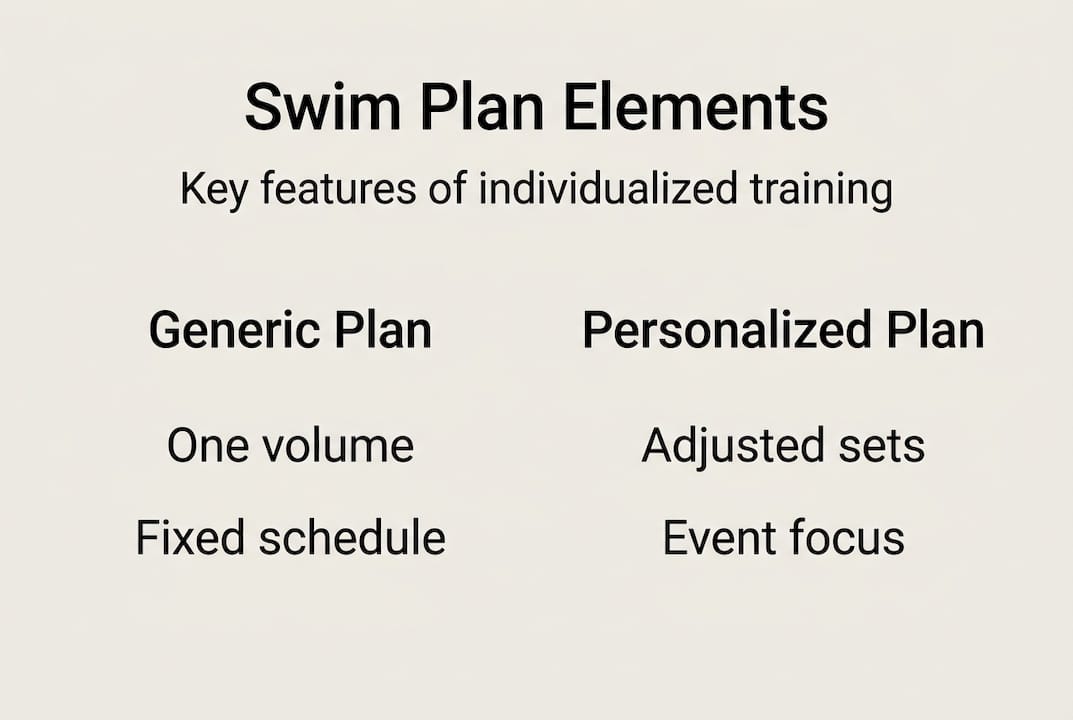
Coaches emphasize traditional periodization with individualized tapering, adjusting for academic and personal schedules. Periodization means dividing the season into phases: base building, intensity, competition prep, and recovery. Each phase has a different purpose, and the transitions between them must be timed carefully for each athlete.
Here is how a tailored plan is typically built:
- Initial assessment — evaluate current fitness, stroke mechanics, injury history, and upcoming competition schedule
- Goal setting — identify target events, time goals, and seasonal priorities with the swimmer and family
- Phase planning — map out training blocks aligned with the competition calendar
- Load management — assign weekly yardage and intensity based on the swimmer’s age and development stage
- Technique integration — embed stroke-specific drills into every phase, not just the off-season
- Dry-land programming — add resistance and mobility work that complements in-water training
- Taper design — reduce volume strategically before key meets to allow peak performance
The table below shows the core difference between a generic and an individualized approach:
| Feature | Generic plan | Individualized plan |
|---|---|---|
| Training volume | Fixed for all athletes | Adjusted by age and fitness |
| Stroke focus | Rotates all four strokes equally | Prioritizes main event stroke |
| Taper timing | Standard 2-week taper | Customized to competition calendar |
| Injury management | One-size recovery protocol | Adapted to individual history |
| Academic schedule | Ignored | Built into load management |
| Feedback loop | Rare or informal | Regular and data-driven |
Following a structured coach training workflow ensures that every element of the plan connects logically and evolves as the swimmer develops through the season.
Maximizing performance: Combining aquatic and dry-land training
With a clear understanding of plan essentials, it is time to zoom into the science. Why does combining aquatic and dry-land training deliver exceptional results for personalized swimmers? The answer lies in what each training environment develops.
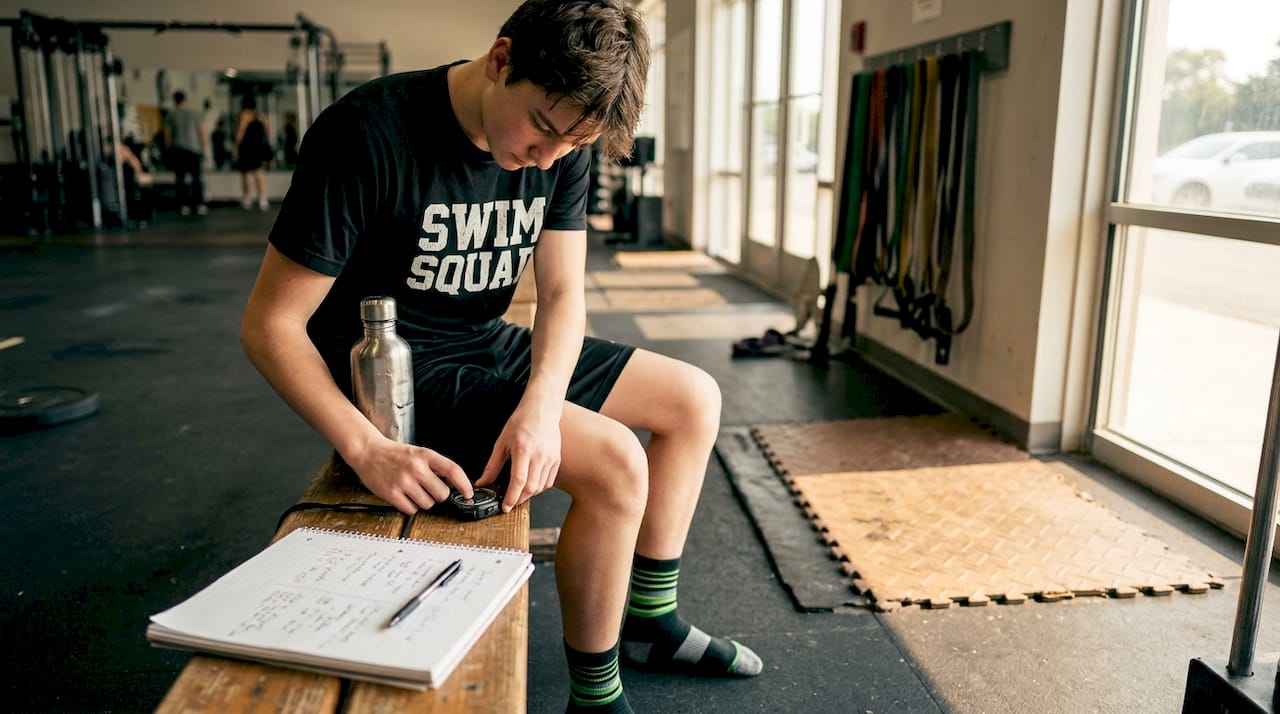
Combined aquatic and dry-land training, especially water plus dry-land resistance, most effectively improves performance metrics including 100m time, stroke rate, and velocity. Pool work builds stroke technique, aerobic base, and race-specific conditioning. Dry-land work builds the power, mobility, and muscular endurance that translate directly into faster, more efficient movement through the water.
A case study on an Olympic-level swimmer showed that load-velocity profiling for individualized in-water resistance improved sprint performance measurably. This approach matches resistance loads to the swimmer’s individual force-velocity curve, meaning the training stimulus is always optimized for that specific athlete’s physiology.
Key dry-land exercises commonly integrated into personalized swim plans include:
- Resistance band pull-throughs to reinforce catch mechanics and shoulder stability
- Medicine ball rotational throws for core power and rotation speed
- Plyometric box jumps to develop explosive leg drive off the walls and blocks
- Lat pulldowns and cable rows to strengthen the pulling muscles used in all four strokes
- Hip flexor and thoracic mobility drills to improve underwater dolphin kick range
The key is that these exercises are selected because they address the specific demands of the swimmer’s main event. A breaststroke specialist needs different dry-land priorities than a backstroke swimmer. This is where physical conditioning for swimmers becomes a true performance multiplier rather than just supplemental work.
Specialization and advanced tailoring: Focusing on main stroke and key events
While plan structure and combined training are essential, top performance hinges on a sharp focus. Tailoring for stroke and event is where maximum potential gets unlocked.
Higher specialization, meaning an individualized focus on the main stroke, correlates with elite performance, and freestyle shows the highest specialization rate among top-level competitors. This does not mean young swimmers should abandon variety. It means that as athletes progress, their training should increasingly reflect the specific demands of their best event.
The distinction between early and late specialization matters here. Early specialization, before age 14 or 15, can limit long-term development by narrowing motor skill acquisition too soon. Late specialization allows athletes to build a broad athletic base before narrowing their competitive focus. The best coaches understand this timeline and plan accordingly.
Here is what advanced tailoring looks like in practice:
- Event-specific energy system training — a 1500m freestyle swimmer trains aerobic capacity differently than a 50m sprinter
- Stroke count and tempo work — targeting the exact race pace and stroke mechanics for the main event
- Start and turn optimization — individualized coaching on reaction time, underwater distance, and breakout timing
- Mental preparation protocols — visualization and focus routines built around the swimmer’s specific race
Coaches who work with technique tips for main strokes know that even small technical adjustments, made at the right developmental stage, can produce significant time drops. The same principle applies to coaching youth swimmers, where the emphasis on gradual, age-appropriate specialization protects long-term athletic development.
Pro Tip: Re-assess your swimmer’s stroke and event focus at the start of every new season. Growth spurts, strength gains, and changing race preferences all affect which event a swimmer should prioritize. What worked at 13 may not be the right focus at 16.
The uncomfortable truth: Why most swim plans fall short (and what really works)
Now that we have laid out the frameworks and evidence, it is time to confront why many swimmers and coaches still miss the mark on individualization. The honest answer is that truly personalized planning is harder and more time-consuming than writing a shared group set. Most programs default to group training because it is efficient, not because it is optimal.
Coaches rarely involve swimmers in the planning process, instead validating group or AI-generated plans but adjusting individually only at the margins. That gap between group structure and genuine individualization is where performance gains get left behind.
The best results we have seen at PEAK come when swimmer feedback, including heart rate data, RPE scores, and weekly well-being check-ins, actively drives plan adjustments. Not once a month. Every week.
Warning signs that your current plan is not personalized enough:
- Training volume never changes regardless of how the swimmer feels
- Taper timing is the same for every athlete before every meet
- Injuries keep recurring without any modification to the training structure
- School exam periods are not reflected in the weekly load
- The swimmer has no input into goal-setting or event selection
If any of these sound familiar, it is worth exploring fundamental swim skills as a starting point for re-evaluating what the plan is actually building toward. Real individualization is not a luxury for elite swimmers. It is the baseline for any athlete who wants to keep improving.
Take the next step: Unlocking your swimmer’s real potential
If you are ready to move past generic group training and embrace high-impact progress, hands-on expert guidance is the next logical step.

At PEAK Performance Swim Camp, every program is built around the individual swimmer, not the other way around. Founded by Olympic coach Nick Baker with over 50 years of coaching experience across more than 1,000 camps in 18 countries, PEAK delivers the kind of structured, personalized attention that produces real competitive results. Whether you are looking for intensive summer training or targeted skill development, explore our Peak Performance swim camps to find the right fit. For more focused, short-term options, our clinic package options offer expert technique assessment and customized training in a concentrated format.
Frequently asked questions
What factors are used to individualize a swim plan?
Plans are personalized based on age, main stroke, event distance, competition schedule, previous injuries, and recovery needs, ensuring that every training decision reflects the athlete’s actual situation.
How does dry-land training enhance swimmer performance?
Combining water and dry-land resistance training improves speed, technique, power, and stroke efficiency more than pool work alone, because each environment develops different but complementary physical qualities.
Is stroke specialization important for youth swimmers?
A gradual, individualized focus on the main event or stroke leads to greater success at higher levels, but early over-specialization should be avoided to protect long-term athletic development and motor skill variety.
How often should a swim plan be adjusted?
Every training cycle, as academic schedules, meet calendars, or recovery needs change. Coaches regularly adjust plans for academic and personal schedules, and seasonal evaluations are the minimum standard for meaningful updates.
Recommended
- Personalized swim coaching: boost skills with tailored training – Peak Performance Swim Camp
- Physical conditioning for swimmers: unlock peak performance – Peak Performance Swim Camp
- Advanced swimming technique tips for peak performance – Peak Performance Swim Camp
- Optimize your swim coach training workflow: 4 key phases – Peak Performance Swim Camp