
TL;DR:
- IM swimming involves completing butterfly, backstroke, breaststroke, and freestyle in a fixed order, with each stroke covering an equal distance. Mastering transitions and technical proficiency in each stroke are crucial, as poor turns and mechanics can cost more race time than fitness alone. Focused skill practice, especially on transitions, significantly improves overall IM performance and race outcomes.
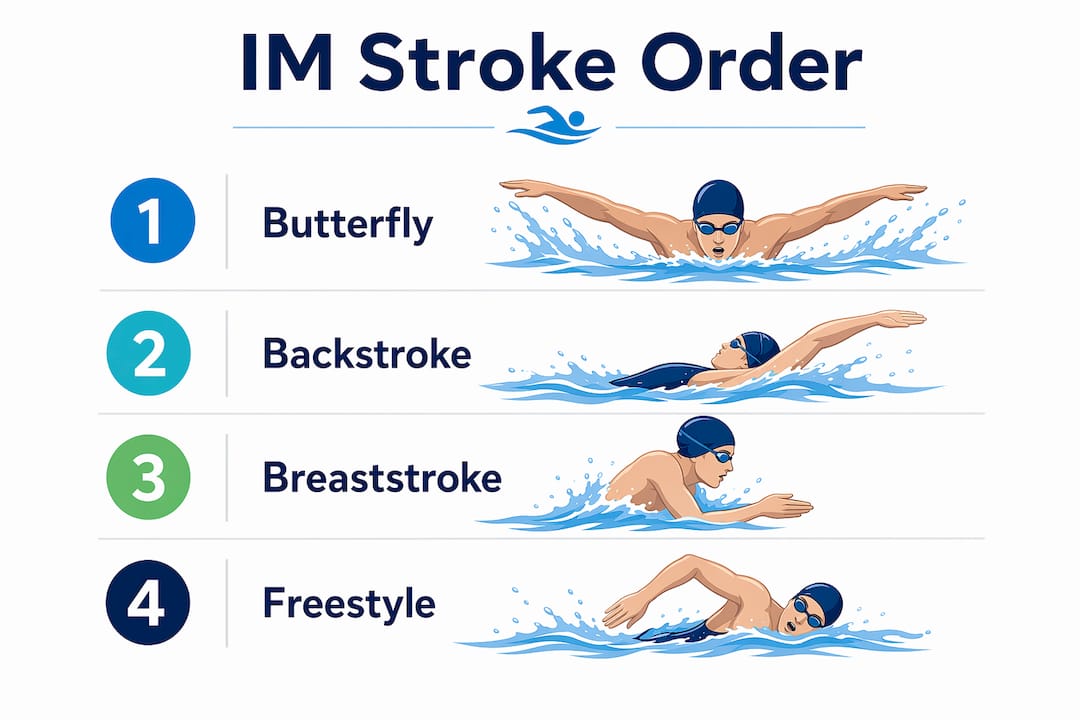
IM swim is the Individual Medley, a race where swimmers complete butterfly, backstroke, breaststroke, and freestyle in that fixed sequence, each stroke covering an equal portion of the total distance. The most common formats are the 100, 200, and 400 IM, making it one of the most technically demanding events in competitive swimming. Mastering the IM requires more than fitness. It demands technical proficiency in all four strokes and the ability to transition between them without losing speed or risking disqualification. This guide covers everything you need to know to swim faster IMs, from stroke order rules to transition mechanics and training structure.
What is the stroke order and basic rules of IM swim?
The official IM stroke order is butterfly, backstroke, breaststroke, and freestyle, and it never changes. Each stroke covers exactly one quarter of the total race distance. In a 200 IM, that means 50 meters of each stroke. In a 400 IM, each stroke covers 100 meters. The equal distance rule is non-negotiable in competition, and any deviation results in disqualification.
Understanding the touch and turn rules at each wall is critical for legal racing. Here is what the rules require at each transition:
- Butterfly to backstroke: Swimmer touches the wall with both hands simultaneously, then pushes off on their back.
- Backstroke to breaststroke: Swimmer touches the wall while still on their back, then rotates to push off on their front.
- Breaststroke to freestyle: Swimmer touches the wall with both hands simultaneously, then pushes off in any position.
One point that confuses many swimmers and parents is the difference between individual medley and medley relay stroke order. In a medley relay, the order is backstroke, breaststroke, butterfly, and freestyle. In the individual medley, butterfly comes first. Mixing these up in practice or warm-up is a common error worth correcting early.
| IM Format | Total Distance | Each Stroke Distance |
|---|---|---|
| 100 IM | 100 meters / yards | 25 meters / yards |
| 200 IM | 200 meters / yards | 50 meters / yards |
| 400 IM | 400 meters / yards | 100 meters / yards |
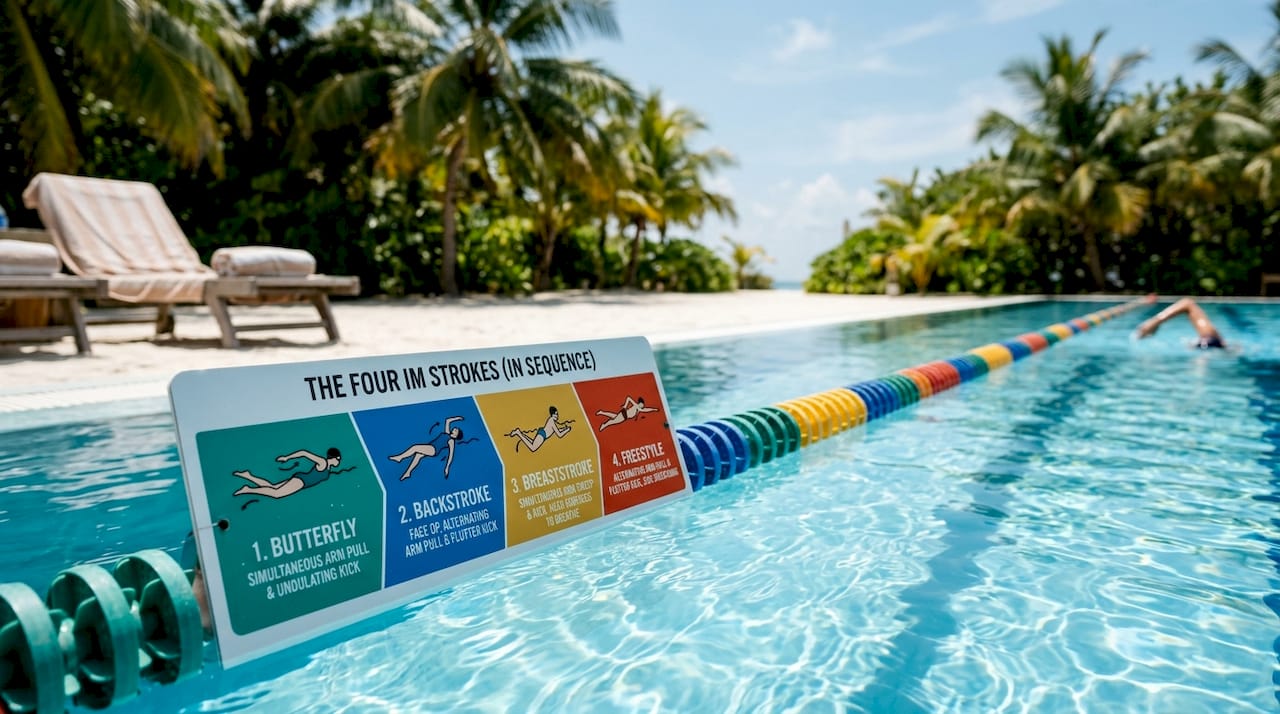
The rules governing each stroke within the IM are identical to those in individual stroke events. Butterfly requires simultaneous arm pulls and a two-hand touch. Backstroke requires the swimmer to remain on their back except during the turn. Breaststroke requires a simultaneous two-hand touch and a legal kick. Freestyle is open, though front crawl is the fastest option and the near-universal choice among competitive swimmers.
How do you perform efficient IM transitions?
IM transitions are where races are won and lost. IM transitions can cost 0.5 to 1.0 seconds per wall, and with three transitions in a 200 IM, that adds up fast. Most swimmers train their strokes but neglect their turns. That is a significant missed opportunity.
Here is how each transition works mechanically, step by step:
- Butterfly to backstroke: Approach the wall at full stroke rate. Touch with both hands simultaneously. Tuck your knees, rotate your body, plant your feet on the wall, and push off on your back into a tight streamline.
- Backstroke to breaststroke: Use a legal backstroke turn by touching the wall while on your back. Rotate your body as you push off, transitioning to a front-facing position. Perform a breaststroke pullout: one arm pull, one kick, then surface.
- Breaststroke to freestyle: Touch the wall with both hands at the same time. Push off on your front into a streamline position. Use dolphin kicks off the wall before transitioning to freestyle arm strokes.
The push-off and breakout after each turn deserve serious attention. Tight streamline and a gradual breakout keep your speed from collapsing after the wall. Many swimmers surface too early, which creates drag and kills momentum before the next stroke even begins.
Pro Tip: Practice each transition in isolation. Swim into the wall for one stroke, execute the turn, and push off into the next stroke for just 10 to 15 meters. This lets you focus entirely on the mechanics without the fatigue of a full IM set.
Common mistakes that lead to disqualification or lost time include:
- Finishing the butterfly stroke early before touching the wall, which causes a one-hand touch instead of two
- Touching the wall while already rotated off the back during the backstroke-to-breaststroke turn
- Skipping the breaststroke pullout after the backstroke-to-breaststroke wall
- Surfacing before completing the pullout on the breaststroke-to-freestyle turn
Training transitions when fresh prevents the formation of poor habits under fatigue. If you only practice transitions at the end of a hard set, your body learns the sloppy version. That is the version that shows up in races.
What stroke-specific techniques improve your IM swim performance?
Each IM stroke has specific technical priorities that directly affect your overall time. Fitness alone does not compensate for poor mechanics in any of the four strokes. Here is what to focus on in each:
Butterfly demands rhythm and undulation above all else. Swimmers who fight the water instead of flowing through it burn energy at a rate that destroys their backstroke split. Focus on a two-beat kick timed to the arm entry, and breathe every two strokes rather than every stroke to maintain a lower head position and reduce drag.
Backstroke presents a unique challenge because you cannot see where you are going. Body rotation is the engine of an efficient backstroke. Rotating from hip to shoulder on each stroke generates power and keeps your stroke long. Count your strokes from the flags to the wall so you never miss a turn or crash into it.
Breaststroke is the slowest stroke in the IM and the one where poor technique costs the most time. A compact pull that stays inside the shoulders, a patient glide after each kick, and a tight streamline during the pullout are the three mechanics that separate fast breaststrokers from slow ones. Avoid pulling too wide or kicking too late.
Freestyle is the final stroke and the one where most swimmers try to make up time. Front crawl is the fastest stroke because of its high propulsion and low drag profile. Focus on a high elbow catch and a consistent six-beat kick to maximize speed when your body is already fatigued from the first three strokes.
Pro Tip: Identify your weakest stroke and dedicate 30 percent of your IM training to it specifically. A 3-second improvement in your breaststroke split will do more for your overall IM time than a 1-second improvement in your already-strong freestyle.
For additional advanced stroke technique guidance covering all four IM strokes, Swimcamp’s coaching resources go deep on the mechanics that matter most at each level.
How to design an IM swim workout focused on skills and endurance
A well-structured IM swim workout balances technical skill work with yardage. Many swimmers make the mistake of treating IM sets as pure conditioning. The result is fast yardage with slow improvement. The most effective IM training separates skill work from endurance work and gives each the attention it deserves.
Here is a sample IM swim workout structure that works for both competitive and recreational swimmers:
| Workout Phase | Example Set | Focus |
|---|---|---|
| Warm-up | 4 x 100 IM on 2:00 | Stroke feel and rhythm |
| Skill block | 8 x 25 transition drills on 0:45 | Turn mechanics, push-off |
| Endurance block | 4 x 200 IM on 3:30 | Pacing and stroke consistency |
| Cool-down | 200 easy choice | Recovery |
For the skill block, use isolated transition sets of 25 meters. Swim the last 10 meters of one stroke into the wall, execute the turn, and swim the first 15 meters of the next stroke. These short sets let you practice the exact mechanics of each transition without accumulating the fatigue that corrupts technique.
Pacing strategy matters in the endurance block. Butterfly should feel controlled, not maximal. Backstroke is where you settle into a rhythm. Breaststroke is where many swimmers blow up if they go out too hard. Freestyle is your opportunity to accelerate. Learning to pace each stroke correctly is a skill that only develops through deliberate practice, not just more yardage.
For guidance on how to structure your training week around IM development, Swimcamp’s resource on swim set design offers a coach-level breakdown of how to organize sets for maximum skill transfer.
What are common mistakes in IM swim and how to troubleshoot them?
Most IM errors fall into a predictable set of categories. Recognizing them early saves significant time and prevents bad habits from becoming permanent.
- Finishing strokes early before the wall: Swimmers who glide into the wall instead of stroking all the way through lose speed and often fail to make legal contact.
- Slow or loose turns: A sloppy tuck and a wide push-off add fractions of a second that compound across three walls.
- Poor streamline off the wall: Arms that are not locked overhead, a lifted head, or a wide body position all create drag that bleeds speed before the breakout.
- Surfacing too early: Coming up before completing the pullout or dolphin kicks cuts the free speed you earned from the push-off.
- Neglecting the backstroke-to-breaststroke rotation: This is the most technically complex turn in the IM. Swimmers who rush it often touch the wall already rotated, which is an illegal turn.
Pro Tip: Film your transitions monthly using a waterproof camera or a phone in a waterproof case positioned at the wall. Video analysis pinpoints faulty mechanics that you simply cannot feel while swimming. What you think you are doing and what you are actually doing are often very different things.
You can also use swim technique videos as a reference point to compare your own turns against correct mechanics before your next practice session.
Key takeaways
Mastering IM swim requires equal investment in stroke technique, transition mechanics, and smart training structure because fitness alone cannot compensate for technical gaps at the walls.
| Point | Details |
|---|---|
| Stroke order is fixed | Butterfly, backstroke, breaststroke, freestyle. Never changes in individual medley. |
| Transitions decide races | Poor turns can add 2.5 or more seconds to a 400 IM, more than most fitness gains. |
| Train transitions when fresh | Practicing turns while fatigued builds the wrong habits that show up in competition. |
| Weakest stroke drives improvement | Targeting your slowest stroke yields more overall time savings than refining your strongest. |
| Skill work before yardage | Isolate transition drills early in practice, before fatigue compromises your mechanics. |
Why transitions matter more than most swimmers think
I have coached swimmers at every level, from first-time IM competitors to national qualifiers, and the pattern is always the same. Swimmers spend 90 percent of their training time on stroke work and almost none on transitions. Then they wonder why their race times do not reflect their fitness.
Poor transitions can add 2.5 or more seconds to a 400 IM. That is more time than most swimmers gain from an entire training cycle of endurance work. Olympic coach Bob Bowman has noted that transitions consistently receive too little training focus at every level of the sport. That observation matches everything I have seen on deck.
The IM is a brain-and-body event. It rewards swimmers who think technically, not just those who train hard. A swimmer with average fitness and excellent transitions will often beat a fitter swimmer with sloppy turns. That is not a theory. It is something you can observe in any age-group meet.
My advice to parents watching their kids compete in the IM for the first time: do not focus on the split times for each stroke. Watch the walls. Watch whether your swimmer is touching legally, pushing off tight, and surfacing at the right moment. Those three things tell you more about future improvement potential than the stroke splits do.
For swimmers themselves, treat the IM as a skill event that also requires fitness, not the other way around. The mental discipline to hold technique when you are tired, especially in the breaststroke leg after two hard strokes, is what separates good IM swimmers from great ones.
— James
Take your IM swim to the next level with Swimcamp

Swimcamp, founded by Olympic coach Nick Baker with over 50 years of coaching experience, runs elite swim camps and clinics across the USA and internationally. The programs are built specifically for swimmers who want to improve technique, not just log yardage. IM swimmers benefit from personalized video analysis and private coaching that identifies exactly where transitions and stroke mechanics are losing time. Structured swim camps give competitive swimmers and developing athletes the focused environment they need to build real IM skills under expert guidance. If you are serious about faster IM times, this is where that work happens.
FAQ
What does IM stand for in swimming?
IM stands for Individual Medley. It is a race where one swimmer completes all four strokes, butterfly, backstroke, breaststroke, and freestyle, in that fixed order, each covering an equal distance.
What is the correct stroke order for IM swim?
The correct order is butterfly, backstroke, breaststroke, and freestyle. This differs from the medley relay, where backstroke comes first.
How many seconds can bad IM transitions cost you?
Each IM transition can cost 0.5 to 1.0 seconds per wall. Across a full 400 IM with three transitions, poor turns can add 2.5 or more seconds to your total time.
When should you practice IM transitions in training?
Practice transitions early in your workout, when you are fresh. Training transitions while fatigued reinforces poor mechanics that transfer directly into race performance.
What is the fastest stroke in the IM?
Freestyle is the fastest stroke in swimming. Most competitive swimmers use front crawl for the freestyle leg of the IM because of its high propulsion and low drag profile.
Recommended
- Advanced swimming technique tips for peak performance – Peak Performance Swim Camp
- When Your Child Starts Swimming: A Beginner’s Guide – Peak Performance Swim Camp
- What Is Swim Set Design: a Coach’s Guide – Peak Performance Swim Camp
- Master swimming conditioning: step-by-step guide to peak performance – Peak Performance Swim Camp