
TL;DR:
- Warm-up scientifically enhances performance by increasing muscle temperature and nervous system efficiency.
- Personalized warm-up routines, adjusted through testing and tracking, optimize race-day results.
- Rigid routines can hinder performance; continuous refinement and individualization are essential.
A poorly planned warm-up can cost you a personal record before you even touch the wall. Many competitive swimmers train for months, fine-tune their stroke mechanics, and nail their nutrition, yet walk onto the pool deck without a structured pre-race routine. Research confirms that regular warm-up led to the fastest mean 50-yard freestyle times, and individual variation plays a significant role in those results. This guide breaks down the science, the tools, and the exact steps you need to build a warm-up that works for your body, your events, and your competitive goals.
Table of Contents
- Why warm up matters: Science and competitive outcomes
- Essential components and tools for an effective swim warm-up
- Step-by-step guide: How to warm up for swimming competition
- Troubleshooting and customizing your warm-up routine
- What most swimmers get wrong about warm-up routines
- Take your swimming to the next level with expert guidance
- Frequently asked questions
Key Takeaways
| Point | Details |
|---|---|
| Personalize your warm-up | Test different routines to see which improves your performance best. |
| Include both dryland and water sets | A mix of physical and mental preparation gives results at competition. |
| Monitor and adjust regularly | Track performance data and adapt your routine to stay competitive. |
| Scientific studies inform best practices | Evidence supports regular warm-up, but individual results matter most. |
Why warm up matters: Science and competitive outcomes
Warm-ups are not just tradition. They are one of the most evidence-supported performance tools available to competitive swimmers. When you raise your core body temperature before a race, your muscles contract faster, your oxygen delivery improves, and your nervous system fires more efficiently. These are not small gains. They are the difference between a flat first 25 meters and an explosive start that sets up your entire race.
Research on warm-up types shows that regular warm-up improves freestyle times and heart rate response compared to no warm-up at all. Swimmers who completed a structured warm-up consistently posted faster times and showed better cardiovascular readiness. That is a measurable, repeatable advantage.
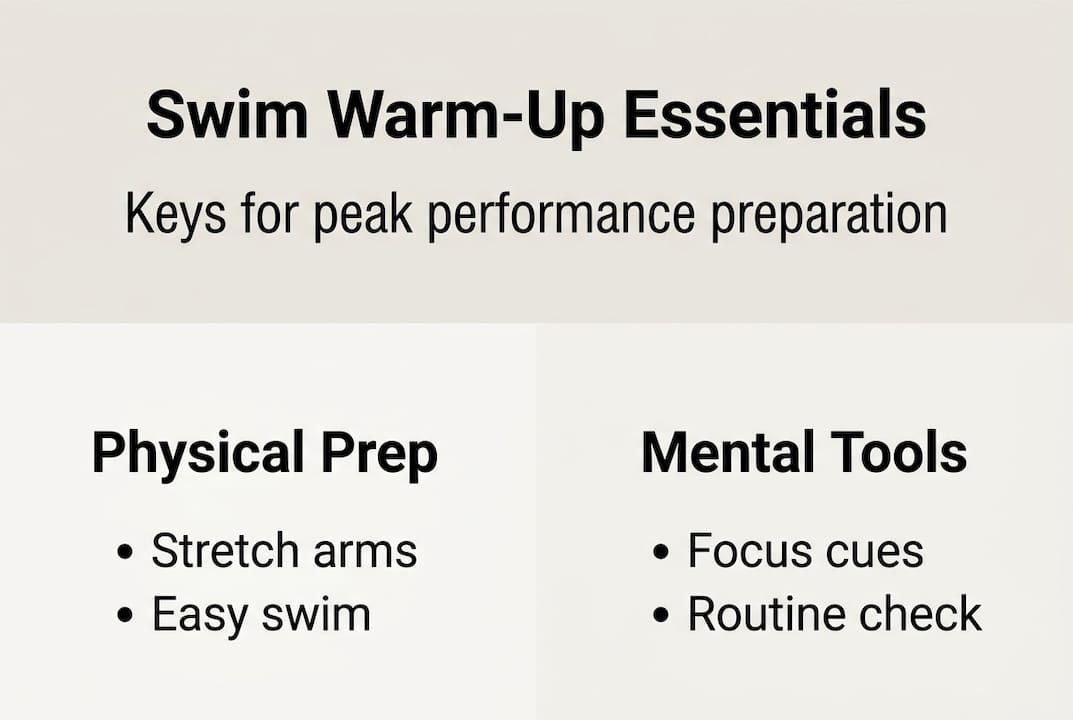
Here is a quick look at how warm-up types compare across key performance indicators:
| Warm-up type | Core temp effect | Heart rate prep | Sprint performance |
|---|---|---|---|
| No warm-up | Minimal | Poor | Below baseline |
| Light aerobic | Moderate | Good | Average |
| Race-pace | High | Excellent | Above average |
| Combined | High | Excellent | Consistently strong |
However, individual testing is critical because conflicting evidence exists on the optimal type and intensity of warm-up for every athlete. What works brilliantly for one swimmer may leave another feeling flat. This is not a flaw in the research. It is a reminder that physiology is personal.
“The best warm-up is the one that prepares your specific body for your specific event. There is no universal formula.”
The physiological benefits of warming up extend beyond the obvious. Muscle elasticity improves, reducing injury risk. Joint range of motion increases, which matters for underwater dolphin kicks and flip turns. Mental focus sharpens as you shift from the chaos of a meet environment into a race-ready state. Understanding these swimmer conditioning principles helps you appreciate why skipping a warm-up is never a neutral decision.
Coaches working with youth athletes should pay particular attention to individual responses. Youth coaching strategies that build warm-up awareness early create athletes who understand their bodies and can self-regulate as they advance. Pair that with advanced swim technique tips and you have a foundation for long-term competitive success.
Key physiological benefits of a proper warm-up include:
- Elevated muscle temperature for faster contraction speed
- Improved oxygen uptake efficiency
- Reduced lactate buildup in the early race phase
- Activated neuromuscular pathways for better stroke coordination
- Lowered perceived effort at race pace
Having set the stage for why warm-ups are indispensable, let’s detail precisely what you need to prepare an effective swim warm-up.
Essential components and tools for an effective swim warm-up
Knowing the science is one thing. Showing up prepared is another. A great warm-up requires both the right mindset and the right equipment. Swimmers and coaches who treat warm-up preparation as seriously as race-day gear selection consistently perform better under pressure.
No single warm-up routine fits all, which means personal adaptation and preparation matter enormously. Your warm-up toolkit should reflect your event, your training age, and your physical tendencies.
Here is how three common warm-up approaches compare:
| Approach | Duration | Best for | Key focus |
|---|---|---|---|
| Standard aerobic | 25 to 35 min | Distance events | Gradual activation |
| Race-pace | 20 to 30 min | Sprint events | Neuromuscular priming |
| Short warm-up | 10 to 15 min | Limited pool time | Efficiency and focus |
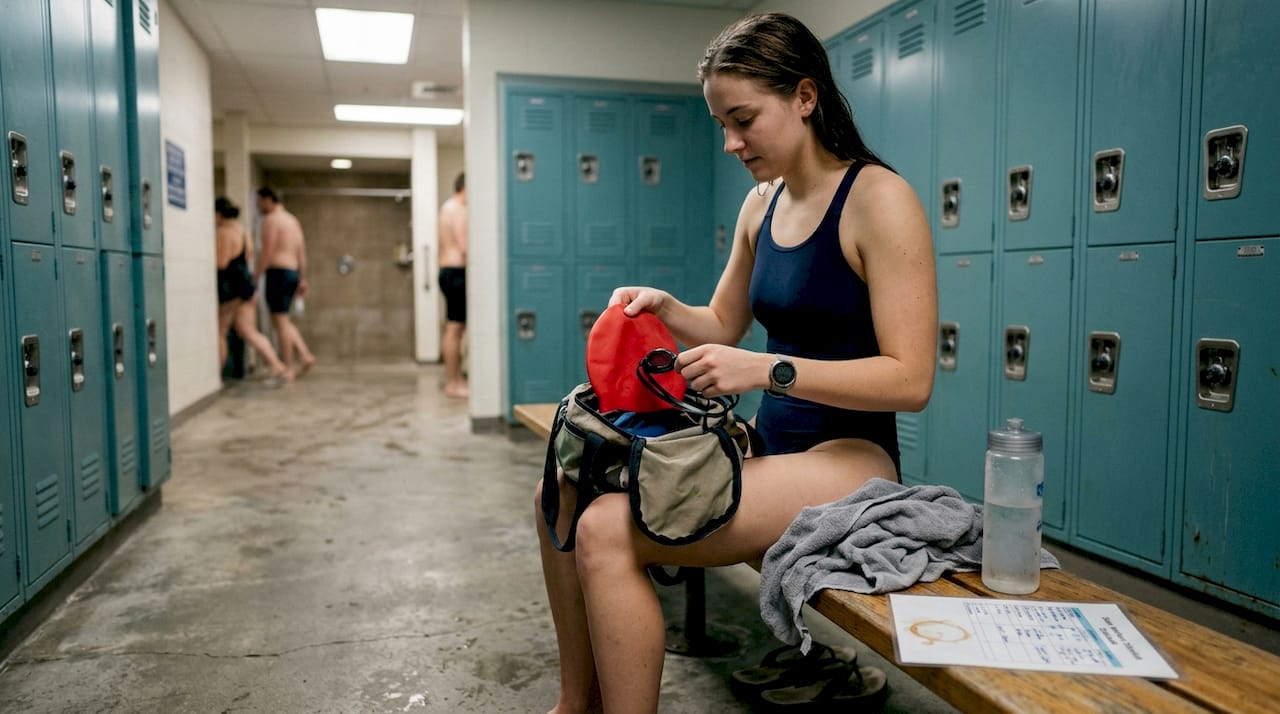
Your physical preparation checklist should include:
- Resistance bands or stretch cords for dryland activation
- Two pairs of goggles (one as backup)
- Two swim caps in case one tears
- A towel and warm layers for between warm-up and race
- A water bottle to stay hydrated throughout
- A written or memorized warm-up plan
Mental preparation is just as important as physical readiness. Before you enter the water, use a short focus cue. This might be a word, a phrase, or a visualization of your race start. Elite athletes do not just warm up their muscles. They warm up their minds. Coach-swimmer communication before warm-up also matters. Coaches should confirm warm-up timing, lane assignments, and any last-minute adjustments so swimmers can focus entirely on execution.
For a more structured approach to building physical readiness, step-by-step swimming conditioning resources can help you integrate warm-up protocols into your broader training cycle.
Pro Tip: Always pack an extra cap and goggles in your swim bag. Equipment failures right before a race create unnecessary stress that disrupts your mental focus and can throw off your entire warm-up rhythm.
Now that you understand the scientific rationale, let’s outline exactly what to have and do before stepping onto the pool deck.
Step-by-step guide: How to warm up for swimming competition
A world-class warm-up follows a clear sequence. It is not random laps. It is a deliberate progression from general movement to race-specific activation. Here is how to build and execute it.
- Arrive early. Get to the pool deck at least 45 to 60 minutes before your event. This gives you time to assess lane availability, mentally review your plan, and start dryland work without rushing.
- Complete dryland activation (10 to 15 minutes). Use resistance bands to activate your shoulders, hips, and core. Include arm circles, leg swings, and light dynamic stretching. Avoid static holds, which can reduce power output.
- Begin in-water aerobic swimming (10 to 12 minutes). Start with easy freestyle or backstroke to gradually raise heart rate and body temperature. Include some kicking sets to activate your legs and loosen your ankles.
- Add drill work (5 minutes). Focus on the specific mechanics of your event. Sprinters might work on turn speed. Distance swimmers might focus on stroke efficiency and breathing patterns.
- Execute race-pace efforts (3 to 5 minutes). Swim two to four short bursts at or near race pace. These prime your fast-twitch fibers and give your body a preview of the effort ahead.
- Cool down briefly (3 to 5 minutes). Easy swimming brings your heart rate down slightly without letting your body cool completely. Time this so you finish 10 to 20 minutes before your race.
Research on elite warm-up timing shows that a shorter warm-up finishing closer to race time improved performance for elite swimmers in some cases, particularly in sprint events. Gabriel Jett’s experience at World Championship Trials demonstrated that adjusting warm-up timing, not just content, can shift race outcomes significantly.
A useful stat: roughly 44% of swimmers perform best with routines that differ from the standard template. That number should motivate every athlete to experiment rather than default to what everyone else is doing.
Pro Tip: Practice your warm-up routine during regular training sessions, not just at meets. Your body should recognize the sequence as a signal to perform, which only happens through repetition over time. Resources like the swim challenge warm-up can give you structured formats to practice.
With tools and knowledge in hand, here’s your complete how-to guide to build and execute a world-class swim warm-up.
Troubleshooting and customizing your warm-up routine
Executing your routine is only part of the process. True mastery means adapting your warm-up to suit your body and your events. Even a well-designed routine can stop working over time if you stop paying attention to how your body responds.
Start by tracking your performance after every meet. Note your warm-up duration, intensity, and timing. Then record how you felt at race start and how your splits compared to training. Patterns will emerge. You may find that on days when you felt flat, your warm-up was either too long or too light. On your best days, look for what was different.
Signs your warm-up may be too short:
- You feel stiff or slow in the first 50 meters
- Your stroke rate takes longer than usual to settle
- Your turns feel sluggish or uncoordinated
Signs your warm-up may be too long:
- You feel fatigued before the race even starts
- Your legs feel heavy during the first lap
- Your focus drifts or you feel mentally flat
Signs your warm-up is mismatched to your event:
- Sprint swimmers doing too much volume without race-pace work
- Distance swimmers skipping aerobic base and going straight to intensity
For sprint events, aerobic and race-pace warm-ups show similar performance outcomes in studies, with individual nuances determining which works best for a given athlete. This means you have flexibility, but you must test both to know which serves you.
“No one-size-fits-all. Test, record results, and adjust for your best performance.”
Knowing how often a swimmer should practice also informs how often you can experiment with warm-up variations without disrupting your training load. Pair that with insights from year-round swim training methods to understand how seasonal changes affect your warm-up needs. Coaches can also benefit from reviewing a structured coach workflow for performance to systematize how they monitor and adjust athlete warm-ups over time.
What most swimmers get wrong about warm-up routines
After working with thousands of swimmers across more than 1,000 camps in 18 countries, we have seen one pattern repeat itself at every level: swimmers copy warm-up routines from athletes they admire without ever testing whether those routines work for them.
It is tempting to follow what an Olympic swimmer does. But that athlete has spent years finding what works for their specific physiology, event, and competitive context. Copying their routine without that context is like wearing someone else’s prescription glasses and wondering why your vision is blurry.
We have seen swimmers improve dramatically, sometimes dropping seconds off personal records, simply by shortening their warm-up or shifting the timing of their race-pace efforts. These were not training breakthroughs. They were warm-up adjustments. The work was already there. The preparation just needed to match it.
Rigid tradition is the enemy of peak performance. If you have been doing the same warm-up for two years without questioning it, that is worth examining. Plateaus and inconsistent race performances are often signals that your warm-up routine has stopped serving you.
Keep a warm-up log. Record what you did, how you felt, and what your results were. Bring that data to your coach. Goal-setting for swimmers works best when it includes process goals like optimizing your warm-up, not just outcome goals like hitting a target time. The athletes who improve fastest are the ones who treat every meet as a source of information, not just a scorecard.
Take your swimming to the next level with expert guidance
You now have the framework to build a warm-up that genuinely prepares you to race at your best. But reading about it and executing it under real competitive pressure are two different things.

At PEAK Performance Swim Camp, our coaches work directly with swimmers to evaluate warm-up routines, identify gaps in preparation, and build personalized protocols that hold up when it matters most. Whether you are looking for structured group training or individualized feedback, our upcoming swim camps offer the environment to test and refine every element of your competitive preparation. For targeted skill development and focused coaching attention, explore our swim clinic packages and take the next step toward consistent, race-ready performance.
Frequently asked questions
How long should a swimming warm-up last before a race?
A swim warm-up typically lasts 15 to 40 minutes, though shorter timing improved performance for some elite swimmers when finishing closer to race start. Your event distance and personal response should guide the final decision.
Is it better to do a race-pace or aerobic warm-up for swimming?
Both approaches can be effective. Race-pace vs. aerobic warm-up showed similar 100-meter sprint performance in studies, so testing which option feels best for your body is the most practical path forward.
Should every swimmer use the same warm-up routine?
No. 20 to 40% of swimmers perform best with routines that differ from the average, which means individual testing and adjustment are essential rather than optional.
What should I do if I feel tired after my warm-up?
Shorten the duration, reduce intensity in the final phase, and consult your coach to identify whether volume, timing, or exercise selection needs adjustment for your specific event and training load.
Recommended
- Physical conditioning for swimmers: unlock peak performance – Peak Performance Swim Camp
- Advanced swimming technique tips for peak performance – Peak Performance Swim Camp
- Master swimming conditioning: step-by-step guide to peak performance – Peak Performance Swim Camp
- Year-round swim training: benefits, methods & success – Peak Performance Swim Camp
- Master Your Pre-Workout Routine Workflow for Peak Results – MyGymSupplements