
TL;DR:
- Proper post-practice recovery involving hydration, nutrition, and rest is essential for optimal performance.
- Immediate actions within the first hour after swimming significantly enhance muscle repair and glycogen replenishment.
- Consistent fundamentals like sleep, hydration, and good nutrition outweigh reliance on advanced recovery tools.
You train hard. You put in the sets, push through fatigue, and hit your splits. But if you feel sluggish at the next practice or notice your times plateauing despite consistent effort, the problem might not be your training volume. It might be what you do in the hours after you get out of the pool. Proper recovery strategies enhance performance and prevent injuries, yet most swimmers treat recovery as an afterthought. This guide breaks down exactly what to do immediately and in the hours following practice so you can feel better, swim faster, and stay healthy throughout the season.
Table of Contents
- Understanding the essentials: What your body needs after swim practice
- Immediate steps: What to do in the first hour after practice
- Advanced recovery tools: Contrast water, stretching, and mobility work
- Long-term success: Sleep, active recovery, and listening to your body
- Our perspective: The biggest opportunity most swimmers miss in recovery
- Ready to recover smarter? Join a Peak Performance Swim Camp
- Frequently asked questions
Key Takeaways
| Point | Details |
|---|---|
| Post-swim recovery pillars | Effective recovery requires hydration, nutrition, mobility work, and sleep. |
| Golden hour actions | The first 30–60 minutes post-practice are key for muscle repair and energy replenishment. |
| Advanced recovery | Contrast baths and stretching accelerate recovery but basics matter most. |
| Track and adjust | Monitor your recovery routines for persistent progress and injury prevention. |
Understanding the essentials: What your body needs after swim practice
Every practice session depletes your body in predictable ways. Glycogen, the stored carbohydrate your muscles rely on for energy, gets burned through during moderate to high-intensity sets. Fluids and electrolytes leave through sweat, even though the pool masks it. Muscle fibers experience small tears that, when repaired, make you stronger. Understanding these mechanisms helps you see why passive rest alone will not cut it.
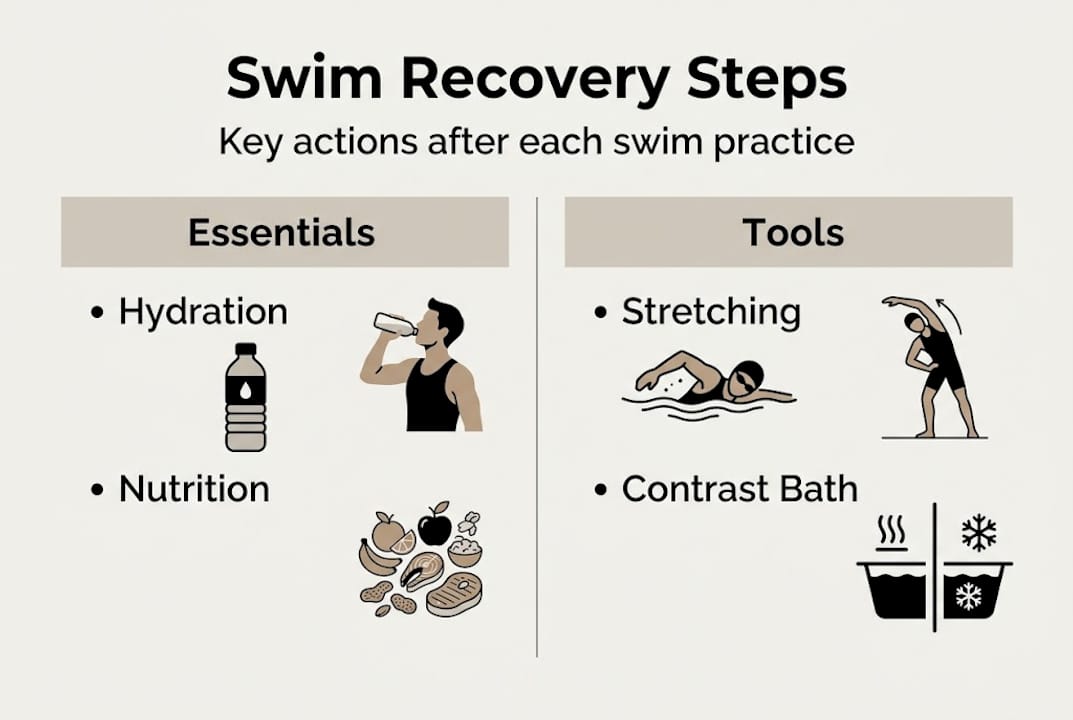
Think of your body after practice like a phone at 5% battery. Resting in airplane mode is better than nothing, but plugging it in is the only real fix. Active recovery strategies are that charger. According to post-swim nutrition science, hydration, nutrition, and rest work together to restore what you lose during swimming. Miss one pillar and the others become less effective.
Here are the four core pillars every swimmer needs to address after practice:
- Hydration: Replacing fluids and electrolytes lost through sweat
- Carbohydrate replenishment: Restoring glycogen so muscles are fueled for the next session
- Protein intake: Supplying amino acids for muscle fiber repair
- Sleep and rest: Allowing hormonal recovery processes to complete overnight
Knowing how often swimmers practice shapes how urgent each pillar becomes. The less time between sessions, the faster you need to act.
| Recovery approach | Speed of results | Effort required |
|---|---|---|
| Passive rest only | Slow | Low |
| Hydration plus nutrition | Moderate to fast | Low to moderate |
| Full active recovery protocol | Fastest | Moderate |
The comparison above makes the case clearly. A full protocol that combines hydration, food, and movement consistently outperforms simply sitting on the couch after practice, even if it feels harder in the short term.
Immediate steps: What to do in the first hour after practice
The first 60 minutes after you exit the pool may be the most critical window in your entire recovery cycle. Research on post-exercise refueling shows that the post-exercise window is 30 to 60 minutes, with chocolate milk improving both swim performance and recovery markers in competitive athletes. That narrow window is where you can make or lose significant gains.
Follow these steps every time after practice:
- Weigh yourself before and after practice when possible. For every pound of body weight lost, you need to replace 20 to 24 ounces of fluid.
- Start drinking immediately. Water is a good baseline, but adding electrolytes helps your body absorb and retain that fluid more effectively.
- Eat a recovery snack or meal within 30 to 60 minutes. The best foods after swimming follow a 3:1 carbohydrate to protein ratio, which is optimal for glycogen reload and muscle repair.
- Perform a brief cool-down. Five to ten minutes of easy movement or light stretching signals your nervous system to shift from high-effort mode to repair mode.
- Avoid skipping the cool-down even when you feel pressed for time. Cutting it shortchanges circulation and can leave your muscles in a contracted state.
The table below gives you real food options that hit the right recovery ratio:
| Food or drink | Carbohydrates | Protein | Ratio |
|---|---|---|---|
| Chocolate milk (16 oz) | 52g | 16g | 3.25:1 |
| Greek yogurt with banana | 45g | 15g | 3:1 |
| Recovery shake (standard) | 60g | 20g | 3:1 |
| Rice cakes with peanut butter | 30g | 8g | ~3.75:1 |
Pro Tip: Pack your recovery snacks and a full water bottle in your swim bag before you leave the house. When you are tired after a hard set, decision fatigue is real. Having food ready removes that barrier entirely.
For more on building the physical base that supports faster recovery, explore conditioning for swimmers and how it connects to your overall training load. And if your technique is creating more muscle strain than necessary, technique tips for swimmers can reduce the physical cost of each practice.
Advanced recovery tools: Contrast water, stretching, and mobility work
Once your nutrition and hydration are handled, additional recovery tools can accelerate muscle repair even further. These are not mandatory for every swimmer, but for those training multiple sessions per week or competing in multi-day meets, they can make a real difference.
Contrast water therapy alternates between cold and warm water immersion. Cold water immersion and contrast baths consistently show benefits for muscle soreness reduction and circulation improvement. The standard protocol involves 1 to 3 minutes in cold water at 10 to 15 degrees Celsius, followed by 3 to 5 minutes in warm water at 37 to 40 degrees Celsius, repeated for 3 to 5 cycles.
Here is a breakdown of supplementary recovery tools and when to use them:
- Cold water immersion (CWI): Best for acute soreness and delayed onset muscle soreness (DOMS). Most effective within one hour post-practice.
- Contrast baths: Especially useful during multi-day competitions or intense training blocks when soreness accumulates.
- Static stretching: Hold each stretch 20 to 30 seconds. Focus on shoulders, hips, and hamstrings after swim-heavy sessions.
- Dynamic mobility work: Light leg swings, arm circles, and trunk rotations prepare the body for the next session.
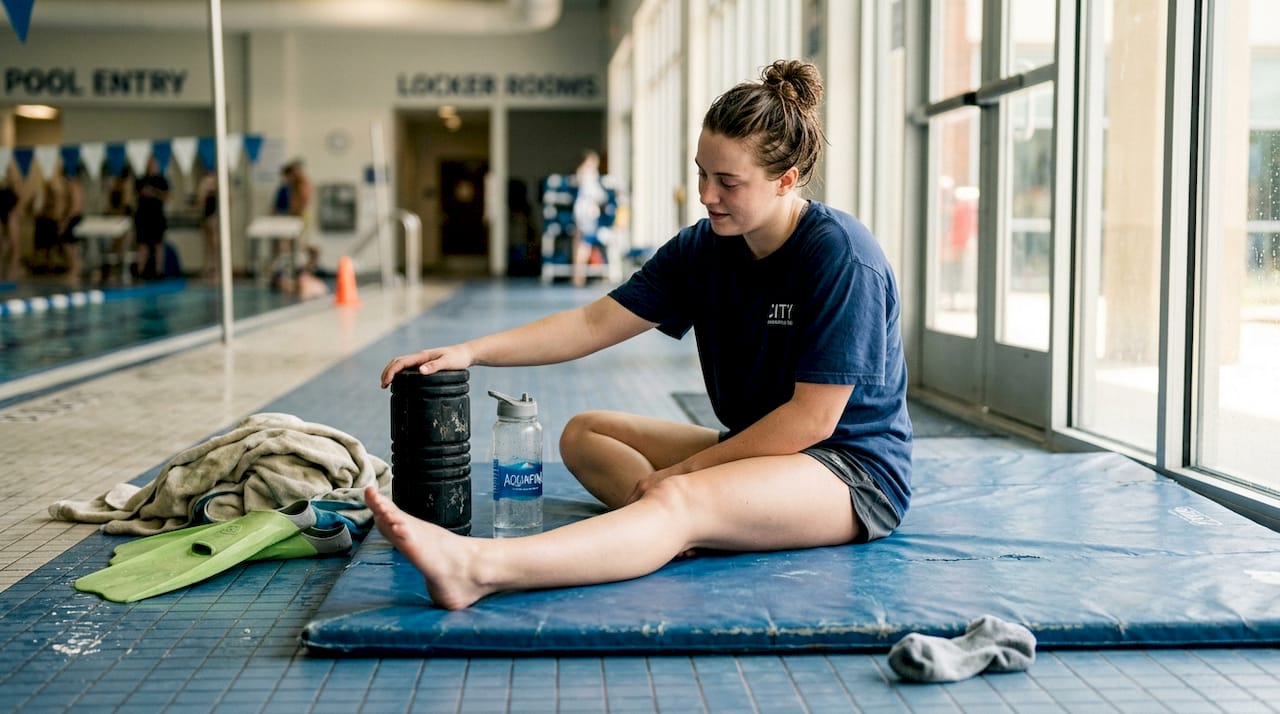
- Foam rolling: Foam rolling and stretching improve flexibility and circulation by breaking down adhesions in the muscle fascia.
“Cold water immersion is most effective when used within one hour of completing practice. Beyond that window, the anti-inflammatory benefits begin to diminish significantly.”
Pro Tip: Use a foam roller for at least 10 minutes immediately after your post-practice stretching session. Work slowly through the calves, quads, lats, and upper back. If an area feels especially tender, spend extra time there rather than rolling past it.
For swimmers who also do dryland workouts, note that recovery tools may need to be adjusted. Strength training creates different muscular stress than endurance-based pool sessions, and recovery protocols should reflect that difference. Coaches who specialize in youth swimmer development can help tailor these strategies for younger athletes.
Long-term success: Sleep, active recovery, and listening to your body
One practice cycle is not where performance is built. Sustainable progress requires consistent recovery habits over weeks and months. That means treating sleep, active recovery swims, and self-monitoring as part of your training program, not extras you do when you have time.
Follow these steps to build a long-term recovery routine:
- Prioritize sleep above all else. Sleeping 7 to 9 hours nightly supports muscle repair, hormonal balance, and cognitive readiness for the next session. Elite swimmers often aim for even more.
- Schedule active recovery swims. A 1000-meter easy swim with sculling drills and dolphin kick work at about 60% of your usual distance keeps blood moving without adding fatigue.
- Track subjective recovery. On a scale of 1 to 10, how rested do you feel? How heavy do your legs feel? Recovery monitoring shows that tracking these numbers weekly against a 21 to 28-day baseline improves tapering decisions and prevents overtraining.
- Recognize warning signs early. Persistent soreness that does not resolve within 48 to 72 hours, lack of motivation, or declining times are signals that your recovery is not keeping up with your training load.
- Adjust before you break down. Reducing intensity or volume for one week is far better than losing several weeks to injury.
For swimmers who benefit from individualized swim planning, structured recovery tracking becomes even more powerful when it feeds directly into load management decisions. And recovery is not only physical. Mental recovery plays a critical role in maintaining motivation and focus through a long season.
Pro Tip: Keep a recovery journal alongside your training log. Note your sleep hours, how you felt before and after practice, and any soreness patterns. After a month, you will start to see trends that even your coach cannot see from the deck.
Our perspective: The biggest opportunity most swimmers miss in recovery
After decades of coaching swimmers at every level, one pattern stands out consistently. Athletes invest enormous energy seeking the next advanced recovery tool, whether it is a new compression device, a specific supplement, or an elaborate ice bath setup. But when you dig into their habits, the basics are often inconsistent. They sleep six hours, skip the post-practice snack, and drink coffee instead of water on recovery days.
No advanced tool compensates for broken fundamentals. The swimmers who recover fastest are not the ones using the most gadgets. They are the ones who are relentlessly consistent about sleep, food timing, and hydration. Those basics, done right every day, outperform any single intervention.
There is also a mindset shift worth making. Recovery is not the absence of training. It is training. It deserves the same intentionality and discipline as your morning practice. Log your recovery habits the same way you log your sets. Track your warm-up techniques using resources like pre-swim warm-up strategies and apply that same rigor to what happens after you get out of the pool. That consistency is where real performance gains live.
Ready to recover smarter? Join a Peak Performance Swim Camp
Knowing the right recovery steps is valuable. Applying them consistently with expert guidance is where real transformation happens.

At PEAK Performance Swim Camp, our coaches don’t just teach technique in the water. They integrate recovery education, physical conditioning, and mental preparation into every camp session. With over 50 years of combined coaching experience and more than 1,000 camps run across 18 countries, we know what it takes to help swimmers of all levels feel better and perform at their highest. Explore our swim camp options and review our camp packages to find the right fit for your season goals.
Frequently asked questions
What’s the most important thing to do right after swim practice?
Hydrate with an electrolyte-rich drink and eat a snack with a 3:1 carbohydrate to protein ratio. Immediate post-swim intake speeds glycogen replacement and jumpstarts muscle repair within that critical 30 to 60-minute window.
How much water should I drink after swimming?
For every pound of body weight lost during practice, drink 20 to 24 ounces of fluid. Aim to replace 150% of fluid lost to account for continued losses after you stop exercising.
Are contrast baths or ice baths necessary after practice?
CWI and contrast baths reduce soreness and aid muscle recovery, making them especially useful for multi-day meets or intense training blocks, but they are not essential for every swimmer at every practice.
Should swimmers practice on rest days for recovery?
Yes. Active recovery swims improve circulation and muscle repair better than complete rest, especially when kept at low intensity with a focus on technique and easy movement.
Recommended
- How to warm up for swimming: techniques for peak performance – Peak Performance Swim Camp
- Master swimming conditioning: step-by-step guide to peak performance – Peak Performance Swim Camp
- Physical conditioning for swimmers: unlock peak performance – Peak Performance Swim Camp
- Guide to effective dryland workouts for competitive swim teams – Peak Performance Swim Camp