
TL;DR:
- Swimmer’s shoulder is the most common injury, caused mainly by overuse and poor technique.
- Preventative dryland exercises twice weekly improve shoulder strength and reduce injury risk.
- Early recognition of pain and form issues allows for timely modifications, safeguarding long-term health.
Injuries are one of the most frustrating barriers a swimmer can face. You train hard, push through fatigue, and stay committed to your goals, only to find your shoulder aching after practice or your lower back tightening mid-season. The good news is that most swim injuries are not random bad luck. They follow patterns, respond to specific risk factors, and, most importantly, can be prevented with the right knowledge and action plan. This guide breaks down the most effective, evidence-based strategies for keeping swimmers healthy, strong, and competing at their best, whether you are just starting out or refining years of experience.
Table of Contents
- Understand common swim injuries and their causes
- Lay the foundation: Technique and stroke mechanics
- Strength and flexibility: Effective preventative training routines
- Monitor warning signs and modify training appropriately
- The critical mindset shift for long-term swim injury prevention
- Supercharge your swim safety and performance with expert coaching
- Frequently asked questions
Key Takeaways
| Point | Details |
|---|---|
| Master fundamentals | Proper swim technique prevents most overuse injuries and is critical for long-term health. |
| Prioritize strength training | Targeted routines, done twice weekly, maintain muscle balance and support joint health. |
| Track warning signs | Consistent monitoring and communication let you adjust training before injuries escalate. |
| Prevention is continuous | Effective injury prevention combines daily habits, coach support, and individualized routines. |
Understand common swim injuries and their causes
Before you can prevent injuries, you need to know what you are up against. Swimming is a demanding, full-body sport, but certain body parts take the hardest hits. The shoulder is the most vulnerable, with shoulder injury rates reported between 40 and 91% of competitive swimmers. Knee pain (often called “swimmer’s knee”) and lower back strain round out the top three.
The root cause in most cases is overuse. Swimmers repeat the same strokes thousands of times per session, placing cumulative stress on muscles, tendons, and joints. When technique breaks down, fatigue sets in, or training volume spikes too quickly, that stress exceeds what the body can absorb and recover from.
Did you know? Shoulder injuries account for up to 91% of all swim-related injuries, making them far and away the most common problem swimmers and coaches need to address.
Several risk factors accelerate injury risk:
- Poor stroke mechanics: Flawed movement patterns force the wrong muscles to compensate, creating localized overload.
- Rapid training load increases: Jumping up mileage too fast overwhelms tissue adaptation.
- Insufficient recovery: Neglecting rest or sleep impairs muscle repair between sessions.
- Muscle imbalances: Weak rotator cuff or hip stabilizers increase stress on adjacent joints.
- Fatigue-driven technique breakdown: Late-practice form errors are a silent injury driver.
Understanding swimming injuries overview at a structural level helps coaches and swimmers identify which training variables need the most attention.
| Injury type | Primary cause | Common symptoms |
|---|---|---|
| Swimmer’s shoulder | Rotator cuff overuse, poor mechanics | Aching pain, limited range of motion |
| Swimmer’s knee | Breaststroke kick mechanics | Inner knee pain during and after practice |
| Lower back strain | Hyperextension in butterfly/breaststroke | Stiffness, dull ache through the lumbar region |
| Neck strain | Head position errors in freestyle | Pain or tension at base of skull |
Getting your swimming fundamentals right from the start is one of the most powerful ways to reduce injury risk before it becomes a problem.
Lay the foundation: Technique and stroke mechanics
Technique is not just about going faster. It is your first line of defense against injury. Improper stroke mechanics directly cause conditions like swimmer’s shoulder and lower back pain from hyperextension in butterfly and breaststroke. The body will compensate for inefficiencies, and those compensations become injury patterns over time.
The most common technique faults and their safer alternatives:
| Stroke flaw | Safer alternative |
|---|---|
| High elbow recovery with internal shoulder rotation | Relaxed, neutral recovery path |
| Dropped elbow during pull phase | High elbow catch with early vertical forearm |
| Overreaching past midline in freestyle | Controlled entry with shoulder-width alignment |
| Excessive lumbar extension in butterfly | Core-driven undulation from the hips |
| Wide, flat breaststroke kick | Narrow, angled kick with hip-led initiation |
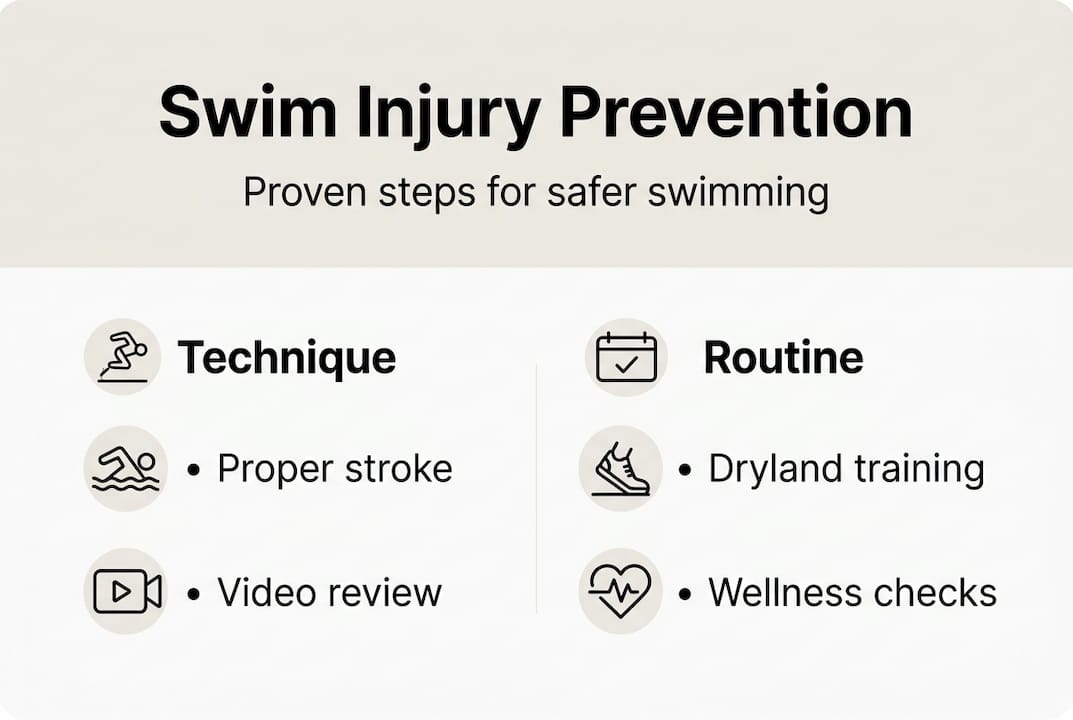
Coaches play an irreplaceable role here. Video analysis is not optional for serious programs. Reviewing underwater footage reveals stroke flaws that are invisible from the pool deck and allows for targeted, specific corrections. Swimmers who receive regular technique feedback experience fewer overuse injuries because movement errors get corrected before they become ingrained habits.
Exploring advanced swimming technique tips can give swimmers and coaches a solid framework for identifying what to look for across all four strokes.
Pro Tip: Schedule a formal video review at least once every four to six weeks throughout the season. Even elite swimmers develop subtle compensations under fatigue. Catching them early keeps technique clean and injury risk low.
Action step: Build a short technique checklist for each swimmer at the start of the season. Review it at mid-season and adjust based on video findings. Consistent check-ins are more valuable than one-off corrections. Coaches can also reference coaching strategies for youth swimmers to learn how to structure feedback effectively across different skill levels.
Strength and flexibility: Effective preventative training routines
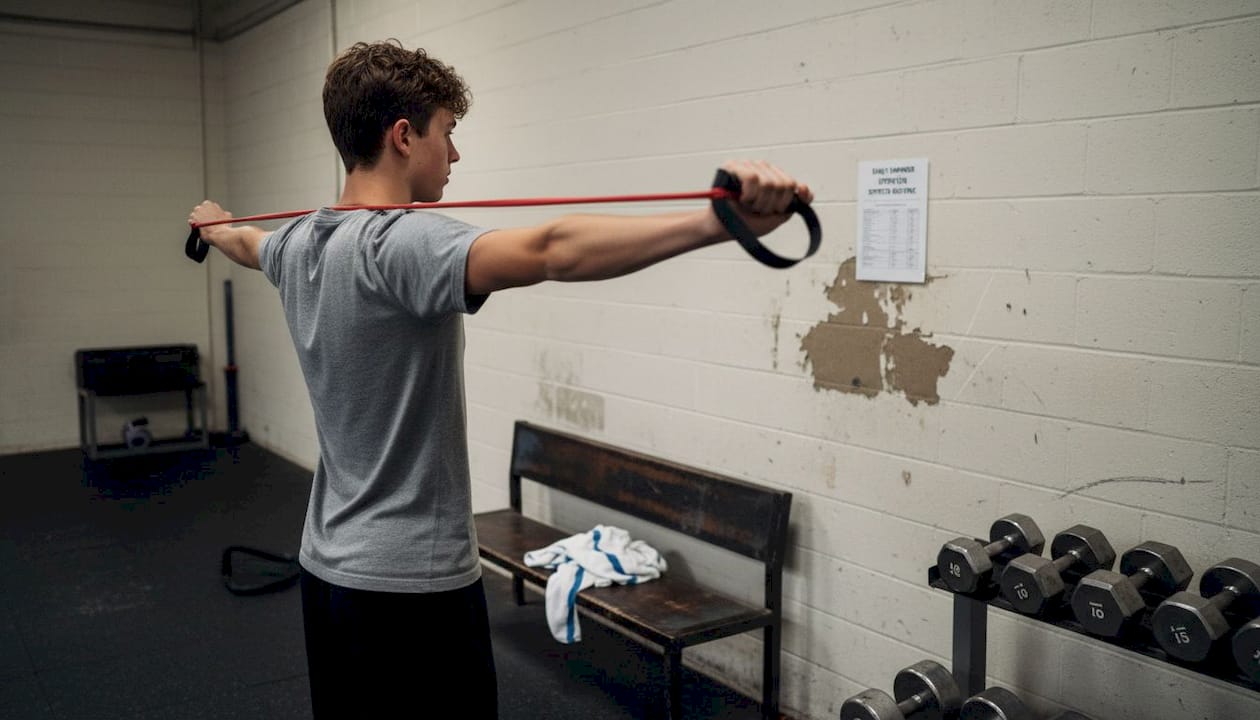
Dryland training is not a supplement to swimming. It is a core part of staying healthy. Research shows that 12-week preventive programs using five targeted exercises performed twice weekly significantly reduce rotator cuff imbalances, while control groups who skipped the program actually lost shoulder strength over the same period.
That finding matters. Doing nothing is not neutral. It is a step backward.
Here are five foundational exercises every swimmer should include in their prevention routine:
- Internal and external shoulder rotation at 90°: Builds rotator cuff strength and corrects the chronic imbalances that develop from heavy freestyle and butterfly volume.
- Scapular punches: Activates serratus anterior to stabilize the shoulder blade during overhead movements, reducing impingement risk.
- T’s (prone shoulder abduction): Strengthens the mid and lower trapezius, countering the forward-rounded posture swimmers develop from high yardage.
- Y’s (prone shoulder elevation): Targets lower trapezius and improves scapular upward rotation, protecting the shoulder joint at full reach.
- Hip bridging with single-leg variation: Builds glute and core stability essential for breaststroke and butterfly power without lower back strain.
For best results, perform these exercises twice per week with two to three sets of 12 to 15 reps each. Light dumbbells or resistance bands work well. The goal is endurance and coordination, not maximum load.
Pro Tip: Resistance bands are ideal for travel or days away from the gym. Pack a set in your swim bag. A 15-minute band routine is enough to maintain shoulder health during competition trips or school breaks.
Key statistic: Swimmers who completed a twice-weekly shoulder prevention program maintained rotator cuff strength across a full season, while those without the program showed measurable strength decline.
Understanding training frequency for swimmers will help you plan when to schedule dryland sessions without adding to total fatigue.
Monitor warning signs and modify training appropriately
Even with great technique and a solid dryland program, the body will occasionally send signals that something is off. Catching those signals early is what separates smart training from preventable injury.
Common early warning signs to watch for:
- Persistent aching in a joint that does not resolve after a warm-up
- Pain that changes your stroke mechanics even slightly
- Swelling, clicking, or catching sensations in a shoulder or knee
- Unusual fatigue that does not improve with a rest day
- Mood changes, sleep disruption, or declining motivation (signs of overtraining)
Coaches should use video analysis for mechanics, track wellness and RPE (rate of perceived exertion), listen to pain early, and adjust training load individually for all levels. This is not just good practice. It is the difference between a swimmer who competes all season and one who misses critical meets.
Communication between athlete and coach is essential. Swimmers need to feel safe reporting discomfort without fear of being pulled from training unnecessarily. Coaches, in turn, must treat pain reports as data, not complaints.
To improve your monitoring system, review a training workflow for coaches that integrates wellness checks into daily practice routines.
Pro Tip: Use a simple 1 to 10 RPE and pain log after every session. If a swimmer’s pain score stays at 3 or higher for three consecutive days, reduce training volume by 20 to 30% and assess before resuming full load. This proactive approach protects both performance and long-term health.
Building injury awareness into your year-round swim training structure ensures prevention never becomes an afterthought during the competitive season.
The critical mindset shift for long-term swim injury prevention
After decades of working with swimmers at every level, one pattern stands out clearly: the programs that produce healthy, high-performing athletes are not the ones that follow prevention protocols perfectly. They are the ones that listen.
Most injury prevention fails not because the plan was wrong, but because the plan became rigid. Swimmers follow a routine until the routine stops matching what their body actually needs. Coaches stick to a program out of habit, even when a swimmer is clearly struggling.
The mindset shift that matters most is moving from compliance to adaptability. Prevention is not a checklist you finish. It is an ongoing conversation between coach, athlete, and the feedback the body provides every single day.
The strongest programs we have seen build individualized swim plans that adjust based on how swimmers respond, not just where they are on the training calendar. That kind of responsiveness is what turns good intentions into long-term, injury-free performance.
Humility plays a role too. The best swimmers we know are the ones willing to dial back when something feels wrong, even when the competition is weeks away. That takes courage, and it pays off.
Supercharge your swim safety and performance with expert coaching
Knowing the strategies is one thing. Putting them into consistent practice is where expert guidance makes all the difference.

At PEAK Performance Swim Camp, we integrate technique assessment, dryland conditioning, and individualized feedback into every program we run. Our coaches use video analysis and hands-on instruction to identify risk factors before they become injuries. Whether you are looking for swim camps for technique and safety, want to invest in video analysis and private coaching, or prefer personalized swim coaching tailored to your specific needs, PEAK gives you the tools to train smarter and stay healthy all season long.
Frequently asked questions
What is the most common swim injury?
Shoulder injuries are the most common, accounting for up to 91% of swimmer injuries due to repetitive overhead motion and rotator cuff stress.
How often should swimmers do preventive exercises?
Twice per week is the evidence-based standard. Studies show this frequency maintains muscle balance and prevents the strength loss seen in swimmers who skip dryland work.
How can coaches spot injury risk early?
Coaches should combine video analysis of stroke mechanics with daily wellness and RPE tracking, responding quickly when swimmers report persistent discomfort or show form changes.
Which strokes cause the most injuries?
Breaststroke and butterfly carry the highest injury risk for the lower back and shoulders, particularly when a swimmer lacks the flexibility or core strength to perform them with proper mechanics.
Recommended
- Master swimming conditioning: step-by-step guide to peak performance – Peak Performance Swim Camp
- How to warm up for swimming: techniques for peak performance – Peak Performance Swim Camp
- Why swimming fundamentals unlock competitive success – Peak Performance Swim Camp
- How parents enhance youth swimming success: evidence-based guide – Peak Performance Swim Camp