
TL;DR:
- Supportive parental behaviors like praise and encouragement enhance motivation and well-being.
- Controlling behaviors such as pressure and immediate technical feedback can lead to burnout and decreased enjoyment.
- Collaboration with coaches and creating a safe emotional environment are key to fostering long-term athlete development.
Many parents of competitive youth swimmers wrestle with a quiet, persistent question: am I helping or hurting my child? You show up at every meet, cheer loudly, and offer feedback on the drive home, all with the best intentions. But research reveals that the type of involvement matters far more than the amount. Some parental behaviors fuel motivation, enjoyment, and performance. Others quietly erode all three. This guide breaks down what the evidence actually says, so you can show up for your swimmer in the ways that truly count.
Table of Contents
- Understanding parental influence: Evidence and misconceptions
- What supportive parental involvement really looks like
- Common pitfalls: When parental involvement goes too far
- Collaboration with coaches: The parent’s partnership role
- A fresh perspective: Rethinking the parent’s impact
- Next steps: Enhance your child’s swimming journey
- Frequently asked questions
Key Takeaways
| Point | Details |
|---|---|
| Support beats pressure | Parents who praise effort and actively support their swimmers tend to foster better performance and lasting enjoyment. |
| Avoid directive coaching | Excessive pressure and directive behavior are linked to burnout and decreased motivation in youth swimmers. |
| Collaboration matters | Partnering with coaches and providing logistical and emotional support drives athlete growth. |
| Presence requires balance | High visibility at competitions can sometimes add stress—know your child’s needs. |
| Programs enhance outcomes | Parent-involved psychosocial initiatives improve both performance and psychological resilience. |
Understanding parental influence: Evidence and misconceptions
Parental involvement in youth swimming takes many forms. You might offer praise after a race, give technical feedback during warm-up, attend every practice, or simply manage the schedule and make sure your child gets to the pool on time. Not all of these behaviors carry equal weight, and understanding the difference is the first step toward becoming the parent your swimmer actually needs.
Research draws a clear line between supportive and controlling involvement. Here is what each looks like in practice:
- Supportive behaviors: Praising effort, celebrating improvement, listening without judgment, attending meets as a fan, asking open-ended questions about enjoyment
- Controlling behaviors: Giving technical instructions, critiquing performance immediately after races, setting outcome-based expectations, comparing your child to teammates, expressing visible frustration
The outcomes tied to each style are strikingly different. Praise and active involvement are positively associated with athlete well-being, mediated through psychological need satisfaction. In contrast, parental pressure and directive behaviors positively correlate with burnout, anxiety, and amotivation in youth swimmers.
| Parental behavior | Performance impact | Motivation impact | Enjoyment impact | Burnout risk |
|---|---|---|---|---|
| Praise and encouragement | Positive | Increases autonomy | High | Low |
| Active logistical support | Neutral to positive | Stable | Moderate to high | Low |
| Directive coaching | Mixed | Reduces autonomy | Lower | Moderate |
| Pressure and outcome focus | Short-term gain possible | Controlled motivation | Low | High |
One of the most persistent myths in youth sports is that more pressure produces better results. Parents often believe that pushing harder will translate to faster times and stronger performances. The data tells a different story.
“The research is consistent: supportive involvement builds the psychological foundation for long-term athletic success, while directive pressure undermines the very motivation it seeks to create.”
If you are just getting started with understanding your role, the swimming parents basics resource covers foundational expectations. And if you are wondering whether your child is ready for a more structured environment, exploring what your child needs from a swim camp can offer useful clarity.
What supportive parental involvement really looks like
Knowing what not to do is useful. But parents also need a clear, practical picture of what genuinely supportive involvement looks like in real life, not just in theory.
Supportive parents show up differently before, during, and after competition. Their actions are guided by their child’s emotional experience, not just the scoreboard. Here are the core behaviors that research and coaching experience consistently support:
- Attend meets and practices as an encouraging presence, not an evaluator
- Celebrate effort and improvement, regardless of finishing position
- Ask questions like “Did you enjoy that race?” rather than “Why did you lose time?”
- Listen attentively when your child shares frustrations or setbacks
- Avoid offering technical feedback unless specifically asked by the coach
- Create a calm, low-pressure environment during the car ride home
The mechanism behind these behaviors is well understood. When children feel that their basic psychological needs, including autonomy, competence, and relatedness, are satisfied rather than frustrated, their intrinsic motivation grows. Praise and active involvement are positively associated with athlete well-being precisely because they feed these psychological needs.
It is also worth noting that your own relationship with swimming matters. Parental encouragement and swimming ability predict better swimming outcomes in youth, with one model explaining 53% of the variance in children’s swimming ability. This does not mean you need to be a former swimmer. It means that your enthusiasm and involvement, when expressed supportively, carry measurable weight.
Consider a real scenario: a 12-year-old finishes a 200 freestyle two seconds slower than her personal best. A supportive parent says, “I loved watching you push through that last 50. How did that feel?” That single question shifts the focus from outcome to experience, which is exactly where a young athlete’s attention belongs.
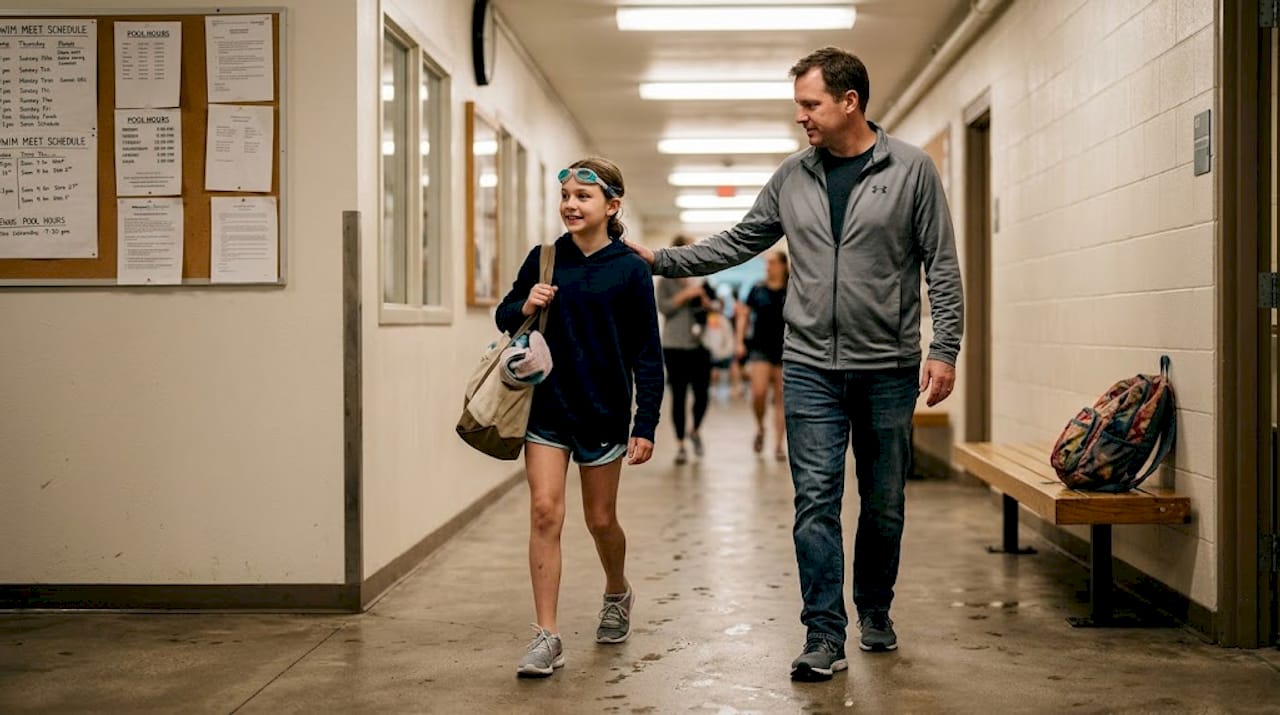
Pro Tip: After every meet, ask your child two questions: “What did you enjoy today?” and “What are you proud of?” These questions build a growth mindset and keep the love of the sport alive.
For coaches and parents looking to align their approaches, youth swim coaching strategies and personalized swim coaching offer practical frameworks that complement supportive parenting.
Common pitfalls: When parental involvement goes too far
Even well-meaning parents can cross the line from supportive to counterproductive. Recognizing these patterns early can prevent long-term damage to your child’s motivation and enjoyment.
Here are the most common mistakes parents make at the competitive youth level:
- Giving directive feedback during or after races. Telling your child to “keep your elbow higher” or “kick harder” immediately after a race competes with the coach’s role and can feel overwhelming.
- Focusing exclusively on results. When every conversation centers on times and placements, children start to believe their worth is tied to performance.
- Hovering at competitions. Staying within earshot of your child during warm-up or between events adds pressure, even when you say nothing.
- Comparing your child to teammates. Statements like “Emma dropped three seconds, why didn’t you?” are deeply demotivating, even when framed as encouragement.
- Expressing visible frustration or disappointment. Children are acutely aware of their parents’ emotional reactions, and a frown or sigh after a race can linger far longer than any verbal comment.
“Perceived parental pressure and directive behaviors positively correlate with burnout and anxiety in youth swimmers, with correlations ranging from r=0.14 to 0.49 across multiple negative outcomes.”
The research also points to an important edge case. High parental presence at competitions can increase pre-competitive anxiety, particularly in certain sports and for some genders. Being physically present is not inherently harmful, but the quality of your presence matters enormously.
Over-involvement also chips away at autonomy, which is a core psychological need. When children feel they are swimming for their parents rather than for themselves, controlled motivation replaces intrinsic drive. The sport becomes an obligation, not a passion.
To avoid these pitfalls, set a personal rule: no performance feedback within 24 hours of a race. Give your child space to process their experience first. Then, if they want to discuss it, follow their lead. Revisiting swimming parents basics and reflecting on whether your child’s needs are being met can also help recalibrate your approach.
Collaboration with coaches: The parent’s partnership role
One of the most powerful things you can do as a swim parent is to clearly understand where your role ends and the coach’s role begins. This boundary is not about being less involved. It is about being involved in the right ways.
Here is a practical breakdown of responsibilities:
- Parent’s role: Transportation, nutrition support, emotional encouragement, celebrating effort, maintaining a positive home environment around swimming
- Coach’s role: Technical instruction, race strategy, training load, performance feedback, skill development
When parents and coaches operate in alignment, swimmers benefit from a consistent, supportive environment. When they conflict, the swimmer is caught in the middle, often at significant emotional cost. Parents’ logistical and emotional support, rather than coaching, is what drives the best outcomes when paired with strong coach alignment.
| Scenario | Swimmer outcome |
|---|---|
| Parent and coach aligned on goals | Higher motivation, clearer focus, better performance |
| Parent undermines coach feedback | Confusion, reduced trust in coach, lower performance |
| Parent overcoaches at home | Anxiety, technique inconsistency, burnout risk |
| Parent provides only emotional support | Strong autonomy, high enjoyment, sustainable development |
The good news is that structured programs can help bridge this gap. Psychosocial programs that involve parents show measurable improvements in swimmers’ perceptions of performance factors, including confidence and focus. These programs teach parents how to support without overstepping.
Pro Tip: Schedule a brief check-in with your child’s coach once a month. Ask one simple question: “How can I best support [your child’s name] right now?” This keeps communication open and ensures you and the coach are pulling in the same direction.
For deeper insights into what makes coaching effective, explore youth swim coaching strategies, learn what to look for in a swim coach, and understand the advantages of elite coaching for young swimmers.
A fresh perspective: Rethinking the parent’s impact
Conventional wisdom in youth sports often prizes results above everything else. Parents measure success in dropped seconds and podium finishes. But after decades of working with competitive swimmers at PEAK Performance Swim Camp, we have seen a different truth play out again and again.
The parents who have the greatest positive impact are not the loudest voices at the meet. They are the ones who make their child feel safe enough to fail, try again, and keep going. That emotional safety is not soft. It is the foundation of every great athletic career.
Supportive parental involvement enhances performance and enjoyment through psychological need satisfaction, while pressure-based styles risk burnout and reduced motivation. The data confirms what great coaches already know: resilience, confidence, and joy are built at home, not just in the water.
When your child has a tough meet, that moment is not a failure. It is a teaching opportunity. How you respond in the car on the way home shapes how they respond to adversity for the rest of their athletic life. For more on building that mental toughness, swimmer resilience insights offer a practical starting point.
Next steps: Enhance your child’s swimming journey
You now have a research-backed foundation for showing up as the parent your swimmer needs. The next step is putting it into practice within an environment designed to bring out the best in young athletes.

At PEAK Performance Swim Camp, we partner with families to create a holistic development experience that addresses technique, mental preparation, and physical conditioning. Our youth swim camps are built around the same principles covered in this guide: autonomy, encouragement, and expert coaching that respects each swimmer’s individual journey. If your child needs more personalized attention, our personal swim coaching program offers one-on-one support tailored to their specific goals. Reach out today and take the next step toward your swimmer’s peak performance.
Frequently asked questions
How can I help my child enjoy swimming without adding pressure?
Focus on praising effort and listening to their experiences after each session. Praise and active involvement are positively linked to athlete well-being when they satisfy core psychological needs rather than create performance expectations.
Does my presence at swim meets help or hurt?
Your presence is generally encouraging, but the quality of that presence matters. High parental presence at competitions can increase pre-competitive anxiety for some children, particularly when it comes with visible emotional reactions or unsolicited feedback.
Should parents coach their own children in swimming?
Leave technical coaching to the professionals. Logistical and emotional support from parents, aligned with the coach’s approach, consistently produces better outcomes than parents taking on a coaching role themselves.
Are there programs that involve parents in supporting their child’s psychological performance?
Yes. Psychosocial programs involving parents show measurable improvements in swimmers’ perceptions of key performance factors, including emotional resilience and confidence under pressure.
Recommended
- Top coaching strategies for youth swimmers: skill & performance gains – Peak Performance Swim Camp
- Ten Things Age Group Swimming Parents Should Know – Peak Performance Swim Camp
- Personalized swim coaching: boost skills with tailored training – Peak Performance Swim Camp
- 8 major advantages of elite coaching for young swimmers – Peak Performance Swim Camp