
TL;DR:
- Holistic swimmer development relies on four interconnected pillars: physiological, technical, tactical, and psychological.
- Support systems like recovery, nutrition, dryland, and technology are essential for sustained progress.
- Early specialization can hinder long-term growth; a multi-stroke, skill-first approach benefits future performance.
Many coaches and parents assume that more laps equal better swimmers. It’s a logical belief, but it misses most of the picture. True swimming excellence comes from developing the whole athlete, not just the body in the water. Physiological conditioning, technical precision, race strategy, and mental toughness all interact to shape performance. Neglect any one of them, and you leave real speed on the table. This guide breaks down the proven framework for holistic swimmer development, the support systems that make it work, and the practical training methods you can apply starting today.
Table of Contents
- The four pillars of holistic swimmer development
- Beyond the pool: The systems supporting holistic growth
- Long-term athlete development: Avoiding early specialization
- Precision in practice: Applying evidence-based training methods
- Why most swimmers overlook true holistic development
- Start your holistic journey with expert guidance
- Frequently asked questions
Key Takeaways
| Point | Details |
|---|---|
| Holistic training pillars | Combining physical, technical, tactical, and psychological training creates complete swimmers. |
| Support systems matter | Recovery, nutrition, dryland training, and technology empower sustainable progress. |
| Long-term progression | Skill-first, well-balanced development avoids burnout and leads to elite performance over years. |
| Evidence-based methods | Research proves that integrating dryland and pool work with advanced tactics boosts results. |
The four pillars of holistic swimmer development
After introducing holistic development, let’s break down the core framework that guides truly complete swimmer growth.
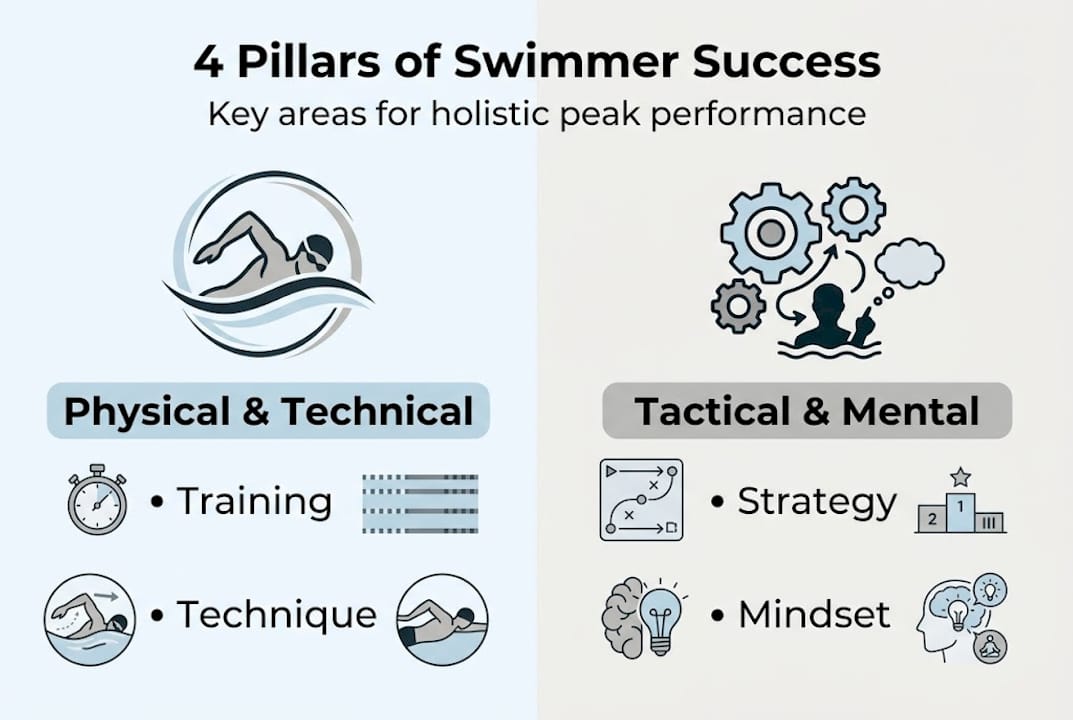
The Four Pillars framework organizes complete swimmer development into four interconnected areas: Physiological Precision, Technical Mastery, Tactical Intelligence, and Psychological Resilience. Each pillar addresses a distinct but deeply connected dimension of performance. Strong physical conditioning for swimmers builds the engine, while technique, strategy, and mental toughness determine how efficiently that engine runs.
Here’s a quick look at what each pillar covers:
- Physiological Precision: Aerobic and anaerobic capacity, endurance, strength, and energy system development
- Technical Mastery: Stroke efficiency, body position, turns, starts, and underwater work. See advanced technique tips for deeper guidance.
- Tactical Intelligence: Race strategy, pacing decisions, competitor awareness, and split management
- Psychological Resilience: Focus under pressure, confidence, goal setting, and managing competition anxiety. Mental training tips are often the most overlooked piece.
What makes this framework powerful is how the pillars are applied across five progression levels, from foundational beginners to high-performance competitors. A Level 1 swimmer focuses on basic body position and water comfort. A Level 5 elite athlete works on race-specific pacing models and advanced mental rehearsal. The same four pillars apply at every stage, but the depth and complexity scale with the athlete.
| Pillar | Beginner focus | Elite focus |
|---|---|---|
| Physiological Precision | Basic aerobic base | Lactate threshold training |
| Technical Mastery | Freestyle fundamentals | Stroke rate optimization |
| Tactical Intelligence | Simple even pacing | Event-specific race modeling |
| Psychological Resilience | Enjoyment and confidence | Pressure management and focus |
Neglecting even one pillar creates a ceiling on performance. A swimmer with elite fitness but poor race strategy will consistently underperform. A technically gifted swimmer who crumbles under pressure will lose races they should win.
Pro Tip: At your next practice, rate your swimmer on each of the four pillars from 1 to 5. The lowest score is almost always where the biggest performance gains are hiding.
Beyond the pool: The systems supporting holistic growth
While the Four Pillars guide training content, support systems outside the pool determine how fully those methods work.
The systems that sustain development include recovery protocols, nutrition education, dryland strength work, technology for performance analysis, and alignment among parents, coaches, and athletes. Think of these systems as the soil in which the Four Pillars grow. Without them, even the best training plan produces limited results.
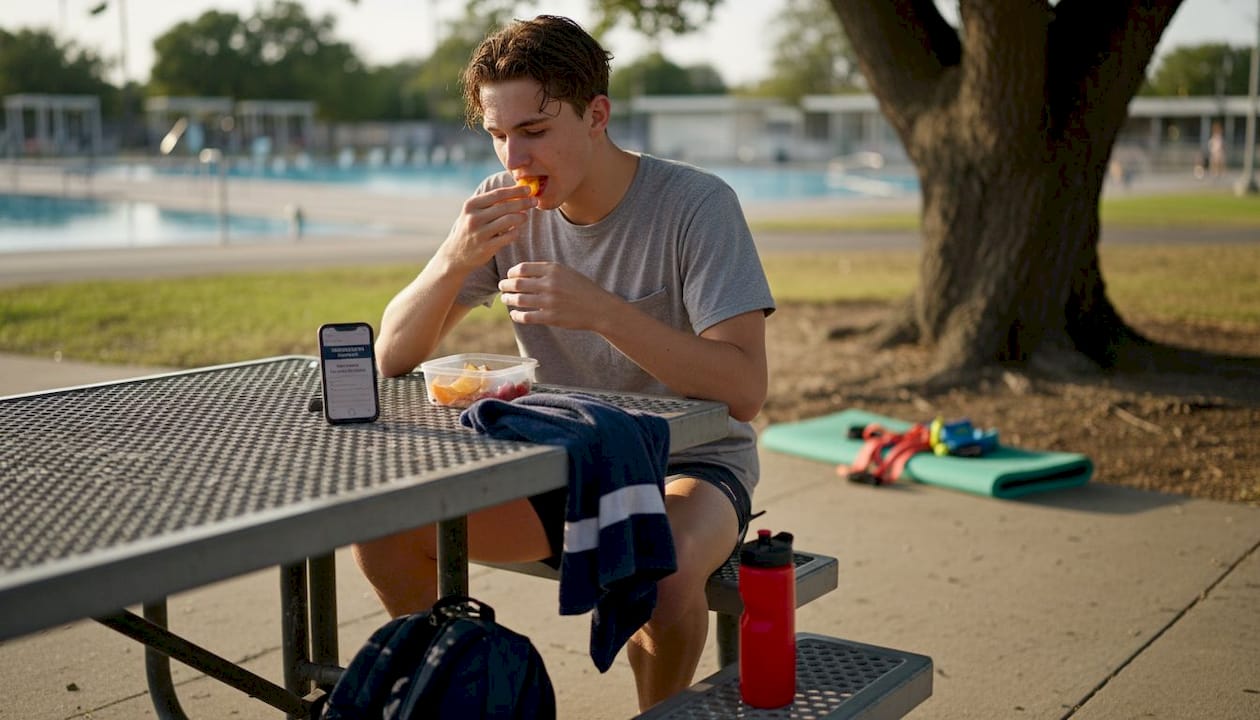
Recovery is where adaptation actually happens. Sleep is the single most powerful recovery tool available, and most youth swimmers are not getting enough of it. Mobility work, contrast therapy, and active rest days reduce injury risk and allow the body to absorb training stress. Post-workout recovery guidance consistently shows that athletes who prioritize recovery outperform those who simply train harder.
Nutrition education is equally critical. Swimmers need to understand how to fuel training, not just eat well in general. Carbohydrate timing, protein intake for muscle repair, and hydration strategies all affect how much a swimmer gets from each session. Explore swimming nutrition advice to build a practical fueling plan.
Dryland training is another major lever. Core strength for swimmers directly translates to better body position, more powerful turns, and reduced drag. Resistance-based dryland work builds the strength that pool training alone cannot develop efficiently.
Key support systems every program should include:
- Sleep and recovery: 8 to 10 hours for youth athletes, active recovery between hard sessions
- Nutrition planning: Pre, during, and post-training fueling tailored to swim volume
- Dryland strength: Resistance training, core stability, and mobility work
- Technology: Video analysis, wearables, and split tracking to identify technique gaps
- Stakeholder alignment: Parents and coaches sharing consistent messages about goals and expectations
Pro Tip: Ask your coach to record one training session per month. Watching yourself swim is one of the fastest ways to spot technical inefficiencies you cannot feel in the water.
Long-term athlete development: Avoiding early specialization
With support systems in place, it’s crucial to understand not just what to train, but when and how to develop each aspect for lifelong progress.
Long-term athlete development (LTAD) is the framework that sequences skill, physical, and psychological growth over a swimmer’s entire career. Reaching elite performance typically takes 10 or more years of structured, progressive development. That timeline is not a discouragement. It’s a roadmap.
Early specialization is one of the most common and damaging mistakes in youth swimming. When young athletes focus exclusively on one stroke or event too soon, they miss critical windows for building foundational movement skills, general athleticism, and psychological resilience. The result is often burnout by the teenage years, or a performance plateau that is very hard to break through.
The importance of swimming fundamentals cannot be overstated in the early stages. A swimmer who has mastered all four strokes, strong turns, and efficient starts has far more room to grow than one who has only ever trained freestyle.
A sensible LTAD progression looks like this:
- Foundation stage: Water confidence, basic stroke mechanics, fun and exploration across all four strokes
- Learning stage: Technique refinement, introduction to dryland, building aerobic base
- Training to train: Structured periodization, event selection, increasing volume with quality focus
- Training to compete: Race strategy, performance testing, mental skills training
- Training to win: Elite-level specificity, individualized programming, peak performance planning
Seasonal planning matters just as much as long-term structure. Within each year, phases should alternate between high-volume base building, technical focus, and race-specific sharpening. Trying to peak for every meet leads to stagnation. Smart periodization leads to real breakthroughs.
“The goal of LTAD is not to produce the fastest 12-year-old. It’s to produce the best possible athlete at 22 and beyond.”
Precision in practice: Applying evidence-based training methods
Having explored why balance and timing matter, let’s turn to the everyday training methods that translate holistic thinking into real, measurable performance.
Research consistently supports combining aquatic and dryland work. Combined training improves 100-meter swim time by approximately 2 seconds and increases velocity by 1.27 meters per second. Core stability training in youth swimmers shows a standardized mean difference of 0.71 in performance outcomes. These are meaningful, measurable gains from methods that do not require more pool time, just smarter use of it.
Elite programs do not simply chase volume. They prioritize stroke smoothness over raw speed in technique sets, use reverse-J shaped pacing strategies for optimal race execution, and break training into phase-specific skills including starts, underwater dolphin kicks, and turns. This contrasts sharply with the common approach of just swimming more laps and hoping for improvement.
Practical methods to apply right now:
- Resistance-based dryland: Band work, medicine ball throws, and bodyweight circuits targeting swim-specific muscles
- Core stability sets: Planks, rotational exercises, and anti-rotation work. Core strength for swimmers is a non-negotiable foundation.
- Technique-first sets: Reduce speed to improve stroke mechanics before adding intensity
- Pacing practice: Swim sets designed to practice even or negative splits, not just all-out efforts
- Warm-up precision: A structured effective swim warm-up primes the nervous system and reduces injury risk
Pro Tip: Replace one all-out sprint set per week with a controlled pacing set where the goal is hitting exact split times. Swimmers who can control pace in practice can execute race strategy under pressure.
The shift from volume-chasing to precision training is not easy. It requires patience, trust in the process, and a willingness to slow down before speeding up. But the data is clear: quality beats quantity every time.
Why most swimmers overlook true holistic development
With practical frameworks and evidence in mind, it’s worth pausing for a frank perspective on why swimmers and families often struggle to embrace the full holistic model.
After decades of coaching at PEAK Performance Swim Camp, we’ve seen the same pattern repeat itself. Swimmers and parents arrive focused almost entirely on physical effort. More yards. More sets. More time in the water. It feels productive. It looks like hard work. But it often masks a reluctance to invest in the less visible elements of development.
Fixating on times and medals at every meet is the most common trap. Short-term results feel urgent, but they consistently undermine long-term growth. A swimmer who drops time at age 12 by grinding volume often hits a wall at 16 because the technical and psychological foundations were never built.
The uncomfortable truth is that mental training mindsets, recovery habits, and nutritional awareness are often the missing factors separating good swimmers from great ones. These areas require collaboration between athletes, parents, and coaches. They also require patience, which is harder to maintain than simply adding another practice.
Real holistic development is a team effort. When everyone involved shares the same long-term vision, the results speak for themselves.
Start your holistic journey with expert guidance
If you’re ready to turn holistic principles into progress, specialized support can make all the difference.

At PEAK Performance Swim Camp, we’ve spent 30 years building programs that integrate all four pillars with the support systems that make them stick. Our Peak swim camps are designed to develop the complete athlete, from stroke mechanics and race strategy to mental preparation and recovery habits. Expert coaches guide each swimmer through personalized planning, targeted technique work, and mindset development tailored to their current level. For more flexible options, our customized clinic options bring the same expert approach in a shorter format. Whether your swimmer is just starting out or chasing elite times, we have the structure and expertise to support every step of the journey.
Frequently asked questions
What are the Four Pillars of holistic swimmer development?
The Four Pillars are Physiological Precision, Technical Mastery, Tactical Intelligence, and Psychological Resilience. Each supports a distinct dimension of complete swimmer growth, and all four must be developed together for lasting performance gains.
How does dryland training improve swimmer performance?
Combined aquatic and dryland training improves 100-meter swim times by approximately 2 seconds and increases velocity by 1.27 meters per second. Core stability work also produces measurable performance gains in youth swimmers.
Why should swimmers avoid early specialization?
Early specialization increases burnout and injury risk while limiting the technical, physical, and psychological foundations that support long-term elite performance. A skill-first, multi-stroke approach in the early years pays off significantly over time.
How do parents and coaches contribute to holistic swimmer development?
Parents and coaches are essential to the support systems that sustain development, including recovery, nutrition education, motivation, and keeping long-term goals in focus. Alignment between all stakeholders is one of the strongest predictors of swimmer success.
Recommended
- Advanced swimming technique tips for peak performance – Peak Performance Swim Camp
- Why swimming fundamentals unlock competitive success – Peak Performance Swim Camp
- Physical conditioning for swimmers: unlock peak performance – Peak Performance Swim Camp
- Optimize your swim coach training workflow: 4 key phases – Peak Performance Swim Camp
- Building a Supplement Routine Naturally for Peak Performance – Interval
- How to Fuel Athletic Performance for Peak Results – MyGymSupplements