
TL;DR:
- Recent research shows that group swim lessons, with peer modeling, can accelerate learning more effectively than private lessons for foundational skills and confidence building. Private lessons offer precise technical corrections but lack the observational peer stimulus that promotes motor learning and emotional development. The most effective approach combines both formats, tailored to a swimmer’s current needs, progression level, and goals for optimal growth.
Most parents assume that one-on-one swim instruction is always the fastest path to improvement. Pay more, get more attention, and your child will progress faster. That logic feels solid. But recent peer-learning research suggests the story is more nuanced than that. Group swim lessons, often seen as the budget option, actually carry a learning advantage that private sessions cannot replicate: peer modeling. Watching other children attempt, struggle, and succeed at the same skills accelerates a swimmer’s own learning in measurable ways. So before you book the next round of lessons, it is worth understanding what the evidence actually says.
Table of Contents
- What sets group and private swim lessons apart?
- How do swimmers learn best? The role of peer learning vs personalized feedback
- When should you choose group or private swim lessons?
- What are the limitations you should know about research on swimming lesson formats?
- Why mixing formats and focusing on the swimmer matters most
- Take the next step: Find the right swim lesson experience
- Frequently asked questions
Key Takeaways
| Point | Details |
|---|---|
| Peer learning drives progress | Group lessons offer powerful observational benefits that help many swimmers learn faster. |
| Personalization matters for technique | Private lessons are effective for advanced skills and correcting subtle errors. |
| Goals should guide your choice | Decide between group or private lessons based on confidence, technique needs, and personality. |
| Blended approaches work best | Combining group and private lessons often supports well-rounded swim growth. |
What sets group and private swim lessons apart?
To break the confusion, let’s clarify how group and private swim lessons differ at a basic level.
Group swim lessons typically involve four to eight swimmers of similar age or ability working with one or two instructors. Learners share lane time, watch each other attempt drills, and absorb feedback that is directed at the group as much as at any individual. This structure naturally creates a social learning environment where swimmers are influenced by each other’s attempts, corrections, and successes.
Private swim lessons are exactly what they sound like: one swimmer, one instructor, and full attention on a single athlete. The coach can address specific technique errors in real time, set a custom pace, and tailor every drill to the individual’s needs. For swimmers with highly specific technical goals, that focused feedback is difficult to replace.
One critical difference is the presence of peer modeling. Group lessons add a peer-learning component that private lessons simply cannot replicate. When a child watches a peer perform a skill correctly or even imperfectly, the brain processes that observation in ways that support motor learning. Private lessons, by definition, remove that modeling opportunity. Neither format is universally superior. They serve different purposes, and the smartest swimmers and swim parent essentials approach uses each strategically.
| Feature | Group lessons | Private lessons |
|---|---|---|
| Instructor attention | Shared across multiple swimmers | Fully individualized |
| Peer modeling | Yes, central to the experience | No |
| Pacing | Set for the group | Tailored to the individual |
| Social interaction | High | Minimal |
| Cost | Lower per session | Higher per session |
| Best for | Confidence building, foundational skills | Specific technique correction |
Key structural differences worth noting:
- Environment: Group settings are dynamic and socially engaging. Private sessions are focused and controlled.
- Personalization: Private lessons win on customization. Group lessons win on variety of stimulus and observation.
- Pacing: Group lessons may move faster or slower than your child’s ideal pace. Private lessons can be adjusted within minutes.
- Motivation: Groups often sustain motivation through friendly competition and shared milestones.
Understanding how enhancing swim progress works in different environments is the first step to making a smart lesson choice.
How do swimmers learn best? The role of peer learning vs personalized feedback
Now that you know the basic differences, let’s dig into how swimmers actually learn and where each style excels according to science.
Motor learning, the process of acquiring physical skills through practice, does not happen in a vacuum. Swimmers learn by doing, yes, but also by watching. Observational learning improved children’s front crawl learning time in a controlled experimental design, demonstrating that watching peers attempt a skill is not passive experience. It actively encodes movement patterns into the brain in ways that speed up physical execution when it is the child’s turn to try.
“Watching a peer succeed at a skill your own child is struggling with can be more motivating and informative than any verbal correction an instructor offers.”
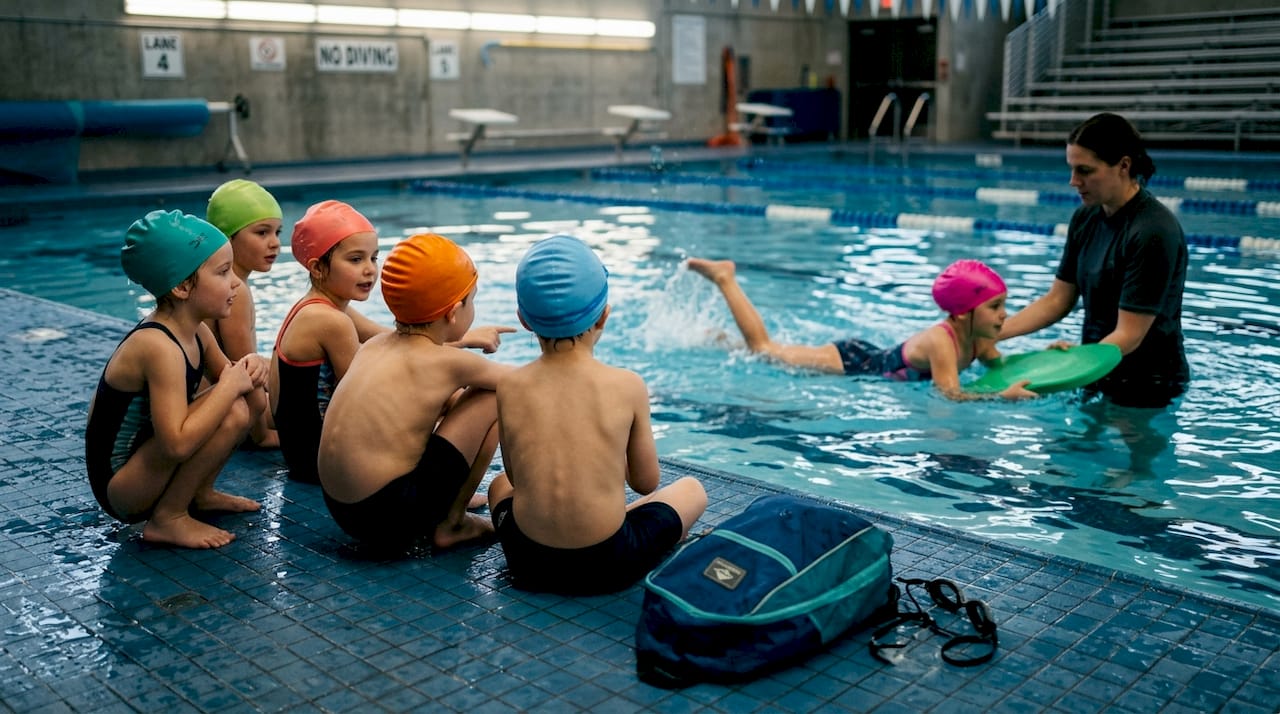
Group settings leverage this naturally. When a child sees a classmate improve their kick technique mid-session, they absorb that correction visually and apply it themselves, often without being told. This is called observational learning, and the swim peer-learning research confirms it works. Private lessons simply do not provide this stimulus, because there is nobody else in the water to watch.
Group formats also support emotional development. Swimmers who feel anxious about water or fearful of being judged benefit enormously from seeing that their peers face the same challenges. Shared struggle normalizes difficulty. It reduces shame and replaces it with camaraderie. For young swimmers still building basic building swim confidence, a group setting often creates faster emotional progress than solo instruction.
Private lessons, however, carry real advantages for complex technical work. Bilateral breathing patterns, underwater dolphin kick timing, and flip turn mechanics all require fine-tuned corrections that a group instructor may not have time to deliver mid-session. A private coach can stop a swimmer mid-lap, adjust their hand entry angle, demonstrate on deck, and immediately re-test the fix. That precision is where private lessons earn their value. See more evidence-based swimming tips for how to apply these ideas at home and at practice.
When peer learning shines:
- Learning foundational strokes for the first time
- Building water confidence and overcoming fear
- Developing motivation through social connection
- Observing and internalizing technique from peers at a similar stage
When 1:1 focus is best:
- Correcting a specific, persistent technical flaw
- Preparing for a major competition with targeted stroke refinement
- Working with a swimmer who has unique physical or learning needs
- Breaking a performance plateau that group instruction has not resolved
Pro Tip: If your child is shy or experiences water anxiety, start them in a small group lesson before considering private sessions. The social environment often reduces anxiety faster than individual instruction because peers model confidence as much as technique.
When should you choose group or private swim lessons?
Understanding the science sets the stage for tailoring lesson choice to each athlete’s journey.
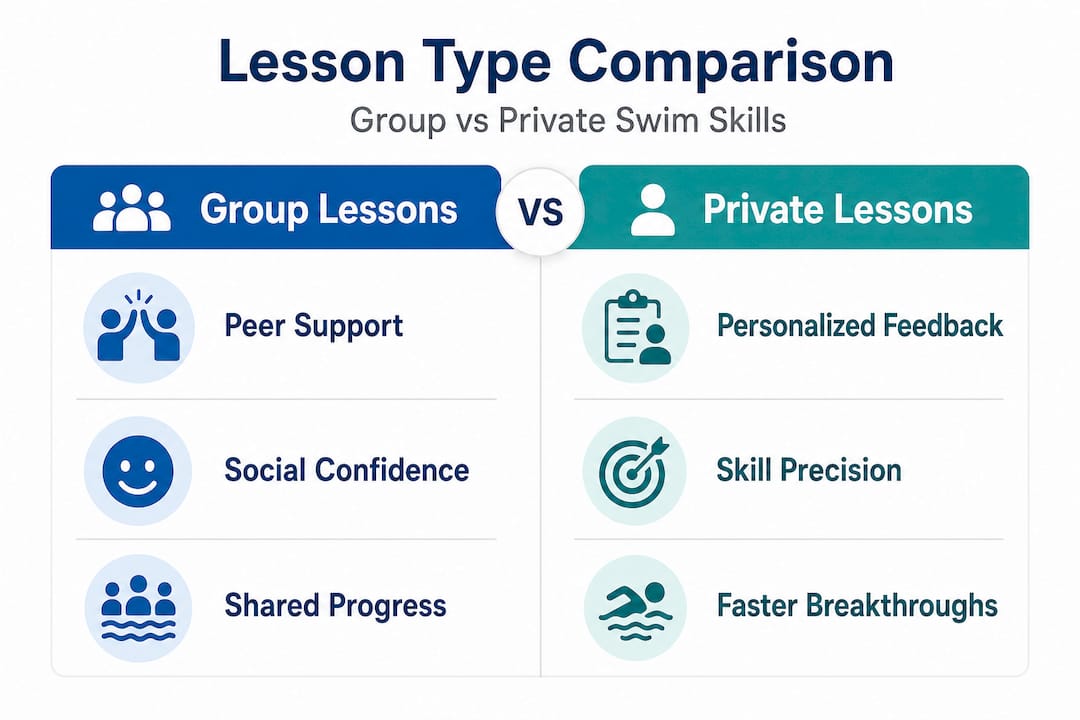
The honest answer is that there is no single correct choice. Parents should treat modality choice as goal-dependent, considering whether the primary objective is building confidence, correcting technique, or reinforcing performance consistency in competition. Research is not yet decisive enough to declare one format always better.
With that in mind, the decision becomes much clearer when you map it to your swimmer’s current needs.
Signs your child may benefit more from group lessons:
- They are just starting out and need to develop comfort in the water before anything else.
- They seem bored or unmotivated during solo practice sessions.
- Social learning energizes them. They thrive when working alongside others.
- Foundational stroke mechanics are still being established.
- Cost is a significant factor, and structured group progression is available.
Signs your child may benefit more from private lessons:
- They have one or two persistent technique errors that are limiting their competitive times.
- They are preparing for a key championship meet and need focused refinement.
- A coach has identified a specific flaw, such as a dropped elbow on the catch, that needs immediate correction.
- They have already mastered group-level skills and are ready for elite-level precision.
- Schedule or learning pace differences make group settings impractical.
| Goal | Recommended format |
|---|---|
| Water confidence and comfort | Group lessons |
| Foundational stroke mechanics | Group lessons |
| Specific technique correction | Private lessons |
| Advanced racing mechanics | Private lessons |
| Motivation and social engagement | Group lessons |
| Pre-competition sharpening | Private lessons |
| Balanced overall development | Combination of both |
Explore youth swim coaching strategies to understand how coaches at the elite level structure development across different stages. A well-designed custom swim plan guide will often include both formats at different points in the competitive calendar. If you are still unsure where to begin, a resource on how to choose swim instruction can help you frame the decision for your specific situation.
Pro Tip: Do not lock into one format for an entire year. Many elite youth programs rotate between group training and private coaching sessions across a competitive season, and for good reason. The combination produces more well-rounded athletes than either format alone.
What are the limitations you should know about research on swimming lesson formats?
Even with compelling findings, every family should recognize the limits of current swim education research.
The evidence supporting observational learning and group settings is real, but the research landscape for swimming instruction is still maturing. Benchmarks for “group vs private” learning outcomes are not straightforward due to study design limitations, small sample sizes, and the difficulty of standardizing what “improvement” actually means across swimmers at different ages and stages.
“A single study showing that group lessons improved front crawl times does not mean group lessons are always better. Context, age, and individual variation matter enormously.”
Here is what current research frequently misses:
- Long-term retention: Most studies measure improvement during or immediately after a lesson block. Few track whether skills hold up weeks or months later without continued instruction.
- Age-specific differences: A method that works beautifully for seven-year-olds may be far less effective for thirteen-year-olds who have different cognitive and physical capacities.
- Transfer of skills: Learning a drill in isolation and then applying it at race speed are very different challenges. Research rarely measures this gap.
- Instructor quality: A highly skilled group instructor may outperform a mediocre private coach every time. Instructor competence often matters more than format.
- Individual personality factors: Introversion, anxiety, learning style, and competitive drive all influence outcomes but are rarely controlled in swim lesson research.
Solid swimming fundamentals guide principles help fill in the gaps that research cannot fully address. The takeaway is not that the science is useless, but that it should inform your decisions without dictating them rigidly. Stay flexible, observe your swimmer closely, and treat lesson format as one tool among many rather than a fixed prescription.
Why mixing formats and focusing on the swimmer matters most
So, how can you apply these insights in the real world, beyond studies and tables?
After three decades of working with swimmers at every level, from beginners finding their rhythm in a six-person group lesson to elite competitors refining race mechanics in focused private sessions, we have seen a consistent pattern. The athletes who develop most fully are rarely those whose parents picked one format and never varied it. They are the athletes whose development was treated as a living, evolving process.
Group lessons build the social identity of a swimmer. When a young athlete sees peers pushing through the same challenges, something clicks beyond the technical. They start to think of themselves as part of a community of swimmers, and that identity drives long-term commitment to the sport in ways that isolated private training rarely does.
Private lessons, on the other hand, create the precision breakthroughs. The moment a coach isolates a swimmer’s timing on the underwater phase of a breaststroke pullout and fixes it in a single session, that athlete’s relationship to their own performance sharpens. They understand that precise correction is possible and that their body can change with focused effort.
The real skill for parents and coaches is recognizing when to shift formats. Progression plateaus are often the clearest signal. When a swimmer has been in group lessons for several months and stops making visible gains, that is usually not a sign that the swimmer has reached their ceiling. It is a sign that the format has given all it can for now, and a few private sessions targeting specific weaknesses can restart the momentum. The reverse is also true. A swimmer who has been doing private lessons for a long stretch may be ready for the motivational boost and observational learning that only a group environment provides.
Monitoring for injury prevention for swimmers is also part of this holistic view. Overtraining in a single format, particularly intense private sessions with high-volume repetition of specific movements, can increase injury risk. Group settings naturally introduce variety that keeps both the body and the mind engaged.
Pro Tip: Review your swimmer’s progress every eight to twelve weeks. If they have plateaued in the current format, switch it up. Stagnation is rarely about talent. It is almost always about environment or approach needing a refresh.
Take the next step: Find the right swim lesson experience
Ready to translate these insights into real results for your swimmer?
At PEAK Performance Swim Camp, we have spent 30 years developing athletes who thrive in both group and individual training environments. Coach Nick Baker and his team understand that every swimmer’s growth curve looks different, and that the best outcomes come from matching training format to the athlete’s current stage, personality, and goals.
Whether your swimmer needs the energy of a structured swim camp programs environment where peer learning accelerates development, or focused refinement through private swim coaching that targets specific technique issues, PEAK has proven options across both formats. Our camps run year-round across the USA and internationally, and our coaching approach is built around the kind of flexibility this article describes. Explore what is available for your swimmer’s age and goals, and take the next step toward their peak performance.
Frequently asked questions
Are group swim lessons better for social confidence?
Yes, group swim lessons consistently support social confidence because peer interaction builds comfort and normalizes difficulty through shared learning experiences. Swimmers see that others face the same challenges, which reduces anxiety and builds belonging.
Do private swim lessons guarantee faster improvement?
Not always. While private lessons offer tailored technical feedback, research shows that observational learning improved front crawl performance in group settings, meaning some skills actually develop faster when swimmers can watch their peers work through the same challenges.
How should I choose between group and private lessons for my child?
Consider your swimmer’s current goals, personality, and confidence level. Research supports treating modality choice as goal-dependent, so a child building water comfort may thrive in a group, while a competitive swimmer targeting a specific technique flaw benefits more from private instruction.
What are the risks of choosing just one lesson format all year?
Sticking to a single format all season can limit either technical precision or motivational momentum, depending on which format you choose. Periodically reassessing your swimmer’s progress and adjusting the lesson structure is the most reliable way to sustain consistent growth throughout the year.
Recommended
- How often should a swimmer practice? – Peak Performance Swim Camp
- Year-round swim training: benefits, methods & success – Peak Performance Swim Camp
- Why swimming fundamentals unlock competitive success – Peak Performance Swim Camp
- Parents: Does Your Child Need Peak Performance Swim Camp? – Peak Performance Swim Camp