
TL;DR:
- Specific, timely, and goal-focused feedback significantly improves swimmer performance.
- Combining verbal, visual, and tech-enabled feedback creates more effective and measurable progress.
- Less frequent, focused feedback with proper follow-up enhances mastery and avoids overload.
Most coaches believe that more feedback automatically leads to better swimmers. It doesn’t. Generic praise like “good job” or vague corrections like “swim faster” are so common in pool decks across the country that swimmers have learned to tune them out entirely. What actually moves the needle is specific, timely, and structured feedback tied to measurable goals. Research on technology-enabled feedback shows swimmers can gain up to a 3.4% increase in maximal speed through individualized data-driven coaching. This article breaks down what effective feedback looks like, which types work best, and how coaches and swimmers can build it into every training session.
Table of Contents
- What is feedback in swim training and why does it matter?
- Types of feedback: From coach cues to tech-enabled insight
- Integrating feedback: Strategies for coaches and swimmers
- Balancing technical and psychological feedback for holistic growth
- Our take: Why less is often more in feedback for swimmers
- Take your swim to the next level with targeted feedback
- Frequently asked questions
Key Takeaways
| Point | Details |
|---|---|
| Specific feedback boosts results | Timely, targeted feedback drives measurable improvements in swim speed and technique. |
| Blend technical and psychological cues | Combining stroke corrections with mental support produces the best performance and athlete growth. |
| Limit to 1-2 focus areas | Overloading swimmers with feedback backfires; less but more focused advice is most effective. |
| Use technology and self-assessment | Tools and swimmer participation make feedback loops more actionable and boost ownership. |
What is feedback in swim training and why does it matter?
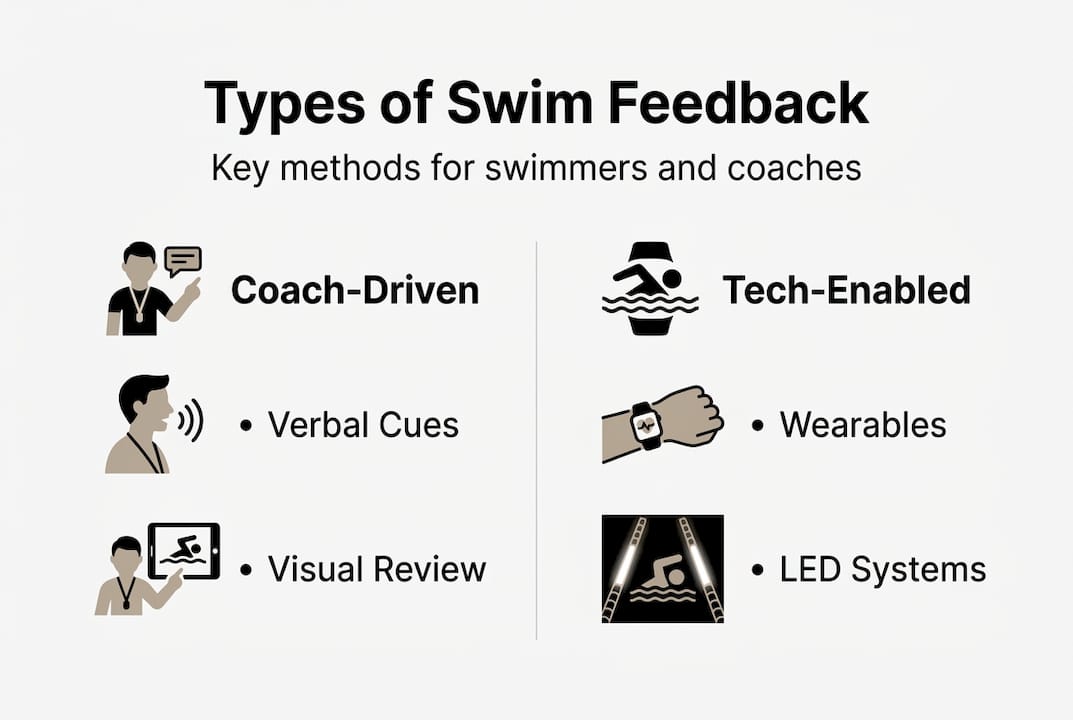
Feedback in swim training is any information a swimmer receives about their performance that helps them adjust, improve, or confirm what they’re doing right. That sounds simple, but it covers a wide range of inputs. Verbal cues from a coach on the pool deck, slow-motion underwater video reviewed after a set, wearable sensors tracking stroke rate in real time, and LED pacing systems that guide effort during a race simulation are all forms of feedback. Each one serves a distinct purpose and works best in specific situations.
The core purpose of feedback is not motivation. Motivation is a byproduct. The real job of feedback is to close the gap between where a swimmer is and where they need to be. That requires precision. A compliment without direction doesn’t close that gap. A correction without a clear action step doesn’t either.
Feedback loops in swim training involve setting specific goals, assessing performance post-set, extracting lessons, and planning adjustments, enabling consistent improvement for competitive swimmers.
This four-step loop is the backbone of any feedback system that actually works:
- Goal-setting: Define what success looks like before the set begins
- Assessment: Measure or observe performance objectively during or after the set
- Learning: Identify the specific gap between the goal and the result
- Adjustment: Plan one concrete change to implement in the next set
The most common pitfalls coaches fall into are vague feedback (“you looked tired”), feedback overload (correcting five things at once), and lack of follow-up (giving a correction and never checking if the swimmer applied it). These habits erode trust and slow development. Strong coaching strategies for youth swimmers always anchor feedback to observable, specific behaviors rather than general impressions.
When feedback is structured this way, it becomes a tool swimmers can actually use. They stop guessing what “better” means and start working toward a defined target. That shift alone can transform the energy and focus in a training session.
Types of feedback: From coach cues to tech-enabled insight
With feedback’s central role established, it’s critical to break down how different types truly work in practice. Not all feedback is created equal, and knowing which type to use and when can make a significant difference in a swimmer’s rate of improvement.
Verbal feedback is the most immediate tool a coach has. Its effectiveness depends almost entirely on timing and specificity. Feedback delivered within seconds of a performance error is far more useful than feedback given at the end of a two-hour practice. Praise that names the exact behavior reinforces it. Correction that identifies the specific fault and offers a fix creates a learning moment.
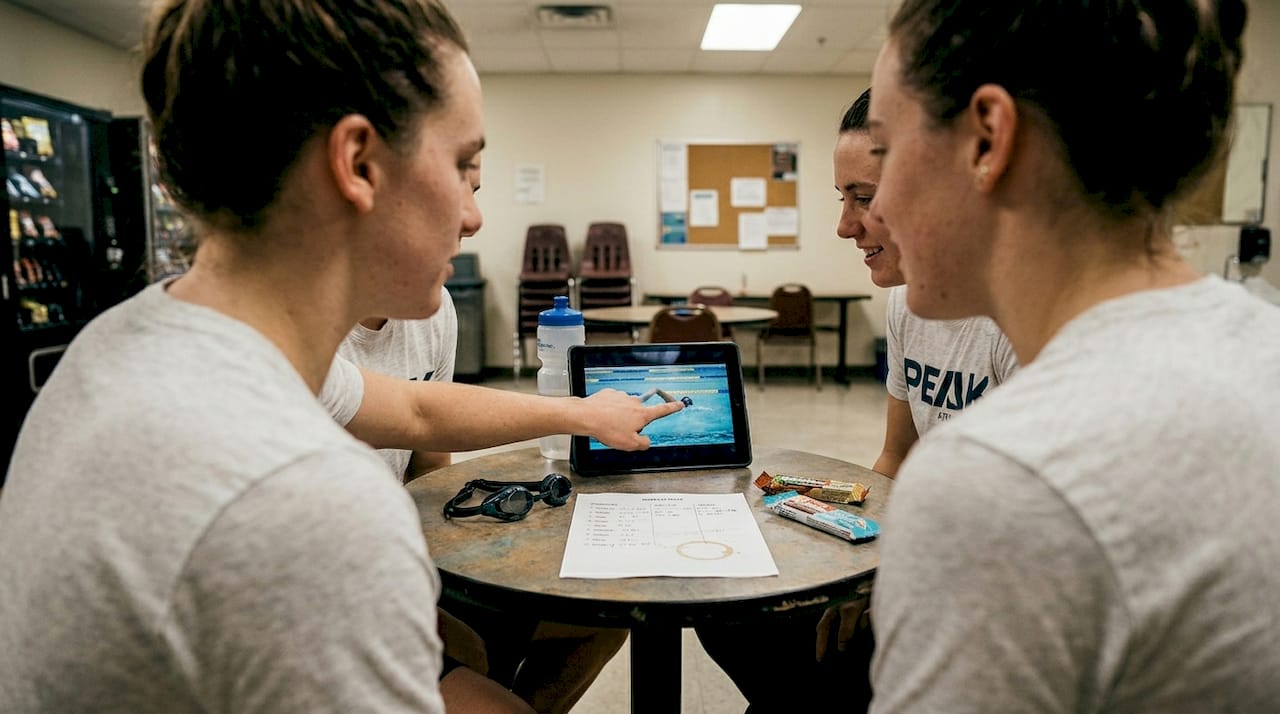
Visual feedback takes verbal instruction and makes it concrete. Watching underwater video of your own stroke is a fundamentally different experience from hearing a coach describe it. Swimmers often don’t realize how wide their kick is or how early they’re dropping their elbow until they see it themselves. LED pacing systems add another layer by giving real-time visual targets during the swim itself.
Formative assessment uses real-time observation to adjust training dynamically: plan, observe, adjust, preventing bad habits and optimizing mechanics during sessions. This approach keeps corrections happening in the moment rather than after the damage is done.
Technology-enabled feedback is where the data gets precise. Wearables, LV profiling, and LED systems provide exact, real-time data for mechanics and pacing, outperforming vague verbal cues especially in sprint resistance training scenarios. The 3.4% maximal speed improvement noted in load-velocity profiling research is a real-world example of what happens when feedback is individualized and data-driven.
Pro Tip: Use video review at least once per week. Swimmers who see their own mechanics correct errors faster than those who only receive verbal coaching.
| Feedback type | Strengths | Limitations |
|---|---|---|
| Verbal | Immediate, flexible | Can be vague or overwhelming |
| Visual (video) | Concrete, self-directed | Requires setup and review time |
| Formative assessment | Real-time, adaptive | Demands high coach attention |
| Technology (wearables, LED) | Precise, objective | Cost, learning curve |
Pairing technique tips for peak performance with the right feedback type is what separates good training from great training. Coaches who focus on improving stroke efficiency know that visual and tech-driven feedback often reveal what verbal coaching alone misses.
Integrating feedback: Strategies for coaches and swimmers
Understanding feedback types leads naturally to the question: How can coaches and swimmers best integrate these insights into training sessions? Having the right tools matters, but the structure around how and when you use them matters just as much.
Here is a practical step-by-step approach to building feedback into every session:
- Set a feedback intention before practice starts. Decide which one or two mechanics or performance metrics you’ll focus on that day. Write it on the whiteboard. Tell the swimmers.
- Give in-set feedback at the wall. Keep it to one point. “Your left hand is entering too wide, bring it to 11 o’clock.” That’s it. One correction, one action.
- Conduct a post-set check-in. Ask the swimmer: “What did you notice? Did the adjustment feel different?” This is where swimmer self-assessment becomes powerful. Involving swimmers in the feedback loop fosters ownership and produces better results than top-down coaching alone.
- End practice with a reflection routine. Two minutes. What worked, what didn’t, what’s the one thing to focus on tomorrow.
- Follow up in the next session. Reference the previous correction. Swimmers notice when coaches remember, and it signals that feedback is a continuous process, not a one-time event.
Pro Tip: Limit your feedback to 1-2 metrics per session. More than that and swimmers can’t prioritize, which means nothing gets fixed. Focus beats volume every time.
Personalized swim coaching works best when swimmers are active participants in the process, not passive recipients. When you build a coach training workflow around structured feedback moments, you create consistency that compounds over a season. Feedback also plays a meaningful role in building self-worth through feedback, especially for younger or developing athletes who need encouragement alongside correction.
Balancing technical and psychological feedback for holistic growth
Tactics alone aren’t enough. Performance relies equally on mindset and mental resilience, making psychological feedback a core ingredient in any complete training approach.
A landmark study of Spanish elite swimming coaches found that coaches provide feedback on psychological aspects 72.2% of the time and technical aspects 38.9% of the time during sessions, using objective measures like heart rate (77.8%) alongside subjective observations. That ratio is striking. Most coaches assume they spend the majority of their time on technique. The data says otherwise.
The most effective coaches don’t separate technical and psychological feedback. They blend them, reading the swimmer’s mental state and adjusting both the content and tone of their feedback accordingly.
Here’s what that looks like in practice:
- Technical feedback examples: “Your stroke rate dropped in the back half. Let’s work on your tempo at the 50-meter turn.” or “Your underwater dolphin kicks are losing power after the third kick.”
- Psychological feedback examples: “You held your race pace under pressure today. That’s a real sign of growth.” or “I noticed you pushed through the discomfort in that last 100. That’s exactly the mental toughness we’re building.”
| Feedback dimension | Primary focus | Key tools used |
|---|---|---|
| Technical | Mechanics, pace, efficiency | Video, wearables, split times |
| Psychological | Confidence, focus, resilience | Verbal cues, reflection, goal review |
The goal is to recognize which dimension needs attention at any given moment. A swimmer who is technically sharp but mentally fragile needs more psychological support. A swimmer who is mentally tough but mechanically inconsistent needs more technical precision. Mental training tips and developing self-esteem in swimming are not soft extras. They are performance variables, and feedback is the delivery mechanism for both.
Our take: Why less is often more in feedback for swimmers
All this research and experience lead us to a counterintuitive truth about feedback: more of it is not better. In fact, too much feedback is one of the most common performance blockers we see at PEAK Performance Swim Camp.
When a swimmer receives five corrections in thirty seconds, the brain doesn’t prioritize. It shuts down. We’ve seen talented athletes plateau for entire seasons because their coaches were technically correct but informationally overwhelming. The research backs this up. Feedback overload or vagueness fails; prioritizing 1-2 metrics per session consistently outperforms the spray-and-pray approach.
After 30 years of running elite swim camps, our experience is clear: the coaches who get the best results from their athletes are the ones who say less, but say it better. They choose one thing, deliver it with clarity, and follow up relentlessly. That’s the discipline most coaches find hardest to practice. Tying feedback to goal-setting for swimmers creates the structure that makes restraint feel purposeful rather than passive. Quality and follow-up beat quantity every time.
Take your swim to the next level with targeted feedback
Ready to apply what you’ve learned with expert guidance and real-time feedback? At PEAK Performance Swim Camp, feedback isn’t an afterthought. It’s built into every session, every set, and every interaction between coach and swimmer.

Founded by Olympic coach Nick Baker with over 50 years of coaching experience, PEAK camps are designed around the exact principles covered in this article: structured feedback loops, individualized coaching, and a holistic approach that addresses both technical and psychological performance. Whether you’re a competitive swimmer looking to sharpen your mechanics or a coach seeking proven frameworks, explore swim camps to find the right fit. You can also check out the PVC Physical Strategy 50 program or connect with personalized swim coaching tailored to your specific goals.
Frequently asked questions
What types of feedback have the biggest impact in swim training?
Real-time, actionable feedback through technology-enabled tools like wearables, load-velocity profiling, and LED systems delivers the greatest measurable gains, outperforming vague verbal cues in precision and consistency.
How can coaches avoid giving too much feedback during swim training?
Limit each session to 1-2 key points and make sure each is specific and actionable. Feedback overload consistently underperforms focused, followed-up coaching in competitive swim environments.
What’s the difference between technical and psychological feedback?
Technical feedback targets stroke mechanics, pace, and efficiency, while psychological feedback supports motivation, focus, and mental resilience. Coaches address both, with psychological feedback occurring more frequently than most coaches realize.
How does swimmer self-assessment improve the feedback process?
When swimmers participate in feedback loops, they develop ownership of their progress and apply corrections more effectively than when feedback flows only from coach to athlete.
Recommended
- Advanced swimming technique tips for peak performance – Peak Performance Swim Camp
- Top coaching strategies for youth swimmers: skill & performance gains – Peak Performance Swim Camp
- Optimize your swim coach training workflow: 4 key phases – Peak Performance Swim Camp
- Coach Nick’s 14-Day Challenge: Volume 14 – Peak Performance Swim Camp