
TL;DR:
- Stroke length, not stroke rate, is the key predictor of sprint freestyle speed, as elite swimmers maintain length at high tempos.
- Resisted sprint training with loads above 20% of body mass alongside dryland strength improves early acceleration and overall velocity.
- Focusing on turn mechanics, especially push-off power, can add significant free speed in short-course swimming, often overlooked by most swimmers.
A fast swim is defined by three factors working together: stroke mechanics, turn efficiency, and the ability to apply force at racing speed. Stroke length, not stroke rate, is the primary driver of sprint freestyle performance, a finding confirmed by data from elite competition. Swimmers who understand this distinction train differently and race faster. This guide covers the techniques and training methods that produce real speed gains, from resisted sprint sets to turn optimization, so you can apply them at your next competition regardless of your current level.
How do stroke length and stroke rate affect swimming speed?
Stroke length drives sprint speed more strongly than stroke rate in 50 m freestyle finals. Data from the 2019 European Championships shows that elite swimmers maintain stroke length even when swimming at high tempos. This means the swimmers who go fastest are not simply spinning their arms faster. They are holding more water with each pull and generating greater force per stroke.
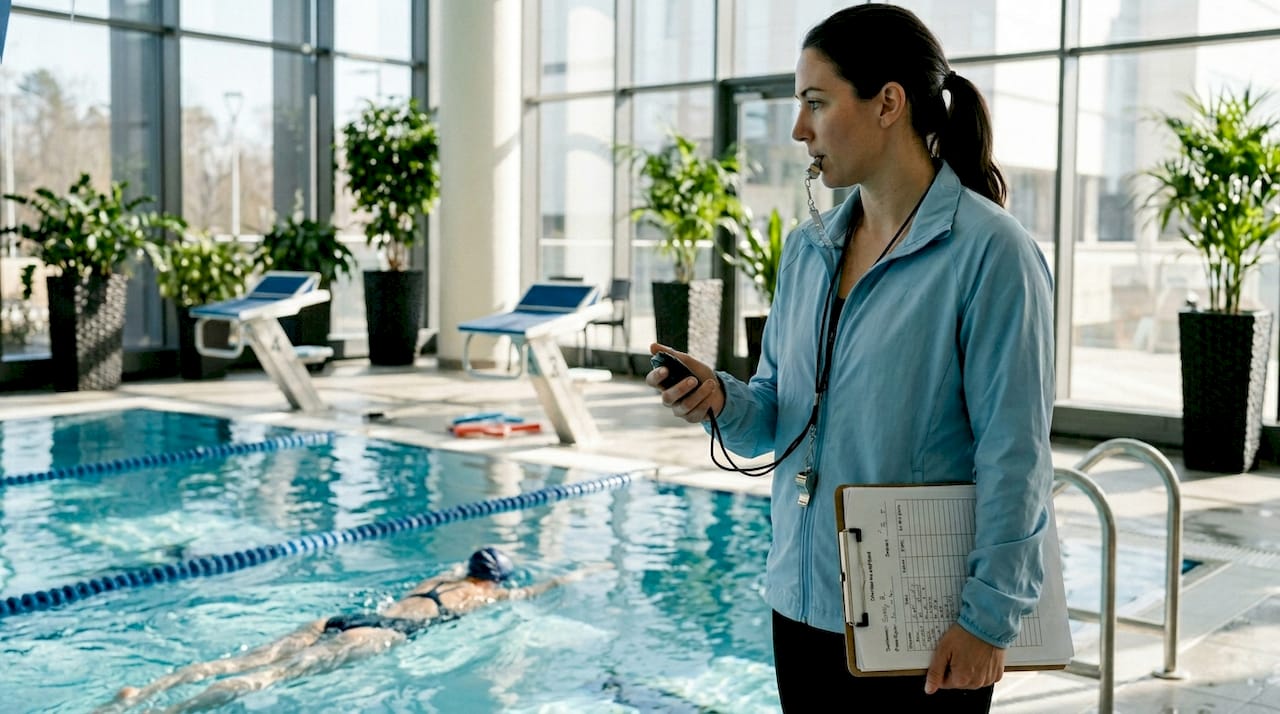
The practical implication is significant. If you increase your stroke rate without maintaining the power behind each pull, you end up with a choppy, inefficient stroke that wastes energy. Elite sprinters balance holding water and stroke rate, and sprint reps with stroke count constraints are one of the most effective ways to train this balance. When you cap your stroke count per length, your body adapts by increasing force per stroke rather than taking more strokes.
Here is what this looks like in practice:
- Swim a 25 m sprint at your normal stroke count, then repeat the same distance with two fewer strokes. Your body is forced to generate more power per pull.
- Use a tempo trainer set slightly below your race tempo to reinforce stroke length before pushing the rate up.
- Count strokes every length during practice. If your count climbs as you fatigue, that is a signal your stroke length is collapsing under pressure.
- Film your underwater catch from the front. A dropped elbow at the catch is the most common reason swimmers lose water and shorten their effective stroke.
The sprint freestyle stroke is inherently choppier than distance freestyle, and it requires specific coordination for maximum force application at high rate. Techniques like a strong early catch, quick hand orientation into the pull, and overlapping arm timing for continuous propulsion all contribute to maintaining length at speed.
Pro Tip: Set a stroke count target for your 50 m race pace and never let it exceed that number in training. This single habit builds the neuromuscular pattern that keeps your stroke long when it matters most.
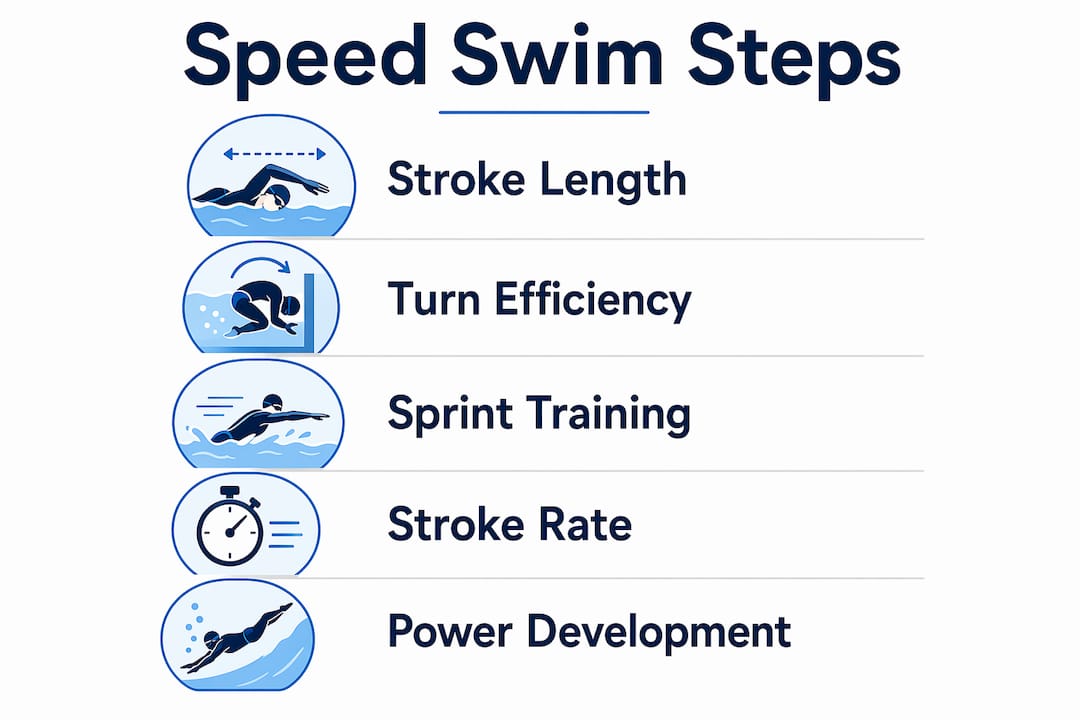
What training methods enhance swim speed efficiently?
Speed in the water does not come from volume alone. The training methods you choose determine whether you develop the neuromuscular power and mechanics needed for genuinely faster swimming.
-
Resisted sprint training with meaningful load. A meta-analysis of 49 studies found that moderate-to-very-heavy resisted sprint training yields better sprint velocity improvements than unresisted training, particularly when loads exceed approximately 20% of body mass. Resisted swimming with a drag sock, parachute, or tethered cord at this load level specifically improves early acceleration and maximal horizontal force output. This is the phase of a race where most swimmers lose ground.
-
Combine dryland strength with resisted swimming. A 2025 meta-analysis found that dryland strength training plus resisted swimming enhances swim velocity more than either method alone. Exercises like trap bar deadlifts, pull-up variations, and medicine ball rotational throws build the posterior chain and rotational power that translate directly to a stronger catch and pull.
-
Short maximal effort reps with constraints. Sets of 12.5 m or 25 m at absolute maximum effort, with a stroke count cap, force you to apply more force per stroke rather than defaulting to a higher rate. These reps should be fully recovered between efforts. Six to eight reps with two to three minutes of rest is a standard structure.
-
Interval work for neuromuscular adaptation. Interval swim training at race pace or above builds the neuromuscular patterns needed to sustain speed. Short rest intervals at 90% effort train lactate tolerance, while longer rest intervals at 100% effort train peak velocity. Both have a place in a speed-focused program.
-
Progressive overload across the training cycle. Start resisted sprint sets at lighter loads and increase resistance over four to six weeks. Introduce dryland strength work in the same phase. This progressive structure prevents accommodation and keeps adaptation moving forward.
Pro Tip: Track your 15 m split times during sprint reps, not just your full-length time. The 15 m split isolates your acceleration phase and tells you whether your resisted training is actually transferring to the water.
How do turns contribute to faster swim times?
Turns are the most underutilized speed tool in competitive swimming. A 2025 study found that short-course swimming reduces energy cost by approximately 4% and boosts mean velocity by roughly 5% compared to long-course swimming. That advantage comes almost entirely from turns. Swimmers who execute turns well are essentially getting free speed that requires no additional aerobic effort.
The mechanics behind this are clear. Turn push-off velocity in 25 m pools measures approximately 0.83 m/s greater than clean swimming velocity. No stroke technique adjustment produces a speed gain that large in such a short window. Turns represent a genuine shortcut in short-course racing, and improving turn mechanics offers a high-leverage performance boost that many swimmers overlook.
| Turn component | Why it matters | Training focus |
|---|---|---|
| Approach speed | Carrying speed into the wall maximizes push-off power | Practice turns at race pace, not slow |
| Flip timing | Flipping too early or late reduces push-off angle | Mark a target spot on the lane line |
| Push-off depth | Optimal depth reduces drag during the glide phase | Practice at 0.4 to 0.6 m below the surface |
| Underwater kick | Dolphin kicks off the wall extend the speed advantage | Add 6 to 8 strong kicks before surfacing |
| Breakout stroke | The first stroke sets rhythm for the next length | Practice the breakout as a separate drill |
- Practice turns in isolation. Swim into the wall at race pace, execute the turn, and hold your streamline for the full underwater phase before stopping. Repeat ten times per session.
- Use a resistance band anchored to the wall to practice explosive push-off power on land before transferring it to the pool.
- Record your turns from the side. Most swimmers surface too early, cutting off the fastest phase of the turn.
What common technique mistakes hinder swimming speed?
Most swimmers who want to improve their speed focus on training harder. The faster path is often fixing what is already broken in their stroke. Technical errors increase drag and reduce propulsion, and even small corrections produce measurable time drops.
- Overemphasis on stroke rate without power. Spinning your arms faster without maintaining force per stroke reduces stroke length and overall speed. The fix is stroke count sets and tempo trainer work that keeps rate honest.
- Poor body alignment. A head that sits too high, hips that drop, or a kick that is too wide all increase frontal drag. A neutral head position, with eyes looking slightly forward and down, keeps the body line flat and fast.
- Incorrect breathing patterns. Lifting the head to breathe instead of rotating to breathe disrupts body alignment and slows the stroke. Practice bilateral breathing in training to build a symmetrical rotation pattern.
- Dropped elbow at the catch. This is the single most common power leak in freestyle. A dropped elbow means you are pushing water down instead of back, which generates lift rather than propulsion. Early vertical forearm drills, practiced slowly before being integrated at speed, correct this pattern.
- Crossing over on entry. When the hand enters across the centerline of the body, it causes the hips to snake and creates lateral drag. Entry should be shoulder-width, with the hand entering thumb-side slightly down.
Reviewing advanced swimming technique tips alongside video analysis of your own stroke is the most efficient way to identify which of these errors is costing you the most time.
How should training differ by race distance and pool type?
Speed training is not one-size-fits-all. The demands of a 50 m sprint differ from a 200 m freestyle, and short-course pools create different physiological demands than long-course pools.
| Variable | Sprint events (50 to 100 m) | Middle distance (200 to 400 m) | Long-course pool |
|---|---|---|---|
| Stroke rate | High, with maintained length | Moderate, pacing-focused | Lower, efficiency-focused |
| Turn emphasis | Critical, multiple turns per race | Important, but less frequent | Minimal impact |
| Training focus | Resisted sprints, maximal effort reps | Threshold sets, race pace work | Aerobic base, pacing control |
| Energy system | Anaerobic power dominant | Mixed aerobic and anaerobic | Aerobic dominant |
Coaches must prescribe different training velocities based on pool size to match the physiological response across course lengths. A swimmer training exclusively in a 25 m pool will experience more frequent turns and lower aerobic demand per length than one training in a 50 m pool. When preparing for a long-course meet, build in specific long-course sessions to recalibrate pacing and stroke efficiency. For race strategy at any distance, understanding your split targets and how your stroke changes under fatigue is as important as the physical training itself.
Physical conditioning for swimmers should also reflect the race distance. Sprint-focused swimmers need more power-based dryland work, while middle-distance swimmers benefit from a mix of strength and aerobic conditioning.
Key takeaways
Fast swimming requires stroke length, turn power, and resisted sprint training working together, not any single factor in isolation.
| Point | Details |
|---|---|
| Stroke length over stroke rate | Maintaining force per stroke drives sprint speed more than increasing tempo. |
| Resisted sprint training | Loads above 20% body mass improve acceleration and maximal horizontal force output. |
| Turns as free speed | Short-course turns reduce energy cost by ~4% and add ~0.83 m/s over clean swim velocity. |
| Fix technique first | Dropped elbows, poor alignment, and breathing errors cost more time than low fitness. |
| Match training to race distance | Sprint and distance events require different stroke rate targets, energy systems, and dryland work. |
What I have learned coaching swimmers toward their fastest times
After years of working with swimmers across all levels, the pattern I see most often is this: swimmers chase fitness when they should be chasing mechanics. A swimmer who adds ten more yards per week of sprint work but still drops their elbow at the catch will plateau. The swimmer who fixes the catch and then adds the sprint work drops time at every meet.
The research on stroke length confirms what I have observed on deck. Elite sprinters are not faster because they move their arms more quickly. They are faster because each stroke moves them farther. That distinction changes how you train. You stop chasing tempo and start chasing power per pull.
Resisted sprint training changed how I structure speed work. Before the research on load thresholds became clear, I used light resistance as a general conditioning tool. Now I prescribe heavier loads specifically for the acceleration phase and track 15 m splits to measure whether it is transferring. The results are consistently better than what lighter resistance produced.
Turns are where I see the biggest untapped gains at the age-group and masters level. Most swimmers treat the turn as a transition. The fastest swimmers treat it as an acceleration event. If you spend two weeks doing nothing but turn-specific work, you will likely drop more time than you would from two weeks of extra yardage.
The uncomfortable truth about fast swimming is that it rewards patience. You cannot rush the catch pattern or the push-off mechanics. But when you build them correctly, the speed follows.
— James
Train faster with Swimcamp’s expert coaching
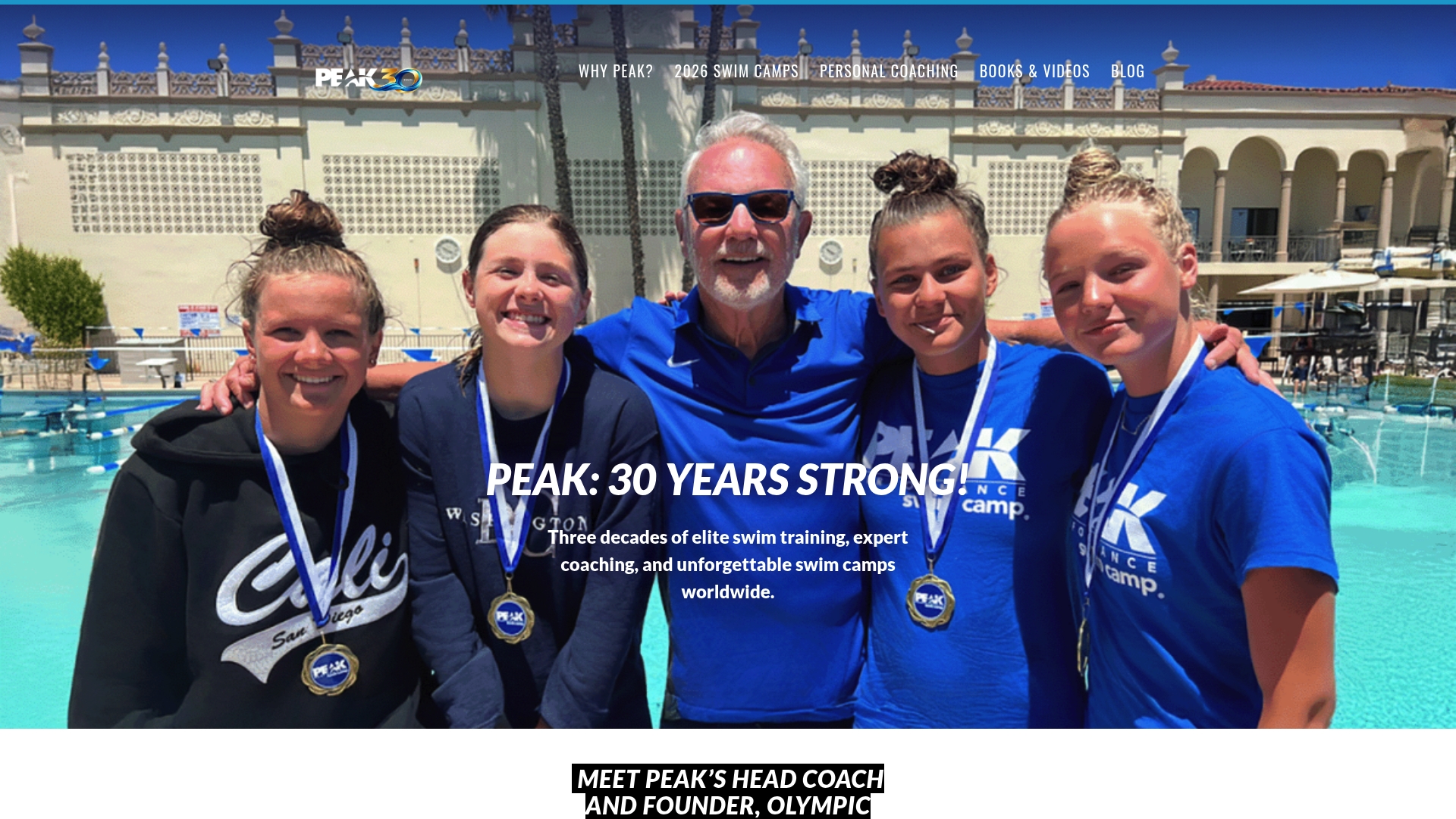
Swimcamp, founded by Olympic coach Nick Baker, has spent 30 years helping swimmers at every level build the mechanics and conditioning that produce real speed gains. PEAK Performance Swim Camp programs cover sprint technique, resisted sprint training, turn optimization, and dryland conditioning in a structured, coach-led environment. With more than 1,000 camps conducted across 18 countries, the coaching methods are proven at every level from age-group competitors to masters swimmers. If you are ready to put these techniques into practice with expert guidance, explore the swim camp options available across the USA and internationally, or review the clinic packages designed for focused speed development.
FAQ
What is the most important factor in fast swimming?
Stroke length is the strongest predictor of sprint freestyle speed, outweighing stroke rate in 50 m events. Swimmers who maintain force per stroke at high tempos consistently outperform those who simply increase arm turnover.
How does resisted sprint training improve swim speed?
Resisted sprint training with loads above 20% of body mass improves early acceleration and maximal horizontal force output. Combining this with dryland strength training produces greater sprint velocity gains than either method alone.
Why are turns so important in short-course swimming?
Turns reduce overall energy cost by approximately 4% and generate push-off velocities roughly 0.83 m/s greater than clean swimming speed. This makes turn mechanics one of the highest-leverage improvements a short-course swimmer can make.
How do I fix a dropped elbow in freestyle?
Practice early vertical forearm drills at slow speed, focusing on keeping the elbow high and the forearm facing backward from the moment of entry. Add this drill at the start of every practice before integrating the pattern into full-speed swimming.
Should sprint and distance swimmers train differently for speed?
Sprint events prioritize resisted sprint sets, maximal effort reps, and power-based dryland work. Distance events require threshold training, pacing control, and aerobic conditioning. Both benefit from turn work, but it is more race-critical for short-course sprint swimmers.
Recommended
- Advanced swimming technique tips for peak performance – Peak Performance Swim Camp
- Best swim technique videos for faster, efficient swimming – Peak Performance Swim Camp
- Why swimming fundamentals unlock competitive success – Peak Performance Swim Camp
- Master Race Strategy in Swimming for Peak Results – Peak Performance Swim Camp