
TL;DR:
- Olympic coaching methods are accessible and beneficial for swimmers at all levels, leading to measurable improvements in race times and speed. These coaches provide holistic support through multidisciplinary teams, enhancing performance and injury prevention while emphasizing mental resilience and goal-setting. Choosing a compatible coach aligned with your goals maximizes long-term development and competitive success.
Most swimmers assume Olympic coaching is reserved for the elite few chasing podium spots on the world stage. That assumption is wrong. Empirical research shows targeted Olympic-level training produces a 1.3% race time reduction and a 3.4% increase in maximum swim speed, gains that are meaningful at every level of competition. Whether you are a junior swimmer at your first regional meet or an adult competitor looking to shave seconds off your best time, Olympic coaching methods are built on universal principles of technique, mindset, and physical conditioning. This guide breaks down exactly why that matters and how you can benefit.
Table of Contents
- The measurable impact of Olympic coaching
- Holistic support: Beyond the pool
- Mental resilience, motivation, and goal-setting
- Innovative methods: From world records to junior development
- Our perspective: Finding the right Olympic coach for you
- Unlock your peak with Olympic coaching
- Frequently asked questions
Key Takeaways
| Point | Details |
|---|---|
| Proven performance gains | Olympic coaching delivers measurable improvements in race times and max swim speed for swimmers of all levels. |
| Holistic support model | Multidisciplinary teams promote injury prevention and optimize both physical and mental well-being. |
| Mental resilience and motivation | Olympic coaches build confidence and reduce dropout with expert goal-setting and psychological strategies. |
| Innovative methods adaptable | Advanced low-volume training techniques are tailored for age, skill, and personal preference. |
| Coach compatibility is key | The right Olympic coach provides a philosophy and approach aligned with each swimmer’s unique goals. |
The measurable impact of Olympic coaching
Numbers tell a story that motivates better than any pep talk. When swimmers train under Olympic swim strategies, the results are documented and repeatable. A 1.3% race time improvement may sound small, but in competitive swimming, fractions of a second separate finalists from also-rans. That same research documents a 3.4% increase in maximum swim speed, a number that is significant at every age group.
Here is a snapshot of what Olympic-level training delivers across different swimmer profiles:
| Metric | Standard coaching | Olympic-level coaching |
|---|---|---|
| Race time improvement | 0.2% to 0.5% | Up to 1.3% |
| Max swim speed increase | 0.5% to 1.0% | Up to 3.4% |
| Injury rate | Higher without structured recovery | Reduced with multidisciplinary support |
| Mental readiness | Variable | Systematically developed |
Junior swimmers benefit just as much as adult competitors. The elite coaching benefits for younger athletes include improved stroke mechanics before bad habits solidify, structured goal-setting that builds confidence early, and exposure to training principles that create a foundation for long-term progress. Young swimmers who train under Olympic-caliber guidance during their developmental years consistently outperform peers who receive generic instruction.
Pro Tip: Start tracking your race times and training splits in a simple spreadsheet or app. When you can see even a 0.5% improvement in your 100m freestyle split over six weeks, it becomes concrete motivation rather than a vague sense of “getting better.”
For swimmers who cannot access in-person sessions, virtual Olympic coaching platforms now deliver elite-level feedback on stroke mechanics, race planning, and conditioning remotely. The data-driven approach remains the same regardless of format.
Holistic support: Beyond the pool
Performance gains are only part of the story. What truly separates Olympic coaching from standard instruction is the full support structure surrounding the swimmer.
Olympic coaches do not work alone. Multidisciplinary support involving physiotherapists, nutritionists, and psychologists has been shown to measurably enhance both performance outcomes and injury prevention. This means a swimmer working with an Olympic coach is not just getting stroke advice; they are accessing an integrated team built around one goal: maximizing their potential without breaking down their body.

Here is how Olympic coaching compares to standard club coaching in terms of support:
| Support element | Standard club coaching | Olympic coaching model |
|---|---|---|
| Nutritional guidance | General advice | Personalized nutrition planning |
| Injury prevention | Reactive treatment | Proactive physiotherapy |
| Mental health support | Rarely included | Integrated psychology support |
| Recovery protocols | Basic rest | Structured recovery science |
The benefits of this approach extend well beyond race day performance. Swimmers who work within a multidisciplinary model report:
- Fewer overuse injuries and faster return-to-pool times after minor setbacks
- Better sleep quality and energy management during heavy training blocks
- Greater understanding of their own bodies, which helps them train smarter
- Improved relationship with competition pressure through consistent psychological support
“The integration of physiotherapy, nutrition science, and sports psychology into a unified coaching model represents the single biggest leap forward in competitive swimming development over the past two decades.” This reflects the consensus across high-performance coaching literature.
Focusing on physical conditioning as a standalone element is no longer sufficient at any competitive level. The body and the mind operate as one system, and Olympic coaching addresses that reality directly. Alongside the physical work, investing in mental strength training is now considered a core component of elite preparation, not an optional extra.
Mental resilience, motivation, and goal-setting
Physical and multidisciplinary support lay the foundation, but mental strength and motivation push swimmers over the top.
One of the most underappreciated advantages of Olympic coaching is how deliberately it builds the psychological side of performance. Olympic coaches foster resilience, structured motivation, and clear goal-setting practices that significantly reduce dropout risk across all age groups. This matters because talent alone does not keep swimmers in the sport. The ability to manage failure, handle pressure, and stay motivated through a difficult season is what separates long-term competitors from those who quit after their first major setback.
Here is how Olympic coaches structure mental development:
-
Establish clear, tiered goals. Coaches work with swimmers to set process goals (like improving turn technique), performance goals (like hitting a specific split time), and outcome goals (like qualifying for regionals). This layered system keeps focus sharp without creating paralyzing pressure around results alone.
-
Use visualization consistently. Elite coaches teach swimmers to mentally rehearse their races in detail before they compete. This is not wishful thinking; it is a proven rehearsal technique that trains the brain to execute under pressure.
-
Build a pre-competition routine. Olympic coaching emphasizes having a personal activation routine before races, whether that involves specific music, breathing sequences, or warm-up drills. Routine creates a sense of control when everything else feels uncertain.
-
Debrief after every competition. Rather than treating a poor race as a failure, Olympic coaches frame each event as data. What worked? What did not? What adjusts next time? This approach prevents the emotional spiral that causes many swimmers to disengage from training.
-
Normalize struggle. A critical skill taught by elite coaches is building a resilient mindset that accepts difficulty as part of the process. Swimmers who understand that hard sessions are investments rather than punishments train harder and recover faster psychologically.
Supporting athlete confidence is also a skill that Olympic coaches practice intentionally. The way a coach communicates after a disappointing race shapes whether a swimmer returns to the pool hungry or defeated.
Pro Tip: Build mini-goals for every single training session. Before you get in the water, decide on one specific technical focus and one effort target. Achieving small daily wins builds the kind of momentum that carries through to competition.
Explore mental training tips tailored specifically for competitive swimmers to see how these strategies translate into practical session planning.
Innovative methods: From world records to junior development
The way Olympic coaches approach technique and innovation truly sets them apart. Let’s look at what this means in practice.
One of the most striking examples of Olympic-level innovation is the McEvoy Method, developed around the training philosophy of Australian Olympic champion Cameron McEvoy. Rather than following the conventional high-volume training model where swimmers log enormous yardage day after day, McEvoy’s low-volume approach prioritizes quality over quantity. Every session is structured around intensity and technical precision rather than accumulating meters. The results speak for themselves at the highest level of world competition.
There is real resistance to this model in traditional swimming circles. High-volume advocates argue that building an aerobic base requires extensive yardage, and many club programs continue to default to this approach simply because it is familiar. However, the evidence from Olympic performances challenges this assumption directly, particularly for sprint-focused swimmers and athletes in junior development stages where avoiding burnout is critical.
Here is a direct comparison of the two approaches:
| Training model | Volume | Intensity | Best suited for | Risk |
|---|---|---|---|---|
| Traditional high-volume | Very high | Moderate | Distance swimmers, base building | Overtraining, burnout |
| Low-volume high-intensity | Lower | Very high | Sprint events, technical refinement | Requires precise periodization |
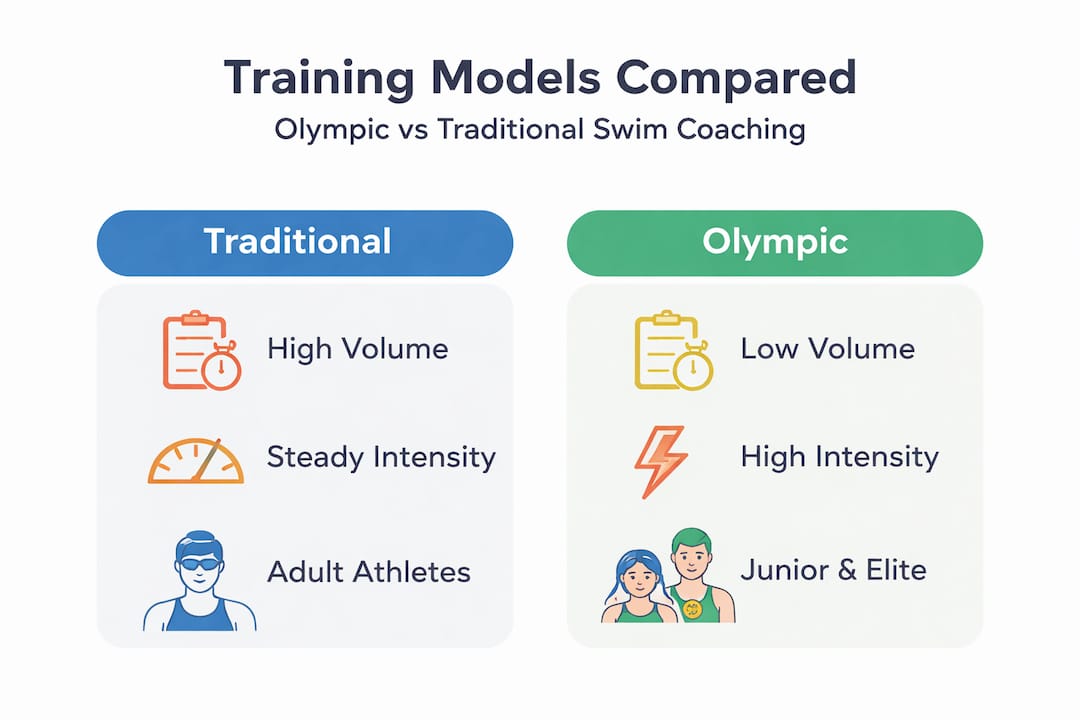
For junior swimmers, the low-volume model requires thoughtful adaptation. Coaches with Olympic-level experience understand how to scale intensity appropriately for younger bodies while preserving the technical precision that makes the method effective. The goal is not to replicate elite adult training directly; it is to extract the principles and apply them with age-appropriate modifications.
How do you know which method suits you? Consider these factors:
- Your primary event. Sprint specialists often respond exceptionally well to high-intensity, lower-volume approaches. Distance swimmers may need more aerobic base work early in their development.
- Your training age. Swimmers new to structured training usually benefit from building consistency first before introducing high-intensity loading.
- Your recovery capacity. Olympic coaches assess how quickly you bounce back from hard sessions before committing to a low-volume, high-intensity program.
Learning about new swimming trends helps swimmers understand where the sport is heading and how to position themselves advantageously. Pairing that awareness with advanced swimming tips gives you a complete picture of what Olympic-level development looks like in 2026. Swimmers who commit to year-round training see the greatest long-term benefit from these innovative approaches because consistency allows coaches to fine-tune methods across full seasonal cycles.
Our perspective: Finding the right Olympic coach for you
Here is something most swimmers miss when choosing elite coaching: credentials matter, but compatibility matters more.
It is easy to get dazzled by a coach’s Olympic resume. And Olympic experience does signal something real, including proven knowledge of what elite performance requires, exposure to world-class methodology, and credibility that tends to attract strong support teams. But we have seen talented swimmers plateau under technically brilliant coaches simply because the communication style, training philosophy, or motivational approach did not fit that swimmer’s psychology.
The research backs this up. Philosophy alignment and compatibility are identified as critical factors in determining whether the investment in Olympic-level coaching actually translates into competitive gains. A coach who leads through fear may produce short-term compliance but undermines the mental resilience that sustains long careers. A coach who communicates primarily through data may inspire one swimmer and completely disconnect another.
Before you commit to an Olympic coach or program, ask yourself these questions honestly. Does this coach’s communication style make you feel challenged and supported at the same time? Does their training philosophy align with your goals, whether that is breaking a personal best at the state level or qualifying for a national team? Do you feel comfortable raising concerns or discussing setbacks openly with them?
The best coaching relationship feels like a genuine partnership. The coach brings expertise and structure; you bring honesty about where you are and openness to being challenged. When that dynamic works, the measurable performance gains we discussed earlier become consistently achievable rather than occasional.
We encourage every swimmer considering elite coaching to meet the coaches available through our program and assess not just their credentials but how they speak about athlete development. The right fit is out there, and it is worth taking time to find it.
Unlock your peak with Olympic coaching
Training under Olympic-level guidance is one of the most powerful investments a competitive swimmer can make at any stage of their career.

At PEAK Performance Swim Camp, we bring 30 years of Olympic coaching experience directly to swimmers of all ages and ability levels across the USA and internationally. Whether you are looking for an intensive swim camp that transforms your technique in a week or ongoing personalized coaching built around your competition schedule, we have structured programs designed to deliver real results. Our video analysis and private coaching sessions give you the precise, expert feedback that closes the gap between where you are and where you want to be. The next step is yours.
Frequently asked questions
Can beginners benefit from Olympic coaching?
Yes. Olympic coaching methods are adaptable for all levels, with junior-specific adaptations proven to improve performance without overwhelming developing athletes.
Are Olympic coaches only focused on elite competition?
No. Olympic coaches build resilience, motivation, and goal-setting skills for swimmers of all ages, making their approach valuable well beyond elite-only competition.
How do Olympic coaches prevent injury?
They assemble multidisciplinary teams including physiotherapists, nutritionists, and psychologists who address injury prevention proactively rather than waiting for problems to develop.
Is innovative low-volume training risky for younger swimmers?
No. Olympic coaches adapt high-intensity methods for junior swimmers using age-appropriate modifications that preserve the benefits while protecting developing bodies.
Do Olympic coach programs cost more?
Olympic-level coaching does require greater investment, but the holistic competitive benefits consistently outweigh the cost for swimmers who are serious about improving their performance.
Recommended
- Olympic swim training: advanced techniques & strategies – Peak Performance Swim Camp
- 8 major advantages of elite coaching for young swimmers – Peak Performance Swim Camp
- Top coaching strategies for youth swimmers: skill & performance gains – Peak Performance Swim Camp
- Individualized swim plans: unlock elite performance – Peak Performance Swim Camp
- How to Improve Recovery: Advanced Techniques for Athletes – Coldture Wellness