
Choosing the right swim program for your child is one of the most consequential decisions you’ll make as a sports parent. The difference between a standard club and a truly elite coaching environment isn’t just about pool time or trophies. It’s about whether your child develops the technical foundation, mental resilience, and competitive edge to reach their real potential. This guide breaks down the proven advantages of elite coaching so you can evaluate programs with confidence, ask the right questions, and give your swimmer the best possible chance at long-term success.
Table of Contents
- Elite coaching defined: What sets top programs apart
- Physical performance gains: Speed, strength, and technique
- Core training & injury resilience: Building the right foundation
- Personalized methods: Targeted performance breakthroughs
- Inside the winning mindset: Motivation, confidence, and focus
- A parent’s checklist: What truly matters beyond the training plan
- Ready to unlock your swimmer’s potential?
- Frequently asked questions
Key Takeaways
| Point | Details |
|---|---|
| Measurable performance improvements | Elite coaching drives faster times and greater power gains in young swimmers using proven training methods. |
| Holistic development | Top programs prioritize both physical and mental growth, building resilient, confident athletes. |
| Personalized training matters | Individualized coaching unlocks each swimmer’s unique capabilities for the best results. |
| Motivation and retention | Elite coaches foster long-term motivation, goal-setting, and a reduced risk of burnout or quitting. |
Elite coaching defined: What sets top programs apart
Not all swim programs are created equal, and the gap between elite and subelite coaching is wider than most parents realize. Elite programs are built around a specific set of pillars that standard club environments rarely match.
Here’s what separates elite coaching from the rest:
- Expert staff: Coaches with competitive, collegiate, or Olympic-level experience who understand high-performance development
- Individualized feedback: Each swimmer receives specific, data-informed corrections rather than group-wide instructions
- Advanced training design: Programs that combine dry-land conditioning, technical drills, and race-pace work in a structured plan
- Performance tracking: Regular measurement of times, stroke mechanics, and physical benchmarks to guide progress
- Athlete-centered culture: An environment where each child’s development is prioritized over team averages
The research backs up why these distinctions matter. Elite swimmers demonstrate superior dry-land and swim turn force-time characteristics compared to subelite swimmers, directly attributable to specialized strength and conditioning programs. That gap doesn’t happen by accident.
“The quality of coaching infrastructure shapes not just performance outcomes, but the entire trajectory of a young athlete’s development.”
When you’re evaluating programs, use clear swim coach criteria to assess whether a program truly meets the elite standard. Credentials matter, but so does the system behind the coach.
Physical performance gains: Speed, strength, and technique
Defining elite coaching is only the first step. What real advantages does it produce for your swimmer?
The performance data is striking. Up to 25-50% higher peak velocity and power outputs have been recorded in youth swimmers trained under elite specialized programs compared to those in standard programs. That’s not a marginal edge. That’s a transformational difference.
One of the key reasons elite programs produce these results is their use of combined training. Combined aquatic and dry-land resistance training is the most effective method for improving swim performance metrics across all competitive age groups. Elite programs build this into every training cycle.
| Training component | Standard program | Elite program |
|---|---|---|
| Dry-land conditioning | Occasional | Structured, weekly |
| Technique video review | Rare | Regular |
| Race-pace sets | Limited | Periodized |
| Individual load adjustment | Minimal | Data-driven |
For parents, the practical takeaway is clear. When you visit a program, look for evidence of structured dry-land sessions, video analysis tools, and coaches who adjust training loads per swimmer, not per group. These technique tips for swimmers give you a sense of the technical depth elite programs prioritize.
Pro Tip: During a program visit, ask the coach how they track individual progress over a season. If the answer involves specific metrics and regular review, you’re likely looking at an elite-level operation. If it’s vague, keep looking. You can also explore personal coaching for swimmers as an option for targeted development.
Core training & injury resilience: Building the right foundation
Besides raw athletic gains, the foundation of safe, sustainable progress comes from one key area: core stability.
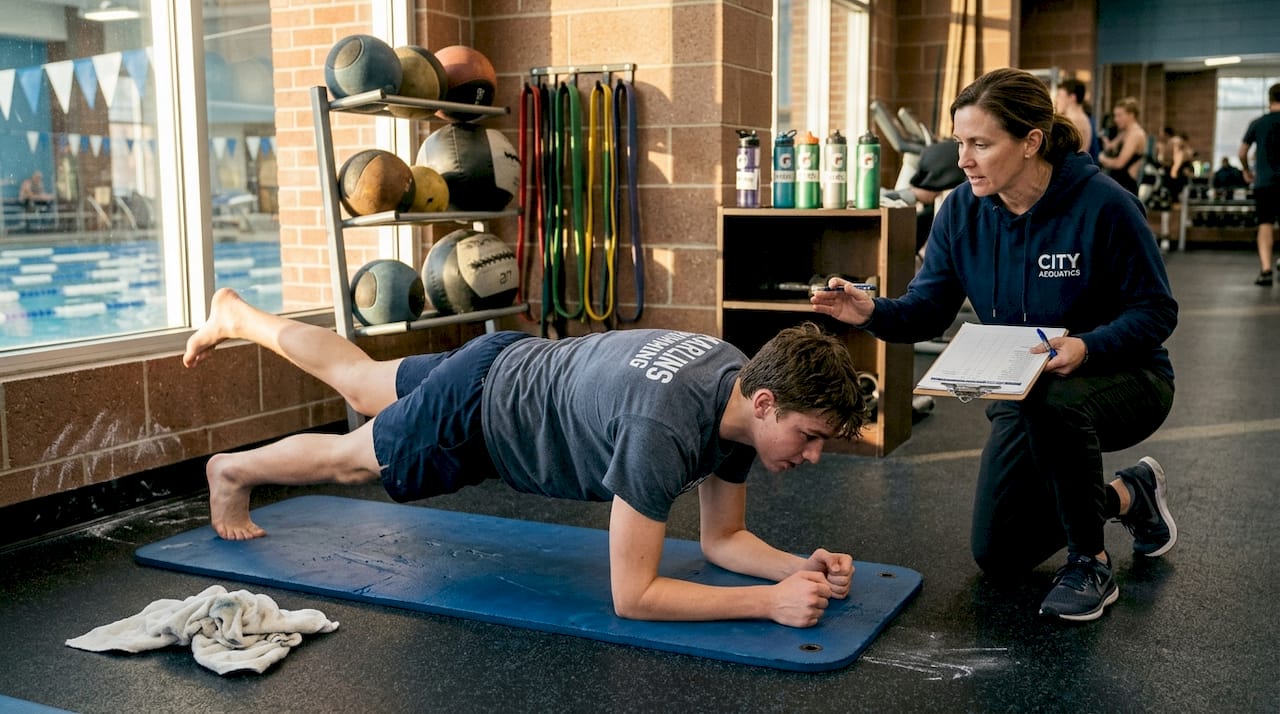
Elite programs treat core training as non-negotiable. Core stability training yields moderate to large effects on youth swimming performance, with the strongest results seen in sprint events and backstroke. The optimal protocol involves two to three sessions per week, each lasting 20 to 30 minutes, integrated alongside pool training rather than replacing it.
Here’s why this matters beyond performance:
- Reduced shoulder injuries: A stable core reduces the compensatory load on the shoulder joint during freestyle and butterfly
- Better body position: Core strength keeps hips elevated, reducing drag and improving stroke efficiency
- Faster turns: Explosive core engagement drives more powerful flip turns and push-offs
- Long-term durability: Swimmers with strong core foundations are less likely to develop overuse injuries as training volume increases
For parents, this is a critical area to ask about. Many programs focus heavily on yardage without investing in the structural strength that keeps young athletes healthy. Explore more about core strength and swimming to understand what a complete program should include.
Pro Tip: Ask any prospective program how they integrate core and dry-land work into the weekly schedule. If core training is an afterthought or optional, that’s a red flag for injury risk and long-term development.
Personalized methods: Targeted performance breakthroughs
A solid foundation is great, but reaching each child’s fastest possible swim takes targeted methods.
One of the most powerful tools in elite coaching is individualized load-velocity profiling. Rather than assigning the same training load to every swimmer, coaches measure how each athlete responds to resistance and speed work, then tailor the program accordingly. The results speak for themselves. Individualized load-velocity profiling and resisted swimming improved maximal swim speed by 3.4% and race time by 1.3%, meaningful gains at any competitive level.
| Approach | Generic program | Individualized elite program |
|---|---|---|
| Training load | Same for all swimmers | Adjusted per athlete profile |
| Speed targets | Group average | Individual velocity benchmarks |
| Progress review | End of season | Ongoing, data-driven |
| Race strategy | General | Tailored to strengths |
This kind of tailored swim coaching is what separates programs that produce consistent improvement from those that plateau after initial gains. Generic routines work for beginners. Competitive swimmers need a plan built around their specific strengths, weaknesses, and race goals.
Effective top coaching strategies also include structured feedback loops. Research into feedback strategies for youth athletes across sports confirms that specific, timely, and actionable feedback accelerates skill acquisition far more than general praise or correction.
Inside the winning mindset: Motivation, confidence, and focus
Physical progress is only one side. Elite swimming is won as much in the mind as in the water.
Elite coaches don’t just train bodies. They build competitors. Motivational coaching interventions significantly boost success confidence, effort, and goal-setting in competitive swimmers while reducing dropout risk. That last point matters enormously. Youth sport dropout rates are high, and the quality of the coaching relationship is one of the strongest predictors of whether a child stays in the sport.
Here are the psychological skills elite coaches develop in young swimmers:
- Goal-setting: Breaking big performance targets into weekly, measurable steps
- Focus routines: Pre-race mental preparation to reduce anxiety and sharpen attention
- Resilience: Learning to respond to poor performances with analysis rather than discouragement
- Self-confidence: Building belief through consistent, acknowledged progress
- Intrinsic motivation: Helping swimmers find personal meaning in training, not just external rewards
“Swimmers who receive motivational coaching show significantly higher confidence and effort levels, and are far less likely to quit the sport before reaching their potential.”
The motivational coaching in swimming approach championed by coaches like Nick Baker at PEAK is built on this exact principle. Combine that with structured goal-setting for swimmers and a focus on swimmer self-worth, and you have a program that develops the whole athlete. Tracking progress also plays a role here. Research on tracking fitness progress shows it directly boosts engagement and motivation in young athletes.
A parent’s checklist: What truly matters beyond the training plan
All the research points to real, measurable competitive advantages from elite coaching. But here’s what parents often overlook: the numbers don’t tell the whole story.
We’ve seen it repeatedly over 30 years of running elite swim camps. A program can have impressive credentials, cutting-edge equipment, and a wall full of results, and still fail a child if the coaching style doesn’t match that swimmer’s emotional needs. How a coach communicates after a bad race matters as much as the training plan they wrote for the good ones.
Visit programs in person before you commit. Watch how coaches interact with swimmers during practice, not just during a formal tour. Is there genuine encouragement? Do coaches correct with patience? Does the team culture feel supportive or high-pressure in an unhealthy way? These are the details that determine whether your child thrives or quietly disengages.
Credentials and data are your starting point, not your finish line. Use solid swim coach evaluation tips to build your checklist, but trust what you observe in the room. Emotional safety and a positive team culture are the invisible infrastructure that makes every other advantage possible.
Ready to unlock your swimmer’s potential?
If you’re ready to take the next step, PEAK Performance Swim Camp offers exactly the kind of elite environment this article describes. Founded by Olympic coach Nick Baker with over 50 years of coaching experience, PEAK has run more than 1,000 camps across 18 countries, developing competitive swimmers at every level.

Whether you’re looking for structured elite swim camps throughout the year or want to explore personalized swim coaching for targeted breakthroughs, PEAK has options designed for serious young athletes. You can also meet our coaches to understand the expertise and philosophy behind every program. Reach out with questions. We’re here to help you make the right choice for your swimmer.
Frequently asked questions
What age should young swimmers start elite coaching?
Many programs accept swimmers from age 8 to 10, with the best results coming from consistent, age-appropriate training that builds technical foundations early.
How soon will my child see results from elite coaching?
Measurable improvements such as faster times and better technique typically appear within 6 to 8 weeks. Individualized resisted swimming methods have shown a 3.4% improvement in maximal swim speed in as little as six weeks.
Can elite coaching help prevent swimmer burnout?
Yes. Motivational coaching interventions significantly reduce dropout risk by building confidence, effort, and a genuine love for the sport in competitive swimmers.
Are elite programs safe for young athletes?
When built on evidence-based protocols, elite programs are not only safe but actively reduce injury risk. Core stability training in particular promotes safe physical development and enhances long-term resilience in young swimmers.
Recommended
- Top coaching strategies for youth swimmers: skill & performance gains – Peak Performance Swim Camp
- What To Look For In A Swim Coach – Peak Performance Swim Camp
- Personalized swim coaching: boost skills with tailored training – Peak Performance Swim Camp
- Blog – Peak Performance Swim Camp
- 7 Key Benefits of Basketball Drills for Youth Coaches – Hoop Mentality