
TL;DR:
- Dryland training enhances swim performance by building strength, power, and core stability.
- Structured resistance, plyometric, and stroke-specific exercises transfer directly to faster race times.
- Consistent monitoring and purposeful programming are essential for maximizing dryland’s benefits.
Swimmers who train hard in the pool but neglect dryland work often hit a performance wall they can’t explain. Sprint times stagnate. Stroke power plateaus. The gap between their effort and their results widens every season. The good news is that combined aquatic and dryland training delivers measurable improvements in sprint times and overall swim velocity. This guide gives coaches and competitive swimmers a clear, structured path to building dryland routines that translate directly to faster, stronger performance in the water. Every section is designed to be practical, evidence-based, and immediately actionable.
Table of Contents
- Why dryland workouts are essential for swim teams
- Key components of an effective dryland workout
- Designing a dryland workout plan for your team
- Monitoring progress and adjusting your workouts
- A coach’s perspective: Why dryland is often misunderstood (and how to get it right)
- Upgrade your swim team’s training with expert help
- Frequently asked questions
Key Takeaways
| Point | Details |
|---|---|
| Dryland boosts performance | Strategic out-of-water workouts enhance swim speed, strength, and race results. |
| Structure matters most | Evidence shows structured, stroke-specific plans outperform random circuits or generic fitness. |
| Measure and adapt | Consistent monitoring and adjustments keep teams improving and reduce injury risks. |
| Warm-up is critical | Proper dryland warm-ups minimize injury and maximize power output for all levels. |
Why dryland workouts are essential for swim teams
Pool time is precious, but it has limits. Water resistance alone does not develop the explosive force required for powerful starts, turns, and stroke cycles. Conditioning for peak swim performance requires building strength and power that the pool simply cannot fully develop on its own. Dryland work fills that gap by targeting the muscles and movement patterns that drive performance in the water.
The data is clear. Sprint times improve by 1.3-4.4% with targeted dryland strength and plyometric training, according to a recent meta-analysis. That kind of improvement can mean the difference between making a final and missing the cut. Elite swimmers make resistance training a standard part of their weekly preparation, not an optional add-on.
Common misconceptions about dryland training:
- Dryland is just general fitness work and any exercise counts
- Heavy lifting will bulk swimmers up and slow them down
- Running and cardio circuits are effective dryland substitutes
- Dryland is only useful for older, elite swimmers
- More volume always leads to better results
These myths lead to wasted time and missed gains. Structured, stroke-specific dryland is a different tool entirely from random fitness circuits. Calisthenic strength gains through bodyweight movements like pull-ups and push-ups, for example, build functional power without adding unnecessary bulk.
Swim performance improvements by training type:
| Training type | Sprint improvement | Velocity gain | Key benefit |
|---|---|---|---|
| Resistance + swim | Up to 4.4% | High | Stroke power and force |
| Plyometrics + swim | Up to 3.1% | Moderate-high | Starts, turns, kick speed |
| Swim only | Minimal | Low-moderate | Technique, aerobic base |
| Random circuits + swim | Negligible | Low | General fitness only |
The importance of core strength cannot be overstated in this context. A strong core stabilizes every stroke and kick, reducing drag and improving power transfer from your hips to your arms and legs. Dryland gives you the space and time to develop that foundation properly.
Key components of an effective dryland workout
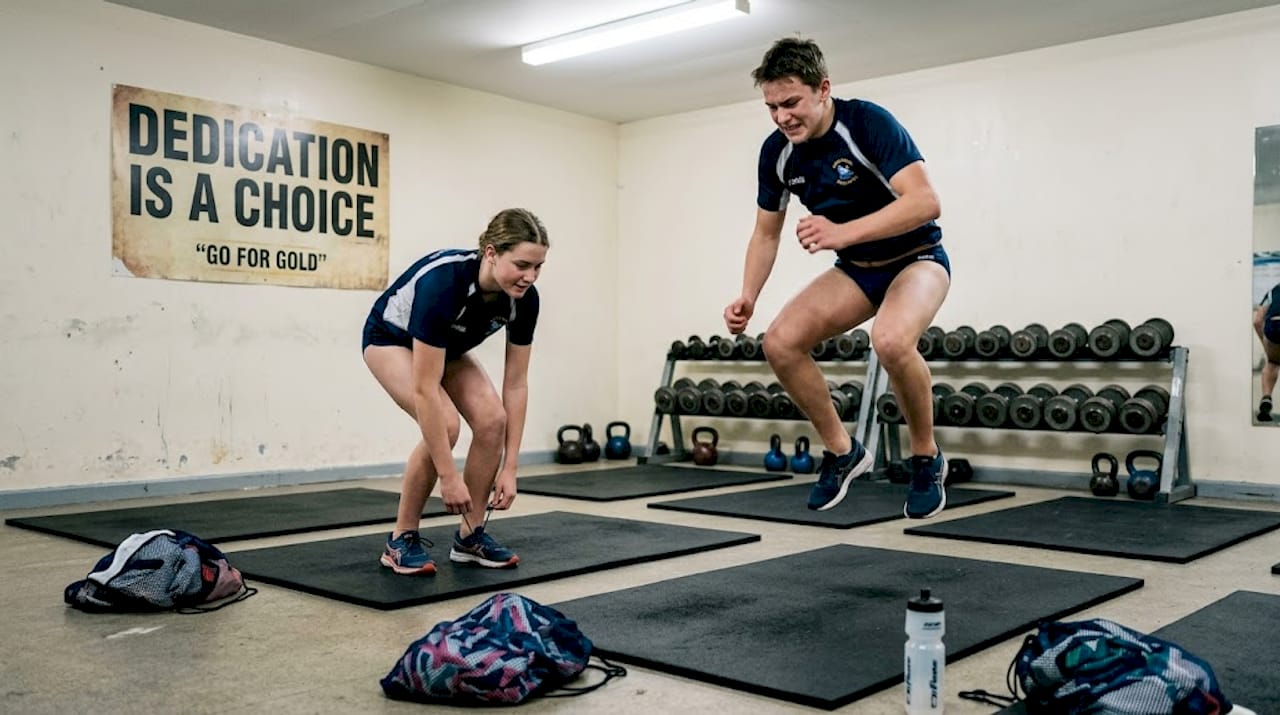
Not all dryland workouts are created equal. The most effective programs for swimmers are built on three pillars: resistance training, plyometrics, and stroke-specific power work. Each one targets a different aspect of swim performance and they work best when combined intentionally.
Elite teams focus on resistance training, plyometrics, single-leg work, and explosive pull-ups and squats for specific swim benefits. These exercises mimic the demands of real race conditions, so strength built in the gym transfers directly to faster splits in the water.
Critical exercises for competitive swimmers:
- Pull-ups and lat pull-downs for stroke power
- Barbell and goblet squats for kick strength and push-off power
- Single-leg Romanian deadlifts for hip stability and kick mechanics
- Plank variations and anti-rotation holds for core strength for swimmers
- Box jumps and broad jumps for explosive starts and turns
- Medicine ball throws for rotational power specific to freestyle and butterfly
Optimal vs. ineffective exercises for swimmers:
| Exercise category | Optimal for swimmers | Avoid or minimize |
|---|---|---|
| Strength | Pull-ups, squats, deadlifts | Slow isolation curls, machines only |
| Power | Box jumps, medicine ball throws | Steady-state running, step aerobics |
| Core | Planks, Pallof presses | Crunches, sit-ups |
| Mobility | Hip flexor stretches, thoracic rotation | Static stretching pre-workout |
One of the most common programming mistakes is prioritizing hypertrophy, meaning training for muscle size, over power and speed. Avoid hypertrophy focus, slow reps, and non-specific circuits or running when designing a swim team dryland plan. Bigger muscles that move slowly do not help you go faster in the water.
For technique improvement alongside dryland work, technique tips for performance can help swimmers connect dryland strength to better in-pool execution. Pairing these resources gives your program a real edge.
Pro Tip: Use explosive compound movements like jump squats and power cleans as the centerpiece of each session. These exercises develop the fast-twitch muscle fibers responsible for fast starts, powerful turns, and strong sprint finishes. An effective calisthenics routine can complement barbell work, especially for teams with limited equipment.
Designing a dryland workout plan for your team
Once you understand the core components, effective dryland programming comes down to smart planning and execution. A well-designed plan accounts for your team’s size, age range, competition schedule, and available equipment.
Steps to build your weekly dryland plan:
- Set clear weekly goals tied to upcoming race events and performance targets
- Select 3-5 primary movements from the strength, power, and core categories
- Schedule dryland sessions on days that don’t directly precede hard pool workouts
- Sequence exercises from most explosive to least: jumps first, core work last
- Build in a proper swimming warm-up before every dryland session
- Integrate sessions with your year-round swim training calendar so they complement, not compete with, pool work
- Reassess and adjust every 3-4 weeks based on swimmer feedback and performance data
Plyometrics appear in 99% of high-performance programs, and injury prevention depends on quality warm-ups. Skipping the warm-up is one of the fastest ways to sideline a swimmer during a key training block.
Important: Technique always comes before quantity. A swimmer doing 5 perfect jump squats develops more race-ready power than one grinding through 20 sloppy reps. Prioritize movement quality, especially with younger athletes or anyone returning from injury.
Structured, stroke-specific dryland is far superior to random circuits for skill transfer. If you’re programming for a breaststroker, emphasize hip abductor work and single-leg strength. For butterfliers, focus on thoracic mobility and explosive hip extension.
Pro Tip: Jump squats and single-leg exercises are especially effective for improving kick mechanics and push-off power. Consider how often a swimmer should practice when deciding how to space dryland and pool sessions. The guidance on practice frequency for swimmers can help coaches build sustainable weekly structures that prevent burnout.
Monitoring progress and adjusting your workouts
Your plan is in action. Now it’s all about tracking, measuring, and refining for sustained results. Without consistent monitoring, even a well-designed dryland program can drift off course without anyone noticing until race day.
Ongoing assessment and tailored adaptation maximizes results and minimizes injuries. Build simple tracking into your weekly routine so you always know what’s working.
Signs your dryland plan is working:
- Sprint times decrease by 1% or more over 6-8 weeks
- Swimmers report feeling more powerful off the blocks and walls
- Stroke rate stays consistent deeper into race distances
- Fewer complaints of shoulder or lower back fatigue
- Repetition quality improves without added volume
Signs your plan needs adjustment:
- Persistent soreness that doesn’t resolve between sessions
- Declining performance times despite consistent effort
- Swimmer motivation drops or enthusiasm fades
- Technique breaks down during dryland exercises
Sample dryland to pool performance tracking:
| Metric | Week 1 | Week 4 | Week 8 | Target change |
|---|---|---|---|---|
| 50m sprint time | Baseline | Check | Check | -1 to -4% |
| Max pull-ups | Baseline | Check | Check | +20-30% |
| Vertical jump height | Baseline | Check | Check | +5-10 cm |
| Subjective power rating | 6/10 | 7/10 | 8/10 | Steady increase |
Use goal-setting for swimmers principles to give each athlete individual performance targets. Personal goals tied to dryland metrics keep swimmers invested and motivated throughout long training blocks. Coaching strategies for youth swimmers also offer valuable frameworks for adapting monitoring systems to younger athletes who need more frequent feedback and encouragement.
A coach’s perspective: Why dryland is often misunderstood (and how to get it right)
After working with elite coaches and top swim teams across multiple countries, we’ve seen the same pattern repeat: teams that treat dryland as an afterthought rarely reach their potential, while teams that program it with purpose consistently outperform their rivals.
The problem isn’t effort. Most coaches care deeply about their athletes. The problem is structure. Unstructured, non-specific dryland training is rarely effective, and what works is structured routines focused on swimming posture and power. Random fitness circuits give swimmers a workout but don’t make them faster.
What separates the best programs we’ve seen? They treat dryland as an extension of stroke work, not a break from it. Every exercise has a reason tied to a specific movement in the water. Progression is planned, not accidental. Feedback is collected, analyzed, and acted on. And when something isn’t working, the plan changes.
The teams that consistently outperform understand that physical conditioning for swimmers is a science, and dryland is one of the most powerful tools in that system. Use it with intention and you’ll see results that pool work alone can’t deliver.
Upgrade your swim team’s training with expert help
Building an effective, evidence-based dryland program takes experience, knowledge, and ongoing refinement. At PEAK Performance Swim Camp, we’ve spent 30 years helping swimmers and coaches develop training systems that produce real results in competition.

Our swim camps integrate dryland conditioning with world-class in-pool coaching, giving your athletes a complete performance program. For individualized support, our personal coaching sessions are designed to address each swimmer’s specific strengths and gaps. You can also explore private coaching and video analysis to connect dryland work directly to technique improvements in the water. Let our expert coaches help your team train smarter and compete at their best.
Frequently asked questions
How many times a week should a swim team do dryland workouts?
Most competitive teams integrate dryland 2-3 times per week, balanced with pool sessions based on age and competition schedule. Weekly integration of dryland with swim training consistently produces optimal performance gains.
Which dryland exercises are best for swimmers?
Pull-ups, squats, plyometrics, core work, and single-leg exercises most directly improve swimming performance. Elite teams prioritize pull-ups, squats, and plyometric work as the foundation of their dryland programs.
Is dryland training safe for young swimmers?
Yes, dryland is safe for young swimmers when it emphasizes technique, age-appropriate progression, and proper warm-up to minimize injury risk. Injury prevention is built into every well-designed youth dryland session through quality movement and smart loading.
How do you know if dryland training is working?
You’ll see improved sprint times, better stroke efficiency, and positive feedback from both swimmers and coaches over 6-8 weeks. Dryland training yields 1.3-4.4% performance improvements in sprints and velocity when properly implemented.
Recommended
- Physical conditioning for swimmers: unlock peak performance – Peak Performance Swim Camp
- Master swimming conditioning: step-by-step guide to peak performance – Peak Performance Swim Camp
- Optimize your swim coach training workflow: 4 key phases – Peak Performance Swim Camp
- Year-round swim training: benefits, methods & success – Peak Performance Swim Camp
- Conquering the Marathon: Your Essential Training Guide