
TL;DR:
- Dryland training enhances swimmers’ strength, flexibility, and injury prevention beyond water workouts.
- Core exercises and power moves improve stroke efficiency, starts, and turns significantly.
- Consistent, simple routines tailored to skill levels lead to better performance gains over complex, infrequent workouts.
Swimming faster is not just about logging more laps. No matter how diligently you train in the water, there are physical qualities that pool workouts simply cannot fully develop on their own. Strength, explosive power, and targeted flexibility all respond better to dryland training, which is any exercise performed outside the water to directly support swim performance. This article walks you through the most effective dryland exercises available, explains what makes each one worth your time, and provides practical routines you can start using immediately. Whether you are a beginner or a seasoned competitive swimmer, these exercises will make a real difference.
Table of Contents
- What makes a great dryland exercise for swimmers?
- Core-strengthening exercises: The foundation for every swimmer
- Building power: Strength and plyometric dryland moves
- Improving mobility and flexibility for optimal strokes
- Putting it all together: Sample dryland routines for every level
- Our take: Why consistency beats complexity in dryland training
- Take your swimming further with expert coaching and camps
- Frequently asked questions
Key Takeaways
| Point | Details |
|---|---|
| Target key muscle groups | Select dryland exercises that replicate swimming motions and activate core, shoulders, and legs for best results. |
| Balance strength and mobility | Combine strength, plyometric, and mobility work for complete athletic development and fewer injuries. |
| Stick with a routine | Consistent, well-structured dryland training leads to measurable improvements in swim performance. |
| Adapt to your level | Adjust exercises and session plans to fit the swimmer’s age, skill, and season goals. |
What makes a great dryland exercise for swimmers?
Not every exercise belongs in a swimmer’s dryland program. Squats and planks are fine in general fitness, but the best dryland exercises do more than build generic muscle. They should directly support what happens in the water.
When evaluating any dryland movement, look for these qualities:
- Targets swim-specific muscles: Shoulders, lats, core, glutes, and hip flexors are the primary movers in most strokes.
- Enhances mobility and range of motion: Swimmers need flexible shoulders, open hips, and a supple spine to reach full stroke extension.
- Prevents common injuries: Rotator cuff issues, lower back strain, and knee problems are frequent in swimmers. Good dryland work addresses these weak points proactively.
- Adjustable to skill level: Exercises should scale easily from beginner to elite without requiring special equipment.
- Mimics stroke mechanics: The closer an exercise mirrors an actual swim movement on land, the more directly it transfers to faster splits.
Dryland exercises support optimal swim performance, and when they are selected with these criteria in mind, they become a powerful extension of your water training rather than a separate activity. Reviewing a solid dryland workout guide helps coaches and athletes build programs that produce real results, not just general fitness.
For swimmers focused on overall conditioning, pairing dryland work with intentional physical conditioning for swimmers creates a well-rounded athlete who is both strong and resilient.
Pro Tip: Choose at least two exercises per session that closely mimic your primary stroke movements. A backstroker, for example, benefits enormously from lat pull-down variations and shoulder rotation drills.
Core-strengthening exercises: The foundation for every swimmer
With those criteria in mind, the most fundamental area to target is your core. Nearly every element of swimming, from your streamline off the wall to your stroke rotation and underwater dolphin kicks, originates from a strong, stable midsection.
Core strength is key to swimming performance, and the good news is that you do not need fancy equipment to develop it. Here are the most effective core exercises for swimmers:
- Plank variations: Standard front planks, side planks, and plank with shoulder taps all build the anti-rotation stability that keeps your body aligned in the water.
- Russian twists: This rotational movement directly trains the obliques, which power your stroke rotation in freestyle and backstroke.
- Flutter kicks on land: Lying on your back and alternating leg kicks mimics the kick pattern used in freestyle and backstroke, building hip flexor endurance.
- Superman holds: Lying face down and lifting both arms and legs simultaneously activates the lower back and glutes, which stabilize your body position during every stroke.
Each of these exercises activates the muscles responsible for your body position in the water. A swimmer with a weak core will drop their hips, creating drag and slowing every stroke. Strong core muscles also improve your push-off from the wall and your starts, giving you a tighter, faster streamline.
“Core strength does not just make you look fit. It is the structural foundation that determines how efficiently you move through the water on every single stroke.”
Pro Tip: Consistency beats intensity with core training. Fifteen minutes of focused core work every day will outperform a single brutal session once a week. Build the habit first, then gradually increase the difficulty.
The importance of core strength for swimmers cannot be overstated. Coaches who prioritize this area consistently see faster improvements in stroke technique and race times across all age groups.
Building power: Strength and plyometric dryland moves
A strong core is only part of the story. Swimmers also need explosive power and strength to generate fast starts, powerful turns, and sustained sprint speed.
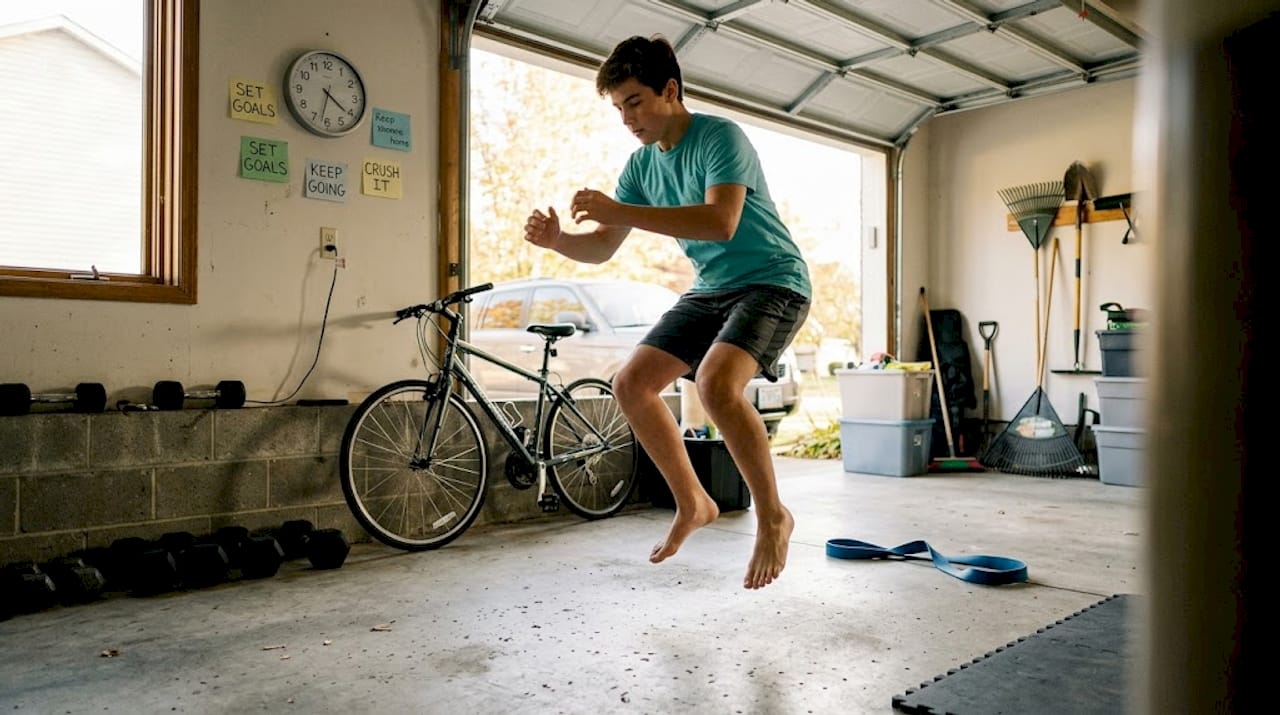
Strength training improves swimming performance and minimizes injury risk, making it a non-negotiable part of any serious program. Here are the key exercises to include:
Strength exercises:
- Squats: Build leg power for starts and turns. Bodyweight versions work for beginners; add a barbell or dumbbells as you progress.
- Push-ups: Strengthen the chest, shoulders, and triceps, directly supporting the pull phase of freestyle and butterfly.
- Single-leg deadlifts: Improve balance and posterior chain strength while addressing left-right muscle imbalances that are common in swimmers.
- Resistance band pulls: Mimic the underwater pull pattern of freestyle and backstroke, reinforcing correct muscle activation.
Plyometric moves:
- Jump squats: Build explosive leg power for race starts and turn push-offs.
- Burpees: Develop total-body conditioning and the fast-twitch muscle fibers that power sprint events.
- Lateral bounds: Train the hip abductors and adductors, improving body rotation and kick efficiency.
| Exercise | Focus area | Primary benefit |
|---|---|---|
| Squats | Legs and glutes | Start and turn power |
| Push-ups | Chest and shoulders | Pull phase strength |
| Jump squats | Explosive leg power | Faster race starts |
| Resistance band pulls | Lats and shoulders | Stroke pull efficiency |
| Lateral bounds | Hips and core | Rotation and kick power |
For swimmers new to dryland training, a helpful resource is this conditioning exercises for swimmers guide, which breaks down safe progressions. You can also follow swimming conditioning steps to build from beginner to advanced loads without risking overuse injuries.
Improving mobility and flexibility for optimal strokes
Strength and power lend themselves to speed, but mobility and flexibility are equally crucial for safe, effective swimming. A tight shoulder or stiff ankle limits your stroke range, forces compensations, and raises your injury risk significantly.
Mobility training supports swimming technique and reduces injury risk, so it deserves dedicated time in your weekly routine. Start with these exercises:
- Arm circles: Warm up the rotator cuff and increase shoulder range of motion before any swim or strength session.
- Shoulder mobility rolls: Using a foam roller or a resistance band, these target the joint capsule and surrounding tissue for deeper flexibility gains.
- Dynamic lunges: Open the hip flexors and improve stride length, which translates directly to a more powerful kick.
- Thoracic rotations: Seated or kneeling, rotating your upper spine increases the body rotation available during freestyle and backstroke.
Key flexibility areas every swimmer should prioritize:
- Shoulders: Essential for a full catch position and injury-free overhead movement.
- Hips: Tight hips reduce kick amplitude and increase drag.
- Ankles: Flexible ankles allow a more effective flutter kick and reduce stress on the knees.
- Spine: Thoracic mobility directly supports body rotation, a critical factor in stroke efficiency.
| Stretch type | Best timing | Primary benefit |
|---|---|---|
| Dynamic stretching | Before swimming | Activates muscles, increases blood flow |
| Static stretching | After swimming | Improves long-term flexibility and recovery |
For practical ways to apply these movements within your stroke technique, reviewing swimming technique tips gives you a clear picture of how mobility and water mechanics connect.
Putting it all together: Sample dryland routines for every level
With the major exercise categories covered, here is how to bring them together in a smart training plan. A well-structured dryland session does not need to be long. Thirty to forty-five minutes, done consistently, produces outstanding results.
Consistent, structured routines maximize dryland training results for swimming, so the goal is to build a repeatable framework you can stick with.
Beginner routine (2 times per week):
- Arm circles and dynamic lunges (5 minutes warm-up)
- Front plank, 3 sets of 20 seconds
- Bodyweight squats, 3 sets of 10
- Push-ups, 3 sets of 8
- Superman holds, 3 sets of 10 reps
- Static shoulder and hip stretches (5 minutes cool-down)
Intermediate routine (3 times per week):
- Dynamic warm-up including thoracic rotations and arm circles (7 minutes)
- Side plank with hip dips, 3 sets of 15 seconds each side
- Goblet squats, 3 sets of 12
- Single-leg deadlifts, 3 sets of 8 per side
- Russian twists, 3 sets of 20 reps
- Jump squats, 3 sets of 8
- Resistance band pull-downs, 3 sets of 12
Advanced routine (3 to 4 times per week):
- Full dynamic warm-up including flutter kicks and arm swings (10 minutes)
- Weighted plank variations, 4 sets of 30 seconds
- Barbell squats, 4 sets of 8
- Burpees, 4 sets of 10
- Lateral bounds, 3 sets of 12 per side
- Resistance band pull-throughs, 4 sets of 15
- Thoracic rotations and static cool-down stretches
Use this dryland conditioning guide to refine the structure further, and check swimming practice frequency to balance dryland sessions with your water training schedule.
Pro Tip: Keep a simple training log. Noting your sets, reps, and how you felt each session lets you spot progress quickly and catch burnout before it derails your training.
Our take: Why consistency beats complexity in dryland training
After decades of working with swimmers across all levels and ages, the biggest mistake we see is not skipping dryland entirely. It is starting with overly complex routines that are impossible to sustain. Swimmers who try to tackle advanced plyometrics and heavy lifting before mastering bodyweight fundamentals almost always plateau faster or pick up preventable injuries.
The swimmers who make the most dramatic improvements are the ones who choose five to eight solid exercises, perform them consistently, and progressively increase the challenge over weeks and months. Simple, repeatable habits beat elaborate programs every time.
For coaches, this means building programs your athletes can actually complete given their schedule, energy, and current fitness. For swimmers, it means trusting the process. Developing strong goal-setting for swimmers habits alongside your dryland program keeps motivation high and results measurable. Start simple. Stay consistent. The performance gains will follow.
Take your swimming further with expert coaching and camps
Understanding the right exercises is a powerful first step, and applying them with expert guidance is where real breakthroughs happen.

At PEAK Performance Swim Camp, founded by Olympic coach Nick Baker, dryland and water training are integrated into every program we offer. Our coaches provide hands-on feedback and personalized adjustments that make good training great. Whether you are looking for structured swim camps with full programs, personalized coaching for swimmers focused on your specific goals, or flexible clinic package options, we have resources built for every swimmer and team. Visit swimcamp.com to find the right program and take your performance to the next level.
Frequently asked questions
How often should swimmers include dryland exercises in their training?
Most swimmers benefit from 2-3 dryland sessions per week, adjusted based on their current season phase, age, and overall training load.
Can younger swimmers safely do dryland exercises?
Yes, when movements are age-appropriate, younger swimmers can safely train with bodyweight exercises that prioritize proper form and controlled progression over load.
What is the best time to do dryland exercises, before or after swimming?
Mobility and activation drills work well before swimming as a warm-up, while strength and flexibility workouts are generally most effective after a swim session when muscles are already warm.
Which dryland exercise helps most with swimming starts?
Jump squats and plyometric push-ups are among the best choices because they build the explosive power and fast-twitch muscle activation that fast swim starts demand.
Should swimmers change their dryland routine during competition season?
Yes. During competition season, reduce dryland volume and intensity while keeping key maintenance movements to stay strong without accumulating fatigue before races.
Recommended
- Guide to effective dryland workouts for competitive swim teams – Peak Performance Swim Camp
- Advanced swimming technique tips for peak performance – Peak Performance Swim Camp
- Physical conditioning for swimmers: unlock peak performance – Peak Performance Swim Camp
- Essential mental training tips to boost swim performance – Peak Performance Swim Camp