
TL;DR:
- Dryland training is a vital component for improving swim performance, enhancing power, stability, endurance, and injury prevention. A simple, well-structured routine using minimal equipment can deliver significant results when properly integrated with pool work. Consistency, feedback tracking, and tailored programming are key to maximizing dryland benefits for both swimmers and triathletes.
Most swimmers and triathletes spend hours perfecting their technique in the water, yet leave serious performance gains sitting on the gym floor. Dryland training, meaning resistance and conditioning work done outside the pool, is one of the most powerful tools available to competitive athletes. Combined aquatic plus dry-land training improves multiple performance outcomes, from swim speed to stroke efficiency. This guide walks you through everything you need to know to build an effective dryland program, whether you’re preparing for your next competitive meet or your first triathlon finish line.
Table of Contents
- Know the fundamentals: Why dryland matters
- Gather your must-haves: Setup and prerequisites
- Design your dryland workout: Key components and structure
- Tailor your approach: Swimmer vs. triathlete adaptation
- Verify results and troubleshoot: How to evaluate effectiveness
- What most guides miss: Real-world lessons from dryland training
- Enhance your dryland training with expert support
- Frequently asked questions
Key Takeaways
| Point | Details |
|---|---|
| Dryland boosts performance | Expert-backed training outside the water significantly enhances speed, endurance, and stroke efficiency. |
| Prep matters | Proper setup and readiness are essential for maximizing dryland workout benefits and minimizing injury risk. |
| Tailor to your sport | Adapting dryland routines for swimmers and triathletes helps address unique fatigue patterns and benchmarks. |
| Track real progress | Monitoring practical metrics, not just lab numbers, reveals meaningful improvements in conditioning and performance. |
| Expert support accelerates results | Professional camps and coaching provide targeted strategies for sustainable gains in dryland and swim performance. |
Know the fundamentals: Why dryland matters
Dryland training is not a supplement to your swim program. For serious athletes, it is a core pillar of performance development. The research is clear: combined training improves 100m time, swim velocity, stroke rate, and stroke length for competitive swimmers. That means you are getting faster, moving more efficiently, and maintaining better mechanics over longer distances.
Elite coaches don’t just throw random gym exercises at their athletes. They use low-volume, high-velocity resistance training to deliver real performance gains without creating excessive fatigue. The emphasis is on quality of movement and targeted force production, not grinding through endless sets.
Here is how dryland training compares to water-only approaches:
| Training approach | Speed gains | Stroke efficiency | Injury prevention | Muscular endurance |
|---|---|---|---|---|
| Water only | Moderate | High | Low to moderate | Moderate |
| Dryland only | Low | Low | Moderate | High |
| Combined (water + dryland) | High | High | High | High |
The four core goals of any dryland program are:
- Enhanced power: Generating more force through pulling and kicking movements
- Core stability: Maintaining body position and reducing drag in the water
- Muscular endurance: Sustaining output over longer race distances
- Injury prevention: Strengthening stabilizer muscles around the shoulder, hip, and knee
Pro Tip: Start by reviewing dryland exercises for swimming to understand which movements transfer most directly to pool performance.
Now that you know why dryland is a proven game-changer, let’s prepare with the essentials.
Gather your must-haves: Setup and prerequisites
Before you design a single session, you need the right setup. The good news is that dryland resistance training practices vary widely by coach and program, and benchmarks are often individualized. You do not need a fully equipped commercial gym to get results. Many elite swimmers train effectively with minimal gear.
Here is a breakdown of essential equipment by training level:
| Equipment | Beginner setup | Intermediate setup | Advanced setup |
|---|---|---|---|
| Resistance bands | Yes | Yes | Yes |
| Exercise mat | Yes | Yes | Yes |
| Medicine ball | Optional | Yes | Yes |
| Pull-up bar | No | Yes | Yes |
| Dumbbells or kettlebells | No | Yes | Yes |
| Plyometric box | No | Optional | Yes |
| Cable machine or swim bench | No | No | Yes |
For space, a 10 by 10 foot area is enough for basic resistance band and mat work. If you are adding plyometrics, you want at least a 15 by 20 foot open area with a ceiling height that lets you jump freely. A garage, backyard, or spare room can all work.
Before starting, run through this readiness checklist:
- You can complete basic movements like squats, push-ups, and planks without pain
- You have cleared any existing injuries with a medical professional
- You understand your current swim training volume so you can balance load
- You have access to a coach or experienced trainer for at least the initial sessions
- You have reviewed your physical conditioning baseline to know where you’re starting
One area that many athletes overlook is core strength. Without a stable core foundation, even well-designed resistance exercises fail to transfer into faster swimming. Before adding heavy loads, make sure you can hold a plank for 60 seconds and perform controlled rotational movements with no compensation.
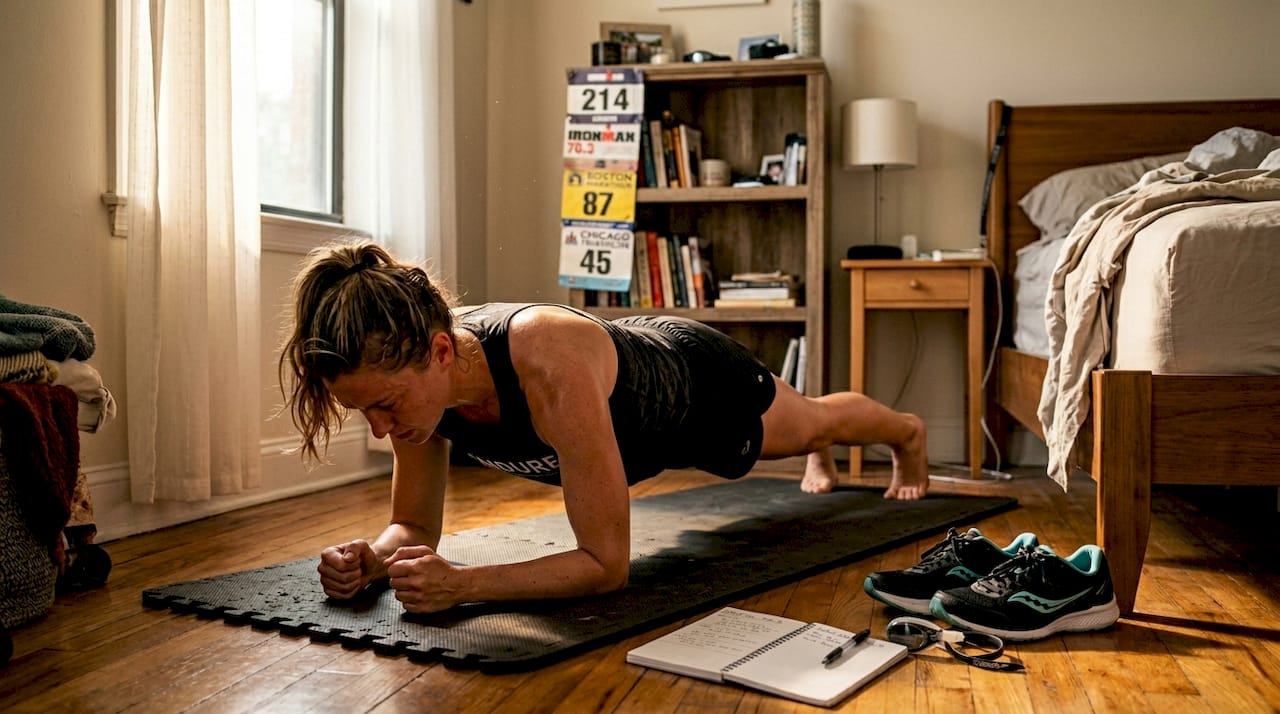
Pro Tip: Start simple. A set of resistance bands, a mat, and your bodyweight can build meaningful strength for at least 8 to 12 weeks before you need additional equipment. Sophistication is not required for results.
With equipment and preparation in place, it’s time to build your routine.
Design your dryland workout: Key components and structure
A well-built dryland session follows a clear structure. Randomness kills progress. Water plus dry-land resistance training ranks highest across several performance metrics for competitive swimmers, but only when sessions are properly programmed and integrated with pool work.
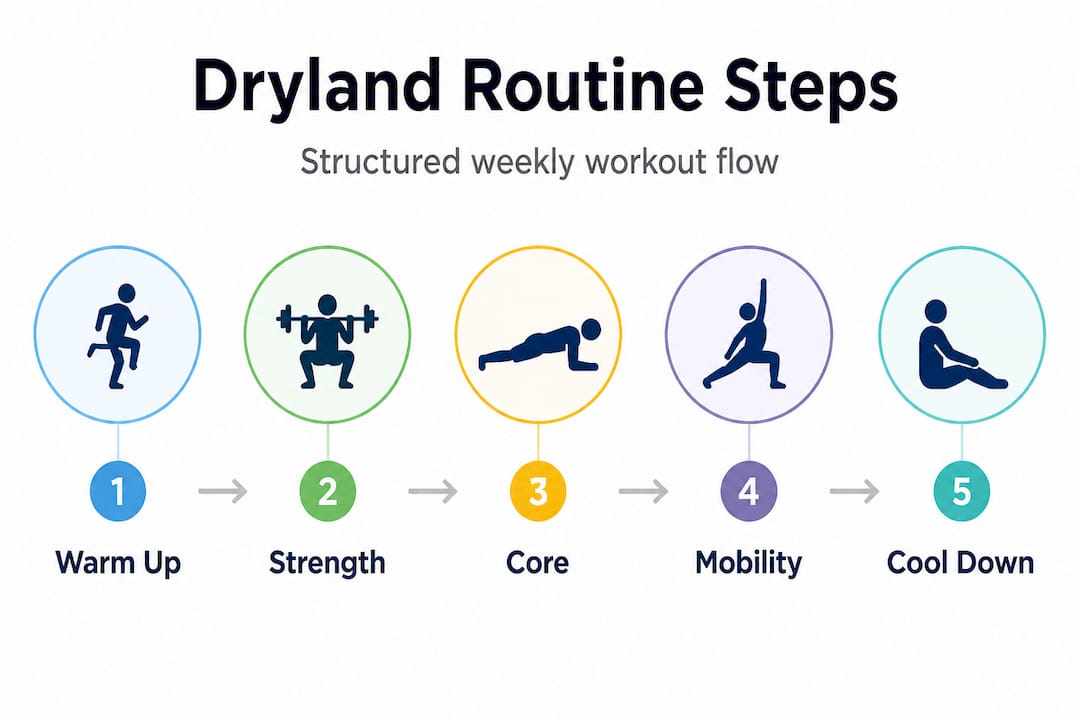
Here is a step-by-step structure for a balanced 45 to 60 minute dryland session:
- Dynamic warm-up (8 to 10 minutes): Arm circles, hip rotations, leg swings, and light band pull-aparts. Prepare joints and activate stabilizers.
- Power or plyometric block (10 to 12 minutes): Medicine ball slams, broad jumps, or explosive push-ups. This is your highest-intensity work while you are freshest.
- Resistance training block (20 to 25 minutes): 3 to 4 exercises targeting pulling patterns (lat pulldowns, rows), pushing patterns (push-ups, dumbbell press), and lower body (goblet squats, Romanian deadlifts).
- Core and stability block (8 to 10 minutes): Planks, hollow body holds, dead bugs, and rotational exercises with a medicine ball.
- Flexibility and cooldown (5 to 8 minutes): Static stretching focused on shoulders, hip flexors, and thoracic spine.
Low-volume, high-velocity resistance programs are favored by elite coaches because they develop power without excessive soreness that would interfere with pool sessions. Keep sets between 3 and 4, reps between 6 and 10 for power work, and rest periods at least 90 seconds between sets.
Key exercises to include and why they matter:
- Lat pulldowns and band pull-aparts: Directly target the pulling muscles used in freestyle and butterfly
- Single-leg Romanian deadlifts: Build posterior chain strength and ankle stability
- Hollow body holds: Train the same body position you need in streamline
- Medicine ball rotational throws: Develop the rotational power used in every stroke cycle
- Box jumps or broad jumps: Improve explosive leg drive for turns and starts
“Quality beats quantity every time. One focused, intentional dryland session will do more for your race performance than three sloppy, exhausted ones.”
Use your conditioning step-by-step plan to map out a weekly schedule that layers dryland sessions around your pool training without creating excessive overlap in fatigue. For most competitive swimmers, two dryland sessions per week is an ideal starting point. Experienced athletes with strong recovery capacity can handle three.
Pro Tip: Never schedule your hardest dryland session the day before a critical swim practice. Protect your best pool sessions by placing dryland work on low-intensity swim days or rest days.
After your workouts are organized, let’s address specific tweaks for swimmers vs. triathletes.
Tailor your approach: Swimmer vs. triathlete adaptation
Not all athletes need the same dryland approach. Competitive swimmers and triathletes have very different fatigue patterns, race demands, and training schedules. A program that works brilliantly for a 200m butterfly swimmer may actually harm a triathlete’s performance if applied without modification.
| Factor | Competitive swimmer | Triathlete |
|---|---|---|
| Primary fatigue source | Upper body, high stroke rate | Full body, multi-sport accumulation |
| Race order consideration | Swim is the primary event | Swim comes first, followed by bike and run |
| Dryland emphasis | Pulling power, shoulder stability | Cycling power, run-to-swim transition recovery |
| Training volume tolerance | High swim volume, moderate dryland | Must balance three sports, lower dryland volume |
| Core training priority | High, for stroke efficiency | Very high, for multi-sport transfer |
For triathletes, the sequencing of events changes everything. Research shows that a race-pace swim reduces subsequent cycling workload by approximately 6%, meaning your body is already compromised before you ever clip into the bike. Your dryland plan must account for this accumulated fatigue or you will underperform on the bike and run.
Three practical tweaks for triathletes to optimize their dryland training:
- Sequence your sessions to mirror race order. Practice doing your dryland cycling or lower body work after a swim session, not before. Train your legs to fire when they are already tired from the water.
- Add single-leg work to your resistance block. Single-leg squats and step-ups develop the stability and power needed for running after cycling, directly targeting the fatigue pattern triathletes face.
- Reduce upper body dryland volume compared to pure swimmers. Your shoulders accumulate stress across all three sports. Prioritize shoulder stability exercises over raw strength work to protect joint health across a full season.
You can also find useful youth swimmer coaching strategies that translate well to age-group triathletes building their first structured dryland programs.
Pro Tip: Use practical benchmarks instead of lab-only metrics. After a swim set, hop on a stationary bike and track your power output for 10 minutes. Record it weekly. That number will tell you more about your real-world fatigue adaptation than most test protocols.
Understanding how to tailor is key. Next, let’s discuss verifying your progress and troubleshooting.
Verify results and troubleshoot: How to evaluate effectiveness
Training without tracking is guessing. You need reliable, repeatable ways to measure whether your dryland work is actually translating into better performance.
Benchmarks from simulated race-order sessions, such as monitoring cycling power output after a swim, give you data that matters in the real world. Set up these test sessions once every three to four weeks and record the results consistently.
Practical benchmarks to track:
- 100m swim time: Test monthly under consistent conditions
- Stroke count per length: Lower stroke count at the same speed signals improved efficiency
- Plank hold time: A reliable indicator of core strength progression
- Post-swim cycling power: Relevant for triathletes tracking event-order fatigue adaptation
- Medicine ball throw distance: A quick measure of upper body power development
Common mistakes and how to fix them:
- Skipping the warm-up: Leads to shoulder injuries. Always spend at least 8 minutes activating before any resistance work.
- Training too heavy, too soon: Causes soreness that wrecks pool sessions. Start at 60% of your max effort and build gradually over four to six weeks.
- Ignoring rest days: Gains are made during recovery, not during the workout. Schedule at least one full rest day between dryland sessions.
- Doing the same routine for months: Your body adapts quickly. Rotate exercises every four to six weeks to continue driving progress.
- Chasing complex metrics too early: Athletes who focus on mental conditioning alongside physical training tend to stick with programs longer and see better long-term results than those who obsess over data.
Pro Tip: At the end of each week, rate your energy, soreness, and motivation on a simple 1 to 10 scale. If two or more scores drop below 5, reduce volume the following week. Your body’s feedback is more actionable than any spreadsheet.
With a solid verification system, let’s explore an informed perspective on dryland training success.
What most guides miss: Real-world lessons from dryland training
After 30 years of coaching swimmers across 18 countries, we have seen one pattern repeat itself constantly. Athletes and coaches overcomplicate dryland training. They chase complicated periodization models, expensive equipment, and lab-level metrics when the most powerful indicator of progress is simpler than any of that.
Consistency in a basic, well-structured program beats a perfect program done sporadically. Every time. Without exception.
We have seen elite swimmers plateau despite sophisticated programs because they were running on low motivation and accumulated fatigue. We have also watched determined age-group athletes break personal records using nothing but resistance bands and a well-organized weekly plan. The difference was not the program. It was the athlete’s ability to stay present, adjust based on feedback, and maintain discipline through difficult training blocks.
Conventional wisdom says more data equals better decisions. We disagree. Tracking your cycling power after every swim, as part of your real-world training challenge, gives you a concrete, honest picture of where you stand. That one metric, done consistently, will tell you more than a battery of lab tests.
Mental resilience also belongs inside your dryland program. The ability to push through a difficult set of hollow body holds when your core is burning, or to maintain focus during a plyometric block after a tough morning practice, directly builds the mental toughness that shows up in competition. Physical training and mental conditioning are not separate categories. They reinforce each other.
Our challenge to you: spend one week tracking your post-swim cycling output before and after implementing the dryland structure outlined in this guide. Compare the numbers. You will likely see a measurable difference in four weeks that no lab metric could have predicted.
Enhance your dryland training with expert support
Building an effective dryland routine takes structure, knowledge, and the right environment to thrive. At PEAK Performance Swim Camp, we have spent 30 years helping swimmers and triathletes find that environment.

Our swim camp programs integrate dryland conditioning directly into structured training schedules, guided by coaches with decades of hands-on experience. Whether you want to sharpen your technique, build sport-specific strength, or learn how to balance dryland and pool work across a competitive season, our camps provide the tools and the expert guidance to make it happen. Explore our clinic package options to find the right fit for your schedule and goals, or get started with our technical strategy guidance to map out your personalized path to peak performance.
Frequently asked questions
What is the main benefit of dryland workouts for swimmers?
Dryland workouts boost swim speed, technique, and endurance by building strength and conditioning outside the pool. Combined aquatic plus dry-land training is proven to improve multiple performance outcomes for competitive swimmers.
How often should triathletes include dryland training?
Triathletes should aim for 2 to 3 dryland sessions per week, with a focus on event-order fatigue and practical race-condition benchmarks. Research confirms that a race-pace swim can meaningfully affect subsequent cycling performance, so programming must account for this.
What equipment is needed for dryland workouts?
Basic equipment includes resistance bands, mats, and medicine balls. Advanced setups may add weights, pull-up bars, or plyometric tools, though dryland resistance training practices confirm that benchmarks and equipment choices are often individualized to each athlete.
How can swimmers track dryland progress?
Swimmers can measure improvements through 100m swim times, stroke count per length, and practical benchmarks like timed core holds or post-swim cycling output. Swimming performance benchmarks are often coach-specific, so work with your training team to define the right metrics for your goals.
Recommended
- Guide to effective dryland workouts for competitive swim teams – Peak Performance Swim Camp
- Top dryland exercises to boost swimming performance – Peak Performance Swim Camp
- Individualized swim plans: unlock elite performance – Peak Performance Swim Camp
- Physical conditioning for swimmers: unlock peak performance – Peak Performance Swim Camp