
TL;DR:
- External focus during races improves performance more than internal or broad focus.
- Mental training exercises like breathing, visualization, and cue words enhance focus stability.
- Recognizing and addressing mental fatigue quickly is crucial for maintaining optimal race focus.
You can log perfect splits in practice, nail every turn, and still fall apart mid-race because your mind drifts for three seconds. That gap between physical readiness and mental sharpness is where races are won or lost, and it’s something that even well-conditioned swimmers overlook entirely. The focus requirements in swimming are demanding in ways that don’t show up on a training log. This guide walks you through research-backed strategies to sharpen mental focus, build race-day routines, and sustain those gains from the first practice of the season to the last heat of your championship meet.
Table of Contents
- Understanding the mental focus challenge in swimming
- Preparation: Essential tools and mental exercises for swimmers
- Step-by-step: Building focus for training and race day
- Troubleshooting and overcoming common obstacles
- Measuring progress and sustaining mental focus gains
- Our take: What most swimmers miss about mental focus
- Take your mental game further with Peak Performance Swim Camp
- Frequently asked questions
Key Takeaways
| Point | Details |
|---|---|
| External focus works best | Focusing on cues around you, not your own movements, leads to better race results. |
| Mindfulness supports consistency | Regular mindfulness routines stabilize mental effort and self-regulation over time. |
| Overcome fatigue proactively | Recognizing and resetting mental fatigue stops performance drops before they start. |
| Measure mental progress | Track consistency in focus and recovery to build strong habits for competition. |
| Coaches are crucial partners | Coaches help shape individualized strategies for mental focus across all swimming levels. |
Understanding the mental focus challenge in swimming
Mental focus in swimming isn’t one single thing. It’s a dynamic skill that shifts depending on the event, the moment in a race, and what’s happening around you in the water. Understanding the different types of focus, and when each one helps or hurts, is the first step toward taking control of your performance.
Researchers distinguish between two main attentional styles: external focus (directing attention to the environment, the water, a competitor’s lane) and internal focus (directing attention to your own body parts, like arm pull or kick tempo). A systematic review of 10 studies confirmed that external attentional focus on environmental cues consistently improves swimming performance, technique, efficiency, and speed compared to internal focus on body mechanics. This is a significant finding that most swimmers aren’t acting on yet.
Beyond the type of focus, there’s the issue of mental fatigue. Swimming fast while mentally depleted is genuinely harder, and the science backs that up. Research shows that mental fatigue impairs 400m front-crawl performance in national-level swimmers by increasing perceived effort at lactate threshold, even when heart rate and blood lactate remain unchanged. Your body can be physiologically ready, but a fatigued mind makes the same effort feel much harder, which leads to slower times.
The focus challenges for swimmers look different depending on the event:
- Sprint events (50m, 100m): Narrow, intense focus is critical. A single distraction can break your reaction time or disrupt your stroke rhythm.
- Middle-distance events (200m, 400m): Pacing strategy demands a blend of internal awareness early on and external cues to push through the back half.
- Distance events (800m, 1500m): Broad external focus helps maintain efficiency over time and prevents the mental drift that leads to slow splits.
Pro Tip: If you notice your focus breaking down consistently at the same point in a race (for example, the third 50 of a 200), that’s a training cue. Target that segment in practice with deliberate focus cues, not just physical pacing.
Preparation: Essential tools and mental exercises for swimmers
Knowing that focus matters is one thing. Building a toolkit to train it consistently is another. The good news is that mental skills respond to practice just like physical ones. A three-week mindfulness intervention in youth swimmers, which included breathing exercises, body awareness drills, and attentional training, produced meaningful improvements in basic, psychosomatic, and cognitive mental skills (with effect sizes ranging from Cohen’s d of 2.02 to 2.83). While race times didn’t improve immediately, the stability of internal training load clearly improved, which sets the foundation for future performance gains.
Here are the core mental training tools every swimmer should build into their routine:
- Controlled breathing: Slows the stress response and anchors attention before a race or a hard set.
- Cue words: Short, powerful words like “drive,” “smooth,” or “lock in” that redirect attention when focus drifts.
- Visualization: Mental rehearsal of the race, including start, turns, and final push, primes the brain for execution.
- Attentional exercises: Drills that practice shifting between broad and narrow focus deliberately.
- Pre-set routines: Consistent warm-up sequences that signal the brain it’s time to switch into performance mode.
| Mental exercise | Recommended frequency | Primary goal |
|---|---|---|
| Controlled breathing | Daily, before sets and races | Reduce anxiety, anchor focus |
| Cue word practice | 3x per week during training | Redirect attention under fatigue |
| Visualization | 4-5x per week, 5-10 minutes | Build race confidence and clarity |
| Attentional shifting drills | 2x per week | Train flexible focus |
| Pre-race routine rehearsal | Every competition warm-up | Consistency and readiness |
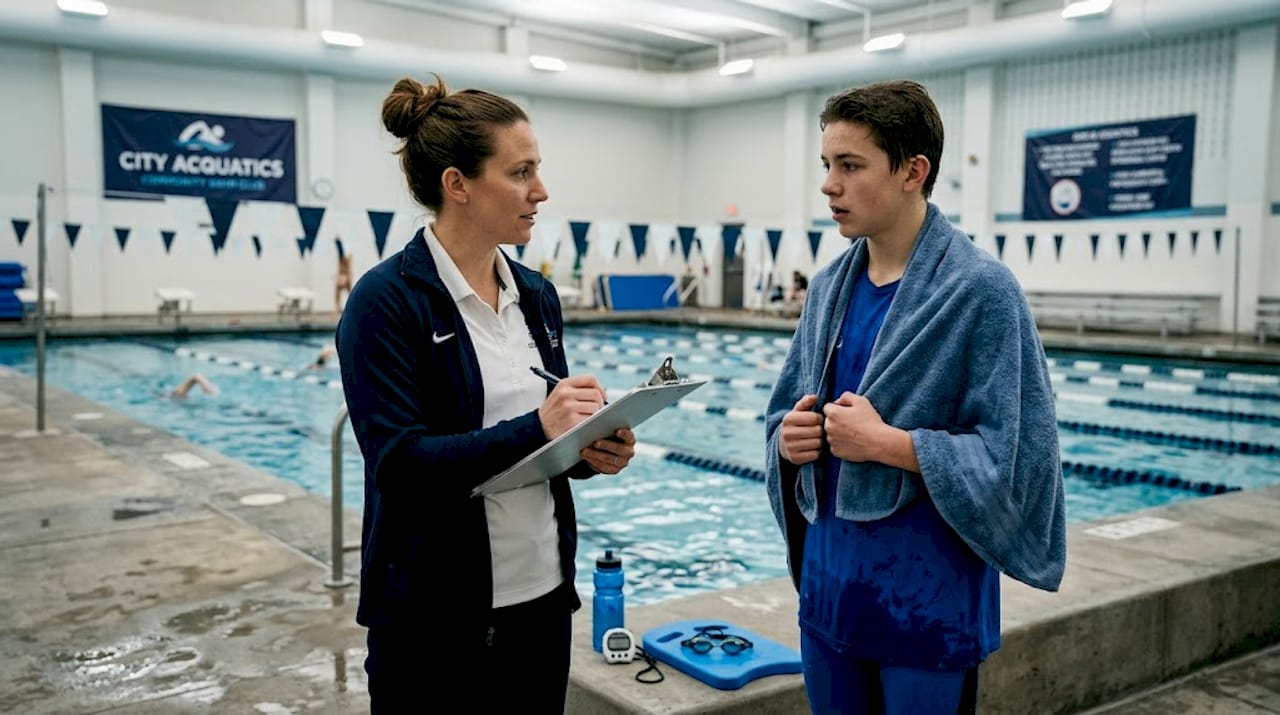
Coaches play a vital role here. Help your swimmers self-assess their readiness before practice by asking two simple questions: “Where’s your head at today?” and “What’s your focus target for this set?” These brief check-ins build metacognitive awareness, which is the ability to monitor your own thinking, and that skill transfers directly to race-day performance.
Step-by-step: Building focus for training and race day
With your tools in place, here’s how to apply them systematically. This sequence works for both individual swimmers and coaches running team programs.
- Start with a mental walk-through. Before practice or competition, spend three to five minutes mentally walking through the session. Picture the key moments: your dive, your first stroke cycle, your turn, your sprint to the wall.
- Set a focus target. Decide specifically what you will pay attention to during the session. For training, this might be the feel of water pressure on your palm during the pull. For racing, it should almost always be an external cue.
- Use a physical anchor in your warm-up. A consistent physical routine, like a specific stretch sequence or a set number of easy laps, signals your nervous system to shift into focus mode.
- Apply cue words at key moments. Identify two or three moments in your race where focus typically fades. Assign a cue word to each and practice firing those words during training.
- Debrief after each set or race. Ask yourself: “Did I stay on my focus target?” Honest self-assessment builds the self-regulation skills that hold focus under pressure.
The research is clear about which focus style to use when. External focus outperforms internal focus in competition, with broad external cues (like water movement or lane lines) better suited to distance events, and narrow external cues (like a competitor’s shoulder) more effective for sprints. Internal focus is best saved for technical skill learning in practice.
| Focus type | When to use | Benefits | Drawbacks |
|---|---|---|---|
| Broad external | Distance events, mid-race pacing | Maintains efficiency, reduces fatigue | Can allow mind to wander |
| Narrow external | Sprints, starts, turns | Sharp execution, reactive | Requires precise cue selection |
| Internal | Skill learning in practice | Speeds technique acquisition | Disrupts automatic movement in competition |

Getting arousal levels right before a race matters just as much as focus style. Research found that psyching-up combined with cognitive challenges improved attention, reaction time, and impulse control in adolescent swimmers, along with better mood and enjoyment, without any added physiological stress. This means combining an energizing pre-race ritual with a short mental challenge (like recalling your race plan step by step) can give you a cognitive edge without burning physical energy.
Pro Tip: For younger swimmers, keep focus cues simple and image-based rather than abstract. Telling a 12-year-old to “activate external attentional focus” won’t help. Saying “watch the water shoot off your fingertips” gives them something concrete to chase. Adapt the language to the age and experience of the athlete.
You can build this further with mental conditioning strategies and sharpen technique alignment through advanced technique practice.
Troubleshooting and overcoming common obstacles
Even with the best preparation, focus breaks down. Knowing how to recognize and recover from mental lapses quickly is as important as preventing them in the first place.
The hidden symptoms of mental fatigue are easy to miss because they don’t look physical. Watch for these signs during training:
- Effort feels disproportionately hard compared to your split times
- You keep losing track of your lap count or split goals
- Your cue words stop working or feel hollow
- You feel irritable or disconnected during usually enjoyable sets
- Your technique degrades faster than normal toward the end of sets
When mental fatigue raises perceived effort without any change in actual physiology, swimmers often interpret the feeling as physical failure, when it’s actually a signal to reset mentally, not physically. A short break, a change of focus cue, or a brief conversation with a coach can restore clarity far more effectively than pushing harder through the discomfort.
Elite swimmers understand this instinctively. Research into mental toughness in elite swimmers shows they view it as multidimensional: overcoming challenges, learning from mistakes and coach feedback, staying calm under pressure, while remaining sensitive to guidance from trusted coaches. Mental toughness isn’t about being emotionless. It’s about staying functional under pressure.
“The best swimmers I’ve worked with don’t try to eliminate nerves or doubt. They learn to perform alongside those feelings. The mental skill is in the coexistence, not the suppression.”
Negative self-talk is one of the most common and most damaging focus disruptors. When a swimmer misses a split and starts running an internal narrative of failure, their focus collapses inward at exactly the wrong moment. The fix is a reset cue: a single word or physical gesture (like pressing fingers together briefly) that interrupts the thought and signals a return to external focus.
Building a strong foundation of self-esteem in swimming also protects against the kinds of pressure-driven mental spirals that derail focus during high-stakes competitions. Swimmers who have a stable sense of identity outside of their times are more resilient when results don’t go according to plan.
Measuring progress and sustaining mental focus gains
Focus improvements don’t always show up immediately in faster times. That’s actually consistent with what the research shows: a three-week mindfulness program stabilized internal load in youth swimmers, reducing variability in heart rate and perceived effort across sessions, without producing immediate performance jumps. Stability is itself a performance gain. It means you’re more consistently ready to perform at your ceiling.
Here are the metrics that coaches and swimmers can log to track mental focus progress:
- RPE consistency: Is perceived effort staying stable across similar sets week to week?
- Focus check-ins: Rate focus quality on a 1-10 scale after each set or race.
- Cue word effectiveness: Note which cue words worked and which didn’t, and why.
- Pre-race routine adherence: Did you complete your routine? How did it affect your readiness?
- Mood and energy ratings: Brief pre-session mood logs reveal patterns in mental readiness over time.
Long-term mental focus habits worth building include:
- Reviewing your focus cues and updating them each mesocycle (a training block, typically three to four weeks)
- Including one dedicated mental rehearsal session per week, separate from physical training
- Scheduling “focus practice” sets where technique and physical output are secondary to sustaining attentional control
- Using resilience-building routines consistently, especially in periods of high competition stress
| Habit | Frequency | Expected outcome |
|---|---|---|
| RPE and focus logging | After every session | Patterns in mental readiness |
| Cue word review | Monthly | More precise focus anchors |
| Visualization sessions | 4-5x per week | Race clarity and confidence |
| Mindfulness breathing | Daily | Lower pre-race anxiety |
| Mental rehearsal blocks | Weekly | Stronger attentional control under fatigue |
Be patient with the process. Focus gains compound quietly over weeks and months, then suddenly make a race feel different in a way you can’t fully explain until you look back at your logs.
Our take: What most swimmers miss about mental focus
After decades of working with competitive swimmers across every level, one pattern stands out clearly: most swimmers treat mental focus as a static setting rather than a dynamic skill. They either “feel focused” or they don’t, and they have no plan for what to do when it slips.
The research on focus differences in competitive swimmers actually reveals something counterintuitive. Swimmers who rely heavily on internal cues in training often perform worse in competition, not because they trained wrong, but because they never practiced shifting their attention outward under pressure. The brain defaults to what it knows. If internal focus is what you’ve practiced, that’s what shows up on race day, even if it works against you.
The elite swimmers who manage their minds best aren’t the ones who feel nothing before a race. They’re the ones who have a rehearsed plan for what to think about and when. They don’t leave their attention to chance. They treat focus as a race strategy with the same specificity they apply to their split goals. That shift in mindset, from passive to deliberate, is where most performance gains are hiding.
There’s also a warning worth issuing directly: don’t over-rehearse internal cues. Coaches sometimes over-correct by drilling technique so intensely that swimmers become hyperaware of every body part, which is useful in practice and actively harmful in competition. Build in external focus practice from early in the season, so it’s as automatic as the stroke itself when it counts most.
Take your mental game further with Peak Performance Swim Camp
Mental focus is a trainable skill, and the environment where you train it matters enormously.

At PEAK Performance Swim Camp, mental preparation isn’t an afterthought. It’s built into every session, just as Olympic coach Nick Baker has emphasized for over 30 years across more than 1,000 camps in 18 countries. Our coaches are trained to teach focus strategies alongside technique and conditioning, so swimmers develop the full toolkit they need to compete at their best. Whether you prefer training in person at one of our competitive swim camps, getting targeted feedback through private and video coaching, or working with us remotely through our virtual coaching program, we have options designed to meet you where you are and take your mental game where it needs to go.
Frequently asked questions
What is the most effective focus strategy for swimmers?
Research confirms that external focus on cues like water flow or a competitor’s position consistently improves race performance more than focusing on your own body mechanics.
Can mindfulness help swimmers swim faster?
Mindfulness won’t produce immediate time drops, but a three-week mindfulness program measurably improved mental skills and stabilized training load in youth swimmers, building the foundation for long-term performance gains.
How can swimmers recover from mental fatigue during training?
Short breaks, shifting to an external focus cue, and checking in with a coach are effective resets, since mental fatigue raises perceived effort without actual physiological change, meaning the body often has more left than the mind believes.
What role does a coach play in developing a swimmer’s mental focus?
Coaches help match focus strategies to specific events, provide real-time feedback that breaks negative thought loops, and design training routines that reinforce consistent mental resilience over an entire season.
Does focusing internally ever make sense for swimmers?
Yes, but only in practice. Internal focus supports skill learning when mastering new technique, but in competition it disrupts automatic movement and usually hurts rather than helps performance.
Recommended
- Swimming Mental Focus – Peak Performance Swim Camp
- Essential mental training tips to boost swim performance – Peak Performance Swim Camp
- Mental conditioning in swimming: unlock superior performance – Peak Performance Swim Camp
- Swimmer mindset: Build resilience and peak performance – Peak Performance Swim Camp